
36 Hours aka Terror Street (4K UHD Review)
Director
Montgomery TullyRelease Date(s)
1954 (June 15, 2026)Studio(s)
Hammer Film Productions (Hammer Films)- Film/Program Grade: B-
- Video Grade: A
- Audio Grade: A-
- Extras Grade: A+


Review
[Editor’s Note: This is a Region-Free British 4K Ultra HD import.]
36 Hours, released in the U.S. as Terror Street, is a perfectly serviceable film noir with a couple of issues, but nothing that keeps it from actually gaining some traction once the plot is underway. We’ve seen this kind of story before, and this genre definitely has plenty of it to offer, but the angle of an American coming to England and getting caught up in a murder mystery is at least distinct, especially considering that he’s not technically supposed to be there. Given a limited amount of time before he’s due back on his plane to take him back to the states and repeatedly warned not to get himself into any trouble, it doesn’t take long before trouble finds him.
The largest overall issue with the film is the lead, Dan Duryea, whose Bill Rogers is difficult to sympathize with. He’s caught in a situation akin to Andy Dufrane in The Shawshank Redemption, just to compare to something more readily familiar. The night of his wife’s murder, Andy was drunk and did have a weapon on him, so his intentions definitely weren’t good. The same can be said of Bill Rogers, who’s in the same boat. The key difference is that you find yourself able to identify with Andy through Tim Robbins’ sensitive performance and you’re more understanding of his plight, especially when it’s revealed that he didn’t actually commit the crime. Dan Duryea’s Bill Rogers, on the other hand, is kind of awful to most of the people around him, especially to women, and he comes off as a pompous blowhard, as well as an abusive husband trying to track down his estranged wife. Therefore, it’s difficult to get behind him and want to see him clear his good name.
This is why Gudrun Ure’s Jenny Miller is the film’s secret weapon. Despite Bill’s behavior, she’s a complete angel to him when he shows up on her doorstep, willing to help him out of his predicament. Being that she works for an organization that aids the impoverished, it makes sense that her character is more compassionate toward him. We as an audience aren’t necessarily, but it’s believable that she would be. There’s also a suggestion that these two might have been romantically linked under different circumstances, or that it may be something that happens in the future, but thankfully the film never makes an attempt to create that romance between them. That would definitely have been a step too far and completely disregard Jenny’s good nature.
The rest of the cast is fine in their roles and there are definitely a few scenes with some suspense, but things get a little convoluted towards the end when multiple parties start getting involved in the plot. Characters begin double-crossing each other for various reasons and Bill’s motivation gets a little lost along the route. Thankfully, 36 Hours aka Terror Street is a brisk 80 minutes, keeping things nice and tight since there’s not much plot to pontificate on. It’s far from being one of the finest options that film noir has to offer, but it’s engaging enough, despite everything going against it.
Cinematographer Walter J. Harvey shot 36 Hours aka Terror Street on 35mm black-and-white film with Vinten camera and spherical lenses. The results were finished photochemically and framed theatrically at the aspect ratio of 1.37:1. Hammer debuts both versions of the film (apparently via seamless branching) on Ultra HD with a new 4K restoration from the original camera negative mixed with sections of a 35mm film grain. The final master has been graded for High Dynamic Range in HDR10 and Dolby Vision, and encoded to a triple-layered BD-100 disc. There’s only a difference of ten seconds between the two versions, each carrying their own opening and closing title card. 36 Hours runs 84:55 and Terror Street runs 84:45. It’s an outstanding restoration of the film, regardless of which title it carries. It’s a crisp and highly detailed presentation with heavy grain that’s well-attenuated and maxed-out bitrates, often sitting in the 80 to 100Mbps range most of the time. The minor amount of footage taken from the fine grain, as well as the opticals and stock footage, are softer by comparison, but the majority of the presentation sourced from the original negative is solid. It’s a beautiful black-and-white image with excellent grayscale and terrific contrast. There are minor instances of scratching and speckling, including a scene from 27:09 to 27:15 featuring obvious scratching that apparently couldn’t be repaired entirely, but it’s all that mars an otherwise gorgeous presentation.
Audio is included in English 2.0 mono and 5.1 DTS-HD Master Audio with optional subtitles in English SDH, French, Italian, Spanish, and German. All audio and subtitle options are applicable to both versions. Both tracks feature good fidelity without any distortion or sibilance issues. Dialogue is the driving force, but the other elements have plenty of aural heft behind them. The new 5.1 option definitely takes advantage of the various elements, moving the score to the surrounding speakers and even steering sound effects and dialogue in specific areas, giving it all more space to live and breathe. It’s otherwise faithful to its mono source. Both tracks feature a mild natural hiss, but they’re fine options nonetheless.
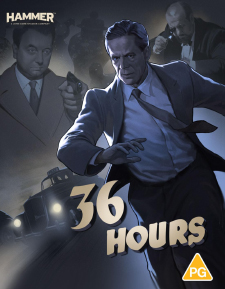
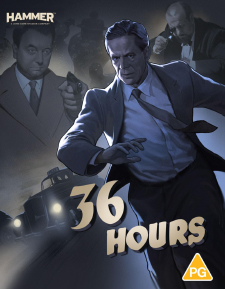
The Hammer Films 2-Disc Limited Collector’s Edition 4K Ultra HD and Blu-ray release of 36 Hours and Terror Street sits in a Digipak case alongside a 4-page re-creation of the full U.S. campaign book. Also included is a 120-page booklet entitled The Hammer Crime Files containing the essay “Play the Fight for as Long as It Will Hold and With as Much Suspense as Possible”, the making of 36 Hours by Wayne Kinsey; extensive multi-part Hammer production documentation; the front and rear covers of the U.S. campaign book; “Audiences Want to See the Irresistibly Detestable Duryea”, a profile of Dan Duryea by Mike Peros; An American in London, a look at the placement of U.S. stars in British pictures by Melanie Williams; Exclusive Films and the King of the B’s, a profile on producer Robert Lippert by Adrian Smith; cast and crew information; Limited Collector’s Edition content information; and a collection of thank yous. Everything is housed in rigid side-loading slipcase packaging, with all new artwork created by Liza Shumska. The following extras are included on both discs, all in HD:
- Audio Commentary on 36 Hours by Kim Newman and Barry Forshaw
- Audio Commentary on Terror Street by Toby Roan and Heath Holland
- 36 Hours Trailer Elements (2:05)
- 36 Hours UK Censor Card (:13)
- Terror Street Trailer (1:33)
- United Kingdom of Noir: Jo Botting & Vic Pratt on Brit Noir & 36 Hours (38:10)
- Shadows Across the Atlantic: Maxim Jakubowski on Crime Fiction and Steve Fisher (16:36)
- Black & White: Chris Alexander on Dan Duryea (22:28)
- 36 Hours on Terror Street (23:24)
- Suspense: The Man Who Couldn’t Lose (29:35)
- Suspense: Remember Me? (29:42)
- Image Gallery (129 in all – 7:16)
The commentary for 36 Hours features authors and film historians Kim Newman and Barry Forshaw, who discuss the film noir genre and its many tributaries and eccentricities, as well as its cast and crew. The commentary for Terror Street featuring author Toby Roan and Cereal at Midnight’s Heath Holland is a much more reactionary experience as the two watch the film together and examine aspects of it as they go along.
Next is a set of 36 Hours Trailer Elements, which are silent and textless, but are included since the original trailer couldn’t be found. Also included is the original 36 Hours UK Censor Card, and the Terror Street trailer, the latter of which has been digitally re-created. United Kingdom of Noir features author Vic Pratt and film historian Dr. Josephine Botting who delve into a discussion of the history British noir, how it’s mostly passed over by the rest of the world, and how it’s reflected in other genres of film, usually circling back to talk about 36 Hours. Shadows Across the Atlantic speaks to writer and producer Maxim Jakubowski about the history of crime, pulp, and mystery fiction, as well as the influence of novelist and 36 Hours screenwriter Steve Fisher.
Black & White talks to author and filmmaker Chris Alexander about his exposure to and appreciation of film noir, but more specifically the work of Dan Duryea. 36 Hours on Terror Street interviews film and TV historian Sergio Angelini who goes in depth about the creation of the film, while also making comparisons to other thrillers of the era, and exploring the work of Steve Fisher. Next are a pair of episodes of the radio program Suspense starring Dan Duryea, including The Man Who Couldn’t Lose from December 12, 1947, and Remember Me? from April 7, 1952. Last is an Image Gallery containing 129 images of posters, lobby cards, publicity materials, and behind-the-scenes photos. It’s worth noting that the 2007 DVD release from Kit Parker Films and VCI Entertainment also includes commentary by Alan K. Rode, which hasn’t been carried over.
No matter what moniker it bears, 36 Hours aka Terror Street is a classic film noir for many, even though I personally have some issues with it. None of them prevent it from being enjoyable for what it is, and Hammer Films’ 4K restoration and amazing extras make it a top notch release that any self-respecting film noir fan should have in their film library. Highly recommended.
- Tim Salmons
(You can follow Tim on social media at these links: Twitter, Facebook, BlueSky, and Letterboxd. And be sure to subscribe to his YouTube channel here.)