
Uncommon Valor (4K UHD Review)
Director
Ted KotcheffRelease Date(s)
1983 (March 24, 2026)Studio(s)
Paramount Pictures (Kino Lorber Studio Classics)- Film/Program Grade: B
- Video Grade: B+
- Audio Grade: A-
- Extras Grade: B

Review
Hollywood is nothing if not imitative, so when the suits see a film that turns into an unexpected box office success, they’re usually quick to pounce on that momentum and offer their own spin on the same formula. That can lead to some strange but interesting trends, few of them odder than the spate of “rescuing MIAs in Vietnam” films that become a thing during the early Eighties. The biggest of all was Sylvester Stallone’s First Blood sequel Rambo: First Blood, Part II, which trailed only the juggernaut that was Back to the Future as the second-highest grossing film of 1985. Of course, Chuck Norris and Cannon Films had moved even quicker, launching their own short-lived franchise with Missing in Action in 1984. Yet both films owed an obvious debt to another film that actually launched the subgenre in 1983, Uncommon Valor. Despite a lack of established action stars on the marquee, it managed to turn a tidy profit late that year, and Hollywood took notice. (As did Rambo II co-screenwriter James Cameron, who never saw other people’s ideas that he wasn’t perfectly happy to appropriate for his own.)
Still, Uncommon Valor remains the odd man out in the entire subgenre, at least in terms of its ambitions. It’s not exactly a serious examination of the post-Vietnam War ethos, and yet it’s far more respectful of its themes than either Missing in Action or Rambo II. Much of that comes down to its cast and crew, but it’s worth noting how the development process played a role in shaping the final film. Uncommon Valor started out as a screenplay by Wings Hauser, which he wrote after a Vietnam veteran acquaintance opened up about his experiences during the war. Enter producer John Milius, who brought in Joe Gayton to rewrite Hauser’s script (and he also took a pass at it himself). Ultimately, Gayton received sole screenwriting credit for the film, with Hauser denied even a “story by” credit, although he was listed as an associate producer in the end credits. (Presumably, Hauser wasn’t a member of the Writer’s Guild, which normally would never have allowed that to happen.) But just like Cameron’s fingerprints are all over Rambo II, Uncommon Valor bears the Milius imprimatur, for good and for ill, much to Hauser’s consternation—he told Psychotronic Video that Milius was a “scumbag right-wing bastard.”
Yet while Uncommon Valor does fit comfortably into the Reagan-era jingoism that marked so many Hollywood productions during the Eighties, this is no Red Dawn. The credit for that arguably belongs to director Ted Kotcheff and his lead actor Gene Hackman, both of whom were always able to elevate potential B-movie material into something deeper and far more interesting. The rest of the fine cast certainly didn’t hurt, either, with their natural camaraderie giving the early training scenes a Dirty Dozen feel, although there’s only seven team members in this case: Col. Jason Rhodes (Hackman), Wilkes (Fred Ward), Blaster (Reb Brown), Sailor (Randall “Tex” Cobb), Kevin Scott (Patrick Swayze), Major Curtis Johnson (Harold Sylvester), and Charts (Tim Thomerson). With the exception of Col. Rhodes, all of these characters are rather thinly drawn, and yet the actors who play them have such outsized personalities that they all feel quite real. Like Alien before it, Uncommon Valor demonstrates that casting the right actors is more effective at establishing characters than pages of dialogue. You know everything that you need to know about this Swaggering Seven without ever learning too much about their backstories—aside from the experiences that some of them had in Vietnam, of course.
Unlike Major Reisman in The Dirty Dozen, Col. Rhodes is no reluctant leader of this seemingly impossible mission; instead, he’s actually the impetus behind it as his son has been missing in action since 1972. With the financial backing of wealthy oil baron Harry McGregor (Robert Stack), whose own son went missing during the same engagement, he chases down leads and then assembles a team to help do what the United States government won’t: sneak across the border into Laos in search of the POW camp where their sons may be located. Just like The Dirty Dozen, the fun of the training scenes soon gives way to the reality of armed conflict, but there’s a key difference: Robert Aldrich’s film was a savage indictment of the rules of warfare, where a group of murderers, rapists, and thieves end up “redeeming” themselves in the eyes of the military by committing acts that are far more heinous than the crimes that put them into prison in the first place. There’s no such irony in Uncommon Valor, which is a relatively straightforward morality tale about people who are willing to put their lives on the line in order to rescue their fallen comrades.
Of course, there’s still an inevitable right-wing wish fulfillment element to Uncommon Valor that was very much in tune with the ethos of Reagan’s America (it was produced by John Milius, after all), and that element is doubtless what appealed to the makers of Missing in Action and Rambo II. Yet under the sure hand of Ted Kotcheff, it’s far more thoughtful than either of those fantasies. After all, we’re talking about the director of the original First Blood here, which managed to balance its hard-hitting adventure story with genuine concern for the plight of returning Vietnam vets. Uncommon Valor falls into a similar category, with plenty of action but real sympathy for the pain that these characters feel over what (and who) they lost in Vietnam. However unrealistic that some parts of the film may be, it still shows the scars that people bear from their nightmarish experiences with war.
Sadly, time marches on, and watching Uncommon Valor today can be a wistful experience for reasons that have nothing to do with veterans or POWs. Nearly half of Col. Rhodes’ team is no longer with us, including the Man himself, Gene Hackman. Yet in a real-life irony, Patrick Swayze was actually the first to go nearly two decades ago, the victim of an implacable enemy that couldn’t be defeated. We lost Fred Ward much more recently, and even original screenwriter Wings Hauser left us just a month after Gene Hackman did—and the month after that, they were all joined by the real commander who had marshaled all of them together, Ted Kotcheff. Yet Uncommon Valor stands as a tribute not just to those who served in Vietnam, but also to the efforts of everyone involved in bringing the story to the screen (yes, even Milius). It’s entertaining, thoughtful, and now poignant, in roughly equal measures.
Cinematographer Stephen H. Burum shot Uncommon Valor on 35mm film using Arriflex cameras with spherical lenses, framed at 1.85:1 for its theatrical release. This Paramount-supplied master is based on 4K scans of the original camera negative, digitally remastered and graded for High Dynamic Range in Dolby Vision and HDR10. Frankly, it’s a bit of a puzzler. On the positive side, the image is beautifully well-resolved, sharp, and detailed (at least wherever clouds of smoke aren’t involved). The contrast range is excellent, with good black levels, and there’s little damage of note. Where things get a bit questionable is in regard to the grading.
Everything has been rebalanced decisively toward yellow tones, almost verging on sepia at times. The skin tones are quite yellow, and the opening titles now look orange rather than blood red like on many older versions. Of course, just because it’s different doesn’t necessarily mean that it’s wrong, but absent any reference materials for comparison purposes (or commentary from Burum), there’s no way of knowing what’s right. Does it look bad? Absolutely not. In fact, the yellowed tones make sense for the first couple of scenes that are flashbacks to the Seventies. But the bulk of the film is set during the present day, and it retains that same yellowish cast. Was it supposed to be timed that way during the flashback scenes and then changed back to normal, but someone forgot to switch it? Who knows? Regardless, it doesn’t look bad at all, just different.
Audio is offered in English 2.0 stereo/surround and 5.1 DTS-HD Master Audio, with optional English subtitles. Uncommon Valor was released theatrically in mono, and it’s not clear what the original source was for both the 2.0 and 5.1 versions included here. But the 2.0 does have encoded surround channels, while the 5.1 doesn’t offer much in the way of split surround activity, so they’re essentially the same mixes, just one matrixed and the other discrete. Yet the 5.1 version does offer more channel separation for James Horner’s score, as well as a bit more dynamic oomph during the plentiful explosions (Blaster earns his nickname, and then some), so it’s the better choice between the two. Either way, they’re clean tracks with minimal noise, distortion, or other issues.
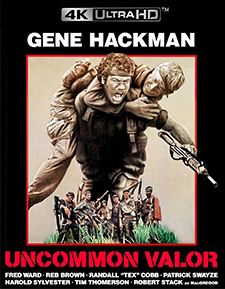
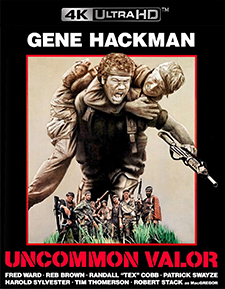
The Kino Lorber Studio Classics 4K Ultra HD release of Uncommon Valor is a two-disc set that includes a Blu-ray with a 1080p copy of the film. There’s also a slipcover that matches the theatrical poster artwork on the insert. Aside from a collection of trailers, the rest of the extras are all-new for this release:
DISC ONE: UHD
- Commentary by Steve Mitchell and Cyrus Voris
- Commentary by Douglas E. Winter
DISC TWO: BD
- Commentary by Steve Mitchell and Cyrus Voris
- Commentary by Douglas E. Winter
- Being Blaster (HD – 29:37)
- Reluctant Warrior (HD – 49:00)
- Uncommon Valor Trailer (SD – 1:21)
- Missing in Action Trailer (HD – 1:41)
- A Bridge Too Far Trailer (HD – 3:18)
- Mississippi Burning Trailer (SD – 1:37)
- The Package Trailer (HD – 2:15)
- Narrow Margin Trailer (SD – 2:01)
- Twilight Trailer (HD – 2:27)
- Billy Two Hats Trailer (HD – 4:00)
- North Dallas Forty Trailer (SD – 3:05)
- Split Image Trailer (HD – 2:39)
Those new extras kick off with two different commentary tracks. The first is with filmmaker/historian Steve Mitchell, paired this time with writer/producer Cyrus Voris. They address the somewhat mixed reputation of Uncommon Valor, which has occasionally been treated as a “mere” action film. It takes its subject matter seriously, but not pretentiously, which sets it apart from some of the other MIA exploitation films at the time. They also address the somewhat torturous background for the script; Ted Kotcheff’s career; the locations; the staging of the action scenes, including the helicopter work; the James Horner score; Stephen Burum’s cinematography; and the cast, with a natural emphasis on Gene Hackman.
The second commentary is with Douglas E. Winter, critic and author of multiple books including A Little Brass Book of Full Metal Fiction. He covers some of the same subject matter as the Mitchell/Voris commentary, like the script, the director, the cast, and the helicopters. But he does so from his own angle as a writer, exploring both a literary perspective (including Gene Hackman’s own career as an author) and the broader context surrounding the both the events depicted in the film and the film itself. He breaks down those particulars in great detail, including the history of military helicopters in Vietnam and elsewhere; the helicopters used in the film; and naturally plenty of specifics about the guns and other weaponry—even Chekhov’s gun, which is why Sailor’s grenade had to be paid off after having been carefully established at the beginning of the film.
The rest of the new extras consist of interviews. Being Blaster is with Reb Brown, who briefly describes his background before diving into the making of Uncommon Valor. He talks about the script, the rest of the cast, the training, working on location, and some of the stunts. He also discusses the film’s release and reactions from Vietnam vets. Reluctant Warrior is with Harold Sylvester, who says that Uncommon Valor is one of his favorites of his own films (even if it feels like he made it 150 years ago). He explains how his relationship with Ted Kotcheff evolved over the production, as well as his relationship with Milius. He also a bit more of a birds-eye view of what he and Tim Thomerson went through working with the helicopters.
It’s a fine set of extras, especially considering the fact that previous releases of Uncommon Valor have all been bare-bones. The grading may be an issue for some, or just a case of me doing some nit-picking. But I’m still glad to have this set in my collection, and I suspect that most viewers will be equally happy with it. It’s not perfect, but it’s still a clear upgrade over everything that has come before it. So, it’s recommended, with minor reservations.
-Stephen Bjork
(You can follow Stephen on social media at these links: Twitter, Facebook, BlueSky, and Letterboxd).