
True Colors (Blu-ray Review)
- Review Date: May 04, 2026
- Format: Blu-ray Disc
-


Director
Herbert RossRelease Date(s)
1991 (February 25, 2026)Studio(s)
Laurence Mark Productions/Paramount Pictures (Imprint Films/Via Vision Entertainment)- Film/Program Grade: A-
- Video Grade: A
- Audio Grade: A
- Extras Grade: B

Review
[Editor’s Note: This is a Region-Free Australian Blu-ray import.]
Political drama has been a staple of both movies and television for years. The machinations, intrigues, back-biting, and clouded motivations provide ample material for conflict, confrontation, and cold-hearted betrayal. True Colors is a study in how principles are compromised when ambition erodes ethical standards.
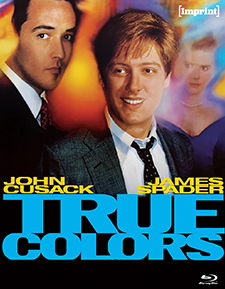
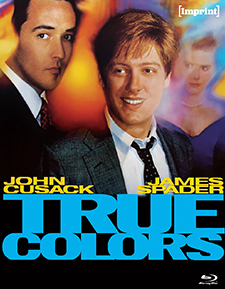
Tim Garrity (James Spader) and Peter Burton (John Cusack) meet in law school in 1983. Though they meet under inauspicious circumstances, they become good friends despite their differences in social class, temperament and goals. Tim was born into wealth and privilege; Peter was not. They both win summer internships in Washington D.C., Tim with the Justice Department and Peter for Senator Stiles (Richard Widmark). When summer ends, Peter drops out of law school to advance his career with the senator and marries Tim’s former girlfriend, Diana Stiles (Imogen Stubbs), the senator’s daughter. Peter is determined to run for Congress within ten years. Meanwhile, Tim finishes school and goes to work as an attorney for the Justice Department.
Focusing on his political future by any means, Peter seeks support by granting favors to shady real estate tycoon John Palmeri (Mandy Patinkin), even convincing Tim to begin an investigation of Palmeri’s competitors. When Peter’s questionable maneuvering leads to Tim’s being upbraided by his superiors, Tim goes undercover as a member of Peter’s Congressional campaign staff. In the process, Tim comes to see the true character of his longtime friend.
The screenplay by Kevin Wade centers on Peter’s consuming ambition and ethical bankruptcy. With no faith in traditional values of honesty, integrity and responsibility, he will cross any line if it means getting him closer to winning a seat in Congress. Everyone is fair game. Wade’s dialogue is sharp and crackles with tension in scenes between two men with opposing ideas and ideals. Tim works hard for Justice while Peter seeks shortcuts, no matter how reprehensible, for power. The script makes no mention of specific political parties, suggesting that Peter would grab any chance at advancement. He’s an equal-opportunity opportunist.
Director Herbert Ross creates a believable seat-of-government milieu with its black-tie parties, power brokers, hangers-on, and those hoping to penetrate that inner-circle. Ross opens up the dialogue-heavy script with scenes in and around Washington, on a golf course, and at a ski resort where stuntmen double for Spader and Cusack in a thrilling downhill run.
Cusack plays Peter with an affected tinge of arrogance to convince his world that he’s the social equal of Tim. His eyes say a lot. You can see his character thinking on the fly, concocting the next lie to make himself fit in. When Palmeri offers him a huge, luxurious apartment, Peter doesn’t ponder whether accepting such a gift is ethical. All it takes is Palmeri’s assurance that this kind of thing happens all the time for Peter to slide down a path he’s already inclined to travel. Cusack mixes naïveté with drive as his Peter weighs the offer for a revealingly short time.
Spader, playing the “good guy,” emits an aura of privilege with his speech patterns, manner, and attire. Tim has been raised by a wealthy family with connections among the rich and those in positions of power. Yet he pursues a career that others of his social station believe is beneath him. He could have a position with an established private law firm and advance quickly, but he’s undeterred from his goal even though life would be easier tif he did what others expect. Spader plays Tim as somewhat ingenuous, overlooking Peter’s actions even though they go beyond the norm. His flaw is an idealism that blinds him to how nefarious his friend really is. When betrayed by Peter, Tim finally realizes his friend must be stopped and vows to be the instrument of his downfall.
The supporting cast—Widmark, Patinkin, Paul Guilfoyle and Philip Bosco—is strong and brings the characters to life. Imogen Stubbs’ Diana however, never emerges as a real person—more a cliche of the rich debutante who can’t understand why someone of her own social class wouldn’t aspire to accumulate more wealth and power. Director Ross and writer Wade make Peter sympathetic initially as we see him lie to suggest a loftier position in life. A scene in which he remains virtually alone on campus while everyone is elsewhere for Christmas break shows how poor he’s in pocket and in spirit. While he hides at school with lies about flying off for big doings with his influential family, his classmates celebrate the holidays at opulent homes. Later, however, what seem innocent attempts to hide a modest background become a well-tempered plan to advance, however unethical.
True Colors was shot by director of photography Dante Spinotti on 35mm film with Panavision cameras and spherical lenses, processed by Technicolor, Hollywood, CA and presented in the aspect ratio of 1.85:1. The Blu-ray from Imprint Films has an aspect ratio of 1.78:1. Clarity is sharp with no perceptible visual imperfections to impair enjoyment. Production design reflects a bustling law school campus, elegant cocktail parties, a neatly manicured golf fairway, and a ski scene with doubles doing amazing stunts as the camera tracks them at high speed down a mountain. The women’s “big hair” reflects a prevailing fashion of the period covered in the film, but there are no other visuals to definitively establish 1983. Camera angles are routine, for the most part, but there’s one shot of Tim and Peter having an intense conversation as the camera slowly rotates around them. Warm interior lighting adds atmosphere to a crowded party. Elegant gowns and black tie indicate the formal nature of a get-together inside the Beltway.
There are two soundtrack options, English 2.0 LPCM Stereo and English 5.1 DTS-HD Master Audio. English SDH subtitles are an option. Dialogue dominates the narrative and is clear throughout. The repartee between Tim and Peter as their relationship evolves reflects their personal notions of success. Sound effects include a fender-bender car mishap, skis shushing and scrunching, ambient party noise, the clanking of metal as a tire is changed, a downpour, and a train leaving the station. Trevor Jones’ music creates some melancholy, pensive moments, and accompanies exciting shots of the skiing sequence with quick tempos. Pop songs heard in the background include Sweet Dreams (Are Made of This) (The Eurythmics), Freeze-Frame (The J. Geils Band), Middle of the Road (The Pretenders), along with standards It Had to Be You, Isn’t It Romantic, The Nearness of You, In the Cool, Cool, Cool of the Evening, and Call Me Irresponsible.
The only bonus material on the Region-Free Blu-ray release from Imprint Films is the following:
- Audio Commentary by Matthew Asprey Gear
Audio Commentary – Cinema author and critic Matthew Asprey Gear says that the opening of the film will be bookended by a scene at the end. The film takes place over a seven-year period and ends with the 1990 mid-term Congressional elections. Fashions aren’t consistent with 1983. Gear tells what was happening in American politics at the time of the film’s release. Popular songs of the period comprise part of the soundtrack. John Cusack and James Spader had both made films prior to True Colors. Gear refers to them as “Brat Pack-adjacent” actors. Peter is defined by ruthlessness. He joins a party because of opportunism, not conviction, while Tim is a straight arrow hoping to join law enforcement at the highest level. Peter become the architect of his own downfall. Spader later went on to an extensive career in television and became an Emmy-winning actor, starring on The Practice, Boston Legal and The Black List. True Colors was designed to be a prestige picture for Paramount, but it didn’t fare well at the box office or with contemporary critics and didn’t receive any Academy Award nominations. It’s non partisan and steers away from Reaganism. Political affiliations aren’t identified. The film has elements of All the King’s Men (1949) and F. Scott Fitzgerald’s The Great Gatsby, in which a character disguises his background. The film fits into the American tradition of storytelling. Gear provides a brief overview of director Herbert Ross’ career including his days as choreographer, tenure on Broadway, director of film adaptations of Neil Simon plays, and director of hit movies The Goodbye Girl and Steel Magnolias. True Colors was Ross’ twenty-second feature film as director. The film’s generous budget of $20 million enabled the director to include a sequence shot at the Big Sky Resort in Montana. Composer Trevor Jones wrote music in many styles, including jazz and electronic. Smooth jazz was popular at the time. Gear suggests that there might be a renewed friendship between Tim and Peter in the future.
With its fine cast, intelligent script, and adept direction, True Colors is well worth a viewing. It’s a fine showcase for the two stars as they built their acting careers. As it deals with political machinations and ambitions that know no bounds, it also illustrates the temptations that exist for politicians more than willing to bend the rules of simple ethics. Though the film is engaging, it does have the feel of contrivance rather than natural development of story. At one point, Peter sees a politician in a compromising situation and, in a non-confrontational way, blackmails him in order to put the politician in his debt. Yet Tim—though surprised—makes no protest. Yes, they’re friends, but Tim’s nearly passive reaction doesn’t jibe with his personality as developed in the script. Still, True Colors has merit. It’s difficult to understand why it didn’t attract many viewers. The Blu-ray offers a welcome opportunity to catch this well-crafted cautionary tale of all-consuming ambition versus naive trust and idealism.
- Dennis Seuling