
Malfeasance: Four Films by Yves Boisset (Blu-ray Review)
Director
Yves BoissetRelease Date(s)
1971-1982 (April 14, 2026)Studio(s)
Various (Kino Lorber Studio Classics)- Film/Program Grade: See Below
- Video Grade: See Below
- Audio Grade: See Below
- Extras Grade: B-
- Overall Grade: A-

Review
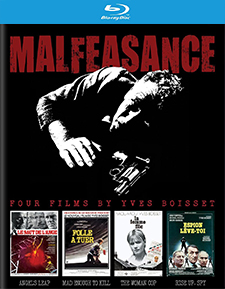
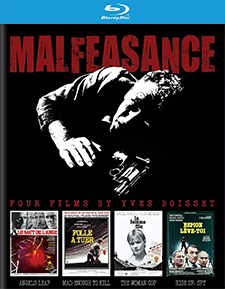
Malfeasance: Four Films by Yves Boisset, is an excellent sampler of this director’s work, an unheralded (outside of his native France) master of ’70s and early ’80s crime thrillers easily comparable to—and I’d say superior to—the much better-known features of Italian Fernando Di Leo. Boisset’s (1939-2025) films tend to be similarly and shrewdly commercial yet also more a personal expression of his left-wing political views, for which he was labeled “the most censored man in France.”
Boisset’s style is typified in the outrageously entertaining Angel’s Leap (Le Saut de l’ange, 1971). The political content is there, but it’s also the kind of film of which Quentin Tarantino would heartily approve. In Marseille, corrupt real estate developer Forestier (Giancarlo Sbragia) is running for political office, pitted against the all-powerful Corsican Orsini clan. To eliminate the competition, he hires SAC operatives to assassinate Lucien and Marc, two of the three Orsini brothers, using American hit man Henry Di Fusco (Gordon Mitchell).
Surviving brother Louis (Jean Yanne, of Week End), who wants nothing to do with the family business, is working on a plantation in Thailand and survives his own assassination attempt, but upon returning to Marseille, learns that his young daughter, entrusted to American cop and longtime friend Mason (Sterling Hayden!), is yet another victim of Forestier’s ruthless extermination plans. Accompanied by two Vietnamese colleagues, Louis returns to France to seek vengeance for all those Orsini deaths, unaware that widowed sister-in-law Sylvaine (Senta Berger), is secretly Forestier’s mistress.
Angel’s Leap is wonderfully over-the-top in its violence, with the two Vietnamese, dressed in identical suits and hats, carrying identical cameras and looking like Japanese tourists, especially wily in their movements and audacious killings. One incredible sequence takes place at a drive-in movie theater—France had those?—ending with spectacularly violent aplomb. But nearly every action scene is imaginatively directed, impressively unpredictable and cleverly done.
The picture pushes the edges of credibility—Forestier’s Blofeld-like headquarters comes complete with pet vultures—yet the acting and gritty cinematography ground it in a kind of acceptable reality allowing viewers to suspend disbelief.
The great actor Sterling Hayden’s presence, given his long history and weight within the genre, adds considerable interest. Incredibly, most of the time it’s really Hayden speaking French, coming off very well as a world-weary alcoholic trying to prevent old pal Louis from going off the deep-end. In a few scenes he appears to be speaking English while dubbing his own voice in French, and a couple of other times it sounds like a French actor dubbing him (perhaps when Hayden’s own French bordered on near-incomprehensibility), albeit via a passable imitation of the actor. Most of the time, though, it’s clearly him, and despite an obvious lack of fluency, his acting and screen presence shine through.
ANGEL’S LEAP (FILM/VIDEO/AUDIO): A-/A-/A
The weakest of the four titles, Mad Enough to Kill (Folle à tuer, or “Madwoman Killer,” 1975) is profoundly predictable, its plot not unlike John Cassevetes’s later Gloria.
Julie (Marlène Jobert), newly released from a five-year stay at a psychiatric hospital, is hired as the governess for seven-year-old Thomas (Thomas Waintrop), whose father recently drowned and mother reportedly committed suicide, though in the opening scene we see that she was actually murdered by hit man Thompson (Tomás Milián), whose next assignment is the mother’s orphaned son.
After meeting her employer, Thomas’s uncle, industrialist Stéphane Mostri (Michael Londsdale), Julie tries settling in at the company’s skyscraper digs, where spoiled-rotten Thomas lives like Richie Rich, complete with expensive toys galore and a “jungle room” full of exotic animals. Also, across the hall, there is lecherous ex-con Georges (Victor Lanoux), a convicted sex offender working as Mostri’s chauffeur. Her first full day on the job, Thompson kidnaps Julie, Thomas, and George at gunpoint, intending to murder the bratty kid while framing Julie, with her history of mental illness, for the crime.
Who’s behind all this? I don’t think I’m giving anything away noting that Michael Lonsdale’s performance is virtually a warm-up for his Hugo Drax in Moonraker. From stem to stern, Mad Enough to Kill is predictable; if you can’t anticipate the entire plot ten minutes in, you’re not paying attention.
Another problem is the many unfortunate choices made for Tomás Milián’s killer. The Cuban-Italian actor really has no character to play and throughout displays only a perpetual scowl. He’s given a goofy haircut and costume, the sum total of which suggests Spinal Tap’s Nigel Tufnel. Indeed, once I noticed the resemblance, I could not un-see it.
However, both Marlène Jobert and Lonsdale are very good, she best known for movies like The Rider on the Rain with Charles Bronson and The Married Couple of the Year with Jean-Paul Belmondo, and the wonderful Last Known Address with Lino Ventura, she and Ventura especially good in that film, also available from Kino. In recent years she’s also become known as the mother of actress Eva Green (Casino Royale). Like Gena Rowlands in Gloria, Jobert’s Julie impresses with her character’s determination to save the young boy; unlike Gloria, Thomas becomes sympathetic by the end of the film.
There are a few nice touches here and there: the movie begins with the amusing famous quote attributed incorrectly to W.C. Fields, “Any man who hates dogs and children can’t be all bad.” (Actually, it was Leo Rosten who said it, about Fields.) The luxurious apartment where Thomas is based is choking with toys and weird rooms, like Willy Wonka’s chocolate factory, and some of the chase scenes and situations are interesting. It’s not bad, just weak compared to the others in this set.
MAD ENOUGH TO KILL (FILM/VIDEO/AUDIO): B-/A/A
The Woman Cop (La femme flic, 1980), with its virtually one-woman investigation of a child prostitution/child pornography ring involving dozens of poor kids exploited by a mining town’s rich, politically powerful, and virtually untouchable, was strong stuff in 1980. Its impact is diminished only by time—it’s the sort of thing virtually taboo in cinema 45 years ago but today a regular component of even TV shows like Law & Order: Special Victims Unit.
In a role intended for Isabelle Huppert, who had to drop out at the last-minute due to Michael Cimino’s Heaven’s Gate falling behind schedule, Miou-Miou stars as police Inspector Corinne Levasseur, the woman cop of the title, who endures daily sexism from both citizens and her own colleagues. Following a disciplinary transfer from Paris to Lens (Pas-de-Calais), she’s initially given jobs little better than an office assistant, but eventually becomes involved with the investigation of the murder of a young girl that balloons into a city-wide conspiracy involving the exploitation of the poor children of mining families who are pimped out and photographed for child pornography distributed internationally.
When it becomes clear the town’s richest and most politically influential men are bankrolling the operation, Levasseur’s partner, Senegalese Inspector Simbert (Alex Lacast) and Levasseur’s boss, Commissioner Porel (Jean-Marc Thibault) are prepared to drop the investigation to save their own careers, but Levasseur refuses to back down.
One is tempted to reference the Britain’s later Prime Suspect television series with Helen Mirren, which began 11 years later but, really, there are more differences than similarities. As if to counter repeated accusations that women are unfit for the job, Levasseur pretty much never shows any emotion throughout, and though both Inspector Simbert and Marcel (Jean-Pierre Kalfon) seem to be attracted in her, the story is utterly without romance of any kind, nor is Levasseur’s personal life a mess like Mirren’s Jane Tennison. For Levasseur, her sex is a non-issue that everyone around her just won’t let go. She’s trying to get on with the job and, rather, the real issue are cops and a justice system that, for the most part, is willing to turn a blind eye to pedophiles in high places. (Sound familiar?)
Instead, the cops mostly go after the low-lifes, real and imagined, like the elderly woman running a sex shop and back-room child prostitute liaising, but also politically leftist students and hippies. When Levasseur encounters a left-wing theatrical group, part of the local cultural center that Marcel directs, they initially welcome her as one of their own—until she admits to being a cop, when immediately and viciously turn on her because of the profession’s far-right reputation in parts of France at the time.
The despairing film is admirably adult and serious, and Miou-Miou, a long way from Tendre Dracula, delivers a strong, understated performance.
THE WOMAN COP (FILM/VIDEO/AUDIO): B+/A/A
At one point during Rise Up, Spy (Espion, lève-toi, 1982), someone jokes that its story is as complex as a John le Carré novel, and it really is in that mold, though in fact based on Chance Awakening (1977), by British writer George Markstein, best known for his work on TV’s The Prisoner. The plot is so murky that, even when it was over, I still couldn’t figure out certain connections or character motivations, though the paranoia it generates appears intentionally ambiguous and deliberately Byzantine. More importantly, the film features strong performances by this writer’s favorite and second-favorite French male stars: Lino Ventura and Michel Piccoli.
Set in Zurich, Sébastien Grenier (Ventura) is a French sleeper agent for the Service de documentation extérieure et de contre-espionnage (SDECE), managing a trust company there and dormant for the past eight years. He lives unmarried with Anna Gretz (Krystyna Janda), a politically leftist university professor unaware of Grenier’s spy background.
When he’s suddenly reactivated, the SDECE agent he’s supposed to meet is assassinated by the radical Popular Action Brigades, of which Anna is somehow perhaps allied. Another meeting is arranged, this time with Jean-Paul Chance (Piccoli), a senior official at the Federal Council in Bern, and supposedly a Swiss agent. Grenier is skeptical when Chance asks him to investigate the PAB, threatening him if he fails. When Grenier reaches out to a band of former colleagues, including Alain Richard (Bruno Cremer), hoping to confirm Chance’s identity, each is systematically assassinated, seemingly by Chance and his subordinates. Grenier and his wife, it appears, are also on Chance’s hit list.
Rise Up, Spy is the kind of movie best enjoyed rolling with its punches, and by not worrying that so much of it is incomprehensible. The important thing is enjoying the subtly-played game of cat and mouse between Lino Ventura and Michel Piccoli, Ventura stoic and nearly unreactive, not giving anything away, and barely responding or not at all when questioned, and Piccoli, almost sweetly menacing, imposing himself every so politely into Ventura’s universe. Watching these two greats of French cinema so expertly spar with one another makes the film worth watching all by itself.
The picture creates the same murky, nasty political atmosphere of John le Carré’s novels, if here with scattered bursts of violence, less so than Boisset’s earlier work, but offset with real ’70s-style political paranoia. Ennio Morricone’s emblematic musical score adds considerable weight to the proceedings.
RISE UP, SPY (FILM/VIDEO/AUDIO): A-/A/A
Licensed from StudioCanal, Kino’s Blu-ray is presented, as are all the others in this set, in 1.66:1 widescreen, with DTS-HD Master Audio (2.0 mono) audio. Though the later films look cleaner than the early ones, all four are given excellent transfers, presenting a pleasing balance of film grain, accurate color, good blacks and contrast. The first three titles were remastered in 4K, with Rise Up, Spy culled from an earlier (but still fine) 2K restoration. There are two discs, with two movies per, and both discs are Region “A” encoded.
Beyond trailers, the only supplement for each film is an audio commentary track, delivered by Max Allan Collins, Heath Holland, Alexandra Heller-Nicholas, Josh Nelson, and Simon Abrams.
Overall, Malfeasance: Four Films by Yves Boisset is an excellent four-film set of titles mostly unknown in the English-speaking market, well worth seeing. Highly Recommended.
- Stuart Galbraith IV