
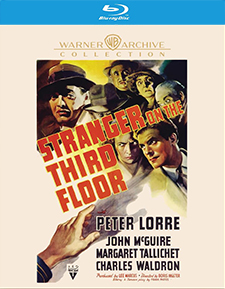
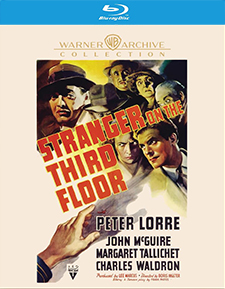
Stranger on the Third Floor (Blu-ray Review)
Director
Boris IngsterRelease Date(s)
1940 (February 24, 2026)Studio(s)
RKO Radio Pictures (Warner Archive Collection)- Film/Program Grade: B-
- Video Grade: A
- Audio Grade: A
- Extras Grade: B-

Review
Made for just $171,000, Stranger on the Third Floor (1940) was a minor second feature from RKO. It wasn’t well-reviewed at the time, and lost money at the box office. Its sole claim to fame is, decades later, it came to be regarded as the very first film noir, the murkily-defined movie genre that flourished from about 1940 to 1959. But even Stranger on the Third Floor’s claim as the first of its kind is debatable. While it has many of the genre’s hallmarks, this very peculiar little movie resembles something else, less easy to define. Director Boris Ingster, who studied under Sergei Eisenstein, was a catch-all screenwriter and producer, working in a variety of movie genres and, later in his career, in television well into the 1960s. This was his directorial debut, and as a director he made just three other features, none memorable.
Despite its short running time—just 62 minutes—top-billed Peter Lorre is barely in it, with probably less than 10 minutes of screentime; he doesn’t even speak aloud until about 50 minutes into the film. His presence can be explained in that he reportedly owed RKO two days of work, so they hurriedly stuck him into this minor film, capitalizing on his starring career in B-movies at 20th Century Fox just prior to this.
Instead, the story revolves around news reporter Michael Ward (John McGuire), the key witness in the murder trial of Joe Biggs (Elisha Cook, Jr.), whom Ward saw hovering over the body—his head nearly severed—of Nick (Charles Judels), a beloved diner owner whose restaurant Ward frequented. Ward’s fiancée, Jane (Margaret Tallichet), worries Biggs may be innocent and, late one night, Ward spots an odd-looking stranger (Lorre), lurking near the apartment of Ward’s irritable next-door neighbor, Albert Meng (Charles Halton). After chasing the Stranger off, Ward notices that Meng’s perennial loud snoring has curiously gone silent. Could he be dead? Did the Stranger murder him? Could the Stranger, not Biggs, be Nick’s murderer?
Most of Stranger on the Third Floor resembles the often-clever “Whistler” films, 60-minute B-thrillers produced by Columbia pictures made soon after. Conversely, it’s hard to see noir classics like The Big Sleep, Leave Her to Heaven, Out of the Past, and Gun Crazy evolving from Stranger on the Third Floor. Yes, it has noir elements—off-kilter camera angles, moody lighting, voice-over narration, staircases, etc., and even the presence of film noir regular Elisha Cook, Jr.—but most of the first-half of the picture is very conventionally made, and the more noirish elements are clunkily integrated. The film has a somewhat celebrated dream sequence, but it’s not particularly well-done, either, and certainly not within light-years of the dream sequence in Hitchcock’s Spellbound a couple of years later. The one in Stranger on the Third Floor borders on the ridiculous; it’s less like Hitchcock’s and more like something out of a ’60s sitcom, a parody of such sequences.
Rather than inventing a new movie genre, instead it appears Ingster was inspired by the stylistic choices of one-time mentor Sergei Eisenstein and maybe other Soviet-era filmmakers. Not in terms of Eisentein’s editing but rather in Ingster’s direction of actors and their blocking, which at times is extremely stylized in terms of McGuire’s and Lorre’s performances particularly. They move and react in exaggerated, unreal ways which is a little startling because it deviates so far from accepted Hollywood stylization, not because it’s done in the familiar style of this newfangled thing called film noir.
Star John MGuire was very briefly an occasional leading man, but within two years of Stranger on the Third Floor he was back to uncredited small parts. He’s not bad but unmemorable. Conversely, leading lady Margaret Tallichet is strikingly beautiful and a very good actress but she only appeared in seven films, retiring from the screen not long after marrying director William Wyler, a union that lasted until his death in 1981.
To his credit, Peter Lorre carves an interesting variation subtly different from the psychopathic killers he portrayed in movies like M and Mad Love. The unnamed Stranger here may be a killer, but seems generously distressed by a hungry stray dog for which he buys raw hamburger, and so unpredictable in his mood swings that he keeps the movie audience off-balance. However, Lorre simply isn’t onscreen enough to be able to fashion a fully-dimensional character.
Warner Archive’s new Blu-ray of Stranger on the Third Floor has been remastered via 4K scans of the original nitrate camera negative. The 1.37:1 standard, black-and-white image impresses throughout, though visually speaking there isn’t all that much there to get excited about. The DTS-HD Master Audio (2.0 mono) is also excellent, supported by optional English subtitles, and the disc is Region-Free.
Supplements consist of two remastered-in-HD cartoons, both eye-popping in Technicolor, Ceiling Hero and Wacky Wildlife. Also included are three Peter Lorre radio appearances, all from the series Mystery on the Air. They are: Beyond Good and Evil, Crime and Punishment (a film version of which Lorre starred in 1935), and Mask of Medusa.
Despite its place in movie history, Stranger on the Third Floor is fair at best, as peculiar as it is clunky, the “first” film noir despite other contenders for that title and stylistic choices arguably coincidental or which don’t exactly connect to the famous movie genre that followed. Definitely worth seeing for historical purposes, but overall not much better than average.
- Stuart Galbraith IV