
Youth Gone Wild! 1950s Juvenile Delinquency (1955 – 1958) (Blu-ray Review)
Director
Fred F. Sears/William Witney/Paul HenreidRelease Date(s)
1955-1958 (June 10, 2026)Studio(s)
Clover Productions/Esla Pictures/Coronado Pictures/BRK Inc. (Imprint Films/Via Vision Entertainment)- Film/Program Grade: See Below
- Video Grade: See Below
- Audio Grade: See Below
- Extras Grade: A-
- Overall Grade: B+

Review
[Editor’s Note: This is a Region-Free Australian Blu-ray import.]
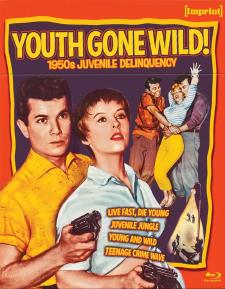
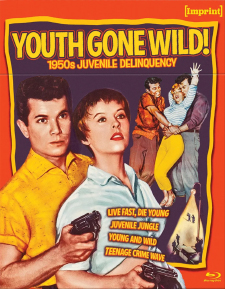
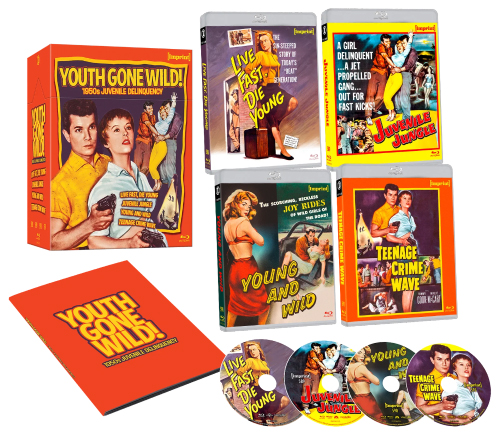
Good video transfers and extra features aren’t usually associated with the disreputable ’50s juvenile delinquent film genre, but that’s what Australia’s Imprint label has done. Further, the four films included in Youth Gone Wild! are obscure, including two little-seen films from Republic Studios, and the discs are region-free, gathered in Imprint’s reliably sturdy box. Each film gets its own Blu-ray case, plus there’s a thin but nevertheless hardcover, full-color book, featuring lots of stills (apparently derived from lobby cards) and an essay on the genre by Andrew Nette.
Teen-Age Crime Wave (1955) is a Columbia Pictures potboiler from Sam Katzman’s Clover Productions, directed by actor-turned-prolific director Fred F. Sears, this being the last of the five features he helmed in 1955 alone. Katzman basically worked Sears to death. In 1957, the year Sears died at just 44, he directed five more features, but he wasn’t done yet, with five more released posthumously in 1959.
Teenager Jane Koberly (27-year-old Sue England) thinks she’s on a blind date when in fact she’s an unwitting accessory in the violent attack of a man (George Cisar) steered into a robbery by redhead teen Terry Marsh (27-year-old Mollie McCart) and her “teen” boyfriend, Mike Denton (26-year-old Tommy Cook). Jane and Terry are arrested, with Jane’s unsympathetic parents (Guy Kingsford and Helen Brown) refusing to believe there’s any possibility she might be completely innocent.
While the two young women are being transferred to a juvenile prison, Mike ambushes the vehicle, killing a deputy in the process. The three make their way to a farmhouse in the Antelope Valley north of Los Angeles, where pious farmer Thomas Grant (James Bell) and his wife, Sarah (Kay Riehl), eagerly await the return of their war veteran son, Ben (Frank Griffin, brother of Debra Paget), for Thanksgiving.
Clover wasn’t above doing cheap knockoffs of hit movies made by others. Sears’s Crash Landing (1958), for instance, was a low-budget rip-off of The High and the Mighty, while Teen-Age Crime Wave “borrows” the basic plot, albeit with juvenile delinquents, from The Desperate Hours (1955), the play-turned-hit movie with Humphrey Bogart and Frederic March, released just one month prior to this. Further, its climax takes place at Griffith Park Observatory, the same locale figuring so prominently in Rebel without a Cause, in release at the same time as Teen-Age Crime Wave. The movie even utilizes the same parts of the Observatory seen in the James Dean film, though to its credit makes good use one of its observatory domes for a series of clever camera angles.
Mostly, though, Teen-Age Crime Wave has the look of a protracted episode of Highway Patrol, minus Dan Matthews (Broderick Crawford), with longtime character actor Larry J. Blake as a State Policeman coming closest to assuming that function. It’s nice to see that usually one-scene actor have a meatier part. Because so much of the action is confined to the cramped farmhouse, the movie couldn’t have taken more than 10 days to shoot, possibly less, and because of its similarities to the bigger-studio releases, may have been rushed into production and release. Most of Sears’s other films for Clover show more studio polish than this turkey.
Adding to the Highway Patrol-like feel is a cast of actors who regularly made the rounds on exactly those kinds of TV shows, particularly James Bell, often typecast as wise, plain-speaking countryfolk. Tommy Cook had a very long career in radio and film, and later as a voice actor in television cartoon shows; he’s even credited with the story for Rollercoaster (1977). He’s not bad as Tommy, but middle-aged screenwriters Ray Buffum and Harry Essex hadn’t the foggiest notion how to write dialogue for teenagers/young adults; Mike and Terry talk like early ’30s gangsters who came from broken homes. Molly McCart, with her close-cropped hair (like Shirley MacLaine in that same year’s The Trouble with Harry) is visually striking, but she’s a terrible actress, her performance on the level of a high school play. Sue England is a little better but her career didn’t amount to much, either; she may be best remembered voicing the noirish femme fatale robot in a couple of episodes of Lost in Space.
Presented in 1.85:1 widescreen, Teen-Age Crime Wave looks okay, the black-and-white image, like most of Columbia’s ’50s product, a little on the gritty, seat-of-your-pants side—overly grainy with a fair share of soft-focus shots. The LPCM 2.0 mono (with optional English subtitles, like all four titles), fares better. No extras on this disc.
TEEN-AGE CRIME WAVE (FILM/VIDEO/AUDIO): C-/B+/A-
Better in every respect is Young and Wild (1958), this and Juvenile Jungle emanating from Republic Pictures, filmed in the CinemaScope-like Naturama process (though in black-and-white), the studio on its last legs and this being one of its last in-house productions.
Underage hoodlums Rick (Scott Marlowe), Allie (Weston Gavin), and Beejay (Tom Gilson) steal a car and head to a nearby drive-in restaurant, where they harass innocent college kids Jerry (Robert Arthur) and Valerie (Carolyn Kearney). After a minor altercation, the trio chase after the couple, forcing them off the road where they beat-up Jerry and threaten Valerie with rape. Interrupted, they retreat but soon after fatally hit an old woman with the stolen vehicle.
Police Det. Sgt. Fred Janusz (Gene Evans), assigned to the case, works with Jerry and Valerie to identify the assailants, the kids cleverly suggesting perusing old high school yearbooks, but later they invade Valerie’s home, beat up Jerry some more, and with a switchblade threaten Valerie’s parents, David and Mrs. Whitman (Ken Lynch and Emlen Davies). The parents, previously haranguing Janusz for not bringing the hoodlums to justice fast enough, now pressure Jerry and Valerie not to identify them in a police lineup. Instead of ending their troubles, it only exacerbates them.
Once again, the youth gone wild are played by overaged thespians, with Robert Arthur (as Jerry) being 33 years old—practically middle-aged. Indeed, both Arthur and Kearney were older than Gavin MacLeod, he then 27, playing an adult policeman in his second film appearance. Scott Marlowe, 26, gives the best performance among the young, wild types, going full-on Method, and the dialogue is more credible than that in Teen-Age Crime Wave. Tom Gilson, as Beejay, apparently really was something of a loser in real-life; four years after Young and Wild, abusive husband Gilson was shot dead by his actress-wife, Saundra Edwards. Gilson was 28.
Nevertheless, Young and Wild is considerably slicker, more polished, and better-directed (by William Witney) than Teen-Age Crime Wave. Witney, heretofore primarily a director of serials, keeps everything moving at a fast clip, the 69-minute B-movie never wearing out its welcome. It also benefits from the fine performance of Gene Evans as the sympathetic-but-tough cop. Evans sometimes played leading roles during this period, most memorably in Samuel Fuller’s great Park Row, but with his thinning hair, freckles, acne scars, and generally mottled features, had a face for radio, not leading man roles in films. As he got older, with those same features Evans soon became typecast playing bad guys, a shame, because he really was a good enough actor to play starring parts. Young and Wild plays to his strengths: he’s a tough, nearly embittered cop whose faith is somewhat restored by Jerry and Valerie, determined to undo the damage they caused lying during the lineup.
And while the film is cheap—reportedly, the living room set of the Whitman family is the same used by the Cleavers during the first two seasons of Leave it to Beaver—the film makes good use of L.A. locations and the cinematography (by Duel’s Jack A. Marta) is way above average for this type of picture.
Imprint’s Blu-ray of Young and Wild presents the film in its original black-and-white, 2.35:1 Naturama screen shape. The image is impressively sharp, with good blacks. The LPCM 2.0 mono audio is fine. Like the others in this set, the disc is Region-Free.
Extras consist of two good documentary featurettes, both new: Directed by William Witney, a video essay by Michael H. Price; and In Naturama: A Guide to Republic Studios’ Short-Lived Film Format, featuring filmmaker Rob Murphy. Also included are pressbook reproductions for Young and Wild and Juvenile Jungle.
YOUNG AND WILD (FILM/VIDEO/AUDIO): B/A/A
Despite coming from the same team behind Young and Wild—together they formed a double-bill—Juvenile Jungle is pretty terrible. The plot revolves around a heist-kidnapping plot that the film’s unlikeable, wishy-washy protagonist won’t quite commit to, and the casting is downright screwy at times. The big climax takes place on Republic’s cramped backlot, across the street from Beaver Cleaver’s first house, in fact. In wide screen Naturama, it’s easy to see why the Cleaver Family soon moved to Universal Studios—there wasn’t enough room!
How unlikeable is Juvenile Jungle’s hero? Hal McQueen (Corey Allen) is 1) a bill collector; 2) an unsuccessful bill collector; and 3) is so smug and arrogant that he brags to petty juvenile (if overaged) delinquents Monte (Joe Di Reda), Tic-Tac (Richard Bakalyan), and Duke (Joe Conley) insisting he could steal way more money in one go than their puny takes. 4) After proposing a plan to sort-of kidnap the daughter of the local liquor store owner (Walter Coy), to extort the $40,000 in cash in a safe he uses to cash checks, Hal stupidly falls in love with the daughter, Carolyn (Anne Whitfield, of White Christmas) and flip-flops for most of the film’s 69-minute running time. Some of the time he feels guilty about the heist when Carolyn gushes and her parents treat him like a son, while at other times Hal’s ego kicks in, feeding a compulsion to impress... Joe Di Reda and Dick Bakalyan?
Ultimately, the gang’s female member, waitress Glory (Rebecca Welles) pushes the inept hoodlums into improvising the heist on their own, mainly because she wants Hal for herself and is insanely jealous of his interests in virginal Carolyn. The poster promised “a jet-propelled gang,” but these losers are more akin to the sputtering biplane Sid Caesar and Edie Adams rode in It’s a Mad, Mad, Mad, Mad World.
The cast is oddly composed. Appearing unbilled on the poster and in the movie itself is Yvette Vickers, playing an outlier of the gang. Around this time, she came to specialize in the sluttiest of sluts in movies like Attack of the 50 Foot Woman and Attack of the Giant Leeches (also both 1958), both showy supporting parts. She was a much better actress and a comparatively bigger name than Rebecca Welles was; Welles’s wild-eyed acting is terrible. (Corey Allen is okay, but someone like Robert Fuller, then playing similar parts on TV, would have been better.)
Dick Bakalyan specialized playing cocky, flashy minor thugs in dozens of films and TV shows of this era, graduating to a kind of Dick Miller-ish familiarity over the decades. The same can’t be said of Joe Di Reda, as busy an actor as Bakalyan but colorless and never memorable. As the de facto leader of the gang, this surely was his most prominent movie role. As the third member of the gang, Joe Conley, later genial Ike Godsey on The Waltons, is simply out of place.
Further, character actor John Zaremba appears fleetingly (and uncredited) as a check-cashing customer at Walter Coy’s liquor store, but he’s recognizable only because of his voice; the part is tiny, no more than a line or two, and the camera never gets a good look at his face—in other words, a part any bit-player could have done. Robert Conrad apparently made his film debut here, but as a background extra always a good distance from the camera. Busy actor William Schallert appears in another uncredited bit, at least according to the Internet Movie Database, but this seems to be an error on their part—he’s nowhere in sight, not even cashing a check with his back to the camera.
None of the music is original; many of the cues heard during Juvenile Jungle turn up in the contemporaneous TV series Mike Hammer, a Revue program partly shot on the Republic lot. Though there’s some location work in nearby Studio City and North Hollywood, key scenes are shot on the backlot. As Republic mostly made Westerns, their backlot was given over to that genre. The street of middle-class Americana was insanely cramped; it’s like a back alley, too tiny to accommodate the climax of Juvenile Jungle. Republic soundstages can even be glimpsed in the background of a couple shots.
Again filmed in 2.35:1 Naturama, Juvenile Jungle’s crisp black-and-white cinematography is one of the film’s few assets, and it’s nice to see this obscure title in its original aspect and looking almost brand-new. The LPCM 2.0 mono is fine, supported by optional English subtitles, and the disc once again is Region-Free.
Extras consist of a new audio commentary by Samm Deighan; The Rebellion of the American Teen, a new video essay by Thomas Doherty; and a reconstruction of the original theatrical trailer.
JUVENILE JUNGLE (FILM/VIDEO/AUDIO): C-/A/A
The least interesting of the four titles, Live Fast, Die Young (1958) is at 83 minutes both sluggish and turgid, partly the fault of actor-turned-director Paul Henreid (Casablanca) but mostly the fault of screenwriters Allen Rivkin and, of all people, Danish sci-fi specialist Ib Melchior. Its cast is singularly uninteresting—when Gordon Jones, Mike the Cop from The Abbott & Costello Show, delivers the film’s best performance—you’re in trouble. The movie starts out as a mildly promising J.D. film but turns a corner to become an elaborate heist film in its last third. After much draggy caper-planning, the heist itself is chaotic both in execution and in terms of Henreid’s direction, which doesn’t even bother to show the most important moment of the would-be heist, and the film ends abruptly and unsatisfactorily.
Kim Winters (Mary Murphy) can’t stop her rebellious kid sister, Jill (Norma Eberhardt) from her delinquent ways; Kim’s too busy caring for her unemployed, bellyaching, alcoholic father (Jones). Jill runs away and, rescued from salacious hotel clerk Sam (Norman Leavitt) by Mary (Jamie O’Hara), learns the B-girl ropes, flirting with drunks and stealing their cash. Kim, having had more than enough abuse from her father, decides to track down Jill, no easy task as she’s constantly on the move.
At a bar Kim encounters another delinquent gang, whose platinum-blonde member (Dorothy Provine, in her film debut) gets into a row with two men (one of whom is longtime stuntman Dick Crockett). Kim eventually locates Jill in Los Angeles, where she’s gone to work for professional thief Sue Hawkins (Peggy Maley) and second-in-command Ric (Mike Connors). They’re planning a big robbery of a post office’s safe, and Jill herself comes up with a novel way to disarm the burglar alarm.
Live Fast, Die Young was produced for Universal-International by the former Jewel Enterprises company, headed by Richard Kaye and Harry Rybnick, the same pair instrumental in importing Japan’s original Gojira and transforming it into a worldwide hit as Godzilla, King of the Monsters! The success of that film may have prompted this deal with Universal (they also signed on the indie team behind The Blob around this time), technically produced by their company, but using all the resources of U-I.
The movie is simply not well made on any level, particularly its screenplay, which relies on coincidences, unrealistic character relationships, psycho-babble, and contrivances to move it along. None of the performances are memorable, though Norma Eberhardt’s amateurish one may have inspired Divine in John Waters movies, especially Female Trouble (1975); Divine’s line readings and expressions are not unlike Eberhardt’s here.
Live Fast, Die Young is in black-and-white, 1.85:1 widescreen, looking comparable to other late-’50s Universal-International titles.
Extras here consist of a new audio commentary track by Rob Kelly; Paul Henreid and the Teen Crime Wave, a video essay by Alexandra Heller-Nicholas; and a trailer.
LIVE FAST, DIE YOUNG (FILM/VIDEO/AUDIO): C/A-/A
So, all-told just one of the four films in this set actually approaches being good, but that’s about par with the genre generally. To be able to see these films so well presented, and accompanied by good extras, is a strong incentive. Recommended.
- Stuart Galbraith IV