
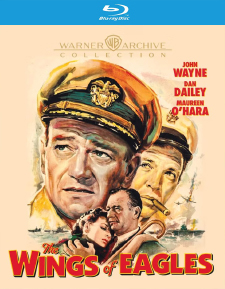
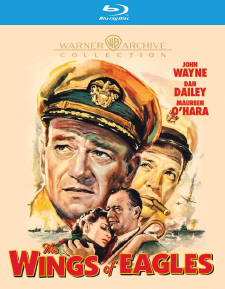
Wings of Eagles, The (Blu-ray Review)
Director
John FordRelease Date(s)
1957 (August 25, 2026)Studio(s)
Metro-Goldwyn-Mayer (Warner Archive Collection)- Film/Program Grade: B+
- Video Grade: A
- Audio Grade: A
- Extras Grade: B-

Review
Biopics were the rage in Hollywood for a dozen or so years, beginning with the staggeringly successful The Jolson Story (1946). War heroes, entertainers, songwriters, athletes, silent era film stars and the like were popular subjects, especially those who met tragic ends (as in The Glenn Miller Story), or overcame personal tragedy or handicaps, such as one-legged pitcher Monty Stratton in The Stratton Story. The Wings of Eagles (1957) also fits neatly into another 1950s Hollywood trend, promotion of the U.S. Military during the height of the Cold War. John Ford, so connected was he with its subject that Ward Bond plays “John Dodge,” a thinly-disguised version of Ford, while Ford’s devotion to the U.S. Navy and admiration for his friend Frank “Spig” Wead (1895-1947), made The Wings of Eagles much more personal than, say, the seriously flawed Mister Roberts (1955), from which Ford departed midway through its troubled production.
To say the least, the film is peculiarly structured. After World War I, Naval Aviator “Spig” Wead (John Wayne) is engaged in a friendly but frequently violent competition with Army flyers, particularly Capt. Hazzard (Kenneth Tobey), over which branch of the service will dominate the nascent use of aviation in combat. While still in training, inexperienced pilot Spig flies a Vought UO-1, taking Hazzard along for the ride, crashing the airplane smack-dab in the middle of an officers garden party. Later, Spig and his fellow Navy friends, including “Jughead” Carson (Dan Dailey), John Dale Price (Ken Curtis), and “Arizona” Pincus (Tige Andrews), crash an army dinner party, with Spig and Hazzard throwing cake at one another before the affair descends into a friendly, if violent brawl. In Ford’s universe (and in most of Wayne’s later films without Ford), this is supposed to be side-splittingly hilarious.
Indeed, the first 45 minutes or so rolls out like this, as a broad, military comedy with endless free-time for roughhousing—though Ford insisted it all really happened—except for a brief scene where Spig and his long-suffering wife, Min (Maureen O’Hara), cope with the tragic death of their infant child. Later they have two daughters, but like many a ’50s biopic, she resents his obsession with his job, and preference for the company of men instead of her and the kids.
But then the film takes a Million Dollar Baby-like turn: the very night Spig is promoted to fighter squadron commander, he hears one of his children cry out, rushes to help her, and spectacularly falls down a flight of stairs, breaking his neck and paralyzing him. Though he spurns Min and the girls from visiting him at the hospital, he allows Jughead to relentlessly attempt to rehabilitate him, Jughead repeatedly drumming a chant of “I’m gonna move that toe” until, miraculously, Spig regains limited use of his arms and hands, and is finally able to move around with the aid of heavy leg braces and crutches. He finds work writing military-themed screenplays in Hollywood, particularly under multiple Oscar-winning director John Dodge (Ward Bond), and later even writes a successful Broadway play (Ceiling Zero). But when the Japanese attack Pearl Harbor, Spig insists on being part of the war effort.
Just as it had been disconcerting to see Ford in The Searchers transform John Wayne, America’s favorite cowboy, into a racist avenger, the best thing about The Wings of Angels is how he again subverts Wayne’s screen image by turning this very typical Wayne character into a pitiful invalid. Suspended from a hospital bed, upside-down and facing the floor, Wayne-as-Spig spends a considerable amount of screentime utterly immobile (for a long time the movie audience only sees the back of his head), and later only able to move about with great difficulty. Further, Ford persuaded Wayne to ditch his usual hairpiece for the latter-half of the picture, as Spig ages, Wayne for the only time in his starring career revealing his balding pate, just like the real Spig Wead. Maureen O’Hara’s Min even kisses it.
It’s not one of Wayne’s great performances or films, because the screenplay never goes into any depth at all about Spig’s career, to the point where it’s not clear what his job even is, or what he accomplishes, focusing as it does on his personal struggles instead. But Wayne and Ford are to be commended; on one hand it’s a typical example of this type of ’50s biopic, but almost startling as a Ford-Wayne collaboration. The herky-jerky narrative diminishes its impact some: raucous comradery and brawlin’ in the first third, medical-psychological crisis to be overcome in the middle, routine but lively World War II combat in the last third, but all of it is interesting.
Lightweight Fox and MGM musical star Dan Dailey would seem out of his depth here, but he’s surprisingly good, his broadly played if determined chum of Wayne’s Spig neatly fitting into Ford’s oeuvre. He’s like a combination of screen types played by Lloyd Nolan and later George Kennedy, even sounding like both actors. O’Hara is good in a thankless role; it seemed no biopic was complete without a resentful wife competing with her husband’s passionate vision.
Warner Archive’s Blu-ray of The Wings of Eagles is excellent, a major upgrade from their earlier DVD release. In Metrocolor and 1.85:1 widescreen, like the near-simultaneous release by Warner Archive of Sergeant Rutledge, the image is impressively sharp with excellent, accurate color. Only during dissolves from one scene to the next does the image degrade, always snapping back into excellent clarity on straight cuts. The Region-Free disc includes DTS-HD Master Audio (2.0 mono) in English only, with optional English subtitles.
Supplements consist of a bland-looking trailer, and Drafty, Isn’t It? (1957), an unusual 10-minute cartoon produced by Warner Bros.’ cartoon department for the U.S. Army. Directed by Chuck Jones it’s also unusual in crediting Daws Butler, rather than Mel Blanc, with the voice characterizations.
As with Sergeant Rutledge, The Wings of Eagles falls well short of greatness, but is a rather fascinating Ford-Wayne collaboration, not a complete success but hardly a total disaster, either, failure. Recommended.
- Stuart Galbraith IV