
Wes Anderson Archive, The: Ten Films, Twenty-Five Years (4K UHD Review)

Director
Wes AndersonRelease Date(s)
1996-2021 (September 30, 2025)Studio(s)
Indian Paintbrush/American Empirical Pictures (The Criterion Collection – Spine #450, #65, #157, #300, #540, #700, #776, #1025, #1281, #1282)- Film/Program Grade: See Below
- Video Grade: See Below
- Audio Grade: See Below
- Extras Grade: A+
- Overall Grade: A+


Review
The work of Wes Anderson continues to garner its fans and its detractors, and has done so since his debut film in 1996, Bottle Rocket, all the way up to and including (as of this writing) his recent work, 2025’s The Phoenician Scheme. Creating worlds in which eccentric, whimsical, lovable, and sometimes unsavory characters live with a style that relies heavily upon wide angles, sweeping symmetrical camera moves, snap-zooms, and unconventional color schemes set to classic pop and rock soundtracks, Wes Anderson’s work has become a style all his own. Some critics describe him as an auteur, others as emotionally distant with a limited capacity for style. Others simply see him as a filmmaker constantly in motion, seeking out stories to tell that fit his particular mold, which is a charming and easygoing but always fascinating mode of storytelling.
The Criterion Collection presents The Wes Anderson Archive: Ten Films, Twenty-Five Years, encapsulating his growth from passionate, small-time amateur to professional filmmaker. This massive and gorgeous 20-disc 4K Ultra HD package is also bursting with extensive bonus materials, and because of its size, I’ll be covering each film one at a time in order to go over it in better detail.
Below, you’ll find quick links that will take to you reviews of each film, as well as the packaging and my final thoughts on this set:
(Click Below to Jump to Individual Disc/Film Reviews):
DISCS ONE & TWO: BOTTLE ROCKET
DISCS FIVE & SIX: THE ROYAL TENENBAUMS
DISCS SEVEN & EIGHT: THE LIFE AQUATIC WITH STEVE ZISSOU
DISCS NINE & TEN: THE DARJEELING LIMITED
DISCS ELEVEN & TWELVE: FANTASTIC MR. FOX
DISCS THIRTEEN & FOURTEEN: MOONRISE KINGDOM
DISCS FIFTEEN & SIXTEEN: THE GRAND BUDAPEST HOTEL
DISCS SEVENTEEN & EIGHTEEN: ISLE OF DOGS
DISCS NINETEEN & TWENTY: THE FRENCH DISPATCH

DISCS ONE & TWO: BOTTLE ROCKET
Often referred to by Martin Scorsese as one of his favorite films of the 1990s, Bottle Rocket was a feature film debut for Wes Anderson, Owen Wilson, and Luke Wilson, all of whom were complete unknowns at the time of the film’s release. Wes and Owen had become friends after meeting in college, eventually writing a short film together, which became the thirteen minute version of Bottle Rocket. When it was screened at the Sundance Film Festival, James L. Brooks saw it and agreed to help finance a feature film version. Eventually the full film was made, and despite a positive critical reaction, wasn’t a financial success for its distributor Columbia Pictures.
Anthony (Luke) has just completed a voluntary stay at a psychiatric hospital for exhaustion when he meets back up with his friend Dignan (Owen), whom Anthony allows to believe that he’s actually helping him to escape. While Anthony was away, Dignan has been making long-term plans for the two of them to pull off a series of heists together, bringing in their mutual friend Bob (Robert Musgrave) as a getaway driver. Bob is preoccupied with his bully of an older brother (Andrew Wilson), as well as his marijuana crop in his parents’ backyard, while Dignan’s goal is to get back into the good graces of Mr. Henry (James Caan), a small-town criminal who owns a landscaping business that Dignan was fired from. After the three pull off their initial book store robbery, they hit the road to lay low, staying at a motel whereupon Anthony falls in love with Inez (Lumi Cavazos), one of the housekeepers. As Dignan’s need for the group to go on and ascend to even greater felonious heights increases, Anthony finds himself at a crossroads, wondering whether he should continue being loyal to his friend or allow his life to take a more positive direction.
Among other things, Bottle Rocket was also this group’s first taste of trying to please audiences. A disastrous first test screening left Anderson in particular feeling shaken and totally unsure of himself. Not only was more editing required to tighten up the film’s pacing, but additional scenes were written and shot to help give the story more structure and character development. The latter is certainly the most obvious aspect of Bottle Rocket, with particular regard to Luke’s and Owen’s characters. Anthony seems to be a wayward but lost soul, fully supportive of Dignan, but also of strong enough mind to speak up to him when he appears to be going off the deep end. It feels like a familial relationship in which a more stable brother supports his chaotic brother, which is quite obvious since they’re actually brothers in real life, but it’s surprising that the film doesn’t hammer that point home more directly. Robert Musgrave and Lumi Cavazos also give terrific supportive performances, the latter of whom was mostly known at the time for her performance in 1992’s Like Water for Chocolate, but helping to ground the film and give it a sweet center.
Bottle Rocket’s mix of real world sentiment, humorous character interactions and dialogue, and slight whimsy would become trademarks of Wes Anderson’s work, the latter increasing over time. The look of the film, shot by future collaborator Robert Yeoman in a non-traditional Wes Anderson 1.85:1 frame, also became more aggressive in future works. Here it gives the story a laid-back sensibility, but a strong base without the need for an overly dynamic style. The back roads of El Paso, Texas and the open landscapes therein are beautifully captured, allowing them to exist in the space without any heavy lifting required. Some may find Bottle Rocket lacking because it’s a prototype for Anderson’s later work, but make no mistake: it’s inherently his, as well as Owen Wilson’s, personality at play.
Bottle Rocket was shot by cinematographer Robert Yeoman on 35mm film using Panavision Panaflex Gold II and Panavision Panaflex Platinum cameras with Panavision Primo spherical lenses, finished photochemically, and presented in the aspect ratio of 1.85:1. Criterion’s Ultra HD debut features a new 4K scan of the original camera negative, which has been graded for High Dynamic Range in HDR10 and Dolby Vision, approved by Wes Anderson, and encoded to a triple-layered BD-100 disc. It’s a quantum leap over previous presentations of the film, with a major boost in fine detail, sharper and more defined. Grain is mostly mild, though it occasionally makes its presence more known during scenes with lower light levels. The bitrate sits mostly in the 80 to 90Mbps range, giving the film a steady and well-encoded appearance without any macroblocking or other digital issues. The HDR passes deepen the color palette dramatically, with much improved saturation that’s more natural than on the previously Blu-ray, with deep blacks and perfect contrast. The image is stable, clean, and organic, leaving no room for complaints.
Audio is included in English 5.1 DTS-HD Master Audio with optional subtitles in English SDH. The film was released in Dolby SR, and the film has had a 5.1 audio option attached to it since its first DVD release, upgraded to a lossless container on Criterion’s first DVD and Blu-ray releases in 2008. It’s not an aggressive multi-speaker experience, but it gives the film’s soundtrack plenty of space to move around in when needed. Dialogue is often anchored to front, sometimes panned to the left and right when characters enter or leave the frame, while Mark Mothersbaugh’s score and the music selection fills the surrounding speakers. Sound effects are also given careful attention, mostly atmospherics with cars passing by in the background, or ambient environmental noises. Overall, the track offers excellent clarity, crisp with plenty of support of the various elements.
This 4K Ultra HD sits in a book-like digipak alongside a 1080p Blu-ray, which is a new pressing of the same disc released in 2008, and an attached 18-page insert booklet containing cast and crew information; the essays Simple Joys by Martin Scorsese, which appeared in the March 2000 issue of Esquire magazine; Genuine Voices by James L. Brooks, which was an introduction to the Rushmore screenplay; various photos and artwork; the film’s synopsis; a list of the special features; restoration information; and a set of acknowledgments. This packaging negates the previous Blu-ray release’s digipak artwork by Ian Dingman, which also contained a re-creation of Dignan’s “75-Year Plan” notebook. The following extras are included on each disc:
DISC ONE (UHD)
- Audio Commentary with Wes Anderson and Owen Wilson
DISC TWO (BD)
- Audio Commentary with Wes Anderson and Owen Wilson
- The Making of Bottle Rocket (HD and Upscaled SD – 25:43)
- The Bottle Rocket Short:
- Bottle Rocket (HD – 13:35)
- Miscellaneous (HD – 19 in all)
- Deleted Scenes:
- Sc. 8: Car Wash (Upscaled SD – :58)
- Sc. 9: Eating Sandwiches (Upscaled SD – 1:09)
- Sc. 11: Goff’s Hamburgers (Upscaled SD – 1:13)
- Sc. 16: Driving Scene (Upscaled SD – :53)
- Sc. 19: Temple Nash Jr. (Upscaled SD – 2:32)
- Sc. 27-29: Police in Bob’s Backyard (Upscaled SD – 2:44)
- Sc. 30: On the Lam (Upscaled SD – 1:12)
- Sc. 33-35: Commander Dignan (Upscaled SD – 2:45)
- Sc. 48-49: Bad News (Upscaled SD – 1:33)
- Sc. 58-59: At the Motel (Upscaled SD – 2:06)
- Sc. 88: Dignan and Applejack (Upscaled SD – 1:29)
- Anamorphic Test (HD and Upscaled SD – 2:33)
- Photos by Laura Wilson (HD – 40 in all)
- Storyboards (HD – 42 in all)
- The Shafrazi Lectures, No. 1: Bottle Rocket (Upscaled SD – 10:32)
- Murita Cycles (HD – 27:12)
- Easter Egg (SD – :51)
The audio commentary with Wes Anderson and Owen Wilson was recorded in 2008. Much like the film itself, it’s very laid back, but it’s a natural and free-flowing conversation about its making. The two reminisce about their experiences, often speaking about the circumstances of the test screening, which clearly affected them both emotionally, but they mostly keep things on track with very few instances of silence. The Making of Bottle Rocket is Barry Braverman’s 2008 documentary about the film, featuring interviews with Wes Anderson, Owen Wilson, Luke Wilson, Robert Musgrave, James Caan, Andrew Wilson, Kumar Pallana, Temple Nash Jr., producer Polly Platt, executive producers James L. Brooks and Richard Sakai, cinematographer Robert Yeoman, composer Mark Mothersbaugh, production designer David Waso, and set decorator Sandy Wasco.
The original Bottle Rocket short film is also included, which is more or less an abridged version of the film’s first act. Also included are a set of Miscellaneous production photos and storyboards from the short. Next are eleven Deleted Scenes from the main film, some of which develop Bob’s character, the marijuana subplot, and subsequent jailing of his brother a little more, the majority of which was left out of the final cut. The Anamorphic Test was shot prior to filming and is made up of moments from Sc. 33-35: Commander Dignan. Ultimately, the choice to shoot the film spherically in 1.85:1 better served the needs of the story. The Photos by Laura Wilson chronicle the original short film shoot and later feature film shoot. The Storyboards feature 44 images of Wes Anderson’s storyboards for various scenes in the film. The Shafrazi Lectures features art dealer and gallery owner Tony Shafrazi speaking about his fascination with the film and how he projects it onto a larger canvas for his own enjoyment. Murita Cycles is a short film by Barry Braverman about his father, Murray, who owned a bicycle shop in Staten Island in 1978. It served as an inspiration during the making of the short.
The Easter Egg can be found by pressing the Blue button on your remote control while in the sub-menu for Anamorphic Test, which will reveal a short snippet of Kumar Pallana spinning plates to camera.
BOTTLE ROCKET (FILM/VIDEO/AUDIO/EXTRAS): A/A/A-/A+

DISCS THREE & FOUR: RUSHMORE
One of Wes Anderson’s most autobiographical films, and the one that arguably brought him the most initial acclaim, Rushmore is also the film that fully cemented his visual and storytelling style. Taking on a heightened, almost fable-tale like reality featuring grounded characters with quirky attributes, it would become one of the most identifiable aspects of his work for the rest of his career—never wavering and almost assuredly ruffling the feathers of the most vocal of his detractors. Once again, he and Owen Wilson co-wrote the script, coming up with the idea prior to Bottle Rocket, and finding muses in two actors who would become among his most frequent collaborators and forever associated with his work: Jason Schwartzman and Bill Murray, the former of whom was a complete unknown at the time, and the latter of whom would experience a complete career rebirth.
Max Fischer (Schwartzman) is a 15-year-old scholarship student at Rushmore Academy. He’s making a career out of going to Rushmore, but perennially failing his courses while spending more time on extracurricular projects. He’s warned by the headmaster, Mr. Guggenheim (Brian Cox), that if he fails one more class he’ll be expelled, which happens to coincide with his meeting of Herman Blume (Murray), a local businessman who becomes his friend, as well as Rosemary Cross (Olivia Williams), a first grade teacher whom he falls in love with. A heated rivalry develops between Max and Herman over Rosemary, who repeatedly expresses no interest in Max due to their age differences, as Max struggles to maintain friendships, academic accomplishments, and his social circles. Among Max’s friends and family are Mason Gamble as his friend and loyal sidekick Dirk, Seymour Cassel as Max’s father Bert, and Sara Tanaka as local high schooler Margaret Yang. Also in the cast are Stephen McCole, Ronnie McCawley, Keith McCawley, Kim Terry, Connie Nielsen, Marietta Marich, Kumar Pallana, Andrew Wilson, and Luke Wilson.
Wes Anderson attributes many of Max’s traits to his own experiences as a teenager. Max is basically a nice kid that underachieves academically while focusing on overachieving in real life. He dreams of shedding himself of his middle class background and being the square peg that fits the round hole, and often has the persuasive tact to do so, at least up to a point. He isn’t expecting somebody like Rosemary or Henry to enter into his life, let alone becoming close to them. Max is also charming, above all else, despite all of the obstacles being thrown at him, and he sees Rosemary and Henry as two separate ways out of his quandaries. If he can successfully be with Rosemary and befriend Henry, everything else will work itself out. He unfortunately finds out the hard way that not only is that impossible, but that his personal relationships may not be what he thinks they are or what he hopes them to be. Meanwhile, Rosemary is adrift and trying to navigate her way after the tragic death of her husband, and for a moment, you could almost believe that she could let her guard down and give in to Max. Instead, she chooses another wrong path with Henry, who’s also a broken person in a loveless marriage. In essence, these people need each other, but it’s all on Max’s shoulders to find a way for them to make it work.
Rushmore is a more mature work than Bottle Rocket and digs deeper into Wes Anderson’s personality, but with the same playful and sometimes absurdist human interplay. He and cinematographer Robert Yeoman chose for the first time to shoot the film anamorphically, giving Anderson a much wider frame in which to compose. The film was also shot almost entirely on location, primarily at the North Shore High School in Houston, Texas, with a larger and more eminent cast than the previous film. It managed to do decent business upon its theatrical release in December 1998, eventually becoming one of Wes Anderson’s most celebrated films critically.
Rushmore was shot by cinematographer Robert Yeoman on 35mm film (Eastman EXR 500T 5298) using Panavision Panaflex Platinum cameras with Panavision Primo anamorphic lenses, finished photochemically, and presented in the aspect ratio of 2.40:1. Criterion’s Ultra HD debut features a new 4K scan of the original camera negative, which has been graded for High Dynamic Range in HDR10 and Dolby Vision, approved by Wes Anderson, and encoded to a triple-layered BD-100 disc. It’s worth noting that the previous Blu-ray release, which is also included, is presented in 2.35:1. Here we are fourteen years later and we have another stellar presentation of the film on a new format. Because the Blu-ray presentation was and still is quite good, the UHD upgrade may not seem all that dramatic at first glance. There’s a very line layer of natural film grain with bitrates sitting mostly between 80 and 100Mps, allowing for sharper and more precise detail. Saturation is also more accurate with natural flesh tones and more robust hues, which the HDR passes take full advantage of, widening the gamut and deepening detail with greater contrast and deeper blacks. Shots involving title overlays revert to interpositives, which are obviously softer, but the differences in detail are not as overly pronounced. The image is stable and clean, and by far the best the film has ever looked outside of a theater.
Audio is included in English 5.1 DTS-HD Master Audio with optional subtitles in English SDH. It’s a very crisp and immersive experience that’s not necessarily driven by aggressive steering in the surrounding speakers. Atmosphere and engrossment are the names of the game, with sometimes subtle activity occurring in the surrounds, but also emboldening Mark Mothersbaugh’s score and the music selection from the likes of The Rolling Stones, Cat Stevens, John Lennon, The Kinks, and The Who, with a fantastic opening number by The Creation. Dialogue reigns supreme, with nary a wasted moment in the encompassing environment. It’s another clean and satisfying listening experience that supports the film’s sound design tremendously.
This 4K Ultra HD sits in a book-like digipak alongside a 1080p Blu-ray, which is a new pressing of the same disc released in 2011 with a different menu, and an attached 18-page insert booklet containing cast and crew information; the essays The Play’s the Thing by David Kehr; With Affection and a Few Queries by Wes Anderson, which was originally published as an introduction to the Rushmore screenplay; various photos and artwork; the film’s synopsis; a list of the special features; restoration information; and a set of acknowledgments. This packaging negates the previous Blu-ray release’s artwork by Eric Chase Anderson, which also contained a fold-out map of events from the film and a fold-out, double-sided insert with the same David Kehr essay and other artwork. The following extras are included on each disc:
DISC THREE (UHD)
- Audio Commentary with Wes Anderson, Owen Wilson, and Jason Schwartzman
DISC FOUR (BD)
- Audio Commentary with Wes Anderson, Owen Wilson, and Jason Schwartzman
- Auditions (SD – 8:40):
- Jason Schawartzman (SD – 4:03)
- Stephen McCole (SD – 2:22)
- Ronnie and Keith McCawley (SD – :51)
- Sara Tanaka (SD – :53)
- Mason Gamble (SD – :28)
- 1999 MTV Movie Awards Shorts (SD – 4:13):
- Introduction (SD – :48)
- The Truman Show (SD – 1:03)
- Armageddon (SD – 1:11)
- Out of Sight (SD – 1:11)
- The Making of Rushmore (SD – 16:49)
- Film to Storyboard Comparison (SD – 1:55)
- Storyboards:
- Geometry Dream (HD – 20 in all)
- Yearbook Montage (HD – 21 in all)
- Country Club Scene (HD – 20 in all)
- ”You Are Forgiven” (HD – 13 in all)
- Vietnam Play, Act One (HD – 19 in all)
- The Charlie Rose Show, Featuring Wes Anderson and Bill Murray (SD – 54:20)
- Theatrical Trailer (SD – 2:32)
- Archiva Graphica (HD – 6 in all)
The audio commentary features Wes Anderson, Jason Schwartzman, and Owen Wilson, recorded separately and stitched together in editing. Anderson leads the conversation, with Schwartzman and Wilson occasionally popping up to provide further information. It’s a very laid-back track, but packed with details about the making of the film. Next are a series of audition tapes with Schawartzman, Stephen McCole, Ronnie and Keith McCawley, Sara Tanaka, and Mason Gamble. Also included are a series of shorts made by Wes Anderson and the crew for the 1999 MTV Movie Awards, featuring brief adaptations of The Truman Show, Armageddon, and Out of Sight. The Making of Rushmore features narration by director Eric Chase Anderson who details the production with behind-the-scenes footage, providing brief, direct interviews with Bill Murray, Wes Anderson, Jason Schwartzman, and Owen Wilson. The Film to Storyboard Comparison shows a side-by-side contrast between the storyboards and the final footage shot for the film’s opening scene. The Storyboards feature five scenes in total without comparisons to the final film. Next is Wes Anderson and Bill Murray appearing on The Charlie Rose Show to talk about and promote the film. Last is the main theatrical trailer and Archiva Graphica, which is a series of stills showcasing paintings by Guy Peellaert, one of which portrays Henry Blume and his family that was used in the film, and the other an alternate poster design that went unused. It’s worth nothing that the Touchstone Pictures DVD release included a shorter version of the film’s trailer, but it hasn’t been carried over.
RUSHMORE (FILM/VIDEO/AUDIO/EXTRAS): A/A+/A/A

DISCS FIVE & SIX: THE ROYAL TENENBAUMS
After the commercial failure of Bottle Rocket and the runaway critical success of Rushmore, Wes Anderson decided to tell the story of a large family torn asunder by personal hang-ups, grudges, and mistrustfulness with bittersweet comedic elements. 2001’s The Royal Tenenbaums features a large cast of characters, larger than any Anderson had worked with previously. It also draws upon his own and co-writer Owen Wilson’s personal lives, particularly Anderson who went through a divorce with his own parents. Today the film is considered one of his darkest and most accomplished pieces of material, while also cementing his visual style for years to come.
Alec Baldwin narrates the story of a broken family that continues to feel the effects of parental separation well into their adulthood. Gene Hackman (in a performance that earned him a Golden Globe) is Royal, an outcast father who hopes to win his way back into the good graces of the family, especially for his wife Etheline (Anjelica Huston), whom he’s still lawfully married to. Their three children include Richie (Luke Wilson), an ex-pro tennis player lost in the world due to his unspoken love for his adopted sister Margot (Gwyneth Paltrow), who’s chronically depressed and spends her days hiding her secrets away from the world; and Chas (Ben Stiller), a widower with two sons, Ari (Grant Rosenmeyer) and Uzi (Jonah Meyerson), whom he’s obsessed with keeping safe after his wife’s sudden and tragic death. Other characters include Eli (Owen Wilson), a successful author and close friend of the family, which he’s always longed to be a part of; Raleigh (Bill Murray), a neurologist and Margot’s devoted husband; and Henry (Danny Glover), the family accountant who’s expressed his love for Etheline, asking for her hand in marriage. When Royal turns up seemingly diagnosed with cancer, some are doubtful that it’s true, Henry and Chas most of all. Uneasy relationships become more strained as the family deals with the situation, while at the same time reconnecting in some surprising ways. The cast also includes Seymour Cassel, Kumar Pallana, Stephen Lea Sheppard, Arianna Turturro, Irene Gorovaia, Aram Aslanian-Persico, Al Thompson, James Fitzgerald, Frank Wood, Andrew Wilson, Dipak Pallana, and Larry Pine.
With a slightly higher budget, Wes Anderson manages to give the story a large canvas upon which to experience it. This is truly where his distinct visual style came into full fruition, and has been a staple of every film that he’s made since. The notion of a broken family coming together under forced circumstances is also a through-line of Anderson’s work as it’s the basis for multiple films, even as recent as The Phoenician Scheme. Purportedly, Gene Hackman had to be talked into taking the part of Royal by his agent and was difficult to work with, corroborated by those involved with the production. However, that tension served the film’s needs and wound up being one of its biggest assets since Royal comes off as such a brazen and spiteful human being. At the same time, there’s also a fondness there that comes through, which some of his most vocal detractors come to realize in the end, particularly Chas who arguably has the film’s largest arc.
The amazing ensemble cast shines due to Anderson’s strong direction and the darkly funny material to springboard from. There’s a brutal honesty to the material with a slightly heightened reality that rings absolutely true, perhaps more than in any other piece of Wes Anderson material. You’d be hard-pressed not to get a little choked up at the end of the film because of where it goes emotionally. It’s not necessarily set up to be a tear-jerking moment, but it’s an earned emotional catharsis that can take you there if you allow it.
Although The Royal Tenenbaums draws heavily upon The Magnificent Ambersons, its dysfunctional family narrative, wherein the participants are pushed to their absolute emotional limits, made quite the splash upon its initial release, and was Wes Anderson’s most successful film financially until 2014’s The Grand Budapest Hotel. It holds beautifully today as one of the finest films of the early 21st century, and one of his best works overall.
The Royal Tenenbaums was shot by cinematographer Robert Yeoman on 35mm film (Kodak Vision 250D 5246, 500T 5279) with Panavision Panaflex Platinum and Panavision Primo anamorphic lenses, finished photochemically, and presented in the aspect ratio of 2.40:1. Criterion’s Ultra HD debut features a new 4K scan of the original camera negative, which has been graded for High Dynamic Range in HDR10 and Dolby Vision, approved by Wes Anderson, and encoded to a triple-layered BD-100 disc. It’s a beautiful upgrade of a film that already looked terrific to begin with, enhancing the finest of details and offering much more clarity in the image. The bitrate mostly sits in the 80 to 90Mbps range with a fine layer of grain. Saturation levels are more natural and refined, with the HDR passes squeezing out the finer textures and detail in the palette. Chas’ red jumpsuit and the multi-hued interiors of the Tenenbaum household really pop in an organic way. Blacks are deep, contrast is perfect, and the image is stable and clean. The only hiccup is that after trying it out on both my Panasonic DP-UB820 and my OPPO UDP-203 players, a glitch occurs during the Maddox Hill Cemetery scene at around the 36:14 mark. This seems to be an unaddressed issue thus far, but I will be asking for a replacement nonetheless. It appears to be nothing more than a bad disc, but otherwise, it’s a flawless presentation.
Audio is included in English 5.1 DTS-HD Master Audio with optional subtitles in English SDH. It’s not a soundtrack that necessarily demands heavy speaker activity, but everything is well-prioritized with some surprising channel-to-channel moments. Dialogue is always clear and mixed in well with the sound effects, music, and Mark Mothersbaugh’s score. There are even some surprising low frequency moments sprinkled in, and while directionality doesn’t play a major role, it’s effective when utilized.
This 4K Ultra HD sits in a book-like digipak alongside a 1080p Blu-ray, which is a new pressing of the same disc released in 2012 with a different menu, and an attached 18-page insert booklet containing cast and crew information; the essay Faded Glories by Kent Jones; various photos and artwork; the film’s synopsis; a list of the special features; restoration information; and a set of acknowledgments. This packaging negates the previous Blu-ray release’s artwork by Eric Chase Anderson, which also contained a fold-out double-sided insert with the same Kent Jones essay and a fold-out, double-sided poster featuring a personal note from Wes Anderson and a collage of Eric Chase Anderson’s artwork. The following extras are included on each disc:
DISC FIVE (UHD)
- Audio Commentary with Wes Anderson
DISC SIX (BD)
- Audio Commentary with Wes Anderson
- With the Filmmaker: A Portrait by Albert Maysles (SD – 27:04)
- Interviews (SD – 27:00):
- Gene Hackman (SD – 3:16)
- Anjelica Huston (SD – 3:22)
- Ben Stiller (SD – 3:18)
- Gwyneth Paltrow (SD – 2:22)
- Luke Wilson (SD – 6:02)
- Owen Wilson (SD – 2:08)
- Bill Murray (SD – 3:57)
- Danny Glover (SD – 2:32)
- Cut Scenes (SD – 1:48)
- The Peter Bradley Show (SD – 26:25)
- Scrapbook:
- Stills (HD – 60 in all)
- Miguel Calderón (HD – 4:33)
- Margot (HD – 22 in all)
- Storyboards (HD – 8 in all)
- Murals (HD – 15 in all)
- Covers (HD – 8 in all)
- Trailers (SD – 2 in all – 4:23)
- Easter Egg #1 (SD – :13)
- Easter Egg #2 (SD – :20)
- Easter Egg #3 (SD – :42)
- Easter Egg #4 (SD – :46)
In the audio commentary with Wes Anderson, he speaks at length about his various inspirations and ideas for the film, some of them coming from his own personal experiences with his parents’ divorce, as well as the many stylistic choices that were made. The track has a bad habit of reverting to the film’s soundtrack whenever Anderson goes silent, even for a second or two, but it’s an otherwise pleasant and educational commentary. With the Filmmaker was produced for the Independent Film Channel (IFC) by Albert Maysles and features a mix of raw behind-the-scenes footage and an interview with Anderson. A series of short interviews follow with Gene Hackman, Anjelica Huston, Ben Stiller, Gwyneth Paltrow, Luke Wilson, Owen Wilson, Bill Murray, and Danny Glover about their roles in the film. Next are two deleted scenes, one featuring Richie visiting Eli’s home early in the story (with a surprise appearance by Olivia Williams, co-star of Rushmore), and another scene between Henry and Etheline in which she begins having doubts about a potential marriage. The Charlie Rose Show parody The Peter Bradley Show (as seen in the film)follows. It features six of the film’s actors, none of which are from the main cast, for a round-table discussion of sorts. They include Stephen Dignan, Sanjay Mathew, Kumar Pallana, Dipak Pallana, Brian Tenenbaum, and “Andrew Wilson” (miked but not present). A Scrapbook section is comprised of various stills and paintings divided into six sections (Stills; Miguel Calderón, which is presented with an interview segment with Calderón from the Public Radio International show Studio 360; Margot; Storyboards; Murals; and Covers, some of which highlight Eric Chase Anderson’s artwork for the film). Last are two theatrical trailers.
The first Easter Egg can be found pressing the Blue button on your remote control in the main menu, which will reveal an introduction to the Criterion DVD release by Ben Stiller, Grant Rosenmeyer, and Jonah Meyerson. The second can be found the same way in the Chapters sub-menu, which will reveal Bill Murray hypothesizing how a snake would react to a “chocolate chip mouse.” The third can be found the same way in the Interviews sub-menu, which will reveal an outtake from the film in which Anjelica Huston accidentally, but briefly, sets her hair on fire. The fourth and final one can be found the same way in the Scrapbook sub-menu, which will reveal footage of Kumar Pallana spinning plates at a cast and crew party.
THE ROYAL TENENBAUMS (FILM/VIDEO/AUDIO/EXTRAS): A+/A+/A+/A-

DISCS SEVEN & EIGHT: THE LIFE AQUATIC WITH STEVE ZISSOU
Now an established filmmaker, Wes Anderson followed up the success of The Royal Tenenbaums with one of the most polarizing films of his career, 2004’s The Life Aquatic with Steve Zissou. Baffling critics and bombing at the box office, it found much more appreciation on home video over time, with critics and film fans re-evaluating its quality, some even naming it their favorite of all his works. It also continued Wes Anderson’s working relationship with Bill Murray, this time at the center of a story about a middle-aged man dealing with the pressures of loss, fading popularity, and an unsecure future, but also having to overcome his own hang-ups.
During the making of his latest underwater documentary, legendary oceanographer Steve Zissou (Murray) loses his best friend and mentor, Esteban (Seymour Cassel), to what he refers to as a “Jaguar shark.” At the documentary’s premiere, he vows to seek revenge against the creature, though many doubt its actual existence, or that Steve isn’t somehow responsible for Esteban’s death. He loses supporters quickly, including his estranged wife and business partner Eleanor (Anjelica Huston), when longtime fan and airline pilot Ned Plimpton (Owen Wilson) appears, revealing that he may be Steve’s illegitimate son. Dubious of the whole ordeal, Steve invites Ned aboard his boat, the research vessel Belafonte, but one of the crew members, Klaus (Willem Dafoe), becomes jealous of Ned’s presence since he sees Steve as a father figure. Also aboard is Jane (Cate Blanchett), a pregnant reporter whose come to interview Steve and chronicle his latest expedition, though Steve is suspicious of her intentions. He’s also attempting to charm Eleanor back into his life, who has returned to her ex-husband Alistair Hennessey (Jeff Goldblum), Steve’s main and more successful competitor. As problems aboard the worn-down Belafonte continue to grow and the crew and the interns come closer to mutiny, Steve must do whatever he can to reach his destination with everyone still on his side. Also among the cast are Noah Taylor, Seu Jorge, Robyn Cohen, Bud Cort, Michael Gambon, and Waris Ahluwalia.
The biggest hurdles for audiences at the time of the film’s release was its unorthodox story, taking inspiration from the work of Jacques Cousteau; Wes Anderson’s distinct visual and melancholic style; and most importantly, Steve Zissou’s character. Steve is a complex leading man in that he says and does things that are absolutely rude and sometimes unforgivable. Bill Murray’s dry and deadpan delivery accentuate these qualities, making him seem more washed up as a person, more so than an oceanographer. At the same time, we’re also meant to side with him, even in the most uncomfortable of situations. He’s a good person at heart, but with a broken moral barometer. All he can do is continue on with what he knows how to do, even if most of the peopla around him believe that his best days are behind him. His only true supporter is Klaus, but Klaus is on Steve’s side for more selfish reasons, yet still longing for the crew’s glory days.
What many have noted is the seemingly unexpected emotional wallop that the ending carries, set perfectly to Starálfur by Sigur Rós, in which Steve finally locates the “jaguar shark,” confirming to all present that it indeed exists as Steve suddenly breaks down in tears. Those that found this moment unexpected failed to realize that this is Steve’s catharsis, a flooding of emotions brought forth by everything he’s been dealing with internally and externally since we met him, and letting go of those feelings finally. It’s an earned moment, and one that shows him to be a changed person. He may not ever be a saint, but he can be better than he was, as demonstrated by the closing scene. It’s a phenomenal performance in a film filled with phenomenal performances.
Sadly, The Life Aquatic with Steve Zissou did not receive of all the flowers it should have upon its release. It’s now thought of as one of Wes Anderson’s finest, germinating from an idea created long before Rushmore and fleshed out with the help of fellow filmmaker Noah Baumbach. Unfortunately, the film’s mix of tones and varying elements wasn’t to everyone’s taste, including the use of imaginary sea creatures, which some felt took away from the reality of the situation. It also prefigured Wes Anderson’s interest in stop-motion animation, which would come to full fruition in future works.
The Life Aquatic with Steve Zissou was shot by cinematographer Robert Yeoman on 35mm film (Kodak Vision2 500T 5218, Eastman Ektachrome 160D 5239, Vision 250D 5246, Ektachrome 100D 5285) with Panavision Panaflex Millennium XL and Panavision Panaflex Platinum cameras with Panavision Primo anamorphic lenses, finished as a 2K Digital Intermediate, and presented in the aspect ratio of 2.40:1. Criterion’s Ultra HD debut features a new 4K restoration of the original camera negative and “the original digital negative,” which has been graded for High Dynamic Range in HDR10 and Dolby Vision, approved by Wes Anderson, and encoded to a triple-layered BD-100 disc. The so-called “digital negative” is likely the original 2K DI, which may be the source for the stop-motion footage. The previous Blu-ray release featured an aspect ratio of 2.35:1, meaning that we’re losing a very slight amount of information at the top and bottom of the frame. It’s negligible though, and the upgrade is enormous as there’s a major uptick in fine detail, with bitrates sitting in the 80 and 90Mbps range for the most part. A fine layer of grain is prominent, with a newfound clarity and sharpness to the image. The color palette has less of a brown and golden push than the previous release, opting for stylistic but slightly more naturalistic tones and hues. The HDR grades boost the detail in the palette, allowing for deeper blacks and a greater range of color, with particular regard to shades of red and blue. It’s also a much brighter presentation that’s stable and clean, besting the Blu-ray presentation ten-fold. It’s gorgeous.
Audio is included in English 5.1 DTS-HD Master Audio with optional subtitles in English SDH. The film offers a greater tableau of sound than any previous Wes Anderson film, from the ambient moments aboard the Belafonte, to the amazing score by Mark Mothersbaugh, to Seu Jorge’s acoustic guitar-driven David Bowie covers. Dialogue is well-prioritized, and the overall soundtrack has excellent clarity and dynamic range, with occasional but very effective uses of LFE.
This 4K Ultra HD sits in a book-like digipak alongside a 1080p Blu-ray, which is a new pressing of the same disc released in 2014 with a different menu, and an attached 18-page insert booklet containing cast and crew information; the 2005 Criterion interview Wes and Eric Chase Anderson: A Conversation; various photos and artwork; the film’s synopsis; a list of the special features; restoration information; and a set of acknowledgments. This packaging negates the previous Blu-ray release’s artwork by Eric Chase Anderson, which also contained a fold-out double-sided insert with the same interview. The following extras are included on each disc:
DISC SEVEN (UHD)
- Audio Commentary with Wes Anderson and Noah Baumbach
DISC EIGHT (BD)
- Audio Commentary with Wes Anderson and Noah Baumbach
- This Is an Adventure (SD – 51:23)
- Deleted Scenes:
- Eleanor’s Writing Shed (Upscaled SD – :58)
- Albino Dolphin Cost Breakdown (Upscaled SD – :23)
- Additional Mutiny Scene (SD – :19)
- Hydronicus Inverticus (Rat-Tail Envelope Fish) (SD – :21)
- Let’s Just Keep It in the Moment (SD – :33)
- Swamp Leeches (Upscaled SD – :21)
- You Lose Track of Time (Upscaled SD – :24)
- Klaus on Fire (SD – :15)
- Mai Tais/Blue Hawaiians (Upscaled SD – :59)
- Mondo Monda (SD – 16:25)
- Cast and Crew Interviews (SD – 36:23):
- Jane (SD – 3:29)
- Ned (SD – 2:57)
- Costumes (SD – 4:37)
- Aquatic Life (SD – 7:55)
- The Look Aquatic (SD – 5:30)
- Creating a Scene (SD – 4:42)
- Esteban du Plantier (SD – 7:10)
- Mark Mothersbaugh (SD – 19:06)
- Seu Jorge Performs David Bowie:
- Starman (SD – 3:57)
- Oh! You Pretty Things (HD – 3:48)
- Changes (HD – 4:01)
- Rebel Rebel (SD – 3:14)
- Lady Stardust (SD – 3:51)
- Rock ‘n’ Roll Suicide (SD – 4:12)
- Five Years (HD – 3:39)
- Life on Mars? (SD – 4:14)
- Suffragette City (HD – 3:22)
- Quicksand (HD – 5:19)
- Intern Video Journal (SD – 15:22)
- Photos (HD – 50 in all)
- Designs (HD – 16 in all)
- Starz on the Set (SD – 14:33)
- Trailer (SD – 2:27)
- Easter Egg #1 (SD – :35)
- Easter Egg #2 (SD – :11)
- Easter Egg #3 (SD – 4:44)
The audio commentary with Wes Anderson and co-writer Noah Baumbach is filled with a massive amount of information about the writing and making of the film, but it will depend upon your tolerance for the environment in which it’s set. According to them, it’s being recorded at a bar in New York City where they would meet to write the film, but the background is a constant hustle and bustle of activity, and in some cases, actually overtakes what’s being said and drowns it out. They also seem to be watching the film on a laptop while recording, making the commentary an all-around oddity in the history of audio commentaries. For legal reasons, any mention of Jacques Cousteau’s name has been bleeped out and there are occasional dropouts along the way, which for some, will be relief to the ears. In other words, your mileage will definitely vary on this one.
This Is an Adventure is an excellent fly-on-the-wall documentary about the making of the film by Antonio Ferrera, Albert Maysles, and Matthew Prinzing, primarily focused on Bill Murray and his performance, but also featuring Wes Anderson, Owen Wilson, Cate Blanchett, Anjelica Huston, Willem Dafoe, Jeff Goldblum, Seymour Cassel, and Seu Jorge. Next is a total of nine Deleted Scenes, all of which are minor trims from scenes that already exist in the final film. Mondo Monda is an Italian talk show hosted by Antonio Monda that features an interview with Wes Anderson and Noah Baumbach as the guests. Following that is a collection of Cast and Crew Interviews with Cate Blanchett, Wes Anderson, producer Barry Mendel, Owen Wilson, Bill Murray, Anjelica Huston, Bud Cort, Willem Dafoe, visual effects supervisor Jeremy Dawson, stop-motion animator Henry Selick, sea creatures supervisor Martin Meunier, fabricator Daren Rabinovitch, animators Justin Kohn and Amy Adamy, production designer Mark Friedberg, Jeff Goldblum, and Seymour Cassel. Next is an interview with composer Mark Mothersbaugh about his background in Devo, his working relationship with Wes Anderson, and his music for the film. An excellent treat follows, which is a collection of Seu Jorge’s raw performances of David Bowie songs translated into Portuguese. Intern Video Journal is a behind-the-scenes video diary by Matthew Gray Gubler aka Nico, or Intern #1. A pair of still galleries follow, including 50 photos taken by set photographer Philippe Antonello, and 16 paintings, design sketches, and models. Last is a Starz on the Set making-of featurette that contains more interviews with Wes Anderson, Owen Wilson, Cate Blanchett, Anjelica Huston, director of photography Robert D. Yeoman, Bill Murray, Barry Mendel, Willem Dafoe, Jeff Goldblum, Mark Friedberg, Henry Selick, and editor David Moritz; as well as the film’s original theatrical trailer.
The first Easter Egg can be found pressing the Blue button on your remote control in the sub-menu for This Is an Adventure, which reveals of a humorous moment in which Bill Murray and company watch Albert Maysles play golf. The next can be found by doing the same, but in the sub-menu for Mondo Monda, which is an introduction to Criterion’s DVD release by Antonio Monda. The third and final one can be found by doing the same in the Cast and Crew Interviews sub-menu, which offers a set of outtakes in which Wes Anderson directs Bill Murray during the scene in the montage of Steve trying out his new shoes.
THE LIFE AQUATIC WITH STEVE ZISSOU (FILM/VIDEO/AUDIO/EXTRAS): A+/A+/A+/A

DISCS NINE & TEN: THE DARJEELING LIMITED
In the mid-2000s, Wes Anderson left the confines of Touchstone Pictures after the critical and box office failure of The Life Aquatic with Steve Zissou, setting up shop at 20th Century Fox, specifically their arthouse division, Fox Searchlight Pictures. He, along with his co-writers Roman Coppola and Jason Schwartzman, continued to examine themes surrounding broken families, an almost constant through-line for much of Anderson’s filmography. Upon completion of a rough draft of the script, the three went on a journey to India, exploring its many locales by train, and coming back with a more solid version of what would become 2007’s The Darjeeling Limited.
Francis (Owen Wilson), Peter (Adrien Brody), and Jack (Jason Schwartzman) are three brothers slightly estranged from each other since the death of their father. One year later, they re-unite in India aboard “The Darjeeling Limited,” a train service that will take them across the country where Francis intends for them to go on a “spiritual journey” together. Secretly, with the help of his assistant Brendan (Wally Wolodarksy), Francis also hopes to find and re-connect with their mother Patricia (Anjelica Huston), who has totally cut herself off from the family and didn’t attend their father’s funeral. Jack is distracted with his on-again, and off-again girlfriend Rhett (Natalie Portman) while rendezvousing with one of the train’s attendants, Rita (Amara Karan); Peter is concerned about the forthcoming birth of his child to his wife Alice (Camilla Rutherford); and Francis is still visibly recovering from a near-death motorcycle accident. As the three of them reconcile their emotions and personal differences, they pull closer to their undisclosed destination. Also appearing in the film are Bill Murray, Waris Ahluwalia, Kumar Pallana, Irrfan Khan, and Barbet Schroeder.
Right off the bat, the film begins with an almost tongue-in-cheek, but no less noteworthy, moment. Bill Murray’s character as a businessman rushing to catch his train but failing, and being overtaken by Adrien Brody’s character, somehow feels more significant for its real world implications than thematic ones. It’s as if Wes Anderson is saying “I hear you didn’t care for The Life Aquatic with Steve Zissou, but don’t worry, we’re doing something entirely different with a new set of actors and characters.” Whether it was planned or not, it feels like a response of sorts. Thematically, it’s likely more about the beginning of a journey, and how you can easily miss that journey if you’re not paying attention, or in Bill Murray’s case, fast enough to get on board. It’s also reflective of how the film deals with journeys, both the physical and the spiritual. Our characters start off on very rocky terrain, and some re-connection is had along the way, but they never fully reach spiritual nirvana with each other. Many have noted that in the end when they rush to board “The Bengal Lancer” and intentionally drop their father’s luggage that they’re actually shedding themselves of their “emotional baggage.” Admittedly, it wasn’t intentional on Anderson’s part, but even so, it does give one the sense that these three characters are about to go on a new journey together. By the film’s end, they are more or less the same people. They haven’t truly grown yet, but they’ve learned that they can, leaving them in a place where they can move forward more positively.
Francis attempting to have their “spiritual journey” rigidly planned, complete with laminated itineraries, is highly amusing, but also a sign that Francis doesn’t quite understand what needs to occur in order for that journey to happen. Even after the film’s most dramatic moment in which they attempt to save some kids from drowning in a river and one of them dies, they’re still on the same spiritual journey as the same people once their physical journey has been reconvened. Earlier in the film, when the train stops in the middle of nowhere, Brendan remarks that they’re lost and that “we haven’t located us yet.” Francis takes note of this openly to everyone, but later when he removes all of his bandages while standing in front of a mirror alongside Peter and Jack to reveal his still badly-battered face, he remarks “I guess I’ve still got some more healing to do.” The difference is that he fails to recognize in the moment that this means more than one thing, but we do as the audience. It’s the closest that the film gets to actually spelling it out, which is perhaps why it’s one of the most memorable moments. His mangled and bloody visage is symbolic of the journeys that all three characters are still on: pained, but healing.
For The Darjeeling Limited, Wes Anderson took a vast amount of inspiration from 1951’s The River, but more significantly, from the Merchant Ivory productions The Householder (1964), Shakespeare Wallah (1965), The Guru (1969), and Bombay Talkie (1970). Wonderfully, the majority of the film was shot on location with actual moving trains, aside from minor moments that re-created the interior of the train, as well as a sequence in which we see various side characters on their own journeys. The production contracted and worked with North Western State Railway while nearly all of the props and various items, including the train itself, were created and painted by local artists, with input by Eric Chase Anderson. It was literally a traveling show of sorts as scenes on and off the train were filmed in conjunction with the North Western State Railway running schedule, giving the film an authenticity that simply could not be replicated in a studio space.
The prologue to the film, Hotel Chevalier, was originally intended as a standalone short film, which Wes Anderson has expressed doing more one-offs of in the future. In it, Jack is holed up in a Parisian hotel when Rhett comes to visit him. As it was being put together, Wes realized that Jack’s character fit into the script he was working on at the time, which would become The Darjeeling Limited, even doing things like setting up Jack’s JLW luggage and Rhett putting a package secretly inside it, the contents of which would be revealed in the final film. Unfortunately, Wes was unsure of how to use the short film once it became a prologue. It was shown by itself and drew some pointless controversy due to Natalie Portman appearing nude (which she later regretted due to how much attention it received), but Wes Anderson later stated that he now believes it to be a more vital part of The Darjeeling Limited, and that watching it before the main film is the best way to experience the story as a whole. Since the main film runs at a scant 91 minutes and the short runs at 13 minutes, it certainly makes it feel like a more complete piece.
The Darjeeling Limited received a fair amount of press upon its release and was certainly given more of a marketing push than The Life Aquatic with Steve Zissou had received. It did slightly better than its predecessor both critically and financially, receiving some fine notices, but didn’t quite captured the zeitgeist the way that films like Rushmore and The Royal Tenenbaums had. Some found it disjointed and directionless, but more grounded than The Life Aquatic. The latter is certainly true, but since the film is all about the fallout from loss, chaos and control, and not finding all of the answers you’re looking for, disjointed and directionless is certainly apt. Over the years, I’ve personally gotten more out of it than just about any piece of Wes Anderson material. I’ve enjoyed and appreciated his work, some of it more than others, but The Darjeeling Limited feels very special, aging beautifully while continuing to find new meaning in it as the years pass.
The Darjeeling Limited and Hotel Chevalier were shot by cinematographer Robert Yeoman on 35mm film (Kodak) with Panavision Panaflex Platinum cameras and Panavision Primo anamorphic lenses, finished as a 2K Digital Intermediate, and presented in the aspect ratio of 2.40:1. Criterion’s Ultra HD debut features a new 4K restoration from an upscale of the original 2K DI, which has been graded for High Dynamic Range in HDR10 and Dolby Vision, supervised and approved by Wes Anderson, and encoded to a triple-layered BD-100 disc. The option to view Hotel Chevalier or The Darjeeling Limited, or both at once, is given at the very start. Despite not returning to the original camera negative and upscaling the existing DI, this new UHD master is still resplendent when it comes to clarity and detail. Bitrates sit between 80 and 90Mbps most of the time, aiding the fine detail in the image with a solid level of grain. Saturation is much improved over Criterion’s release, with a stylized but much more real world feel to it and not drowning in orange like DVD releases prior to Criterion. The HDR passes boost the finer details of the interiors and exteriors of the train, but also the monastery visited late in the film, and the busy merchant-inundated streets that Francis, Peter, and Jack all visit. Blacks are deep with excellent contrast, and the image is stable and clean. Going back to the original negative would have been a lengthy and expensive process, but thankfully, this is still a marvelous upgrade that heightens and improves upon the previous Blu-ray presentation from 2010, which was also great.
Audio is included in English 5.1 DTS-HD Master Audio with optional subtitles in English SDH. For this film, Wes Anderson chose to mostly use existing music from Indian cinema and Merchant Ivory films instead of a traditional score. Most of the music was composed by filmmaker Satyajit Ray, but Wes did manage to work in a few tunes from The Kinks and The Rolling Stones, as well as Peter Sarstedt’s Where Do You Go To (My Lovely), which figures prominently into both the short and main feature. It’s all used quite effectively, and given plenty of aural room to move around in. Dialogue is the primary focus, and it comes through discernibly while still allowing for mild atmospherics. This isn’t necessarily a soundtrack about dynamics as much as it is immersion. The frequent sounds of the running train and the world of India keep things grounded, but never to amaze you sonically. It’s a solid surround experience, all said and done.
This 4K Ultra HD sits in a book-like digipak alongside a 1080p Blu-ray, which is a new pressing of the same disc released in 2010 with a different menu, and an attached 18-page insert booklet containing cast and crew information; the essay Voyage to India by Richard Brody; various photos and artwork; the film’s synopsis; a list of the special features; restoration information; and a set of acknowledgments. This packaging negates the previous Blu-ray release’s artwork by Eric Chase Anderson, which also contained a fold-out double-sided insert with the same essay. The following extras are included on each disc:
DISC NINE (UHD)
- Audio Commentary on Hotel Chevalier with Wes Anderson
- Audio Commentary on The Darjeeling Limited with Wes Anderson, Roman Coppola, and Jason Schwartzman
DISC TEN (BD)
- Audio Commentary on Hotel Chevalier with Wes Anderson
- Audio Commentary on The Darjeeling Limited with Wes Anderson, Roman Coppola, and Jason Schwartzman
- The Making of The Darjeeling Limited: A Documentary by Barry Braverman (HD – 40:50)
- Conversation with James Ivory (SD – 20:45)
- Dream Train: Chaos and Control in The Darjeeling Limited (HD – 11:48)
- American Express Commercial (HD – 2:02)
- Sriharsh’s Audition (SD – 2:41)
- Oakley Friedberg/Packer Speech (SD – 3:32)
- Deleted Scene and Alternate Takes (HD – 3 in all – 3:22)
- Sketch by Roman Coppola (SD – 2:29)
- Waris’ Diary:
- Animals (SD – 1:52)
- Fitness (SD – 1:16)
- Life on the Rails (SD – 2:38)
- Special Effects (SD – :57)
- My Costume (SD – :55)
- Fans (SD – :22)
- Lucky Men (SD – :48)
- The Scene (SD – 1:12)
- Food (SD – 1:46)
- Feelings (SD – :27)
- Polaroids (HD – 51 in all)
- Trophy Case (HD - :41)
- Stills Galleries:
- James Hamilton (HD – 112 in all)
- Laura Wilson (HD – 10 in all)
- Sylvia Plachy (HD – 10 in all)
- Trailer (HD – 2:23)
The commentary for Hotel Chevalier sees Wes Anderson flying solo, giving some insight into its creation, while the commentary for The Darjeeling Limited is comprised of a Skype session between he and the film’s co-writers, Roman Coppola and Jason Schwartzman, with some additional recording punch-up here and there. It’s a very enjoyable track filled with information about the experiences of writing and executing the film, with some humorous moments sprinkled in, including Jason Schwartzman answering a phone call from a man trying to pitch an idea of a TV show to American Imperical.
The Making of The Darjeeling Limited is a raw behind-the-scenes documentary by Barry Braverman that was shot on location during the making of the film. In the Conversation with James Ivory, he and Wes Anderson discuss the music from his films that was used in The Darjeeling Limited, including his collaborations with Satyajit Ray. Dream Train is an essay by film critic Matt Zoller Seitz who analyzes the film’s themes of control and chaos, and how they’re delineated through the main characters. Wes Anderson’s American Express Commercial features a humorous look behind-the-scenes at the making of one of this “films.” Next is Sriharsh’s Audition, featuring footage of the young actor trying out for his part. In Oakley Friedberg/Packer Speech, production designer Mark Friedberg’s son Oakley Friedberg gives a speech and shows a slideshow of photos from his trip with his father to India over the summer.
The Deleted Scene features Adrien Brody’s character playing cricket with the local children while the Alternate Takes feature the characters running down the side of a sand dune, and trying to board an airplane. The latter is hilarious because we can actually hear their dialogue now, and it’s complete gibberish since it’s covered up by the sound of the plane later in post. Sketch is a collection of images and footage shot by Roman Coppola during the writing of the film. Waris’ Diary is a selection of 10 different short video subjects from footage shot on the set by actor Waris Ahluwalia, as well as a set of Polaroid photos. Trophy Case is a short video on two awards that the film later won: the Leoncino d’Oro from some schoolchildren in Venice, and another from the American Association of Retired Persons. Three Still Galleries follow, all featuring a total of 132 production stills and behind-the-scenes photographs taken by still photographer James Hamilton; photographer Laura Wilson, mother of Owen Wilson; and photographer Sylvia Plachy, mother of Adrien Brody. Last is the theatrical trailer.
THE DARJEELING LIMITED (FILM/VIDEO/AUDIO/EXTRAS): A+/A/A/A

DISCS ELEVEN & TWELVE: FANTASTIC MR. FOX
One of the most accessible films in Wes Anderson’s catalog, Fantastic Mr. Fox is an adaptation of a children’s book by Roald Dahl, a familiar name to anyone whose a fan of some of his other, more famous adaptations: Willie Wonka & the Chocolate Factory, Matilda, and James and the Giant Peach (as well as Wes Anderson’s other Roald Dahl adaptation: The Wonderful Story of Henry Sugar and Three More). In some ways, it’s a complete left turn for a filmmaker who, by this time, was certainly being criticized more and more for the style and content of his work. It’s a criticism that continues to plague his career to this day, many noting that he actually peaked early on, but anyone who’s been charmed by the adventures of Fantastic Mr. Fox and his furry family and friends can tell you that Wes Anderson is far from a one trick pony.
Mr. Fox (George Clooney) and Felicity (Meryl Streep), soon to become Mrs. Fox, are caught in a trap while attempting to make off with pigeons from Berk’s Squab Farm, whereupon Felicity reveals that she’s pregnant. Making Mr. Fox promise that if they manage to escape that he’ll put his days of carefree abandon and stealing for a living behind him, they later marry and settle down. Unsatisfied with his position as a newspaper writer and living in a small hole, he moves his family, including his antagonistic young son Ash (Jason Schwartzman), into a tree. Nearby are three infamously crooked farmers: Boggis, Bunce, and Bean, who live on heavily-guarded compounds where they grow and cultivate chickens, ducks and geese, and turkeys and apples, respectively. While Felicity’s nephew Kristofferson (Eric Chase Anderson) is temporarily staying with them, Mr. Fox gives into temptation, and with the help of Kylie the opossum (Wally Wadarsky), they begin secretly raiding the three farms. Once the farmers discover who’s behind it, they launch an all-out attack against Mr. Fox and the other woodland residents, forcing them underground to potentially starve to death while still on the run. It’s now up to Mr. Fox to rise to the occasion, help his friends and family by outsmarting the three farmers, and save them all from certain doom. The rest of the cast includes Bill Murray, Michael Gambon, Willem Dafoe, Owen Wilson, Brian Cox, Jarvis Cocker, Helen McCrory, Garth Jennings, Robin Hurlstone, Hugo Guinness, Karen Duffy, Roman Coppola, Steven Rales, Jeremy Dawson, and Adrien Brody.
One of the remarkable aspects of Fantastic Mr. Fox is that Wes Anderson’s overt style and aesthetic managed to carry over into the stop motion animated world, which requires one to slowly shoot 24 frames for every second of film. Even without his name in the credits, you would know that it’s a Wes Anderson project. He also made the unorthodox decision to mostly record his actors in the real world rather than sequester them off in a recording booth, with few exceptions. Because of this, the performances are somehow much more alive, caught in the moment and giving Mr. Fox’s world a more natural feeling. Anderson also expanded upon Roald Dahl’s original story, within the confines of the writing hut of the long-since passed author’s home, Gypsy House, with his widow’s blessing. Anderson went so far as to take pictures of objects and furniture within the house, instructing his designers and animators to re-create them for the film. In that sense, Roald Dahl’s influence on the film is as much visual as it is narratively. Anderson, along with his co-writer Noah Baumbach, gave Mr. Fox more depth as a troubled adult, longing for his glory days, but finding himself having to use those traits to help others instead of himself. Roald Dahl’s penchant for a simple country existence and child-like playfulness matched perfectly with Wes Anderson’s quirky and humanistic sensibilities, making it truly a match made in heaven.
One should not overlook the monumental contributions of Alexandre Desplat, who provides a perfect musical folk-ish country backdrop to the outstanding visuals with banjos, jaw harps, fiddles, and the like. There’s also a smattering of classic British rock and roll with The Beach Boys and The Rolling Stones, as well as a memorable closing number by The Bobby Fuller Four, and a pocket radio-based appearance by The Wellingtons’ The Ballad of Davy Crockett, the latter of which ties in thematically with Mr. Fox in a very simple but no less effective manner. As for the animation, it’s absolutely gorgeous, with a rough but lived-in feel that thoroughly contrasts to other stop motion animated features, particularly those by Laika. In fact, Henry Selick left Fantastic Mr. Fox during development to produce Coraline, Laika’s first feature. He was replaced by the late Mark Gustafson, who among his credits worked on A Claymation Christmas Special and The PJs, later co-directing Guillermo Del Toro’s Pinocchio before passing away in 2024.
Gustafson’s work speaks for itself, and under the guidance of Wes Anderson, Fantastic Mr. Fox endures as a sweet and masterfully-produced children’s tale that has just as much, if not more, appeal for adults. It remains a beautiful film with massively wide appeal that honors its creator, perhaps more so than other iterations of his more famous works. Little else need be said.
Fantastic Mr. Fox was animated digitally by various animators under the supervision of cinematographer Tristan Oliver using Nikon D3 cameras with Nikon and Cooke Varotal lenses, finished as a 2K Digital Intermediate, and presented in the aspect ratio of 1.85:1. Criterion’s Ultra HD debut features a new 4K restoration from an upscale of the original 2K DI, which has been graded for High Dynamic Range in HDR10 and Dolby Vision, supervised and approved by Wes Anderson, and encoded to a triple-layered BD-100 disc. Criterion’s previous Blu-ray was gorgeous unto itself, but their UHD upgrade gives the animation much more depth and clarity. There’s far more detail in the foreground, while subtleties in the background, such as cloud formations and foliage, are much more evident. Character models are crisper, right down to the finest hairs and textures in the costumes, not to mention the environments when the wind blows across the open plains and stirs up grass and leaves. Everything is just sharper and more refined. The bitrate sits primarily between 80 and 100Mbps while the HDR passes wring every last bit of detail out of the palette, which features warm but rich autumnal overtones. Everything is stable and clean with deep blacks and perfect contrast, with even the subtlest of changes in the vibrancy of the lighting appearing more pronounced. It’s an amazing 4K upgrade that takes an already “fantastic” looking film and allows it dazzle even more.
Audio is included in English 5.1 DTS-HD Master Audio with optional subtitles in English SDH. Dialogue is crisp and clear, with every little sound effect given careful attention in the surrounding speakers. Low frequency moments run very deep when called for, but immersion is the name of the game here, with a soundtrack that depends upon ambience as much as performances. Alexandre Desplat’s score and the music selection are also mixed into the track perfectly.
This 4K Ultra HD sits in a book-like digipak alongside a 1080p Blu-ray, which is a new pressing of the same disc released in 2014 with a different menu, and an attached 14-page insert booklet containing cast and crew information; the essay Vulpine Nature by Erica Wagner by Richard Brody; various photos and artwork; the film’s synopsis; a list of the special features; restoration information; and a set of acknowledgments. This packaging negates the previous Blu-ray release’s artwork by Turlo Griffin, which also contained a 34-page booklet with the same Erica Wagner essay, as well as the article Welcome to the Dahl House and a reproduction of the White Cape comic book as seen in the film by Christian De Vita, neither of which are included here. The following extras are included on each disc:
DISC ELEVEN (UHD)
- Audio Commentary with Wes Anderson
DISC TWELVE (BD)
- Introduction (HD – 1:12)
- Audio Commentary with Wes Anderson
- Animatic (HD – 75:09)
- The Making of Fantastic Mr. Fox:
- Recording the Voices (SD – 7:44)
- Puppet Tests/Early Animation (HD – 3:53)
- References for Art Department (HD – 1:31)
- A Visit to the Studio (SD – 10:27)
- Time-Lapse Photography (HD – 2:23)
- The Music of Fantastic Mr. Fox (SD – 4:54)
- Miniature Objects (HD – 1:16)
- Roald Dahl Reads Fantastic Mr. Fox (HD – 53:23):
- Introduction
- The Three Farmers
- Mr. Fox
- The Shooting
- The Terrible Shovels
- The Terrible Tractors
- The Race
- “We’ll Never Let Him Go”
- The Foxes Begin to Starve
- Mr. Fox Has a Plan
- Boggis’ Chicken House Number One
- A Surprise for Mrs. Fox
- Badger
- Bunce’s Giant Storehouse
- Badger Has Doubts
- Bean’s Secret Cider Cellar
- The Woman
- The Great Feast
- Still Waiting
- Awards Speeches:
- Acceptance Speech (HD – 1:17)
- Potential Victory Speech (HD – 1:22)
- Press Statement (HD – :27)
- Set Photography by Ray Lewis (HD – 50 in all)
- Publicity Featurettes:
- Roald Dahl (HD – 2:49)
- Adaptation (HD – 6:52)
- Puppet Makers (HD – 8:20)
- The Cast (HD – 6:25)
- Designing the World (HD – 8:04)
- Bill and Badger (HD – 7:35)
- Sony Robots Commercial (HD – 1:01)
- Discussion and Analysis of Fantastic Mr. Fox (HD – 11:27)
- Fantastic Mr. Dahl (SD – 61:26)
- Witch’s Tree (SD – 1:43)
- Dahl’s Manuscripts (HD – 19 in all)
Starting things off is an Introduction to the Criterion edition of the film by Jarvis Cocker as the character of Petey. Next is an audio commentary with Wes Anderson, which is a little more reactionary than some of this other commentaries. It’s nevertheless witty, dry, and informative. Presented next is the Animatic for the film, made up almost entirely of storyboards set to the film’s final audio. Next is a series of featurettes comprising The Making of Fantastic Mr. Fox, showcasing the recording of the voices; a set of puppet and early animation tests; pictorial references for the art department; footage from the studio with Wes Anderson, puppet fabrication supervisor Andy Gent, environment designer and painter of Mrs. Fox’s watercolors Turlo Green, modeler and painter Roy Bell, animation director Mark Gustafson, co-producer Molly Cooper, producer Jeremy Dawson, production designer Nelson Lowry, lighting cameraman Toby Howell, animation supervisor Mark Waring, assistant animator Patricia Sourdes, director of photography and voice of explosives man Tristan Oliver, key animators Brad Schiff, Jens Gulliksen, Jason Stalman, Will Hodge, Andy Biddle, and animators Kevin Walton and Leo Nicholson; time-lapse photography of the animation and creation of the sets and characters; behind-the-scenes footage of the music being recorded at Abbey Road Studios with composer Alexandre Desplat, choirmaster Lee Ward, The London Oratory School Schola boys choir, banjo player Jean-Yves Lozach, Jarvis Cocker, music supervisor Randall Poster, percussionist Paul Clarvis, and other unnamed musicians; and lastly, photos of miniature objects used in the film, photographed by Ray Lewis.
Divided into nineteen chapters is an audio recording of author Roald Dahl reading the original book. The Awards Speeches are given by Wes Anderson as Stan Weasel and George Clooney as Mr. Fox, with some of the other animated characters showing up to silently participate, as well. Next is a gallery of fifty photographs taken by Ray Lewis. The Publicity Featurettes examine various aspects of the film, featuring interviews with Wes Anderson, Felicity Dahl, producers Allison Abbate, Jeremy Dawson, animation director Mark Gustafson, production designer Nelson Lowry, animator Mark Waring, Bill Murray, puppet fabrication supervisor Andy Gent, Jason Schwartzman, director of photography Tristan Oliver, animator Kim Keukeleire, and animator Mark Waring. Next is a commercial for the Sony Xperia smartphone directed by Wes Anderson featuring a series of stop-motion animated robots. The Discussion and Analysis of Fantastic Mr. Fox is a humorous look at the film with two children: Jake Ryan and Jeremy Logan. Fantastic Mr. Dahl is a 2005 episode of the long-running BBC documentary TV series Imagine, hosted by the late Alan Yentob, about the work of Roald Dahl, which features a vintage interview with the author, as well as interviews with his friends and family. Witch’s Tree showcases Roald Dahl himself sitting in the very tree in which he told the story of Mr. Fox to his children. Last is a gallery of Roald Dahl’s original 1968 manuscripts for Fantastic Mr. Fox, as well as two letters between he and editor Fabio Coen of the Alfred A. Knopf publishing company.
Nearly all of the materials from the 20th Century Fox Blu-ray release have carried over aside from the A Beginner’s Guide to Whack-Bat and Fantastic Mr. Fox: The World of Roald Dahl featurettes, and the theatrical trailer.
FANTASTIC MR. FOX (FILM/VIDEO/AUDIO/EXTRAS): A+/A/A+/A

DISCS THIRTEEN & FOURTEEN: MOONRISE KINGDOM
Before the release of Moonrise Kingdom in 2012, critics and film fans were becoming more and more vocal about Wes Anderson’s work, feeling that his best days were behind him and that he was no longer the intriguing filmmaker that he once was. Never one to allow his detractors to prevent him from pushing on, he once again re-teamed with Roman Coppola to hatch another tale of troubled and broken families, and the effects that it would have on all involved, particularly on the children. It also appears that after Fantastic Mr. Fox, which was more about the exploration of identity than familial fragmentation, Anderson became fascinated in delving into issues of child neglect and abandonment, but in the presence of a blossoming young romance.
Off the coast of New England sits the island of New Penzance, home to a small but tightly-knit community of people. Among them is the film’s narrator (Bob Balaban), an expert on the history of the island, including the events that are about to unfold. He tells the story of two 12-year-olds, Sam Shakusky (Jared Gilman), an orphaned Khaki Scout, and Suzy Bishop (Kara Hayward), two awkward and introverted young people that fall in love after meeting the previous summer and keeping correspondence. Intending to escape their world, they trek across the wilderness using Sam’s Khaki Scout skills, while avoiding adults and other scouts. Meanwhile, Khaki Scout Master Ward (Edward Norton) is panicked that one of his charges has run away, as are Suzy’s parents, Mr. and Mrs. Bishop (Bill Murray and Frances McDormand). Along with Police Captain Sharp (Bruce Willis), they set out to search for Sam and Suzy, unaware of just how much everyone’s lives will be forever changed by the experience. Also among the cast are Tilda Swinton, Jason Schwartzman, and Harvey Keitel.
In Moonrise Kingdom, the children take center stage, becoming the main focus of the story. However, their relationship has some drastic effects on the adults who cannot see past their own personal hang-ups and recognize how important it is. These two young people, despite their age, are somehow magnetically drawn to each other and must find a way to be together, knowing full well that no one will ever allow it. There’s a tongue-in-cheek nature to the idea that Sam and Suzy are acting out the behaviors of adults, but it’s played out in an innocent and honest way. Some of the film’s critics took unkindly to some of the more coming-of-age moments, such as Sam and Suzy dancing in their underwear and Suzy giving Sam permission to feel her breasts. It never goes beyond that, and some have even noted the symbolic nature of Sam crudely piercing Suzy’s ear, reading it as a metaphor for a loss of virginity. Depending upon one’s personal beliefs when viewing this material, there’s nothing inherently sexually exploitative about these moments. They’re inherently innocent, and we’re seeing two young people acting out what comes naturally into their minds without actually coupling. They don’t seem to have an idea of what to do in that regard anyway, and given the film’s firmly-established year of 1965, their ignorance is all the more plausible. There’s also an element of whimsy at play, which for some doesn’t mesh with what’s happening between Sam and Suzy, who are just starting to experience hormonal changes.
The far more intriguing aspect of the story is that the island’s community is broken internally and never realizes it until the events of the film unfold. Mr. and Mrs. Bishop (or Walt and Laura), despite having several children, don’t seem to have all that much connection with each other, leading Laura to having a quasi affair with Captain Sharp that ultimately goes nowhere and leaves him feeling lonely and dejected. Scout Master Ward is a lonely single man trying to do his best as a Scout leader, ever-doubting himself, especially when one of his charges just abandons the troop. When these people are forced to come together and not just find Sam and Suzy, but save Sam from the clutches of Social Services (Tilda Swinton), a familial unit among the community forms. Part of this is exemplified in an unexpected flash flood during a thunderstorm, symbolically washing away the old guard and bringing in the new. In some fashion, Sam and Suzy fix their unhappy worlds without really trying. They just know they’re in love and will do anything to be together, but progress for everyone else is also made along the way.
Upon its release, Moonrise Kingdom was hailed by many as a sort of return to form for Wes Anderson, seen as one of his most affectionate and sincere works since The Royal Tenenbaums. I personally never felt that he lost his touch and that each of his films have something indelible and absorbing to offer, Moonrise Kingdom chief among them.
Moonrise Kingdom was shot by cinematographer Robert Yeoman on Super 16mm film (Kodak Vision3 200T 7213) using Aaton A-Minima and Aaton Xterà cameras with Zeiss Super Speed and Canon lenses, finished as a 2K Digital Intermediate, and presented in the aspect ratio of 1.85:1. Criterion’s Ultra HD debut features a new 4K restoration from an upscale of the original 2K DI, which has been graded for High Dynamic Range in HDR10 and Dolby Vision, supervised and approved by Wes Anderson, and encoded to a triple-layered BD-100 disc. In a tactile sense, Moonrise Kingdom is one of the most unique films in Wes Anderson’s filmography, chiefly due to it being shot on Super 16mm, which gives it a grittier, aged feel. It’s fitting since the film already stylistically plays around with colors and designs reminiscent of the period in which it takes place. Criterion’s new restoration soaks up the detail in the original DI, enhancing detail tremendously, and tightening up the heavy grain a little more. Bitrates sit between 80 and 100Mbps most of the time, improving textures in all capacities. The palette has less of a brown/orange push as seen on the previous Blu-ray and features more golden yellow overtones, with some rich reds and green peeking through. There are some areas of the frame where detail falters, such as Sam’s foster parents home, but this appears to be inherent to the source and not as flaw in the restoration. Detail is enhanced substantially in the shadows, especially in the latter half of the film during the thunderstorm on the rooftop. The HDR boosts the blacks and improves the contrast, giving the shadows more definition and shape. It’s a stable and clean presentation with only very mild speckling, but this might be a case where going back to the original camera negative might have been the smarter move. It’s very much improved, but could have been marginally better.
Audio is included in English 5.1 DTS-HD Master Audio with optional subtitles in English SDH. While the film is dialogue-heavy, the other elements are never sacrificed. The dialogue itself is mostly front and center, and perfectly audible. Other ambient effects, including wind, crickets chirping, and rainfall, definitely give the rear speakers a surrounding presence. There are some low frequency moments sprinkled in, while Alexandre Desplat’s and Mark Mothersbaugh’s score and mix of songs by Hank Williams with Benjamin Britten’s classical selections complete the 1960s aural tableau. It all comes together with impressive speaker-to-speaker movement for a rich and immersive experience.
This 4K Ultra HD sits in a book-like digipak alongside a 1080p Blu-ray, which is a new pressing of the same disc released in 2014 with a different menu, and an attached 14-page insert booklet containing cast and crew information; the essay Awakenings by Geoffrey O’Brien; various photos and artwork; the film’s synopsis; a list of the special features; restoration information; and a set of acknowledgments. This packaging negates the previous Blu-ray release’s artwork by Michael Gaskell, which also contained a 22-page booklet re-creation of the September 1965 issue of Indian Corn magazine with the same Geoffrey O’Brien essay and a flier for the performance of Noye’s Fludde, a double-sided map of the islands of New Penzance and St. Jack Wood, and a period portrait postcard of the cast, minus Social Services and Snoopy (R.I.P.). None of this has been included here, but the following extras are included on each disc:
DISC THIRTEEN (UHD)
- Audio Commentary with Wes Anderson, Roman Coppola, Bill Murray, Edward Norton, Jason Schwartzman, Jake Ryan, and Peter Becker
DISC FOURTEEN (BD)
- Audio Commentary with Wes Anderson, Roman Coppola, Bill Murray, Edward Norton, Jason Schwartzman, Jake Ryan, and Peter Becker
- The Making of Moonrise Kingdom:
- Exploring the Set of Moonrise Kingdom (HD – 17:11)
- Storyboard Animatics and Narrator Tests (HD – 8:39):
- Opening Sequence
- Church Flashback
- The Island of New Penzance
- The Island of St. Jack Wood
- Auditions (HD – 4:34)
- Miniatures (HD – 1:38)
- Welcome to New Penzance (HD – 4:01)
- Set Tour with Bill Murray (HD – 2:59)
- Noye’s Fludde: The Chester Miracle Play – Set to Music by Benjamin Britten (HD – 1:53)
- Eleven iPhone Videos by Edward Norton (SD – 20:48):
- Intro
- 1
- 2
- 3
- 4
- 5
- 6
- 7
- 8
- 9
- 10
- 11
- Animated Books (HD – 4:14)
- Cousin Ben (HD – 2:03)
- Trailer (HD – 1:52)
The audio commentary primarily features Wes Anderson, actor Jake Ryan, and director of The Criterion Collection, Peter Becker. It’s a free-for-all sort of commentary wherein they talk about the production, but there are many asides and variations along the way, even calling Edward Norton, Roman Coppola, Bill Murray, and Jason Schwartzman on the phone to get their takes. Next is a set of programs that encompass The Making of Moonrise Kingdom. Exploring the Set shows footage of everything under construction, during rehearsals, and while filming, which has been shot and narrated by Wes Anderson’s assistant, Martin Scali. Next is a set of Storyboard Animatics and Narrator Tests for four scenes, featuring Wes Anderson as the narrator. The Auditions feature Kara Hayward, Jared Gilman, Lucas Hedges, Rob Campbell, Tommy Nelson, Andreas Sheikh, L.J. Foley, Gabriel Rush, Charlie Kilgore, Chandler Frantz, and Seamus Davey-Fitzpatrick. The Miniatures were used for the flash flood as seen in the film.
Welcome to the Island of New Penzance contains four vignettes about Bill Murray, Bruce Willis, Edward Norton, and Wes Anderson, all underscored and narrated by Bob Balaban. Next is a Set Tour with Bill Murray, who highlights the story, the sets, and the actors in his own way. A pictorial history of the first production of Noye’s Fludde, as well as a 1970 production in Houston, Texas that Wes Anderson appeared in as a child, is set to Benjamin Britten’s music. Next we’re treated to a series of Edward Norton’s personal home movies shot during filming in Spring of 2011, which was shot with his iPhone through an app-based 8mm filter. Following that are a set of animations based upon Suzy’s books in the film, which are introduced by The Narrator (Bob Balaban). In a humorous skit, Cousin Ben presents a presentation of Moonrise Kingdom to the scouts, which serves as a promotional piece, Last is the film’s trailer. Not carried over from the 2012 Universal Pictures Blu-ray release is the A Look Inside Moonrise Kingdom featurette.
MOONRISE KINGDOM (FILM/VIDEO/AUDIO/EXTRAS): A+/A-/A+/B+

DISCS FIFTEEN & SIXTEEN: THE GRAND BUDAPEST HOTEL
After Moonrise Kingdom, Wes Anderson made, what is to date, his mostly highly rated and financially successful film, 2014’s The Grand Budapest Hotel. This pastiche of Stefan Zweig stories, European political and cultural upheaval, and a murder mystery plot presented him with a set of new challenges as to how to depict and structure a narrative using four different time periods and changing aspect ratios. Besides the visuals, the performances are what drive this particular film, specifically its stand-out Ralph Fiennes, in a story about two people from different walks of life coming together as one working unit—but in Wes Anderson’s own bittersweet blending of comically light, beautifully-rendered, and heartfelt storytelling.
As recounted in his book in present day, a young author (Jude Law) visits the dwindling Grand Budapest Hotel in 1968, whereupon he meets the aged owner, Zero Moustafa (F. Murray Abraham). The pair meet for dinner under the watchful eye of concierge M. Jean (Jason Schwartzman), whereupon Zero tells the tale of how he became the hotel’s proprietor. In 1932, the young Zero (Tony Revolori) becomes the new bellhop at the respected world-class hotel, run by M. Gustave H. (Ralph Fiennes), the dedicated concierge who wines and dines older women who come for a visit. His latest and most devoted admirer is Madame D. (Tilda Swinton), a wealthy 90-year-old woman who loves him dearly. Upon her sudden and mysterious death, her attorney Vilmos (Jeff Goldblum) announces that her most prized and priceless possession, a painting known as “Boy with Apple,” is to be put into Gustave’s possession at her request. Furious with this news, her son Dimitri (Adrien Brody) forces her butler Serge (Mathieu Amalric) to inform the police that he suspects Gustave of murder. Gustave and Zero then go on the run, attempting to hide the painting from the family with the help of Zero’s love interest Agatha (Saoirse Ronan), an apprentice baker for Mendl’s with a large birthmark on her face. Attempting to secure the rights to the family fortune, Dimitri hires Jopling (Willem Dafoe), a ruthlessly brutal hit man, to hunt down and take care of Gustave. Along the way, Gustave and Zero form a brotherly bond while evading Jopling and the police, led by inspector Henckels (Edward Norton). Also among the ensemble are Tom Wilkinson, Harvey Keitel, Bill Murray, Owen Wilson, Bob Balaban, Fisher Stevens, Wallace Wolodarsky, Waris Ahluwalia, Léa Seydoux, Larry Pine, and Lucas Hedges.
As is to be expected, the entire cast shines, delivering terrifically funny and often poignant performances. Ralph Fiennes steals the show as Monsieur Gustave, a man with questionable morals taking unorthodox measures to save his own hide. He’s effortlessly charming and often hysterical, with Tony Revolori as Zero more or less in a reactionary role, mostly to Gustave’s aristocratic monologues and outrageous actions. The bond between them grows steadily as we follow the two of them on their adventures, witnessing them getting into one bad predicament after another. Meanwhile, Saoirse Ronan is entirely bewitching and Willem Dafoe is simultaneously droll and menacing, mostly because it’s Willem Dafoe. Thankless roles go to F. Murray Abraham, who serves a wonderful narration role with plenty of much-deserved pathos, as well as Edward Norton, who humorously tracks Gustave’s every step, but with nostalgic affection.
The structure of The Grand Budapest Hotel is a story within a story within a story within a story, which sounds confusing and could wind up being a convoluted nightmare, but it’s nothing more than a set of frameworks, jibing with Anderson’s boxes within boxes approach to the narrative. The story itself is fairly straightforward, with Gustave and Zero jumping from one escapade to the next with little to no abandon, yet never in a disorienting manner. Things heat up occasionally due to the backdrop of war as it creeps its ways into the proceedings, not to the mention the ultimate fate of some of the characters, but none of it is ever at the expense of the film’s tone. The Grand Budapest Hotel is unmitigated dark humor with a spot of charm, and remains consistently entertaining.
“You see, there are still faint glimmers of civilization left in this barbaric slaughterhouse that was once known as humanity. Indeed that’s what we provide in our own modest, humble, insignificant... eh, fuck it.”
The Grand Budapest Hotel was shot by cinematographer Robert Yeoman on 35mm film (Kodak Vision3 200T 5213) using Arricam ST, Canon EOS 5D Mark II, and Red Epic cameras with Cooke S4, Technovision/Cooke, and Angenieux Optimo lenses. The results were finished as a 2K Digital Intermediate and presented in the varying aspect ratios of 1.37:1, 1.85:1, and 2.40:1. Criterion’s Ultra HD debut features a new 4K restoration from an upscale of the original 2K DI, which has been graded for High Dynamic Range in HDR10 and Dolby Vision, supervised and approved by Wes Anderson, and encoded to a triple-layered BD-100 disc. Criterion’s previous Blu-ray didn’t offer a significant upgrade over the 20th Century Fox Home Entertainment Blu-ray as they were essentially sourced from the same HD master, but this new restoration, albeit upsampled from the original DI, tightens up the picture and allows for more solid textures. Bitrates sit primarily between 80 and 100Mbps with a very fine layer of grain and a marginal increase in fine detail. The HDR grades boost the film’s palette with bolder pinks, purples, blues, and reds, but also improve contrast with more natural shadows. The image is stable and clean with excellent definition, though one does wonder if a restoration from the ground up would sharpen the film up even more. As is, it’s not a mind-blowing upgrade, but improvements have been made overall.
Audio is included in English 5.1 DTS-HD Master Audio with optional subtitles in English SDH. It isn’t an overly aggressive track, but it does feature an abundance of surround and ambient activity. Dialogue is always clean and clear, while Alexandre Desplat’s score and a classic collection of orchestral pieces, as well as the sound effects, all sound fantastic together.
This 4K Ultra HD sits in a book-like digipak alongside a 1080p Blu-ray, which is a new pressing of the same disc released in 2020 with a different menu, and an attached 22-page insert booklet containing cast and crew information; the essay Wes Anderson’s Artistic Manifesto, Stefan Zweig, and a Longing for the Past by Richard Brody; various photos and artwork; the film’s synopsis; a list of the special features; restoration information; and a set of acknowledgments. This packaging negates the previous Blu-ray release’s artwork by Emma Wesley, which also contained a 38-page booklet with the same Richard Brody essay and The Portier by Mark Twain; an accordion-style foldout with a re-creation of Romantic Poetry: Vol. I alongside various props, newspaper clippings, photos, and other pieces of ephemera as seen in the film; and a double-sided fold-out poster featuring Emma Wesley’s artwork on both sides. None of this has been included here, but the following extras are included on each disc:
DISC FIFTEEN (UHD)
- Audio Commentary with Wes Anderson, Roman Coppola, Jeff Goldblum, and Kent Jones
DISC SIXTEEN (BD)
- Audio Commentary with Wes Anderson, Roman Coppola, Jeff Goldblum, and Kent Jones
- Visiting The Grand Budapest Hotel:
- The Special Effects and Design of The Grand Budapest Hotel (HD – 25:21)
- Music (HD – 5:24)
- The Models and Miniatures of The Grand Budapest Hotel (HD – 2:10)
- The Making of The Grand Budapest Hotel (HD – 21:28)
- Storyboard Animatics (HD – 25:42):
- Hotel Intro (HD – 5:18)
- Washer Woman (HD – 1:00)
- Killing of Kovacs (HD – 2:37)
- Prison Escape (HD – 3:07)
- Gabelmeister’s Peak (HD – 7:27)
- Hotel Show-Down (HD – 6:10)
- Video Essays:
- Wes Anderson Takes the 4:3 Challenge (HD – 23:23)
- The Wes Anderson Collection: The Grand Budapest Hotel (HD – 16:08)
- Featurettes:
- The Grand Budapest Hotel – Part 1: The Story (HD – 4:36)
- The Grand Budapest Hotel – Part 2: The Society of the Crossed Keys (HD – 4:02)
- The Grand Budapest Hotel – Part 3: Creating the Hotel (HD – 4:28)
- The Grand Budapest Hotel – Part 4: Creating a World (HD – 4:57)
- Wes Anderson (HD – 3:49)
- The Cast (HD – 3:22)
- Bill Murray Tours Görlitz (HD – 4:16)
- Kunstmuseum Zubrowka Lecture (HD – 2:52)
- “The Society of the Crossed Keys” (HD – 2:55)
- How to Make Mendel’s Courtesans au chocolat (HD – 3:21)
- Theatrical Trailer (HD – 2:26)
The audio commentary featuring Wes Anderson, Roman Coppola, Jeff Goldblum, and critic Kent Jones is delightful. Anderson does most of the talking, but everyone contributes a variety of subjects. Jones occasionally asks questions, but for the most part, it’s a pleasant, free-flowing conversation. Three featurettes comprise Visiting The Grand Budapest Hotel. Special Effects and Design speaks to producer Jeremy Dawson and production designer Adam Stockhausen about how Anderson uses practical and computer-generated effects as tools, and how many of the film’s various facets were created. In Music, the music supervisor, Randall Poster, introduces us to random footage of the film’s score being recorded, with Wes Anderson present to throw out ideas. Models and Miniatures is a montage of the film’s various sets being created. The Making of The Grand Budapest Hotel offers a mostly fly-on-the-wall look at the film in production, with various on-set interviews scattered throughout. The Storyboard Animatics present an assortment of scenes as originally conceived. Next are a pair of Video Essays. In Wes Anderson Takes the 4:3 Challenge, film historian David Bordwell examines the film’s use of varying styles and framing to tell its story. In The Wes Anderson Collection, film critic and author Matt Zoller Seitz explores the film more fully, including its characters and its story.
Next are a series of ten short promotional Featurettes that interview many members of the film’s cast and crew during production, including Wes Anderson, Edward Norton, Owen Wilson, Ralph Fiennes, Tony Revolori, Jeff Goldblum, Tilda Swinton, Saoirse Ronan, Jason Schwartzman, F. Murray Abraham, Bob Balaban, Bill Murray, Willem Dafoe, Jude Law, producer Jeremy Dawson, cinematographer Robert Yeoman, production designer Adam Stockhausen, and property master Robert L. Miller. There’s also a tour of the town of Görlitz by Bill Murray, a “lecture” at “Kunstmuseum Zubrowka” by Tom Wilkinson’s character showcasing a number of paintings and photographs, a humorous history of “The Society of the Crossed Keys,” and a recipe for Mendel’s Courtesans au chocolat. Last is the film’s trailer. Not carried over from the 2014 20th Century Fox Home Entertainment Blu-ray release is a stills gallery. There are also a couple of additional promotional featurettes not included with any release, as well as additional TV spots.
THE GRAND BUDAPEST HOTEL (FILM/VIDEO/AUDIO/EXTRAS): A+/A/A+/A-

DISCS SEVENTEEN & EIGHTEEN: ISLE OF DOGS
It seemed almost fitting that after spending years being criticized for making films in which there was almost always a moment when a small animal, particularly a dog, would be the unlucky recipient of harm or worse, Wes Anderson would make an entire love letter to canines with 2018’s Isle of Dogs. Influenced by the 2006 stop motion animated film adaptation of Peter & the Wolf, Isle of Dogs is an original story written by Wes Anderson, Roman Coppola, Jason Schwartzman, and writer and actor Kunichi Nomura. Though the film was released to nearly universal praise, it still garnered some disapproval from Asian and Asian-American viewers and critics for its portrayal of Japanese culture, as well as its use of what is described as the “white savior.” It wasn’t a box office smash, but it did further solidify Anderson’s interest in stop motion animation.
Sometime in the near future, the dog population of the fictional city of Megasaki contracts a severe form of canine flu. Mayor Kenji Kobayashi (Kunichi Nomura), fearing that it could pass on to humans, declares that all dogs must be removed from the city and sent to Trash Island. An underground movement of scientists, as well as foreign exchange student and conspiracy theorist Tracy Walker (Greta Gerwig), insist that the dogs can be cured and that a serum has been developed, but they’re ignored. Six months pass as the dogs have become survivors by traveling in packs, including one led by Chief (Bryan Cranston), with Rex (Edward Norton), Duke (Jeff Goldblum), King (Bob Balaban), and Boss (Bill Murray), among them. One day they see a small plane fly to the island carrying a young boy, Atari Kobayashi (Koyu Rankin), ward to the Mayor who has come to find his bodyguard dog Spots (Liev Schreiber). Understanding his plight, the pack agrees to help him, though not unanimously as Chief has misgivings about the whole ordeal. Meanwhile, the scientists and Tracy are putting together the reasons why Mayor Kobayashi is putting so much effort in keeping dogs out of Megasaki, sending newly-developed robotic guard dogs to the island to retrieve Atari and stamp out any resistance. The enormous cast also includes Courtney B. Vance, Frances McDormand, Scarlett Johansson, F. Murray Abraham, Tilda Swinton, Harvey Keitel, Fisher Stevens, Anjelica Huston, Akira Takayama, Akira Ito, Yoko Ono, Ken Watanabe, Mari Natsuki, Nijirō Murakami, Kara Hayward, and Jake Ryan.
On the surface, Isle of Dogs is a charming and touching story, as well as an appreciation for man’s best friend, at least for most viewers. Indeed, the title serves as a double meaning, phonetically proclaiming “I Love Dogs,” which feels like a direct response to all of the criticisms that plagued Wes Anderson’s previous work. As for criticisms laid against the film, I’m not sure that it would be possible for non-Asian people to make an American production about Japan without being inaccurate or stereotypical in some fashion or another. This isn’t necessarily a film about Japanese culture. It acts more as a backdrop and a setting for the story to take place in. Some of the details may be incorrect or perhaps even outdated, but it appears, externally at least, that no maliciousness was intended. In fact, one might argue that the film is trying its best to be respectful. As Wes Anderson points out in the commentary, he and his fellow co-writers were not only fans of Japanese cinema, but had an affinity for the country itself, visiting there often. Again, the intent is what counts, and there seems to be no intent here to malign or misrepresent. You certainly can’t get everything right, but you can be reverent while still telling an interesting story.
This is also coming off of the heels of The Grand Budapest Hotel, one of Wes Anderson’s most popular films, and to date, his most successful. He had also gained back some of his momentum based on the popularity of Fantastic Mr. Fox and Moonrise Kingdom, and doing another stop motion animated film felt like a natural progression (and hopefully not the last). Performances are wonderful across the board, and the level of detail in the designs of the world, especially Trash Island, is staggering. There’s always something new and interesting to notice on further re-watches. Anderson was also becoming less reliant on dialogue, incorporated more visual humor into his work, which he’s continued to do, even in his usual live action milieu. Alexandre Desplat returns to do the score, which also features music from Seven Samurai and Drunken Angel, as well as the memorably sweet and low key I Won’t Hurt You by the relatively obscure 1960s psychedelic rock band The West Coast Pop Art Experimental Band.
If anything, Isle of Dogs is about healing—the healing of old wounds and finding your place in a world that doesn’t have any use for you. It’s very surprising that the story hasn’t been adapted from anything because its themes are quite universal, helping to make the film very accessible, even if non-Western audiences aren’t familiar with the Japanese language, or any Japanese culture in general. It’s a fairy tale of sorts, but one that only becomes more prescient with age.
Isle of Dogs was animated digitally by various animators under the supervision of cinematographer Tristan Oliver in 5.2K using Canon EOS 1DX cameras, finished as a 2K Digital Intermediate, and presented in the aspect ratio of 2.39:1. Criterion’s Ultra HD debut features a new 4K restoration from an upscale of the original 2K DI, which has been graded for High Dynamic Range in HDR10 and Dolby Vision, supervised and approved by Wes Anderson, and encoded to a triple-layered BD-100 disc. The previous Blu-ray release from 20th Century Fox Home Entertainment offered the film in a mostly attractive presentation, though its encoding left a little to be desired. The Criterion release on 4K Ultra HD outshines it completely with much deeper levels of color and detail. It’s a sharper and more precise picture, with bitrates that sit mostly between 90 and 100Mbps, enhancing the often intricate and mostly nanoscopic of textures on objects and backgrounds. Overall brightness is also improved with deeper blacks and improved contrast, while the HDR grades squeeze every last detail out of the color palette, allowing for some gorgeous hues. It’s a beautiful encode that leaves absolutely no room for complaint.
Audio is included in English 5.1 DTS-HD Master Audio with optional subtitles in English SDH. It’s a highly immersive track with clear dialogue, though some of the music, specifically Kaoru Watanabe’s Taiko Drumming that opens the film, is a little quiet before getting started. Ambient activity is frequent, especially in the vast, open environments of Trash Island, while the whole of the soundtrack is aided dutifully by deep bass and precise staging.
This 4K Ultra HD sits in a book-like digipak alongside a 1080p Blu-ray and an attached 18-page insert booklet containing cast and crew information; the essay Strays and Show Dogs by Moeko Fujii; various photos and artwork; the film’s synopsis; a list of the special features; restoration information; and a set of acknowledgments. This packaging negates the simultaneous standalone 4K Ultra HD release’s artwork by Katsuhiro Otomo, which contains a fold-out insert containing the same essay by Moeko Fujii. The following extras are included on each disc:
DISC SEVENTEEN (UHD)
- Audio Commentary with Wes Anderson and Jeff Goldblum
DISC EIGHTEEN (BD)
- Audio Commentary with Wes Anderson and Jeff Goldblum
- Storyboard Animatic (HD – 89:30)
- The Making of Isle of Dogs:
- Meet the Crew (HD – 20:56)
- Jupiter in the Studio (HD – 16:58)
- Voices of the Hero Pack (HD – 7:32)
- Animation Tests (HD – 4:08)
- Visual-Effects Breakdowns (HD – 4:54)
- Time-Lapse (HD – 3:57)
- Sushi (HD – 1:33)
- The Visual Comedy of Isle of Dogs (HD – 10:49)
- Featurettes:
- Making of: Animators (HD – 3:40)
- Cast Interviews (HD – 5:08)
- Making of: Puppets (HD – 4:03)
- An Ode to Dogs on Set (HD – 2:00)
- Making a World: Megasaki City and Trash Island (HD – 2:59)
- Making a World: Weather & Elements (HD – 3:04)
- Actors & Their Puppets (HD – :49)
- Trailer (HD – 2:38)
The audio commentary features Wes Anderson, who provides his own style of reactive but informative commentary on the film, sometimes dropping out entirely. Jeff Goldblum pops up late in the commentary to discuss his character and his history with Wes. It’s a sporadic track, but nonetheless entertaining. The entire Storyboard Animatic for the film is provided, complete with some of the film’s final audio. The Making of Isle of Dogs is split up into seven featurettes. Meet the Crew speaks to animation director Mark Waring, co-production designer Paul Harrod, head of puppets department Andy Gent, and director of photography Tristan Oliver about the animation and filming processes. Jupiter in the Studio is primarily a studio tour for actor F. Murray Abraham, who portrays Jupiter, hosted by producer Jeremy Dawson and featuring behind-the-scenes moments and interviews with key animator Chuck Duke, lead animator Jason Stalman, Andy Gent, animator Frej Bengtsson, and lead animators Antony Elworthy and Kim Keukeleire. Voices of the Hero Pack offers footage of the voice recording sessions with Wes Anderson, Bryan Cranston, Bob Balaban, Bill Murray, and Edward Norton. Animation Tests takes a look at the early stages and designs for the animation. Visual-Effects Breakdowns exhibits the many layers of visual effects for various shots. Time-Lapse the animators at work. Sushi shows off the raw animation footage of the creation of the sushi in the film.
The Visual Comedy of Isle of Dogs is a video essay by Taylor Ramos and Tony Zhou (Every Frame a Painting) about Wes Anderson’s exploration of comedy through visuals instead of dialogue. Next is a set promotional Featurettes. Animators examines the animation process with Wes Anderson, producer Jeremy Dawson, animation director Mark Waring, lead animator Jason Stalman, and key animator Chuck Duke. Cast Interviews speaks to Chief (Bryan Cranston), Boss (Bill Murray), Rex (Edward Norton), Spots (Liev Schreiber), Jupiter (F. Murray Abraham), Duke (Jeff Goldblum), Nutmeg (Scarlett Johansson), King (Bob Balaban), and Oracle (Tilda Swinton). Puppets takes a look at the models for the film with Wes Anderson, head of puppets department Andy Gent, head of sculpting Christy Matta, head of moulding Cormac McKee, lead armature maker Josie Corben, head of silicone Magda Bieszczak, head of painting department Angela Kiely, head of hair department Alex Williams, head of fur department Aine Woods, and head of costume Maggie Haden. An Ode to Dogs on Set discusses the importance of dogs and some of the real ones that were brought to set with Tilda Swinton, Bryan Cranston, Liev Schreiber, Andy Gent, Bill Murray, Greta Gerwig, Jeff Goldblum, and Bob Balaban. Making a World: Megasaki City and Trash Island delves into the design of the film’s two main locations with Wes Anderson, Tristan Oliver, lead graphic designer Erica Dorn, Paul Harrod, Jeremy Dawson, and Bryan Cranston. Making a World: Weather & Elements gets into the animation processes outside of the main models with Jeremy Dawson, lead set dresser Barry Jones, Paul Harrod, senior visual effects supervisor Tim Ledbury, Tristan Oliver, writers Jason Schwartzman and Roman Coppola, and Bryan Cranston. Actors & Their Puppets offers a series of still photographs taken by Charlie Gray of the actors next to their characters, including Mari Natsuki, Jeff Goldblum, Liev Schreiber, Tilda Swinton, Koyu Rankin, Bryan Cranston, Yojiro Noda, Greta Gerwig, Kunichi Nomura, Akira Takayama, Bill Murray, and Bob Balaban, as well as Roman Coppola, Jason Schwartzman, and Wes Anderson. Last is the film’s trailer.
ISLE OF DOGS (FILM/VIDEO/AUDIO/EXTRAS): A+/A+/A/A-
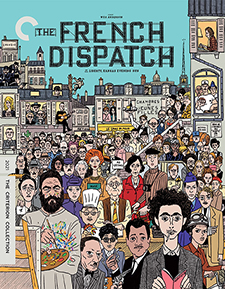
DISCS NINETEEN & TWENTY: THE FRENCH DISPATCH
Wes Anderson began the next phase of his career with a pair of films that sometimes divided even his long-time fans. Asteroid City is arguably the least-liked film in his entire filmography, but 2021’s The French Dispatch of the Liberty, Kansas Evening Sun wasn’t fully appreciated upon release by everyone either. In both cases, it’s easy to understand why as these are more intellectual exercises than straight narratives, especially The French Dispatch. Gone completely are the central character through lines from Rushmore and The Royal Tenenbaums. Instead, The French Dispatch opts for the omnibus format, centered around a fictional magazine based upon The New Yorker that relays its stories in a very literature-based manner, laid against an ever changing kaleidoscope of visuals. It’s all unmistakably in the Wes Anderson house style, but it’s not quite as grounded emotionally as most of his previous works, leading to some disconnect.
Arthur Howitzer Jr. (Bill Murray) is the editor for The French Dispatch, a magazine published in Liberty, Kansas that covers topics centered around the fictional French town of Ennui-sur-Blasé, where Arthur lives and works with his fellow ex-patriot writers. Upon his sudden death, the final issue of the magazine is released with four articles attached. In The Cycling Reporter, Herbsaint Sazerac (Owen Wilson) takes a tour of the local area via bicycle, relaying its many sights and sounds with comparisons to its past. In The Concrete Masterpiece, J.K.L. Berensen (Tilda Swinton) tells of convicted murderer Moses Rosenthaler (Benicio del Toro), a painter in love with the prison guard Simone (Léa Seydoux), when his work catches the eye of art dealer Julien Cadazio (Adrien Brody). In Revisions to a Manifesto, Lucinda Krementz (Frances McDormand) reports on student protests led by two revolutionaries, Zeffirelli (Timothée Chalamet) and Juliette (Lyna Khoudri). And in The Private Dining Room of the Police Commissioner, Roebuck Wright (Jeffrey Wright) recalls to a talk show host (Liev Schreiber) his involvement during the kidnapping of the son of Commissaire de la Vilatte (Mathieu Amalric) while also reporting on the legendary chef Nescaffier (Stephen Park). Also among the richly-diverse and expansive cast is Elisabeth Moss, Fisher Stevens, Griffin Dunne, Jason Schwartzman, Bob Balaban, Henry Winkler, Tony Revolori, Lois Smith, Christoph Waltz, Rupert Friend, Jarvis Cocker, Saoirse Ronan, Edward Norton, Willem Dafoe, Wally Wolodarsky, Cécile de France, Damien Bonnard, Larry Pine, Tom Hudson, Toheeb Jimoh, Stéphane Bak, and Anjelica Huston, among many, many others.
To say the least, The French Dispatch is a dense film, maybe Wes Anderson’s most dense. That’s certainly not a criticism, but it’s the least penetrable of his career, at least as of this writing. It revels in the reports and publications of authors such as Mavis Gallant, James Baldwin, E.B White, William Shawn, Joseph Mitchell, Lillian Ross, and A. J. Liebling, among many other writers whose works filled publications like The New Yorker, of which Wes Anderson is extremely fond of. At the same time, the film pays homage to French anthology films like La Ronde and Le Plaisir, taking influences from a number of sources including Max Ophüls, but also Jean-Pierre Melville, Federico Fellini, and Hergé. Wes Anderson creates a stylized version of France, and in some ways, an idealized version, told through the eyes of those writing about it, all of whom bring their own interpretations, as well as their personal baggage. This isn’t necessarily a deeply emotional film that gets to the heart of its characters, hardly anthology film does, but it spends enough time with them to give you a snapshot of events in their lives while reporting on what they’ve seen and heard. That’s important to remember. We’re not always being told the naked truth necessarily, but a truth based upon a reflection of these individual people. Amid the chaos, Lucinda Krementz is dealing with being an older woman in a young person’s world, while Roebuck Wright is finding his place as a black homosexual. None of these traits are overstated, but they’re there if you’re paying attention, which is the key to understanding this film more fully.
The performances are great as usual, but they’re a little more heightened in this film. Wes Anderson’s work has always contained an air of sophisticated hyperrealism. It can go from solemn to humorous to melancholy, sometimes all at once, but his characters tend to be a little more grounded and give us an anchor to follow them through his fanciful digressions. The French Dispatch doesn’t necessarily have that, but that’s the point. This is not about any one character or set of characters. It’s a love letter, a paean to the written word, and because of that, it’s primarily a dialogue-driven set of stories. The closest that it comes to having thoughtful characters is The Concrete Masterpiece, which takes its time a little more than the other stories in getting to know its subject. But again, this isn’t a traditional narrative. This is a tribute to exquisite journalism.
To be fair to outsiders of Wes Anderson’s work, The French Dispatch is more difficult to take in on an initial sitting than any of his other films. It’s garnered a bit more praise since its release, but its artistic pretense, which borders on self-parody many times, mixed with a genuine love for France and (for lack of a better term) bohemian literature, isn’t easy to approach for some viewers at the outset. But if you give the film your full, undivided attention, you’ll be rewarded with a meticulously-curated mise-en-scène of absolutely gorgeous images and outstanding prose.
The French Dispatch was shot by cinematographer Robert Yeoman on Super 35mm film (Kodak Vision3 200T 5213, Eastman Double-X 5222) using Arricam LT, Arricam ST, and Arriflex 235 cameras with Cooke Anamorphic/i, S4 and Zeiss Master lenses. The results were finished as a 4K Digital Intermediate and presented in the varying aspect ratios of 1.37:1, 1.85:1, and 2.40:1. Criterion’s Ultra HD debut features a presentation sourced from a new 4K Digital Intermediate created by colorist Gareth Spensley from the original color project and scans of the original camera negative, which has been graded for High Dynamic Range in HDR10 and Dolby Vision, supervised and approved by Wes Anderson, and encoded to a triple-layered BD-100 disc. The film’s changing aspect ratios and switching back and forth between color and black-and-white gives it a magazine-like feel, highlighting various moments in very specific ways. Textures are crisp and detail is sharp, with a steady but fine layer of grain. The bitrate sits mostly between 80 and 100Mbps, soaking up detail and stabilizing the picture’s intended visual structure. Some of the black-and-white portions can appear flat at first glance, but this appears to be an intended stylistic choice on Anderson’s and Yeoman’s part. Otherwise, shadows in the color footage are deep with perfect contrast. Awash in color, the HDR grades widen the film’s gamut, with bold uses of yellow, green, pink, and red, and everything else under the sun. The image is clean and precise through and through, and spectacular at that.
Audio is included in English 5.1 DTS-HD Master Audio with optional subtitles in English SDH. It’s a mostly low key, dialogue-driven soundtrack, but punctuated by sound effects that can range from subtle to explosive, quite literally. There’s some terrific immersion at play, with occasional low end response when needed, often accentuating unexpected cacophony, or even echoing environments. Dialogue is obviously the main drive, and it’s presented here with authority.
This 4K Ultra HD sits in a book-like digipak alongside a 1080p Blu-ray and an attached 22-page insert booklet containing cast and crew information; the essay On Deadline by Richard Brody; various photos and artwork, including all of the covert art for The French Dispatch magazines; the film’s synopsis; a list of the special features; restoration information; and a set of acknowledgments. This packaging negates the simultaneous standalone 4K Ultra HD release’s artwork by Javi Aznarez, which also contains a fold-out, double-sided poster featuring the same artwork on one side and the magazine covers on the other, as well as a booklet containing the same essay by Richard Brody. The following extras are included on each disc:
DISC NINETEEN (UHD)
- Audio Commentary with Wes Anderson, Roman Coppola, and Jason Schwartzman
DISC TWENTY (BD)
- Audio Commentary with Wes Anderson, Roman Coppola, and Jason Schwartzman
- Select-Scene Storyboard Animatic (HD – 34:15)
- Behind the Scenes of The French Dispatch (HD – 29:27)
- No Crying: How to Overcome Blasé Ennui (HD – 26:10)
- Painting Moses Rosenthaler’s Pictures a.k.a. “Ten Reinforced Cement Aggregate (Load-Bearing) Murals” (HD – 15:51)
- Aline by Jarvis Cocker Music Video (HD – 3:32)
- The French Dispatch: Miniature Unit Berlin (HD – 5:47)
- Accidentally Angoulême (SD – 6:43)
- The New Yorker Radio Hour (HD – 27:16)
- The French Dispatch Reads The New Yorker (And Other Magazines) (HD – 28:26)
- Featurettes:
- La Famille (HD – 1:04)
- May 68: Les Enfants Sont Grognons (HD – 1:04)
- Table Setter (HD – 3:31)
- The Theory and Practice of Editing New Yorker Articles (HD – 2:49)
- Trailer (HD – 2:26)
The audio commentary features Wes Anderson, Roman Coppola, and Jason Schwartzman. Coppola sits in for part of the commentary while Schwartzman comes in later via phone, and there’s a brief appearance by associate producer John Peet. Anderson leads a lovely discussion about the creation of the film, allowing his collaborators to speak up and asking them questions along the way.
The Select-Scene Storyboard Animatic basically covers the first 34 minutes of the film, featuring voiceover by Wes Anderson. Behind the Scenes of The French Dispatch offers a collection of fly-on-the-wall behind-the-scenes footage that was captured during the making of the film, from the sets being created, to the rehearsals, to the actual shooting. No Crying is an essay by the late film scholar David Bordwell, read by Rupert Friend, delving into the stylings of Wes Anderson and his “minimalist maximalist” approach, while examining The French Dispatch. Painting Moses Rosenthaler’s Pictures features an interview with Sandro Kopp, who painted Moses Rosethaler’s paintings for the film and how he became involved with the project. The music video for Aline by Jarvis Cocker (Tip-Top in the film) was directed by Wes Anderson and illustrated by Javi Aznarez, which highlights the settings of the film and its cast, coming off almost like an opening or closing credit sequence.
The French Dispatch: Miniature Unit Berlin highlights the incredible miniatures used in the film and the crew that created them. Accidentally Angoulême is an explorational piece with voiceover by Seamus Mcmahon of the Accidentally Wes Anderson web site, examining the architecture, food, and locales in France that inspired and informed the film. Next is an episode of The New Yorker Radio Hour from September 17, 2021 that features an interview with Wes Anderson and Jeffrey Wright, hosted by David Remnick. They discuss the influences on the film, its political and nonpolitical leanings, and why certain aspects of The New Yorker and other magazines were utilized, while also listening to readings from Jeffrey Wright, Frances McDormand, and Bill Murray. As an addendum, The French Dispatch Reads The New Yorker (And Other Magazines) offers further readings of classic articles from The New Yorker on a bonus episode of the same podcast, introduced by editor Susan Morrison and featuring Bill Murray, Stephen Park, Elisabeth Moss, Owen Wilson, Frances McDormand, Tilda Swinton, and Jeffrey Wright. A series of promotional Featurettes follow that briefly speak to the cast and crew about the film. Last is the film’s trailer.
THE FRENCH DISPATCH (FILM/VIDEO/AUDIO/EXTRAS): A-/A+/A+/A
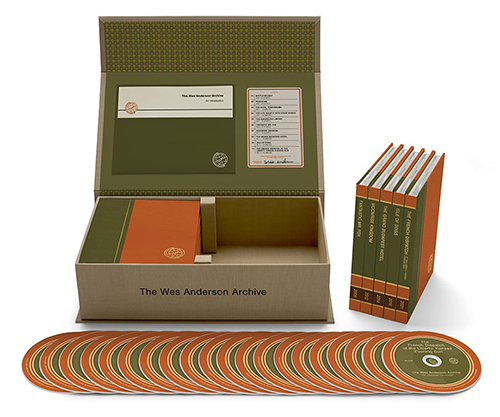
PACKAGING & FINAL THOUGHTS
Designed by Beth Mathews, all of these films are gathered together in a deluxe cloth-bound, burlap canvas-like package that’s literally a film library in a box. It contains a removable card on the back of the set, revealing its contents with a note of thanks from Wes Anderson, as well as a 4-page stationary within the package that features the essay Wes Anderson’s Impossible Dreams by Bilge Ebiri.
While this boxed set doesn’t contain all of Wes Anderson’s work, including more of his commercials and short films, as well as the feature films Asteroid City, The Wonderful Story of Henry Sugar and Three More, and The Phoenician Scheme, we will likely see these titles in The Criterion Collection sooner or later. Whether or not we’ll see another boxed set bearing his name remains to be seen, but for now, The Wes Anderson Archive: Ten Films, Twenty-Five Years is without a doubt one of the finest home entertainment releases ever produced, as well as one of the best releases of 2025. It’s more than just recommended, it’s an essential purchase.
- Tim Salmons
(You can follow Tim on social media at these links: Twitter, Facebook, BlueSky, and Letterboxd. And be sure to subscribe to his YouTube channel here.)