
Magnificent Seven Collection, The (Blu-ray Review)
Director
John Sturges/Burt Kennedy/Paul Wendkos/George McCowanRelease Date(s)
1960/1966/1969/1972 (March 25, 2026)Studio(s)
The Mirisch Company/United Artists (Imprint Films/Via Vision Entertainment)- Film/Program Grade: See Below
- Video Grade: See Below
- Audio Grade: See Below
- Extras Grade: B
- Overall Grade: B+

Review
[Editor’s Note: This is a Region-Free Australian Blu-ray and 4K Ultra HD import.]
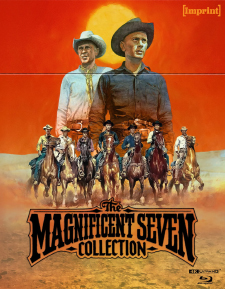
The law of diminishing returns definitely applies when it comes to The Magnificent Seven (1960) and its three sequels: Return of the Seven (1966), Guns of the Magnificent Seven (1969), and The Magnificent Seven Ride! (1972), a good Western followed by increasingly perfunctory, lesser sequels, though #3 is a little better than #2. However, Australia label Imprint’s boxed set, The Magnificent Seven Collection is an undeniably handsome packaging combining older and brand-new extra features in an attractive, sturdy box that includes all four original movies, the last two (I think) making their worldwide Blu-ray debuts. To my surprise there’s even a 4K disc of the first movie.
Unfortunately, the Blu-rays of Guns and Ride! obviously source very old, very imperfect high-def masters. Based on the older MGM logo used at the beginning, I’d guess they were at least 20 years old. Guns has a pesky vertical line pervading three full reels, apparently a photochemical issue but which might be a clumsy digital fix of a long-running negative scratch. Ride! looks especially bad; the entire film is so soft, almost out-of-focus, that the image resembles a 16:9 enhanced DVD more than it does a Blu-ray.
THE MAGNIFICENT SEVEN
For about the 40 years that followed the release of The Magnificent Seven, audiences widely regarded it as one of the two or three best Westerns ever made. However, with the DVD boom and other home video formats, film fans discovered many dozens of better Westerns, as well as the film that inspired it, the much superior Seven Samurai (1954) from director Akira Kurosawa. In fairness to the Americans behind The Magnificent Seven, they had access only to the egregiously shorted international version of Kurosawa’s film to work from, it cut by more than an hour (!), deleting important subplots and muting that film’s subtler themes.
The basic plot is the same, however: when bandits threaten a small village of poor farmers, they audaciously hire what ultimately becomes of crack fighting force of seven men to combat them. The masterless samurai become Western gunfighters, the mountain village of rice farmers becomes a Mexican village. Led by Chris (Yul Brynner), the rest of the seven consist of Vin (Steve McQueen), Bernardo (Charles Bronson), Britt (James Coburn), Lee (Robert Vaughn), Harry (Brad Dexter), and hotheaded Mexican Chico (Horst Buchholz).
On its own terms The Magnificent Seven is quite entertaining, its main assets being the surefire basic plot; the star-making, charismatic performances by five of the seven and by Eli Wallach as Calvera, leader of the bandits; and Elmer Bernstein’s celebrated film score. It is, however, ultimately inferior to Seven Samurai in every respect. Fumio Hayasaka’s score for Kurosawa’s film is better overall, and while John Sturges’s direction is good, the two films demonstrate the difference between a good director and a great director. When one compares how they stage and cut moments virtually identical in content, there’s just no contest. (Sturges’s direction of The Great Escape is much better.)
Yul Brynner’s Chris lacks the humanity of Takashi Shima’s samurai leader, but otherwise makes a good counterpart. He’s got a great gunfighter walk, later capitalized by the makers of Westworld, where his gait—kind of a sped-up John Wayne—became integral to his killer robot gunslinger character. Steve McQueen famously tried stealing every scene he’s in, and succeeds most of the time. But it’s Charles Bronson who comes off best, whose gunman is beloved by the village’s children; amidst all those charismatic stars, when Bronson’s onscreen you don’t look at anyone else, he’s that good. And maybe because he’s that good his character—unlike his Japanese counterpart, who dies early on—sticks around until the end; maybe rewrites kept Bronson around longer than originally intended.
James Coburn, a huge fan of Kurosawa’s film, is most like his Japanese counterpart; he seems to be having a blast recreating Seiji Miyaguchi’s master swordsman, almost scene-for-scene. Brad Dexter is okay in what effectively is an original character created for the remake, but Horst Buchholz is nearly terrible playing a role that combines those played by Toshiro Mifune and Isao Kimura, mostly the former. Mifune gave one of the great performances in all of cinema in Seven Samurai, and the alternately funny and tragic qualities of that character are complete lost on Buchholz, who instead is little more than annoying.
One major change is quite clever. Kurosawa’s film introduces Kambei (Takashi Shimura), the leader of the seven samurai, in a marvelous scene where a madman is holding a child hostage. Kambei has his head shaved, exchanging clothes with a Buddhist priest to allow him to approach the hut where the child is being held, before drawing his sword with lightning speed. For the remake, instead Chris volunteers to drive a hearse up to Boot Hill, against angry locals opposed to burying an Indian there. It’s a tense, amusing scene, almost the best in the film. Once the seven reach the village, the film loses both momentum and suspense. (It wouldn’t have worked, but it would have been great to introduce Brynner with a full head of hair, then forced to shave it off at the beginning, like Shimura’s character.)
Where The Magnificent Seven most falls short of Seven Samurai is in the original’s complex relationship between the samurai and the farmers, though a lot of that material was unavailable to the filmmakers then. Nevertheless, whereas in Kurosawa’s film five or six of the farmers become important characters in the story, in the remake they’re little more than a faceless mob, and some of their resentment toward the gunfighters seems unmotivated. Further, they appear far less desperate and more prosperous than the farmers of Seven Samurai. The remake also lacks the carefully dramatized spatial relationships of the village conceived by Kurosawa, so that audiences would more coherently be able to follow the battles better, there’s no attempt at all to do this in the remake, rendering the bandit sieges unnecessarily chaotic.
In the opposite direction, whereas the bandits in Seven Samurai were a seemingly unstoppable, faceless army (yet still individually identifiable by their distinctive armor), the film gives a showy, proto-Tuco role to Wallach, who has more dialogue than the seven put together. It’s a strong, enjoyable performance, but it simultaneously lessens the bandits’ overall impact.
Surprised to find a Dolby Vision 4K version included for The Magnificent Seven along with the standard Blu-ray, I watched that. The film, shot in color and anamorphic Panavision, had always looked a bit less than pristine over the years, probably owing to overprinting during its original theatrical run and reissues. On one hand, the 4K remastering evens out the color and draws out more detail, especially landscapes and Sturges’s surprisingly rare close shots of the actors, like more than a few 4K discs I found the transfer unduly dark. I’ve been told turning off the Dolby Vision in favor of HDR10 often corrects this problem but, for me, that didn’t help much.
(I wonder if this inexplicable trend may be the result of younger generations becoming accustomed to the commonplace problem of theater owners projecting insufficient light onto movie screens to save money. It’s one of the reasons I rarely see movies theatrically anymore, so dark are movie screens at times one can barely tell what’s going on. Do some of those doing 4K transfers today regard that too-low illumination as the standard bearer?)
The 4K disc includes two audio commentary tracks, both previously released: the first one has producer Walter Mirisch, actors Eli Wallach and James Coburn, and assistant director Robert E. Relyea, while the second features genre historian Christopher Frayling. The Blu-ray, conversely, is brighter and more in line with what the film should look like, brightness-wise. Audio options include LPCM 2.0 mono, a DTS-HD 5.1 surround remix, and an LPCM 2.0 stereo mix. As with all the discs on this set, optional English subtitles are included, and the discs are all Region-Free.
Extras on the Blu-ray consist of archival featurettes: Guns for Hire: The Making of The Magnificent Seven; To Bring a Knife to a Gunfight and Win, featuring Coburn; Elmer Bernstein and The Magnificent Seven; Sir Christopher Frayling on The Magnificent Seven; and The Linen Book: Lost Images from The Magnificent Seven. Also included is a Trailers from Hell segment with filmmaker Jesus Trevino; two trailers and a still gallery.
THE MAGNIFICENT SEVEN (FILM/VIDEO/AUDIO/EXTRAS): B+/A-/A/A
RETURN OF THE SEVEN
The first of three sequels to the 1960 remake of Akira Kurosawa’s superlative Seven Samurai is a misbegotten affair, not half as good as the 1960 film which isn’t half as good as the Japanese original, though it has the best cinematography (by Paul C. Vogel) of the four films and Burt Kennedy’s direction is better than Sturges’s, pluses offset by an especially weak, redundant script. Sequels weren’t as commonplace in 1966 as they are today, so in some ways the film can almost be forgiven for making so many bad errors of judgment, but it does just that. Nearly every choice its creators make is a step in the wrong direction. While the two more that followed are lightweight entertainments in the extreme, they are at least slightly more entertaining.
The Blu-ray of Return of the Seven is an older transfer, okay but hardly spectacular. The first few reels are grainy and unimpressive, but from about 20-minute mark onward the picture quality improves and, while still a long way from splendiferous, the high-def image looked significantly sharper.
The awkwardness of this movie is readily apparent in its title, which is a little like trying to make a follow-up to The Alamo. Four of the original Magnificent Seven were dead by the end of the first film, making a return in the full sense of the word impossible. Although Yul Brynner returns as Chris, the leader of the Seven Samu—er, gunfighters, he’s the only returning cast member.
In the same poor Mexican village where The Magnificent Seven had taken place—the first movie was shot in Mexico while this was made in Spain yet the village looks exactly the same; Mirisch obviously kept the original’s set drawings—a shock-and-awe-style raid by 50 gunmen takes place and all the men are kidnapped and enslaved, including farmer Chico (Horst Buchholz in the original, Julián Mateos here), one of the original seven. Chico’s wife, Petra (Rosenda Monteros in The Magnificent Seven, Elisa Montés in the sequel), makes a beeline into the city, where she finds Chris (Brynner) and Vin, who coincidentally run into one another at a bullfight.
In the original Magnificent Seven, Vin was played by Steve McQueen, and the picture’s phenomenal success helped establish him as a movie star. Between Magnificent Seven and its first sequel, McQueen’s star status had risen sharply while Brynner’s dropped somewhat. Nevertheless, the Mirisch Company, which owned the franchise, and United Artists, which distributed the films, obviously would have loved to have had both Brynner and McQueen in the same picture, the rest of the cast hardly mattering after that.
However, it appears that both stars were monumentally vain and even paranoid about the other, and supposedly Brynner agreed to do the film only on the condition that McQueen wouldn’t be involved. On the other hand, it’s entirely possible McQueen was asked and he turned it down, which would have been entirely understandable. His thin character in the first film was carried almost entirely by McQueen’s charisma, and in Return of the Seven Vin is never anything more than level-headed acolyte. He’s utterly subservient throughout, taking orders from Chris and doing almost nothing heroic on his own or even anything to move its plot forward.
Worse, he’s played by actor Robert Fuller who, like McQueen, had been culled from the ranks of TV Westerns, chiefly Laramie and Wagon Train. Though a decent enough actor, Fuller has none of McQueen’s charisma. Casting him as Vin in McQueen’s wake is downright perverse, like assigning Lee Majors to Gary Cooper’s part in High Noon, Part II (1980), or David Soul as Rick Blaine, Humphrey Bogart’s character, in the 1980s TV version of Casablanca.
The plot, such as it is, is nearly a remake of The Magnificent Seven, repeated again and again in the two sequels that followed. Chris with Vin’s help recruit more gunfighters to fight more Mexicans against more impossible odds. Sexual firecracker Colbee (Warren Oates, a bit like his character on Stoney Burke) is in it for the women, while Frank (Claude Akins) has a death wish after mercy-killing his wife in an Indian raid. The less interesting Luis (Virgilio Teixeira) and Manuel (Jordan Christopher) round out the seven, akin to the spear carriers used to fill out the Bowery Boys.
Which begs a rather obvious question: Why seven? “For luck,” Chris says. Yeah, but why content yourself with seven? Wouldn’t, say, eight or ten versus fifty guns be better odds? The reason, of course, is obvious: It’s just gotta be seven otherwise it wouldn’t be Return of the Seven, ya schmuck.
And so, what you’re left with is a movie that follows the original’s well-worn path with almost no variation, with the same rousing let’s-smoke-some-Marlboros-on-the-range music by Elmer Bernstein. But Larry Cohen’s script is all too obviously made-to-order.
One side note: There’s an unintentional laugh at 6:02 during the raid. As an angry Chico storms out of his home to face the gunman, the camera angle strongly suggests that the door he slams flies smack into wife Petra’s face, her head jerking back like a jack-in-the-box. Laurel & Hardy couldn’t have done better.
As described above, the 2.35:1, filmed in Panavision Return of the Seven looks okay but no better than that, especially during its first few reels, which to me seem weaker than those that follow. Audio is a choice between a DTS-HD Master Audio 5.1 Surround remix, LPCM 2.0 Stereo, and Dolby Digital 2.0 mono.
Extras consist of a new audio commentary by Toby Roan and a trailer.
RETURN OF THE SEVEN (FILM/VIDEO/AUDIO/EXTRAS): C/A-/A-/B-
GUNS OF THE MAGNIFICENT SEVEN
Perfunctory is the operative word for Guns of the Magnificent Seven (1969) the third of four Westerns adapted from Akira Kurosawa’s classic Seven Samurai. Taken in the right spirit and with low expectations, the film can be enjoyable if acutely predictable fun. The picture hit theaters in July 1969—the very same time as The Wild Bunch; the two films have somewhat similar stories but, needless to say, Sam Peckinpah’s landmark film is otherwise light years ahead of this unambitious rehash.
This installment finds Mexican peasants terrorized by a sadistic anti-revolution militarist, Colonel Diego (Michael Ansara). After revolutionary leader Quintero (Fernando Rey, slumming between Buñuel films) is imprisoned, the revolutionaries dispatch handsome Maximiliano (Reni Santoni) to hire gunslinger Chris to help break Quintero out of the jail dubbed “the cave of the rats.”
Chris, now beefier and sporting a full head of yellow hair (and played by George Kennedy), accepts Maximiliano’s offer of $600, and predictably decides to hire five more gunmen to aid them. Along for the ride this time is Keno (Monte Markham), an enigmatic drifter who refuses to discuss his past; Levi (James Whitmore, an odd casting choice), an expert knife-thrower and family man; Cassie (Bernie Casey), a strong but angry black man; P.J. (Scott Thomas), a Doc Holliday type who coughs a lot, though we never learn much about him; and Slater (Joe Don Baker), a racist gunslinger who lost his arm in the Civil War and reduced to touring the country as a sideshow performer named “Buffalo Ben.” Baker’s injured Reb is more than a bit unstuck in time considering the film is set around 1890.
After The Magnificent Seven became a big hit, a sequel seemed inevitable, but there was really nowhere for the story to go. Return of the Seven ended up little more than a remake of the first film. Yul Brynner, who played Chris in the first film, reprised his image-remaking role, but by 1966 co-star Steve McQueen had outgrown his second banana status, and his part went to Robert Fuller, an actor not known for his scintillating screen presence. In Guns of the Magnificent Seven, busy TV actor Monte Markham plays Keno, a thinly-disguised McQueen clone given the same wardrobe McQueen wore in The Magnificent Seven.
Similarly, Whitmore’s expert knife-thrower, who becomes a father figure to a Mexican child (a young Emiliano Zapata, no less) recalls the original film’s James Coburn, an expert knife-thrower, as well as Charles Bronson’s character, beloved among the Mexican children.
Kennedy’s Chris reads like it was written with Brynner in mind, though the recent Oscar-winner (for Cool Hand Luke, 1967) works to make the part his own, and Kennedy’s natural likeability goes a long way to achieve this. The same holds true with Whitmore, hardly Western hero material, though a favorite with kids ever since Them! (1954). Most of the characters are slim at best, however. Markham’s Keno is no McQueen, his malevolent looks better suited to villains, while Thomas’s P.J. does little more than cough and fire a gun. Slater’s tormented veteran is embarrassingly overplayed, complete with hilarious voice-over taunts (“I’m a freak...freak...FREAK!”)
In a sense, the big star of all four films is Elmer Bernstein’s seminal Western theme music, which gives it a badly needed shot in the arm, and is nearly expected to carry it through its weakest patches. The picture was shot in Spain, and DP Antonio Macasoli uses the 2.35:1 aspect ratio to its fullest effect. When Macasoli’s more inspired images, like a terrific shot of the seven riding in silhouette, is matched with Bernstein’s cues, the picture comes to life, however fleetingly.
The film has a vaguely condescending attitude toward the Mexicans. There are dozens of armed revolutionaries (led by Frank Silvera), yet the seven are hired because the tequila-guzzling Hispanics, according to Maximiliano, are “quick with the guns, slow with the brains.” Ansara’s Diego also subjects the peasants to all manner of torture, which is shown with a vague air of titillation. Their bodies are left to rot dangling from telegraph poles, dragged to death by horses, while some of the prisoners are buried up to their necks in sand and trampled.
The film was directed by Paul Wendkos, a prolific TV director, and written by Herman Hoffman, another television name. Neither brings much to the material. An opening set piece, clearly meant to delight audiences, falls flat due to bad direction and sloppy scripting. Keno is accused of stealing another man’s horse, and it’s decided to place the horse in the center of town and see which man it will come to. Keno, it turns out, really did steal the horse, but it comes to him just the same because on this hot day he positions himself next to a trough of cool water. Unfortunately, Wendkos gives the punch line away by cutting, repeatedly, to a tight close-up of the water, deflating all mystery and suspense.
Just as The Magnificent Seven was entertaining if several notches below the film that had inspired it, so too is Guns of the Magnificent Seven to the two earlier pictures that inspired it. Instantly forgettable but not as bad as Return of the Seven, its main fault lies in its inability to break away from a proven formula.
Filmed in Panavision, Guns of the Magnificent Seven is presented on Blu-ray in 1080p in what appears to be an older transfer, okay, but inconsistent, with some minor damage here and there and overall not great. When I reviewed the DVD release 20 years ago I noted a hairline scratches on the negative. Most of those are gone, but for about three full reels there’s a vertical line very visible in some shots; it seems more photochemical damage than a scratch on the negative. The U.S. DVD release was mono with an alternate Spanish track, but Imprint’s version is presented in English only, but with multiple audio options: DTS-HD 5.1 surround, LPCM 2.0 stereo, and LPCM 2.0 mono.
Supplements consist of a new audio commentary by Steve Mitchell; a nearly half-hour featurette; A Man of Potential: Visions of Paul Wendkos, the Godard of Gidget, a video essay by Daniel Kremer; and a trailer.
GUNS OF THE MAGNIFICENT SEVEN (FILM/VIDEO/AUDIO/EXTRAS): B-/A-/A-/B
THE MAGNIFICENT SEVEN RIDE!
Though it partly breaks free from the rigid formula of its two predecessors, the third sequel to The Magnificent Seven (1960), The Magnificent Seven Ride! (1972), is pretty feeble entertainment. It’s easy to imagine this playing as a second feature at drive-ins, the kind of movie that generates a little excitement at the intermission but which triggers a mass exodus of cars about thirty minutes into the picture.
The story this time finds an older Chris, now wiry of build with beady eyes and bushy gray sideburns and unconvincing toupee (and played by Lee Van Cleef), settled down as a town marshal. Pressured by new wife Arilla (Mariette Hartley) to parole a troubled youth, Shelly (Darrell Larson), Chris reluctantly lets the boy go. The couple is repaid for their kindness the very next day, when Shelly and two of his hoodlum friends (including a young Gary Busey) rob a bank, kidnap, rape and murder Arilla.
Joined by a print-the-legend biographer Noah Forbes (Michael Callan, the young hero in Mysterious Island), an embittered Chris tracks the three violent men. Along the way, Chris and Noah form a posse to aid a border town where nearly all its men have been murdered by some 70 marauding bandits. Unbelievably, Chris goes to a nearby prison and casually offers five killers a pardon if they join his posse. (Perhaps the film should have been called The Dirty Seven Ride!) When Noah notes the 10-to-1 odds against them and suggests they get more men, Chris immediately dismisses the idea because, he says, “Seven’s always been my lucky number.” Well, maybe for you, Chris.
Unlike Return of the Seven and Guns of the Magnificent Seven, which at least imitated the look of the first film reasonably well, The Magnificent Seven Ride! is shot like a TV-movie, in 1.85:1 format (the others were in Panavision), on a budget of $3 million according to Wikipedia, but more likely closer to half that, cheap even by 1972 standards. The previous sequels were made in Spain, but The Magnificent Seven Ride! was filmed in and around Hollywood, on backlot Western streets, and at nearby Vasquez Rocks, whose picturesque scenery is overused here. One particularly cramped backlot street may account for a weird bit of staging, where Chris shoots a key character who flies off his horse at a 90-degree angle. Even Elmer Bernstein’s music seems malnourished. Some cues play like stock music, while the opening titles offer the signature theme on what sounds like a meager, 15-piece orchestra.
After finding belated stardom in a long series of Spaghetti Westerns, Van Cleef seems out of place back in a conventional Hollywood backlot environment, even though he spent years on these same streets throughout the 1950s and early ’60s. He’s a welcome presence, in some ways better cast than predecessor George Kennedy, though the script and uninspired direction err mightily in trying to mold him into a conventional Western hero type. He’s not remotely recognizable as the Chris from the Yul Brynner films, or as the kind of characters Van Cleef played in his spaghettis.
The film is a peculiar mix of family fare and brutal post-Peckinpah Western. Some gunshot deaths are shown the old-fashioned way, with actors clutching their stomach, wincing and falling to the ground with no sign of blood or even a bullet hole in their shirt. Others die via bright red blood packs. More than a dozen women are raped in the course of the film (thankfully not shown), yet on the eve of battle a padre cheerfully serves lemonade—lemonade—to a hardened posse led by Pa Walton himself, actor Ralph Waite, very good in a minor role.
The script also has a peculiar sense of elapsed time. Chris’s beloved wife is raped and brutally murdered, yet within days of her death Chris happily begins flirting with another woman (Stephanie Powers), who herself was widowed and gang raped only days before.
One is tempted to give the film credit for adopting a faintly elegiac air, and for making Chris, in the opening scenes at least, a bit more reflective than usual. But such Westerns were commonplace by the early-1970s, and this is hardly on the level of The Cowboys (also 1972) or The Shootist (1976). The film imitates the earlier films in odd ways. As in the first Magnificent Seven, the leader of the bandits, De Toro, is given a huge build-up—everybody talks about him as if he were the Devil incarnate. This was done in the first film to build Eli Wallach’s character, Calvera, into a truly formidable villain. But when De Toro finally turns up at the climax, the camera barely acknowledges his presence. He has no lines and is nearly indistinguishable from the other bandits.
Except for Chris, the seven are even less defined than they were in Guns of the Magnificent Seven. You’ll learn more about them in the trailer than you do in the actual movie. For the record, besides Chris and Noah, there’s expert shot Skinner (Luke Askew), token Hispanic Pepe (Pedro Armendariz, Jr.), dumb ox Walt (William Lucking), strategist Captain Hayes (James Sikking), and explosives man Scott (Ed Lauter).
Though shot with no visual flair of any kind, The Magnificent Seven Ride! looks pretty good in its widescreen, 16:9 transfer. The English mono is clean if unimpressive. A Spanish audio track, also mono, is offered as an alternate track, along with English, Spanish, and French subtitles. Included is an amusingly misleading trailer, suggesting a film full of a lot more excitement than there actually is, and implying the original film’s characters were all reuniting for one last hurrah. The trailer is in okay shape and also 16:9 anamorphic.
It’s too bad The Mirisch Corporation, producers of all four films, simply milked the series until it ran dry. A good script that went in new directions might have lured back both Brynner and McQueen (and Horst Buchholz, for that matter) for what might have been a series of really great Westerns, instead of a series of uninspired retreads.
While Return and Guns are passable, barely, The Magnificent Seven Ride! is definitely one sequel too many. At least.
As noted above, The Magnificent Seven Ride! is a dreary, older transfer that looks closer to a 16:9 enhanced DVD more than it does a Blu-ray. The image is dishearteningly soft throughout; close-ups fare okay, but wide-angle shots are nearly blurry. On smaller monitors this might not be a deal-breaker, but on big screen projection systems, it’s a big disappointment. Once again, audio is DTS-HD 5.1 surround, with LPCM 2.0 stereo and 2.0 mono options.
Other than a trailer, the lone extra here is a new audio commentary track by Steve Mitchell.
THE MAGNIFICENT SEVEN RIDE! (FILM/VIDEO/AUDIO/EXTRAS): B-/C-/A-/B-
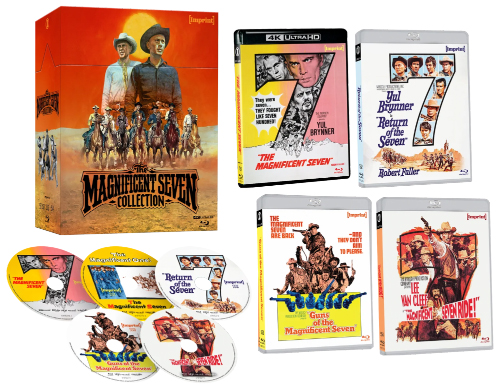
The Magnificent Seven Collection is a good packaging of material let down by disappointing video transfers. But this does seem to be the current best way to see these titles until something better comes along. Of course, only the first movie is actually good, but if you want the entire series, this may be the best way to go for now.
- Stuart Galbraith IV