
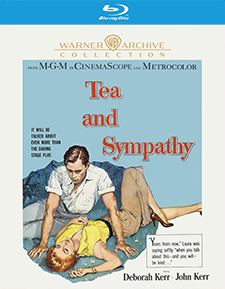
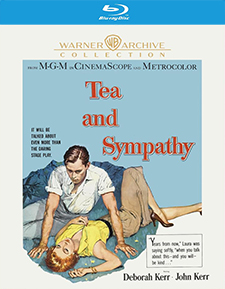
Tea and Sympathy (Blu-ray Review)
Director
Vincente MinnelliRelease Date(s)
1956 (March 31, 2026)Studio(s)
Metro-Goldwyn-Mayer (Warner Archive Collection)- Film/Program Grade: A-
- Video Grade: A
- Audio Grade: A
- Extras Grade: C

Review
Mid-twentieth century movies were beginning to change their depiction of masculinity. Films from The Adventures of Robin Hood to a long series of Tarzan movies had emphasized men who were tough, courageous, and strong. The 1950s saw a shift from this stereotype to more multi-dimensional men in such films as Rebel Without a Cause, Strangers on a Train, Cat on a Hot Tin Roof and Vertigo. In Tea and Sympathy, a young man is bullied by his peers for his sensitivity.
The film is bookended by scenes of Tom Lee (John Kerr) returning as an adult to a prep school class reunion. The surprised reactions of fellow alumni upon seeing him pique our interest. Why do these men react the way they do? What’s the story behind this average looking guy? As Tom walks around the campus and visits his old room, the film flashes back to his experiences as a young student at the school.
In the extended flashback, we see Tom as a student at the all-boys prep school. His interests lean toward the arts and he plays tennis rather than football, preferences that make his classmates uneasy. When he’s seen sewing on the beach with a group of faculty wives, word spreads and he’s dubbed “sister boy.” He finds peace and respite from the boys’ cruelty with his housemaster’s wife, Laura (Deborah Kerr), who shares his interests and feels bad that he’s the butt of jokes among his peers. Because his room is in the same building as her apartment, they encounter each other often and enjoy speaking.
Laura’s husband, Bill (Leif Erickson), is the school’s coach and devotes more attention to his team members than his wife. Tom provides both company for Laura and a break from marital tension.
Tom’s father Herb (Edward Andrews) stops by to both visit Bill, his friend and former classmate at the school, and see how Tom is doing. He observes that the boy doesn’t fit in with the “regular” guys and urges him to be more like them, even demanding he get a crewcut. Herb also talks to Bill, who claims he’s tried to toughen up the boy but he’s just resistant.
Laura stands up for Tom, saying that he has fine qualities that neither of them appreciates. But their notion of masculinity is rigid. A boy who fails to conform to it is a disappointment. As things get more difficult for Tom, his roommate, Al (Darryl Hickman), offers to help him act more like a man. A scene in which Al shows Tom how to walk like a man emphasizes the foolishness of equating mannerisms with masculinity. The bullying becomes so intense that Tom, desperate to prove his manliness, makes a date with town tramp Ellie Martin (Norma Crane). When Laura learns of this, she feels Tom is on the edge of a breakdown and decides to intercede.
Deborah Kerr is perfect in the role of Laura, a part she played on Broadway and on tour for years. She conveys kindness, intelligence, and genuine empathy for Tom’s anguish. As a housemaster’s wife, Laura is ready to offer tea and sympathy to the boys rooming in her house, but she sees that Tom needs more attention. Kerr is an expressive actress in her facial and body language as well as her gentle tone of voice. With Bill, her Laura is clearly tense and nervous. With Tom, she’s relaxed.
John Kerr, also from the Broadway cast, shows a range of emotion as Tom. With Laura, he’s talkative and happy. With his father, he avoids eye contact and looks uncomfortable at his judgmental comments. With the other boys, he looks ill at ease, knowing that to them, he’s an outsider. The film never makes clear whether Tom is actually gay, so there are no overt mannerisms or suggestions that he is or isn’t. That the viewer can interpret John Kerr’s performance either way strengthens the theme of masculine stereotyping.
Bill is likely a latent homosexual. He always seems to be pulling away from Laura, whether to go off on a camping trip with the boys or heading out for team practice. She struggles to get his attention for a serious conversation with him. When she finally succeeds, he looks uncomfortable and cornered, as if his own failings as a husband will come to the fore. Erickson delivers as the big, muscular, athletic man who thrives on male camaraderie and might well fear consistently living up to the masculine stereotype.
Adapted by Robert Anderson from his play, the film benefits from moving performances by Deborah Kerr and John Kerr. Vincente Minnelli’s direction opens up the stage play with scenes of the school campus, the beach, and streets of the nearby town, and the Technicolor photography gives vibrancy to the lush outdoor area where Laura spends time gardening.
After 70 years, Tea and Sympathy comes across as too cautious to be specific about Tom’s sexual orientation. Homosexuality wasn’t treated candidly in the 1950s, and leaving this point open gives the film added resonance, since it also addresses how labels can affect behavior. Tom is driven to extremes by pressure from his father, his peers, his coach, and society. He’s victimized for being himself because that self doesn’t jibe with the norm. Tom is bullied and ridiculed because he doesn’t conform to expectations.
Tea and Sympathy was shot by director of photography John Alton on 35mm Eastman color film with anamorphic lenses, processed at Metrocolor, Culver City, CA, and presented in the widescreen aspect ratio of 2.35:1. The Blu-ray from the Warner Archive Collection is sourced from a 4K scan of the original camera negative. Imperfections such as scratches, embedded dirt, and emulsion clouding have been eliminated, resulting in sharp images and vibrant color reproduction. Details are nicely delineated, such as decor in Laura’s apartment, Tom’s dorm room, gentle waves splashing on the shore, and the texture of rock outcroppings on the beach. A bonfire scene adds considerable production value. Complexions are pleasantly rendered, especially Deborah Kerr’s smooth skin and light make-up. Local filming enhances the sense of reality.
The soundtrack is English 2.0 mono DTS-HD Master Audio. English SDH subtitles are an option. This was an early CinemaScope picture produced with monophonic sound, since four-track stereo was considered too costly for the then-new format. Dialogue is crisp and clear. Since the film is based on a play, it’s dialogue-heavy, with much of the drama arising from interactions among characters. Sound effects include the crackling of a huge bonfire, distant waves lapping at the shore, the boys’ teasing horseplay, a tennis ball being volleyed, crowd noise at a school rally, and a downpour. Adolph Deutsch’s original score captures Laura’s loneliness and Tom’s inner turmoil, and adds atmosphere to the dramatic tale.
Bonus materials on the Blu-ray release from the Warner Archive Collection include the following:
- Down Beat Bear (6:30)
- Theatrical Trailer (2:52)
Down Beat Bear – In this 1956 Technicolor CinemaScope Tom & Jerry cartoon directed by William Hanna and Joseph Barbera, Jerry enters his home inside a cabinet radio and turns on loud music. Tom enters the living room, sits down to read the newspaper and turns off the distracting radio. Jerry turns it back on, then Tom turns it off. This goes on for a while until a breaking news announcement tells of a dancing bear that has escaped from the carnival. The bear finds his way to Tom and Jerry’s house and dances with Tom, making it impossible for him to call the authorities. Jerry takes every opportunity to play music and keep Tom and the bear dancing. When a reward for the bear is doubled, Tom tries even harder to call the police, but Jerry sees to it that he never gets the chance. Lots of slapstick comedy ensues.
When Tea and Sympathy debuted on the stage in 1953, it was ground-breaking as one off the first plays to address homosexuality and homophobia. The film adaptation was subject to censorship by the Hays Office, Hollywood’s moral gatekeeper at the time, so the screenplay relies on deft use of language and the complete absence of the term “homosexual” to comply. Even though the film is dated by today’s standards, its themes of persecution and being an outsider remain relevant.
- Dennis Seuling