
War Wagon, The (Blu-ray Review)
Director
Burt KennedyRelease Date(s)
1967 (August 25, 2026)Studio(s)
Batjac Productions/Marvin Schwarz Productions/Universal Pictures (Kino Lorber Studio Classics)- Film/Program Grade: A-
- Video Grade: A
- Audio Grade: A
- Extras Grade: B-

Review
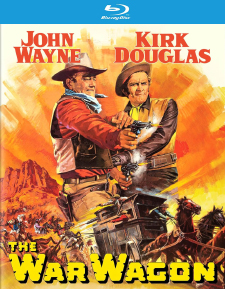
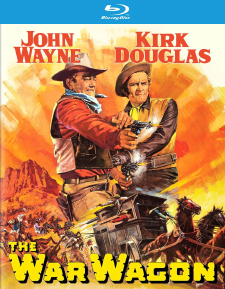
The War Wagon marked the final screen pairing of John Wayne and Kirk Douglas. Previously, they had starred together In Harm’s Way and Cast a Giant Shadow. Their chemistry is a major asset in a heist flick dressed up as a Western.
Taw Jackson (Wayne) was framed by gold-mining magnate Frank Pierce (Bruce Cabot) and convicted of a crime he didn’t commit. While he’s incarcerated, Pierce lays claim to Jackson’s gold-rich land. On parole, Jackson returns to town surprisingly mild-mannered and affable. Pierce wants him out of the way and offers hired gun Lomax (Douglas) a handsome fee to kill him. Jackson turns the tables on Pierce by offering Lomax a fortune in gold dust to steal Pierce’s next shipment of gold. The prize is located in an armor-plated coach, a precursor of the armored truck. Equipped with a safe and a turret-mounted Gatling gun and accompanied by 33 armed men on horseback, the war wagon looks impossible to rob.
Jackson is sure he can pull the robbery off with the right help and Lomax is an expert safecracker. Other members of the colorful gang include young Billy Hyatt (Robert Walker, Jr.), an explosives expert with an unquenchable thirst for booze; Wes Fletcher (Keenan Wynn), who will drive his buckboard, a mid-19th century version of a getaway car; and Levi Walking Bear (Howard Keel), the gang’s liaison with local Indians. The first part of the film shows how Jackson assembles his crew of thieves and the obstacles Pierce and his hired guns put in their way.
The film has a lightness of tone despite its basis in revenge. The repartee between Jackson and Lomax is well scripted with clever lines that show both their appreciation and apprehension of one another.
Wayne looks right at home as Jackson, a larger-than-life Westerner who’s more than a match for his enemies. Technically, his Jackson is a bad guy, but he’s pitted against a man who does him one better in the villain category. Jackson wants only to retrieve what is rightfully his—his stolen land and at least some of the gold that was extracted from it.
Douglas has a showy role as would-be assassin Lomax. He shows off his athleticism in a physically demanding role, especially in the unorthodox way he mounts his horse.
It’s unfathomable that musical film veteran Howard Keel was cast as an Indian. Tricked out in an unconvincing wig and dark make-up, Keel nevertheless adheres to the script and plays it straight for the most part.
Keenan Wynn plays elderly, cranky Fletcher, Pierce’s errand runner, who keeps a jealous eye on his much-younger wife, perpetually seated in his wagon. He doesn’t say much but when he does, he usually shouts or snaps. Because Jackson has accepted him for an important role in the robbery, the others put up with his sourness and nasty outbursts.
Young Robert Walker, Jr’s character spends considerable screen time drunk, suggesting he’s a shaky choice for the person who will handle the explosives. A great deal of suspense is created when he has to plant glass bottles of nitroglycerin strategically under a bridge, his every move nearly balletic in its precision.
We first see the war wagon racing across a picturesque Mexican landscape. The panoramic camera shows the vehicle from many angles, giving it an impressive introduction. Ironclad both to protect it from robbers and to support the enormous weight of a half-million dollars worth of gold, the wagon’s defenses wouldn’t amount to much if just one of the six horses drawing it were shot, but the filmmakers apparently didn’t expect viewers to think about that. In any case, the wagon looks great on screen.
Director Burt Kennedy packs The War Wagon with action. There’s a huge barroom brawl, an Indian attack, Molotov cocktails, chases, explosions, and shoot-outs. It doesn’t follow the typical template of a traditional Western; it’s more a heist movie in a Western milieu. The film lacks the gravitas of say a High Noon or Unforgiven, and is more like Rio Bravo in tone. It looks as if everyone was having fun making the film and that feeling comes through, though not at the expense of the main story.
The War Wagon was shot by director of photography William H. Clothier on 35mm film with Panavision cameras and spherical lenses, processed by Technicolor, Hollywood, and presented in the aspect ratio of 2.35:1. The Blu-ray features a new 4K restoration sourced from the original camera negative. I remember seeing The War Wagon on television and it looked faded and washed out. It has been given new life on Blu-ray. What jumps out at the viewer instantly is the beauty of the widescreen images of the Mexican landscapes that serve as the setting as the war wagon races along. These shots give the picture an epic feel. Clarity is exceptional, with color vibrant. Details of buildings, bolts on the war wagon, the mane on Lomax’s horse, a long bar in the saloon, and wooden beams supporting a bridge are well delineated. Complexions are well rendered with Wayne’s rugged face and Douglas’ chin dimple prominent. Image stability is excellent. The Blu-ray is pristine, with no evidence of visual imperfections.
The soundtrack is English 2.0 mono DTS-HD Master Audio. English subtitles are an available option. Dialogue is clear and distinct. The saloon brawl scene contains a sound mix of tables and chairs being broken, bodies pummeled, men grunting, glass breaking, and music. Dimitri Tiomkin’s score is appropriately exciting but the title song, The Ballad of the War Wagon sung by Ed Ames, has such dumb lyrics and sub-par music that it almost seems a parody of title movie songs.
Bonus materials on the Blu-ray release from Kino Lorber Studio Classics include the following:
- Audio Commentary by Julie Kirgo and Peter Hankoff
- Audio Commentary by Toby Roan
- Trailers:
- The War Wagon (2:29)
- The Horse Soldiers (2:39)
- The Shepherd of the Hills (2:19)
- Gunfight at the O.K. Corral (2:13)
- Posse (1:44)
- The Last Sunset (2:31)
- Lonely Are the Brave (:54)
Audio Commentary #1 – Film historian/writer Julie Kirgo and writer/filmmaker Peter Hankoff identify the opening location as the Sierra Madre Mountains in Durango, Mexico. They point out the unique organ-type mountains that form a picturesque backdrop. The local scenery is used a lot, giving the film magnificence. They call the film an “extremely fun Western” as well as an homage to the classic Western. With few female characters, it’s a “manly” movie. John Wayne usually played a sheriff, cop, military man, or other type of hero. Before making The War Wagon, Wayne had his first bout with cancer. He had a lung and several ribs removed. Flying down to Mexico, Wayne had to be on oxygen and it was also available on location. At this point in Wayne’s career, he gives a consistent, familiar, somewhat cranky performance. In a changing world, he was unchanged—the quintessential cowboy. There was political turmoil in America but Wayne represented the silent majority. Kirk Douglas had appeared with Wayne in two other movies. They were political opposites but worked well together, respecting each other’s professionalism. Wayne is the cornerstone of morality and a “pillar of the Western.” The two men are a good team. Douglas shows off with the way he mounts his horse. His character is a charmer who can get information out of people. Bruce Dern, “eccentric in a quiet way,” has only two scenes but he had done a lot of television. Howard Keel is “bizarrely cast” as an Indian. Of the team members, Keenan Wynn’s character is the outsider. In his later years, Wynn played older, curmudgeon types. In 1870, gold was $20.57 an ounce. Five hundred thousand dollars worth of gold would weigh 3/4 of a ton. That would explain why the war wagon is so heavy. The commentators compare The War Wagon to Topkapi (1964) and Armored Car Robbery (1950). The editor for The War Wagon had also edited High Noon (1952). Cinematographer William Clothier worked for many of the great directors, including John Ford, Raoul Walsh, Michael Curtiz, Frank Borzage, William Wellman, and Sam Peckinpah.
Audio Commentary #2 – Western film historian Toby Roan says that The War Wagon was put together by Batjac, John Wayne’s production company. The screenplay by Clair Huffaker is based on his own novel. The film was shot in and around Durango, Mexico and at Universal in Hollywood. It was followed a month later by the release of El Dorado, also starring John Wayne. Matte shots were created by longtime Universal visual effects expert Albert Whitlock. Wayne was 59 years old when he made The War Wagon. Kirk Douglas accomplished the impressive horse mountings with the help of a small, unseen trampoline. Supporting actor Bruce Cabot, who plays Pierce, was the hero in the original King Kong (1933). Carey Wilson was in every episode of TV’s Wagon Train after star Ward Bond insisted that he be cast. He also appeared in other TV Westerns. Keenan Wynn came from a theatrical family. He was the son of comedian Ed Wynn. He signed with MGM in the 1940s and was cast mostly in comedy roles. He had an extensive career in movies and television. Another cast member, Sheb Wooley, had a hit song in 1958 with Purple People Eater. Bruce Dern was nominated for Best Supporting Actor for Coming Home. Dern’s character shot and killed John Wayne’s Will Andersen in The Cowboys, for which he received “a lot of heat.” Howard Keel took over the leads in the original Broadway productions of Oklahoma and Carousel. His films include Show Boat, Kiss Me Kate, Calamity Jane, and Seven Brides for Seven Brothers. Later, he worked in summer stock and in 1981 joined the cast of TV’s Dallas. Parallels between The War Wagon and heist films are pointed out—there’s a lead crook, a team is assembled, the robbery occurs, and the aftermath is shown. The Western street was created expressly for The War Wagon. Two buildings had full interiors. The Gatling gun was introduced in 1865. The actual war wagon was used to promote the film. It was built of plywood and painted to look like metal. Commentator Toby Roan concludes by saying that the film is clever and has an excellent cast. “Seeing the vibrant restoration of The War Wagon is seeing the movie at its best.”
Though The War Wagon doesn’t enter the ranks of Western classics like Stagecoach, High Noon or The Magnificent Seven, it combines Western tropes with those of heist films, making it an intriguing hybrid. John Wayne delivers a solid performance as a wronged man planning vengeance. His chemistry with Kirk Douglas and their comfortable repartee give the film a sense of fun. Burt Kennedy’s fast-paced direction and a fine supporting cast contribute to its appeal. Even though the plot can be predictable, these colorful characters make the trip worthwhile.
- Dennis Seuling