
Till We Meet Again (Blu-ray Review)
Director
Frank BorzageRelease Date(s)
1944 (August 25, 2026)Studio(s)
Paramount Pictures (Kino Lorber Studio Classics)- Film/Program Grade: B-
- Video Grade: A-
- Audio Grade: A
- Extras Grade: B

Review
Ray Milland gets top billing in the World War II drama Till We Meet Again but Paramount contract player Barbara Britton has the dominant role in this story about faith pitted against the Nazi occupation of France.
Britton plays Sister Clothilde, a young French novice cloistered in a convent. The Mother Superior (Lucille Watson) regularly deals with questions and accusations from the German officer assigned to the area, Major Krupp (Konstantin Shayne). Krupp thus far has shown respect for her position as a woman of God. Sister Clothilde, inexperienced with the dark reality of the current world and unable to face down intimidating men, inadvertently reveals that the convent is harboring a downed American flyer (Milland). When Krupp’s men demand to enter the convent, Mother Superior refuses and she’s shot and killed.
Blaming herself for Mother Superior’s death, Clothilde takes responsibility for getting the airman, John, out of France. On the run, John tells Clothilde how much he loves his wife and from his stories about her, the sheltered Clothilde comes to see a side of the world she’s never known. At one point, she tells John, “You have the right to know if I can be trusted.” A bond develops based on their mutual need to survive. If they’re captured by the Germans, they both will be executed.
The screenplay by Lenore Coffee walks a delicate line, making sure that the theme of survival is foremost. Clothilde’s awakening to what life is like beyond convent walls is an education in reality, not the start of a romantic longing. Director Frank Borzage avoids the pitfalls of overt sentimentality. The nuns are shown respect even by the Germans. They’re perceived as removed from the war. When the Mother Superior is shot, one German soldier crosses himself, and even Maj. Krupp defers to her authority as spiritual leader until his suspicions are aroused. Borzage makes a point of showing Clothilde’s reactions as John talks enthusiastically about his wife and son. She’s fascinated by his life, as one might be by learning a new subject. To Clothilde, life is a mystery she’s never known or explored. John is her teacher.
Milland, who would win the Best Actor Academy Award the following year for The Lost Weekend, takes on an odd role for an actor at the peak of his career. A leading man at Paramount, here he plays a secondary role. The film is centered on Sister Clothilde. Barbara Britton has one of her biggest roles as the nun thrown into the midst of wartime intrigue. A natural beauty (she would become spokeswoman for Revlon cosmetics in the 1950s), she conveys youthful innocence while also bringing out a deep-seated sense of responsibility.
Britton made her film debut in Secret of the Wastelands (1941). She also appeared in The Virginian (1946) and Champagne for Caesar (1950) and co-starred with Richard Denning in the TV series Mr. & Mrs. North (1952-1954).
The supporting cast includes Walter Slezak as a small-town mayor whose loyalties aren’t always clear and Vladimir Sokoloff as Cabeau, a member of the French resistance who helps John get away from the convent and escape from France.
There are some action sequences. These include the Allied bombing of a German airfield, witnessed from afar by Clothilde and John. During their obstacle-filled journey to safety, they depend on one another. The male lead is not the sole hero. Both are heroic, protective of each other, and constantly in fear of discovery. With a typical female lead of the time Till We Meet Again would have been a routine wartime action/romance. Instead, it’s an outlier and didn’t do well at the box office because it wasn’t what audiences expected.
Till We Meet Again was shot by director of photography Theodore Sparkuhl on black & white 35mm film with spherical lenses and presented in the Academy aspect ratio of 1.37:1. The 4K restoration was done by Universal Pictures in collaboration with The Film Foundation, sourced from a 35mm nitrate original negative and 35mm black & white composite fine grain. Despite the restoration, the image seems soft in places and sharp in others. There are no visual imperfections on this 82-year-old feature. Exterior scenes are filmed on interior studio sets. Though Sister Clothilde is a nun, she’s nonetheless given glamour lighting and her close-ups make her look ethereal. Scenes of Airman John hiding are deeply shadowed so that he’s partially obscured. In a dramatic scene, a puff of cigarette smoke emerges from complete darkness, revealing a character you thought was someone else. It’s a bit of a shock. The airfield bombing is shown on a process screen as Sister Clothilde and John hide on a hill above the airfield, reflections of the blasts flashing on their faces. Director Frank Borzage uses a crane shot when John climbs a tree to replace a fledgling bird that has fallen out of its nest.
The soundtrack is English 2.0 mono DTS-HD Master Audio. English subtitles are an option. Dialogue is clear and distinct. In the beginning, there’s overlapping sound of Germans noisily rounding up men for forced labor and Sister Clothilde leading a group of girls in prayer within the convent to contrast the brutality of the outside world with the gentleness of the cloistered one. Sound effects include a horse-drawn cart rumbling over a dirt road, machine gun fire, ambient noise in a crowded restaurant, doors slamming, and a train entering a station.
Bonus materials on the Region A Blu-ray release from Kino Lorber Studio Classics include the following:
- Audio Commentary by Imogen Sara Smith
- Trailers:
- Alias Nick Beal (2:23)
- Arise, My Love (1:45)
- Desire (2:50)
- Golden Earrings (2:17)
- The Lost Weekend (2:08)
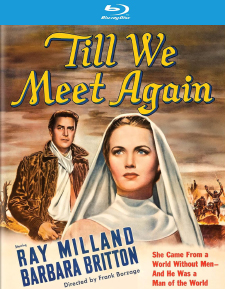
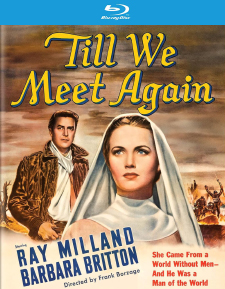
Audio Commentary – Film historian Imogen Sara Smith says that Till We Meet Again is underestimated among director Frank Borzage’s filmography. The neglect might be based on its religious subject matter. Borzage transcends the sentimental, treating the ambiguity of the relationship between Sister Clothilde and the airman. Two people share a soulful bond. This is one of few of Borage’s films dealing with religion. There’s no hint of the cause of Sister Clothilde’s fear of the outside world. The emotional background, not religion, is the focus. The Catholic church had an influence on Hollywood during this period as a proponent of the Production Code. The church’s Legion of Decency was appalled that Till We Meet Again might feature a romance between a nun and a soldier so changes were made in the script to place greater emphasis on John talking about his family. The nun’s feelings are unspoken. The film was made the same year as others with religion as themes, including The Song of Bernadette and Going My Way. Till We Meet Again was marketed suggestively and misleadingly with the tagline, “She came from a world without men and he was a man of the world.” It’s based on an unpublished play by Alfred Maury. The film is tightly constructed. John represents a gentler and kinder brand of masculinity unafraid to be tender, nurturing, and vulnerable. He’s a man of peace—a small-town guy who married his childhood sweetheart. In Three Comrades, director Borzage depicts the rise of Nazism, but in vague terms because of German threats to ban American films. The U.S. government frowned on films that violated America’s neutrality. In The Mortal Storm, Borzage depicted book burning, concentration camps and racial hatred. At the time, it was regarded as powerful and courageous. Till We Meet Again wasn’t a success at the box office because at the time of its release D-Day had already occurred and much of France had been liberated, so the film was “yesterday’s news.” By the late 1940s, Borzage was out of step with the times. He didn’t like psychological and crime stories, which had come into vogue. He felt melodrama was part of life. His films are often referred to as sentimental. A viewer has to suspend reality and cynicism.
Till We Meet Again is intelligently scripted, constantly raising questions about complacency and championing action over retreat. Director Frank Borzage creates suspense not only from the basic plot of an American flyer trying to escape France but also from how the growing relationship between a cloistered nun and a married man will play out. The film indicates that Barbara Britton could have been a bigger star. She handles a tricky role, her Sister Clothilde throwing herself headfirst into a world she’s never known and experiencing life vicariously through a family man. There’s a tentativeness, a nervousness, and a hesitation in the writing. Had the religious aspect been removed, the film wouldn’t have to dance so carefully on every word, every glance, every scene.
- Dennis Seuling