
Third Man, The: 75th Anniversary Collector’s Edition Steelbook (4K UHD Review)
Director
Carol ReedRelease Date(s)
1949 (February 25, 2025)Studio(s)
London Films/Selznick Releasing Corporation (Lionsgate Limited)- Film/Program Grade: A+
- Video Grade: A-
- Audio Grade: A-
- Extras Grade: A-
Review
One of the greatest film noirs ever mounted, Carol Reed’s 1949 classic The Third Man is also one of the more intricate character-based thrillers of its era, with an ever-escalating plot that drives our three leads both closer and apart from each other due to the circumstances they find themselves in at any given moment. Despite the 1940s-era Vienna setting, there’s also something almost out of time about the film, enhanced by the highly-influential cinematography by Robert Krasker, music by Anton Karas, and performances from Joseph Cotten, Alida Valli, and Orson Welles, the latter of whom occupies very little of the film’s screen time.
American author Holly Martins (Cotten) has just arrived in the British Allied-occupied area of Vienna looking for his old friend Harry Lime (Welles), who offered him a job. Upon his arrival, he’s informed that Harry was recently killed in a car accident while crossing the street. At his funeral, he discovers that two men moved Harry’s body away from the street after the accident, with Harry asking them to look after his girlfriend, Anna (Valli). Holly soon pays her a visit, also learning from a bystander that there was actually a third man involved in carrying away Harry’s body. When they meet with him for more information, he’s murdered, and Holly is implicated. Convinced that there was more to Harry’s accident, Holly sets out to find the truth while clearing his name with the local police and shielding Anna from the truth of who Harry really was and what he was doing.
The interesting thing about Orson Welles’ presence in The Third Man is that, for many, it seems like a film that he might have secretly directed. It’s a rumor that has fueled many debates since the film’s release, and though Welles is on record as saying that he contributed to his character’s dialogue, he has also said that “It was Carol’s picture.” One can’t ignore how similar the film is thematically and stylistically to some of Welles’ earlier works, but it’s likely that Carol Reed, like a lot of filmmakers, was informed and influenced by Welles, and Welles actually appearing in the film is a simple case of creative kismet.
Because of this, some of the other aspects of The Third Man can get bogged down or overlooked, most importantly the performance from Alida Valli, who is absolutely terrific a thankless role. Torn between her love for Harry and attempting to hide her identity from the authorities while also wanting to help Holly and trying not to fall in love with him, she makes for a complicated character that does the best she can given the terrible situation she’s been dropped into. She’s put through the ringer emotionally, and it’s a wonder that she survives the film at all. Cotten is fairly straight and stoic with a slight (and very inebriated) edge. He’s very reliable as the leading man caught in a situation that wasn’t of his making, and how he deals with that situation is partly where the heart of the film lies, being less of a hero and more or less Harry’s victim.
The most obvious and intricately discussed aspect of The Third Man is Robert Krasker’s cinematography, which gives the film its entire visual personality, almost re-defining what a film noir should look like. The genre has always been known for its darkened corridors and shadowy figures, but Krasker with input from Carol reed uses just as much light as he does dark to aid in the visual storytelling, not to mention the groundbreaking use of dutch angles. The black-and-white German expressionism-inspired images are absolutely sumptuous, and there’s never a wasted shot. All of it matters, and all of it is a pleasure to behold.
Much ink has been spilled about The Third Man since its 1949 release, having since become known not just as one of the greatest British films ever produced, but one of the greatest films ever made, so there’s little need to delve into that with any greater depth. For film fans, this is essential viewing, whether you’re learning how to make movies or interested in how they’re constructed; but even if your intent is neither of those things, you’ll be rewarded with a high quality dramatic thriller that rivals most if not all of its predecessors and its contemporaries.
Cinematographer Robert Krasker shot The Third Man on 35mm black-and-white film (Eastman Plus-X 1231 and Super-XX 1232) with spherical lenses. The results were finished photochemically and framed theatrically at the aspect ratio of 1.37:1. Lionsgate Limited brings the film to Ultra HD in the US utilizing StudioCanal’s 2015 4K restoration, which was sourced mostly from the original camera negative. It has been graded for High Dynamic Range in HDR10 and Dolby Vision, and encoded to a triple-layered BD-100 disc. The elements used for this restoration were clearly in excellent condition, and after watching the restoration featurette, it should be noted that much digital work was employed by Deluxe to make it look its best. Some very mild density issues are present, which are hardly noticeable, and the restoration reverts to film-based opticals for transitions and titles, which I personally prefer. The images are crisp and grain is often heavy but resolves well enough, with a bitrate sitting in the 80 to 100Mbps range most of the time. The HDR passes soak up all of the finer details in the frame, especially in the darkest areas where contrast is virtually perfect. Blacks are deep and whites are bright without ever bleeding, and grayscaling is excellent, allowing for many shades and tones in the black-and-white images. The image is stable with the only leftover damage being mild speckling and an occasional scratch here and there. It’s a wonderful visual upgrade from the previous DVD and Blu-ray releases.
Audio is included in English 2.0 mono DTS-HD Master Audio with optional subtitles in English SDH and Spanish. It’s a well-balanced split-channel experience with only a mild natural hiss present. It’s otherwise clean with terrific support for dialogue and special effects. The zither-based score by Anton Karas drives the film and comes through perfectly. No multi-channel upgrade was necessary here. The original mono is the finest representation of the film as a whole.
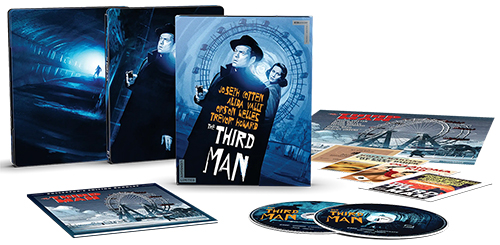
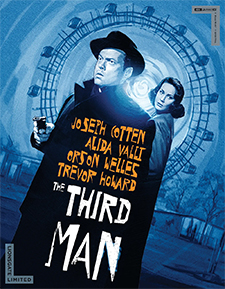
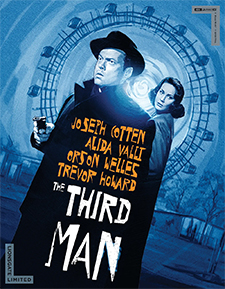
The Lionsgate Limited 2-Disc 4K Ultra HD 75th Anniversary Collector’s Edition Steelbook release of The Third Man also includes a 1080p Blu-ray; a Digital Code on a paper insert; a poster featuring StudioCanal’s artwork for their UHD release; and four art cards featuring two mockups of pulp Western paperback covers written by Holly Martins, Anna Schmidt’s forged passport, and the film’s original poster. Also included is a 60-page Collector’s Edition Booklet featuring cast and crew information; the essays The Third Man 75th Anniversary: Timeless but Topical by Charles Drazin, Looking for The Third Man by John Walsh, The Last Good Woman in Vienna by Anna Bogutskaya, and “I Never Knew the Old Vienna...”: The Third Man and the City by Adam Scovell; museum artifacts, and behind-the-scenes stills. Everything is housed in a Steelbook case with a plastic slipcover, both containing artwork by William Walker. The following extras are included:
- Noreen Ackland on Saving The Third Man (HD – 5:42)
- Audio Commentary with Guy Hamilton, Simon Callow, and Angela Allen
- The Third Man: A Filmmaker’s Influence (HD – 16:48)
- Restoring The Third Man (HD – 19:38)
- Joseph Cotten’s Alternate Opening Voiceover Narration (Upscaled SD – 1:23)
- The Third Man Interactive Tour:
- Mölkerbastei (HD – 3:31)
- Stephansdom (HD – 2:01)
- Hoher Markt (HD – 2:10)
- Maria am Gestade (HD – 4:21)
- Am Hof (HD – 5:09)
- Prater – Riesenrad (The Ferris Wheel) (HD – 3:55)
- Morzinplatz (HD – 3:02)
- Ruprechtskirche (HD – 2:35)
- Josefsplatz (Harry’s Place) (HD – 3:19)
- Sacher Hotel (HD – 5:15)
- Stadtpark – Johann Strauss Monument (HD – 3:08)
- The Third Man Museum (HD – 3:21)
- Karlsplatz (Sewer Entrance) (HD – 3:26)
- Zentralfriedhof (HD – 4:28)
- The Third Man on the Radio (HD – 28:46)
- Interview and Zither Performance by Cornelia Mayer (HD – 4:43)
- Shadowing The Third Man (Upscaled SD – 93:29)
- Behind the Scenes Still Gallery (HD – 31 in all)
- Anniversary Trailer (HD – :39)
Noreen Ackland on Saving The Third Man is an excerpted audio interview from the archive of the British Entertainment History Project with one of the film’s uncredited editors. She talks about when the film was nearly destroyed in a fire and how she subsequently tried to sort it out before its premiere, as well as her memories of Carol Reed’s appreciation of her. Recorded in 2010, the audio commentary features assistant director Guy Hamilton, actor and author Simon Callow, and second unit script supervisor (or “continuity girl”, as she puts it) Angela Allen. It’s an excellent track as Callow questions Hamilton and Allen about their memories of the production, keeping things rolling along with good humor and plenty of information to digest.
The Third Man: A Filmmaker’s Influence speaks to a number of filmmakers about the importance of the film and their appreciation of it, featuring directors Martin Scorsese, Ben Wheatley, John Sayles, Franc Rodham, and screenwriter Hossein Amini. Restoring The Third Man speaks to various members of the Deluxe restoration team about the film’s restoration, including vice president of film & digital services Paul Collard, film specialist Marie Fieldman, head of scanning Paul Doogan, an unnamed female restorationist, restoration supervisor Tom Barrett, digital restoration artist Tom Wiltshire, and senior grader Stephen Bearman.
Joseph Cotten’s Alternate Opening Voiceover Narration is taken from the shorter US version, which was cut down by David O. Selznick and is subsequently no longer in circulation (for good reason). The Third Man Interactive Tour takes us to an interactive map of Vienna. There film historian Dr. Brigitte Timmermann gives us a tour of fourteen current day locations throughout the city that were utilized for the film. The Third Man on the Radio features a 1951 episode of The Lives of Harry Lime, specifically A Ticket to Tangiers, which is written and performed by Orson Welles. Next is an Interview and Zither Performance by Cornelia Mayer, who performs some of the film’s music, discusses the instrument, and how she mastered it.
Shadowing The Third Man is Frederick Baker’s excellent 2004 documentary about the making of film, narrated by John Hurt and featuring interviews with film producer and Alexander Korda’s nephew David Korda, second unit script supervisor Angela Allen, assistant director Guy Hamilton, theatre producer and David O. Selznick’s son Daniel Selznick, film historians Charles Drazin and Dr. Brigitte Timmermann, Shepperton Studios’ Malcom Conway, actor Herbert Halbik, director of the British Council in Vienna Simon Cole, runner for Shepperton Studios Joe Marks, and penicillin expert Professor Karl Hermann Spitzy. Also featured is a selection of archival footage and audio recordings of Orson Welles, author Graham Greene, founder of London Films Sir Alexander Korda, Carol Reed, Robert Krasker, and Anton Karas.
Last is a Behind-the-Scenes Still Gallery containing 31 photos and a 75th Anniversary Trailer.
As the film has been released a number of times on LaserDisc, DVD, Blu-ray, and 4K Ultra HD, there’s quite a bit of bonus material that hasn’t carried over. First of all, StudioCanal’s various 75th Anniversary Edition releases from 2024 in the UK and Europe all contain a pair of Guardian/NFT interviews with Joseph Cotten and Graham Greene. The Criterion Collection’s 1989 LaserDisc re-release contains liner notes by Michael Wilmington, while their 1999 DVD release features a Production History archive containing behind-the-scenes photos and text notes, as well as their own Restoration Demonstration. Their 2008 deluxe DVD and Blu-ray releases contain the bulk of the material not carried over. This includes an audio commentary with filmmakers Steven Soderbergh and Tony Gilroy; another with film scholar Dana Polan; The Third Man Treatment containing an abridged recording of Graham Greene’s treatment, read by actor Richard Clarke which doubles an audio commentary; a 1999 introduction by writer and director Peter Bogdanovich; The Third Man File containing an Insider Information photo gallery with a narrated production history written by Charles Drazin and narrated by actor Robb Webb, both the US and UK openings for the film, Kind to Foreigners which contains scenes from the film with intentionally untranslated German dialogue, the US theatrical trailer, and a UK press book picture gallery; the 2000 featurette Who Was The Third Man?; an hour-long Lux Radio Theatre adaptation; Graham Greene: The Hunted Man, a 1968 episode of BBC Omnibus; two Pathé newsreels: Anton Karas at London’s Empress Club and In the Underworld of Vienna; The Third Man’s Vienna picture gallery; and essays by Lucy Sante, Charles Drazin, and Philip Kerr. StudioCanal’s 2015 Blu-ray also contains a CD soundtrack while Lionsgate’s StudioCanal Collection Blu-ray release from 2010 contains two trailers for the film. Last is the 2006 Region 2 DVD from Arthaus in Germany which contains text biographies for Carol Reed, Orson Welles, Joseph Cotten, Alida Valli, and Paul Hörbiger, as well as the German trailer. And since we’re covering absolutely everything, there’s also a 1992 Japanese LaserDisc release by IVC that contains a Castle Films 1949 News Parade newsreel, an introduction to the film by and an interview with G. William Jones, and the 1949 Famous Studios cartoon short Snow Foolin’.
The Third Man is at or near the top of many film scholars’ lists of the greatest ever, with a plot that constantly unwinds and becomes more engrossing as it goes along. Lionsgate’s and StudioCanal’s 4K upgrade of the film is truly marvelous. It deserves only the most lavish of home video treatment, and it gets it here. If you can still track down this release (it’s out of stock as of this writing), then you own it to yourself to do so. Just make sure to also hold on to those previous releases for all of the missing extras if you have them. Either way, highly recommended.
- Tim Salmons
(You can follow Tim on social media at these links: Twitter, Facebook, BlueSky, and Letterboxd. And be sure to subscribe to his YouTube channel here.)