
Terror Train (4K UHD Review)
Director
Roger SpottiswoodeRelease Date(s)
1980 (May 26, 2026)Studio(s)
Astral Bellevue Pathé/Triple T Productions (Kino Lorber Studio Classics)- Film/Program Grade: B-
- Video Grade: A-
- Audio Grade: B
- Extras Grade: B-

Review
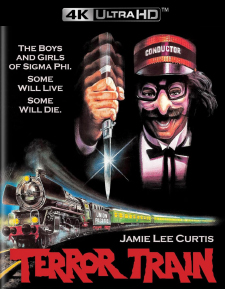
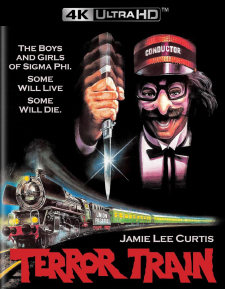
Slasher films of the 1980s tend to range greatly in quality, with most scraping the bottom of the barrel of entertainment value in terms of their budgets and how much effort was put into making them. One of the earliest ones to rise to the surface was 1980’s Terror Train, an American and Canadian co-production that aimed to copy the success of 1978’s Halloween, but placing its cadre of victims on a locomotive. It’s plot is also reminiscent of Prom Night, which was released a few months prior that same year and also featured Jamie Lee Curtis as its lead. Terror Train wasn’t an enormous success upon release despite being released in October, but continues on as a slasher that’s a cut above many of its contemporaries. It’s not a particularly sophisticated horror film, but it offers some unique elements that make it stand out more than most.
During a New Year’s Eve party, a group of medical students play a disturbing prank on the shy and awkward Kenny (Derek MacKinnon), which traumatizes him and puts him in a mental hospital. Three years later, the same group has a graduation party aboard a train, this time dressing up in costumes with a mysterious magician (David Copperfield) hired as the evening’s entertainment. Alana (Jamie Lee Curtis), Mo (Timothy Webber), Doc (Hart Bochner), Mitchy (Sandee Currie), Pet (Joy Boushel), and Jackson (Anthony Sherwood) all soon realize that there’s a killer loose on the train, which the conductor, Carne (Ben Johnson), attempts to keep quiet. Also among the cast are Vanity, Howard Busgang, and Greg Swanson.
Murder on the Orient Express this ain’t, nor does it attempt to be. Terror Train is your basic horror revenge plot that ultimately became the backbone of many slasher films that continue to this day, taking its plot seriously enough with a slight sarcastic edge that makes it mostly effective. It also helps that there’s some chemistry between the characters while the interpersonal relationships and issues therein give the story a more grounded feel. There are no tropes or archetypes because the rule book on slashers hadn’t really been written yet. For instance, Hart Bochner’s Doc is an odious character, and you have to wonder why these people put up with him. He’s constantly causing trouble for his close friend Mo, who at one point he somewhat admits to having a homosexual affection for, which sadly goes absolutely nowhere. The kills themselves aren’t necessarily creative, but the fact that there’s someone aboard the train constantly switching costumes at a costume party and offing the attendees somehow works.
Terror Train did decent business upon release, but it certainly wasn’t the Halloween-type powerhouse that 20th Century Fox was hoping for, even with the presence of Jamie Lee Curtis. The film is certainly dated when it comes to some of the clothes and music, but it’s held together with decent performances, a smooth pace, and terrific cinematography, courtesy of Stanley Kubrick regular John Alcott, the latter of whom was purportedly happy to have a more traditional film experience for a change. Sam Peckinpah editor-turned-director Roger Spottiswoode, for whom Terror Train was his first directing assignment, would go on to make a number of comedies and dramas including Turner & Hooch, And the Band Played On, and the 1997 James Bond entry Tomorrow Never Dies. As for Terror Train, most genre fans contend that it’s an enjoyable if imperfect slasher that tends to get better with age. Conversely, the straight-to-Tubi sequel, Terror Train 2, is more or less forgotten, if it was even on anybody’s radar to begin with.
Cinematographer John Alcott shot Terror Train on 35mm film with Arriflex cameras and spherical lenses. The results were finished photochemically and framed theatrically for the aspect ratio of 1.85:1. Kino Lorber Studio Classics debuts the film on Ultra HD with a new 4K scan of the original camera negative, which has been graded for High Dynamic Range in HDR10 only, and encoded to a triple-layered BD-100 disc. Terror Train, due to its limited light levels and often heavy grain, has always been tricky to transfer to optical disc, never mind the murky VHS presentations. That said, it’s hard to argue that there’s a better looking version of the movie than this one. Enhanced clarity and higher levels of fine detail, even during sections with low light, is evident right away. Opticals, including the opening and closing titles, are sourced from an interpositive; which are a little rougher comparatively, but the rest of the presentation is much more crisp. There’s a very steady bitrate that sits primarily between 90 and 100Mbps with only minor speckling and occasional moments of light instability. Grain isn’t always even, but it resolves well enough and it’s never distracting. Saturation is lovely with more accurate flesh tones and a surprising array of colors, which the HDR passes boost even further, improving the contrast, as well. A more aggressive encode could ameliorate things even further, but this is still a terrific-looking presentation of a film that has rarely looked good on home video.
Audio is included in English 5.1 and 2.0 mono DTS-HD Master Audio with optional subtitles in English SDH. The 5.1 track mainly opens up the score for the rear speakers, but anchors pretty much everything else to front. It also has an odd phasing quality to the sounds of the locomotive, which isn’t present on the mono track. Once you notice it, you can’t unhear it, which makes the mono track all the more attractive since the 5.1 doesn’t offer anything in terms of panning or envelopment. Dialogue is front and center and both tracks are clear, but the original theatrical audio, even in a split-channel container, is still the way to go.
The Kino Lorber Studio Classics 2-Disc 4K Ultra HD release of Terror Train sits in a black Amaray case alongside a 1080p Blu-ray and insert that features artwork from the original Italian theatrical poster (which is also replicated on the slipcover). The following extras are included on each disc:
DISC ONE (UHD)
- Audio Commentary by Paul Corupe and Jason Pichonsky
- Audio Commentary by Alexandra Heller-Nicholas and Josh Nelson
DISC TWO (BD)
- Audio Commentary by Paul Corupe and Jason Pichonsky
- Audio Commentary by Alexandra Heller-Nicholas and Josh Nelson
- Interview with Director Roger Spottiswoode (SD – 16:47)
- Interview with Screenwriter Judith Rascoe (SD – 5:36)
- Murder Music with John Mills-Cockell (HD – 8:11)
- TV Spot (SD – :30)
- Trailers:
- Terror Train (HD – 2:29)
- Death Ship (HD – 1:35)
- Dust Devil (HD – 1:37)
- Mimic (HD – 1:52)
- The Pursuit of D.B. Cooper (HD – 2:55)
The first audio commentary features Paul Corupe of Canuxploitation.com and film historian Jason Pichonsky. It’s almost entirely a background discussion on the project and a recap of the careers of the cast and crew, occasionally offering some discourse on slasher films of the era and the varying qualities of the film at hand. The second commentary with film historians Alexandra Heller-Nicholas and Josh Nelson is very much of the same variety, but with much more forward personalities at the helm. Between the two tracks, a lot of information about the film is covered.
In the 2019 interview with director Roger Spottiswoode, he talks about the genesis of the project, being in awe of cinematographer John Alcott before working with him, the difficulties in working on a functioning train with restrictions, having to finish shooting before Christmas Eve, dealing with the producers, working with Ben Johnson and Jamie Lee Curtis, David Copperfield’s magic in the film, what Derek MacKinnon was like, trying to create the illusion of real deadly weapons, and his feelings on the film now. In the 2019 interview with screenwriter Judith Rascoe, she recalls an incident with Jamie Lee Curtis’ original hairdresser, being able to see the train in person which helped her come up with ideas, seeing the original Halloween, her thoughts on the cast, and fondly remembering having fun shooting in Montreal. In Murder Music, composer John Mills-Cockell talks about getting the job on the film but having never worked in horror before, Rogert Spottiswoode’s input for the score, recording the rock music for the film, working with conductor Lionel Newman, and creating scores for different types of films and plays. Last is a TV spot, the film’s trailer, and trailers for other releases from Kino Lorber.
Some of the bonus materials from previous releases have fallen by the wayside. The 2012 Shout! Factory and 2019 Scorpion Releasing Blu-rays include interviews with producer Don Carmody, writer and executive producer Daniel Grodnik, production designer Glenn Bydwell, and a still gallery. The 2019 Region B Blu-ray from 88 Films in the U.K. includes an audio commentary with The Hysteria Continues (Justin Kerswell, Joseph Henson, Nathan Johnson and Erik Threlfall) and another with journalists Dave Wain and Maty Budrewicz. The 2020 Region Free Blu-ray by Rimini in France includes the French language documentary Portrait of Jamie Lee Curtis. And finally, the 2020 Region B Blu-ray by X-Rated in Germany includes two commentaries: one with film historians Gerd Naumann, Matthias Künnecke and Christian Klaese; and the other with fans Christoph N. Kellerbach and Tom Burgas.
Terror Train’s debut on 4K Ultra HD is mostly a win, though I can envision another company coming along and improving upon it with better encoding and a more substantial collection of bonus materials. Still, if you’re a long-time fan of the film, this is a great release to pick up. Very much recommended.
- Tim Salmons
(You can follow Tim on social media at these links: Twitter, Facebook, BlueSky, and Letterboxd. And be sure to subscribe to his YouTube channel here.)