
Tales of the Wild West: Collection Two (Blu-ray Review)
Director
Henry Hathaway/Tom Gries/Andrew V. McLaglen/Daniel Mann/Kirk DouglasRelease Date(s)
1968/1971/1972/1975 (April 29, 2026)Studio(s)
Paramount Pictures/National General Pictures (Imprint Films/Via Vision Entertainment)- Film/Program Grade: See Below
- Video Grade: See Below
- Audio Grade: See Below
- Extras Grade: B+
- Overall Grade: B+

Review
[Editor’s Note: This is a Region-Free Australian Blu-ray import.]
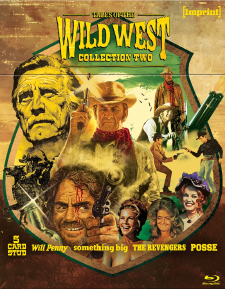
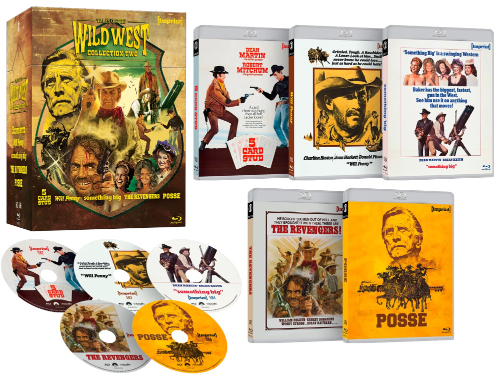
Imprint’s Region-Free Tales of the Wild West: Collection Two is a schizophrenic jumble of great, good, and terrible Westerns spanning the late-1960s through mid-1970s. Like me, you may already have one or more of these on Blu-ray and/or DVD, but it’s a good opportunity to upgrade and, in my case, see one title for the first time. As usual, Imprint has packaged these films in an impressively sturdy box, giving each title its own Blu-ray and case.
The oldest title in this collection is also far and away the best. Will Penny (1968) is one of the finest Westerns of its era, much more like the later television miniseries Lonesome Dove than, say, 5 Card Stud, also in this set and released later that same year. Like Lonesome Dove, Will Penny is more of an engrossing character study coupled with an unusual degree of historical verisimilitude: characters talk, dress, and act like real 19th century cowboys.
Charlton Heston stars as the title character, a cow puncher at the end of trail drive. Decades of experience have made him an excellent cowboy but little else. He’s illiterate, and outside work he’s halting, shy, and awkward, embarrassed by his inexperience at just about everything else.
Following the end of the trail drive, Penny rides with fellow cowhands Blue (Lee Majors, in his first credited film role) and Dutchy (Anthony Zerbe). When early one morning Blue and Dutchy go after an elk for its meat, they encounter a motley family of rawhiders, including patriarch Preacher Quint (Donald Pleasence) and his boys, including Rafe (Bruce Dern) and Rufus (Gene Rutherford). A shootout ensues, with one of Quint’s boys killed, the so-called preacher vowing biblical vengeance, and Dutchy gut-shot.
Looking for help, the three stop at a trail store, where they observe Catherine Allen (Joan Hackett) and her son, Horace (Jon Gries, director Tom Gries’s son), heading west. After finally getting Dutchy to a doctor (William Schallert), Penny moves on, finding work with the foreman (Ben Johnson) of the Flat Iron Ranch, Penny assigned to ride the remote, mountainous upper-range, many miles from anyone. But there he finds Catherine and Horace, staying in the line-rider’s cabin, they having been cheated and abandoned by their guide. Penny is obliged to evict them but the harsh winter is fast-approaching...
Heston was justly proud of his work as Will Penny, often citing it as the favorite of all of his film performances. Up to that point he was, of course, best-known playing larger-than-life historical and biblical characters. Even in the same year’s Planet of the Apes, Heston’s displaced astronaut was awfully swaggering. But Heston loved Gries’s screenplay, and avoids the temptation of letting his intelligence and usual onscreen masculinity peak through. Penny is a man who knows nothing but cow-punching. Embarrassed when he signs for his pay with an illiterate’s “X” mark, he uses his hands to hide what he’s writing so that the other cowboys can’t see it. Though not a virgin—a brief scene shows him with a prostitute—he otherwise has zero experience with male-female relationships. His innate decency is the engine driving him through those uncharted waters with Catherine.
As Catherine, Joan Hackett is as good as Heston is. The filmmakers toyed with casting a more established name actresses, but were wise in choosing her. Deglamorized without anachronistic make-up, Hackett is completely believable as a 19th century pioneer woman, put into an impossibly vulnerable position when abandoned, but ready to do whatever it takes to protect her son and herself. The film has similarities to Shane (especially the ending), and Hackett has many of the same qualities as that film’s Jean Arthur. Even her voice is somewhat similar to Arthur’s unique one, though in Will Penny Hackett has a more fleshed-out character to play, which Hackett plays with enormous subtlety. Jon Gries is surprisingly good as the boy.
Many who love Will Penny acknowledge its only weakness: Donald Pleasence and his brood. They’re conventional, even clichéd heavies. Grubby, violent and even sadistic families wandering the West had become overly familiar in Westerns, even on television. (During the mid-1960s, it seemed about every third episode of Gunsmoke featured one.) Pleasence’s wild-eyed character is particularly outrageous, and the actor plays him as written, but those characters could have been omitted from the story entirely. Whenever they’re around, Will Penny loses its unique qualities.
Imprint’s Blu-ray of Will Penny utilizes the same superb video transfer as Kino Lorber’s 2023 release. Presented in 1.85:1 widescreen, the image is exceptionally sharp with superb color, critical as Lucien Ballard’s cinematography matches the screenplay’s aims. It doesn’t resemble Ballard’s other Westerns, with their high-key, studio-style lighting. Ballard was robbed; his stunning work wasn’t even nominated for an Academy Award, nor was anyone else connected to Will Penny, a real shame. The LPCM 2.0 mono is likewise way above average, and as with all the titles here, optional English subtitles are provided on this Region-Free disc.
Extras consist of a new audio commentary by Daniel Kremer; a trailer and two archival featurettes from Paramount’s original DVD release: Remembering Will Penny and The Cowboys of Will Penny both worth revisiting.
WILL PENNY (FILM/VIDEO/AUDIO/EXTRAS): A-/A/A/B+
Director Henry Hathaway’s 5 Card Stud (1968) is mostly dreadful, despite its unusual premise. A drifter is caught cheating at a light-night, five-card stud poker game, but rather than simply run him out of town, Nick Evers (Roddy McDowall) and the other players decide to lynch him. Another player, Van Morgan (Dean Martin), who briefly stepped away from the game (to pee?) belatedly tries to stop the lynching, along with black bartender Little George (Yaphet Kotto), but Van is knocked unconscious.
Later, the players involved in the lynching begin turning up dead, brutally murdered by some form of asphyxiation. Van begins hanging around Lily Langford’s (Inger Stevens) barbershop, primarily a brothel, and Colt .45-toting preacher Reverend Rudd (Robert Mitchum) moves into the local, unused church, Mitchum doing a variation of his Night of the Hunter (1955) character. Any guesses who might be responsible?
Mitchum is always interesting to watch even in the worst movies, and he’s about the only reason to watch 5 Card Stud. He briefly retired from acting soon after this (and was, he claimed, considering suicide as well) before being persuaded back for David Lean’s Ryan’s Daughter (1970). His Reverend Rudd isn’t as flamboyant as his serial killer in Night of the Hunter, but whenever Mitchum’s onscreen, at least you won’t be tempted to look at your cellphone.
After his break with Jerry Lewis, initially Dean Martin worked hard to establish himself as a solo actor, doing excellent work in films like Some Came Running (1958) Rio Bravo (1959), and Kiss Me, Stupid (1964). But after that Martin was mostly on autopilot, in lame Rat Pack and Matt Helm vehicles, though he was surprisingly effective in a few scattered movies, notably Bandolero! (also 1968) and Airport (1970). In 5 Card Stud he waltzes through the part with obvious ambivalence. He carries little in the way of screen presence, and shows no effort to mold Van into anything more than cardboard. (Amusingly, for 5 Card Stud, the movie teams Martin, who played a drunk lawman in Howard Hawks’ classic Rio Bravo, with Mitchum, who essentially played the same character in Hawks’ semi-remake, El Dorado.)
But far worse than Dean is the terrible screenplay by Marguerite Roberts. It’s a riot of narrative contradictions and nonsensicalness. (Major spoilers) How does Rudd know the identities of those at the card game? The movie claims her learned them from McDowall’s character, but the scene where does that happens near the end of the film, not the beginning. How did he slip into town and kill several of the card players unseen, before his arrival into town? Why does Dean’s Van assume he’ll be targeted by the killer, considering he was taking a pee (or whatever) when the cheat was caught, plus he tried to stop the lynching? Those involved in the lynching aren’t exactly discreet about discussing their actions, yet the town apparently believes the killings are random, prompting an inexplicable shootout by gold miners fearing their lives are in danger. A big fuss is made over the fact that the men are being murdered by some form of asphyxiation, thus symbolically tying them to the hanging, but all the subsequent victims are shot. And on and on.
But even if 5 Card Stud’s script had been better, the movie is further thwarted in other ways. Hathaway’s direction is lazy and disinterested. Inger Stevens’s character is anachronistically modern, with her hairspray coif, makeup, and wardrobe. The musical score by Maurice Jarre is absurdly inapt—Doctor Zhivago on the Range, at times even overwhelming ordinary conversation scenes. And his title song, sung by Dean, is unbelievably bad.
The upside is that at least Imprint’s Blu-ray of 5 Card Stud looks great. It doesn’t say so on the packaging, but it looks like a 4K remastering from the original camera negative. The image is impressively sharp and the colors accurate, though I was constantly adjusting the volume of the LPCM 2.0 mono because the music/effects track was mixed too high relative to the dialogue track. Optional English subtitles are provided and the disc, like everything in this set, is Region-Free.
Supplements include a new audio commentary by Lee Pfeiffer, Tony Latino, and Paul Scrabo; Disguised as Purity, a new video essay by Eloise Ross; a radio spot and a pressbook image gallery.
5 CARD STUD (FILM/VIDEO/AUDIO/EXTRAS): D/A/A-/A-
The development phase of Something Big (1971) was likely more interesting than the movie that resulted. Though I wasn’t able to find any conclusive evidence, it sure plays like it was written for bigger stars than the two this Western comedy ended up with: Dean Martin (again) and Brian Keith. Indeed, much about the picture suggests it was conceived with John Wayne in Keith’s part, and maybe a bigger caliber star like Robert Mitchum in Martin’s.
Producers James Lee Barrett (who also wrote the script) and Andrew V. McLaglen (who also directed) each had worked with Wayne: Barrett wrote The Green Berets (1968) and The Undefeated (1969), while McLaglen, the son of actor Victor, had known Wayne since childhood and directed him in four features including Hellfighters (1968) and The Undefeated.
Brian Keith, then 49, plays a retiring U.S. Cavalry colonel about 65, roughly Wayne’s real age at the time, in scenes that gently (and sometimes inelegantly) but directly spoof one of Wayne’s most famous roles, in John Ford’s She Wore a Yellow Ribbon (1949). Nearly the entirety of the John Ford and/or John Wayne stock company is present: Ben Johnson, Harry Carey, Jr., Paul Fix, Edward Faulkner, Bob Steele, plus a few others that had recently worked with Wayne, such as Merlin Olsen.
But none of this really matters as the picture is a nearly stillborn effort. The tone is wildly inconsistent, with fitful slapstick jumbled indiscriminately with moments of syrupy sentiment and tame genre parody. Likewise, the Burt Bacharach-Hal David title song (performed by Mark Lindsay), reflecting the obvious influence of Butch Cassidy and the Sundance Kid (1971), seems out of place.
On the eve of his retirement, U.S. Cavalry Col. Morgan (Brian Keith) learns that wily bandit Joe Baker (Dean Martin) is up to “something big” (a term repeatedly and greatly overused in the dialogue), one last big score before the easygoing thief likewise retires. Baker, planning to rob a veritable fortress held by well-armed Mexican banditos just across the border, strikes a bargain with two-bit thief Johnny Cobb (Albert Salmi), who’ll exchange a Gatling gun for something unusual: a cultured woman. After a series of stagecoach hold-ups, Baker finally kidnaps Mary Ann (Goldfinger’s Honor Blackman), unaware that she’s the colonel’s long-separated wife, come to collect him in his retirement. Meanwhile, Baker’s own fiancée, fiery Scotswoman, Dover (Carol White), has also gone west to collect him.
Neither Dean Martin nor Brian Keith was exactly a box-office powerhouse at the time. Martin’s 1965-74 variety show was popular, but his starring films had steadily declined, Gruff Brian Keith, a household name owing to the sentimental sitcom Family Affair (1966-71), was a difficult actor to cast, and tended to over- or underplay his movie roles, though occasionally could be excellent. Oddly, he gave one of his best performances in what was probably his worst movie, as a quietly amused Russian-speaking scientist in the disaster film Meteor (1979).
Of more interest to Western genre fans are the substantial supporting parts given to Ben Johnson (as a Cavalry-hired tracker), Harry Carey, Jr. (as a one-legged pal of Martin’s), and B-Western great Bob Steele as a stagecoach driver. The movie isn’t very good but they’re all fun to watch.
About the only thing memorable about Something Big are Joyce Van Patten and Judi Meredith as sex-starved sisters, widowed some years before by their miner husbands. Their determination to bed down with any man lucky or unlucky enough to cross their path is rather refreshing and original for a Western comedy. The film should have offered more scenes like this. Not terrible and nearly likeable at times, Something Big itself sure seemed to have had bigger ambitions at one point, but then all but gave up.
Presented in 1.78:1 widescreen, approximating its original 1.85:1 widescreen Something Big, licensed from CBS (inheritors of the National General library) looks fine, with a reasonably sharp image, decent color, etc. The LPCM 2.0 mono is adequate and supported by optional English subtitles. Like the other discs, it’s Region-Free.
Extras consist of a trailer, a Trailers from Hell segment hosted by Larry Karaszewski, and The Films of Andy McLaglen, a video essay by C. Courtney Joyner.
SOMETHING BIG (FILM/VIDEO/AUDIO/EXTRAS): D+/A/A-/A-
I steered clear of The Revengers (1972) for years, based on terrible reviews and advertising suggesting an artless, more violent rehash of The Wild Bunch. To my surprise I found it much better than I anticipated. It’s as if writers Wendell Mayes and Steven W. Carabatsos took a look at a dozen or so great and near-great movies—everything from The Wild Bunch, The Searchers, and The Magnificent Seven films, but also The Dirty Dozen and even Zulu—to create this pastiche. But, admittedly, if you’re going to steal, steal from the best, and the result is more entertaining than it ought to be. Moreover, director Daniel Mann and his cast, particularly Ernest Borgnine and, most unexpectedly, Susan Hayward in her final film role, somehow manage to create vivid, colorful characters.
On an idyllic Colorado horse ranch, John Benedict (Holden) is out hunting a mountain lion when Comancheros, led by white man Tarp (Warren Vanders), steal his horses while butchering Benedict’s wife, children, and farmhand (Arthur Hunnicutt). Vowing revenge, Benedict heads to a Mexican prison camp, supposedly to hire laborers for a mine, but actually desiring the toughest, most-hardened prisoners to help him locate Tarp. Ultimately, he recruits scalawag ex-Comanchero Hoop (Borgnine), former slave Job (Woody Strode), gunslinger Chamaco (Jorge Luke), intelligent bandit Cholo (Jorge Martinez de Hoyos), French womanizer Quiberon (Roger Hanin), and hulking German Zweig (René Koldehoff). Once outside the prison he buys them new clothes, promising a reward after the job is done.
What follows is, at times, unexpectedly clever, funny, and even tender. One obvious problem with this premise is that nothing is stopping this gang of mostly cutthroat bandits from killing Benedict, robbing him of his money, and riding off, but the manner in which Benedict manages this unruly mob is almost ingenious. It’s not believable in any real-world sense, but within the confines of a movie Western is both smart and acceptable.
Unlike the Magnificent Seven sequels, in which the lesser four or five of the seven were generally boring stock characters, in The Revengers there’s an obvious attempt to make each man colorful and distinctive. Jorge Martinez de Hoyos’s Cholo, for instance, has a funny scene acting as an interpreter between Benedict and the corrupt prison warden, who doesn’t speak any English, allowing Cholo to warn Benedict that the warden is trying to cheat him, lacing the conversation with outrageous insults directed at his keeper.
Unsurprisingly, standing out most is Ernest Borgnine’s Hoop, unscrupulous, cowardly, garrulous, Hoop unhesitatingly robs dead men of their belongings, feigns friendship and loyalty toward Benedict while plotting against him, even as the others are inexorably drawn to this determined rancher. Borgnine is a wonder: during this period the actor created distinctive characters in both good and bad films (Willard, also for Daniel Mann, The Poseidon Adventure, Emperor of the North); Hoop is another captivating original.
With his considerable screen presence, Holden is expectedly compelling, but the real surprise is Susan Hayward, an actress I never cared for much—I can always see the acting. Undoubtedly pulled out of retirement by director Mann, who directed Hayward in I’ll Cry Tomorrow, she and Holden appear in an extended vignette lasting about 15 minutes, she playing an Irish nurse tending to Benedict for several weeks after he’s been shot. Hayward not only pulls off a reasonably convincing Irish brogue, the artifice of her past work is gone and she’s entirely naturalistic and believable, her nurse and Holden’s embittered rancher drawn to one another. There’s a marvelous scene of her and Benedict digging potatoes out of the ground from her modest garden that’s so marvelously understated, so sensitively directed, it’s worth seeing The Revengers just for this sequence.
Imprint’s Blu-ray of The Revengers sources an outstanding video transfer of the film, shot in 2.35:1 Panavision. The image is impressively sharp revealing much detail, especially in the actors faces in close-up, and the colors are bright and rich. The LPCM 2.0 mono is very good for what it is, supported by optional English subtitles on this Region-Free disc.
Extras consist of an image gallery, trailer, and a new video essay by film historian C. Courtney Joyner, William Holden and the West.
THE REVENGERS (FILM/VIDEO/AUDIO/EXTRAS): A-/A/A/B
I reviewed Posse (1975), directed by and starring Kirk Douglas, when it was first released to DVD in 2004. I kind of liked it then, but seeing it again more than 20 years later, projected in high-def on a big screen, my appreciation of this virtually one-of-a-kind Western grew appreciably.
Douglas stars as lawman and aspiring—and very savvy—politician Howard Nightingale. With the help of his deputies, Nightingale is on the trail of bank robber Jack Strawhorn (Bruce Dern). Strawhorn is soon captured, and as he plots his escape from the hangman’s noose, Nightingale uses the arrest to ensure his election to the United States Senate.
With the Western dying a slow death in the ’70s, Kirk Douglas made several that were nothing if not unique. He starred in the now-obscure The Villain (1979), a broad comedy that emulated the style of Warner Bros. cartoons (especially those featuring the Road Runner and Wile E. Coyote). For Scalawag (1973), Douglas’s only other directing credit, Stevenson’s Treasure Island was adapted to the Old West (though the movie was filmed in Yugoslavia) and turned into a musical!
Though not nearly as bizarre, Posse definitely has an odd feel to it. There are several standard action set pieces, including a very well-crafted sequence involving a train Strawhorn has commandeered. In addition, the scenes where Nightingale and Strawhorn try to outwit one another are entertaining and clever. Mostly though, Posse is about flip-flopping the expectations of moviegoers by making Dern, who had played countless Western movie psycho-killers (in Will Penny, to name one) into a sympathetic character (though he still kills in self-defense), and Douglas into a charming but ruthless S.O.B.
Though somewhat overdone at times, for the most part this works. In one sense, the movie answers Butch and Sundance’s oft-quoted line, “Who are those guys?” Nightingale and his deputies are, at least according to Christopher Knopf and William Roberts’s script, superb trackers and gunmen, yet ultimately as reprehensible or worse than the outlaws they’re pursuing. In some ways, the film recalls Peckinpah’s The Wild Bunch and Robert Ryan’s posse of lowlifes.
Douglas and Dern are both very good throughout, subtly playing their roles with a cool intelligence, the kind of performances where without any dialogue you can read what’s going on inside their heads, though their actions are often unpredictable. Douglas particularly captures the essence of a calculating, manipulative politician.
Nightingale’s politically savvy lawman uses Strawhorn’s capture to its fullest advantage, misleadingly playing him up as something along the lines of a terrorist, and the town eats it up. After Nightingale’s deputies wonder what will become of them after their boss is elected to congress, he slickly appeases (most of) them with a speech full of nostalgia but played with a disturbing glossy insincerity. Douglas must have known his share of disingenuous politicians and slippery Hollywood types.
Strawhorn’s motives aren’t as believable; he’s too noble in attempting to expose Nightingale to the townsfolk when he should be trying to save his own neck. But Dern’s understated performance makes the character work. Actor James Stacey, who had lost his left arm and leg in a motorcycle accident a year before this was made, has an interesting role as Hellman, a local newspaperman who questions Nightingale’s willingness to have his campaign bankrolled by the railroaders. Whose interests, Hellman asks, is he ultimately prioritizing? Eventually, as Nightingale’s political ambitions begin to fall like a house of cards the film’s message, already a little overcooked, sledgehammers its message home. When I first saw the film, I was disappointed with the ending; this time I found it much more satisfying.
Back in 2004, I also found the movie visually bland, but on a big screen in high-def I could better appreciate the 2.35:1 Panavision cinematography by Fred J. Koenekamp, which is much more imaginative than I had remembered. Imprint’s 1080p video transfer is excellent, with superb detail and excellent color, perhaps derived from a recent 2K or 4K scan. The LPCM 2.0 mono is fine; curiously, the DVD offered a 5.1 surround mix that’s not included here. Optional English subtitles are offered on this Region-Free-disc.
Where the DVD had no extras, Imprint’s Blu-ray includes a battered trailer and a new visual essay by Daniel Kremer, A Tinkling Twang: The Western Soundscapes of Maurice Jarre. Unlike Jarre’s terrible score for 5 Card Stud, his music here more aptly fits this unusual film.
One suspects Posse didn’t do much at the box office. The kind of audience that might have enjoyed the film just didn’t go to see Westerns, while the genre’s regular audience had pretty much dried up. Posse is a small-scale success, original and interesting.
POSSE (FILM/VIDEO/AUDIO/EXTRAS): A-/A/A-/B
So while it’s three-out-of-five movie-wise, overall this is an excellent package touting excellent-to-superb video transfers throughout, plus lots of new extras. Highly Recommended.
- Stuart Galbraith IV