
Stavisky... (Blu-ray Review)
Director
Alain ResnaisRelease Date(s)
1974 (July 21, 2026)Studio(s)
Cérito Films/Les Films Airane/CCFC (Indicator/Powerhouse Films)- Film/Program Grade: A-
- Video Grade: A
- Audio Grade: A
- Extras Grade: A

Review
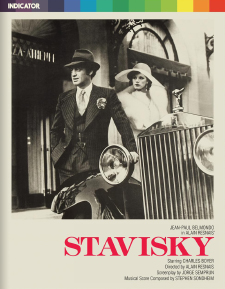
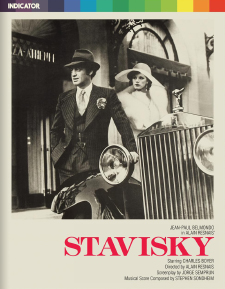
A French biographical drama directed by Alain Resnais and starring Jean-Paul Belmondo, Stavisky... (1974) covers the final months in the life of Serge Alexandre Stavisky (1886-1934), a con artist turned high-powered French impresario and financier whose embezzling, eventually collapsing like a house of cards, nearly brought down the French government and weakened France internally in the critical lead-up to the Second World War.
Those unfamiliar with this period of French history may find Stavisky... confusing at times, with its references to historical figures and events; Stavisky himself used myriad aliases, different characters calling him by different names in the film. And though the screenplay by Jorge Semprún is generally linear, it incorporates both flashbacks and flash-forwards. But it’s a handsome production boasting fine acting and even a musical score by, of all people, Stephen Sondheim.
Most of the film covers a short period from roughly November 1933 to January 1934, when Stavisky (Belmondo), a Russian Jew born in what today is Ukraine, now uses the name Serge Alexandre because it sounds more aristocratically French. Agreeably presenting himself as a financial consultant and theatrical producer, he wheels and deals junk, sometimes forged international bonds while laundering stolen jewelry to keep up appearances as a man with an almost unlimited bankroll: tipping generously, gambling heavily, buying expensive gifts for his wife, Arlette (Anny Duperey), and openly paying off police inspectors, bribing newspapers and government officials. In one intriguing scene, he argues to a confederate concerned about his voluminous spending that it’s all toward a greater investment that attracts France’s elite class and the politically powerful. And, on this point, he’s not wrong.
His closest associates include lawyer Albert Borelli (François Périer), Doctor Mézy (Michael Lonsdale), Alexandre’s physician, and personal friend (and heavy investor) Baron Jean Raoul (Charles Boyer, in his penultimate film and last French one), a right-wing aristocrat fascinated by Stavisky even after he realizes he being squeezed dry. Seemingly disconnected at first, the script juxtaposes the arrival of Trotsky in France, the famous communist seeking political asylum, the parallel stories connected by a German-Jewish refugee actress who first encounters Alexandre at an audition for his latest theatrical production, who later goes to work for Trotsky as a translator.
Like Bernie Madoff and his $65 billion Ponzi scheme, those impacted by Stavisky’s extraordinary con game were primarily the rich and powerful. In Stavisky..., Resnais is primarily interested less about how its title character charms his way to the top than how his closest associates, no matter how much he drains them of their riches, no matter the degree in which he lies and deceives them, somehow still admire him, a stark contrast to the Madoff’s marks. This is exemplified by Stavisky’s relationship with the Baron, who seems to feel sorrier for Alexandre than bitter about his own financial losses and greatly diminished social standing. Boyer’s performance is really wonderful, so honestly admiring, so saddened at his friend’s inevitable downfall.
Further, Resnais is intrigued by the notion of Stavisky as a man with veritable multiple personalities, a man who reinvented himself from an inveterate low-level Russian-Jewish con artist into a non-Jewish French wheeler-dealer accepted by a largely anti-Semite French society, who no longer wants any part of his former identity and reluctant to surrender the current one (and its accompanying financial empire) and start over. The Trotsky part of the story implies that the French government and king-makers happily enabled a crook like Stavisky for years while suppressing the anti-fascism activities of Trotsky, another Russian-Jew, awarded political asylum... so long as he stayed out of French politics.
Resnais’s first feature in six years, Stavisky... is a lavish production, awash in period detail, with a fine cast led by Belmondo, whose screen persona as a charming rogue obviously suited this character. Yet, as good as almost everything is, the picture tends to leave the viewer wanting more insight into its characters; it hits all the salient points but never is entirely satisfying with any of them. No doubt French viewers more familiar with this point in history will catch observations missed by this viewer, but so much of it is inferred, implicit when a bit more clarification and depth might have made it even more intriguing and rewarding. It’s one of those films that, on one hand, made me grateful I could pause the film to look up certain events and historical figures, but which also left me frustrated that I felt such mid-movie research was necessary in the first place.
Sporting a 4K restoration of the original camera negative, Powerhouse Films’ Blu-ray of Stavisky..., released in both the U.S. and U.K. (reviewed here as a Region “B” disc), looks great, the 1.66:1 image impressively sharp with excellent color and contrast. Also fine is the original mono, here LPCM 1.0, with good English subtitles.
Good supplements abound. They begins with Pour le cinema, a set report from 1974 running 16 minutes, featuring interviews with the primary cast and crew during production; another Cinéma set report, this running 5 minutes, featuring interviews with actors Belmondo, Boyer, Duperey, and Périer; a location report from the French news program JT Aquitaine, with more behind-the-scenes footage, also five minutes in length; a 3-minute interview with Duperey, out of costume; five minutes-worth of Cannes Film Festival coverage of the premiere; archival audio-only interviews with Resnais and Sondheim, 86 and 104 minutes, respectively, which play over the film like an audio commentary track; a trailer, image galleries, and a dialogue spotting list.
Alas, The Digital Bits was sent only a check disc that did not include the reportedly 36-page booklet accompanying this release, which itself is limited to 4,000 copies for the UK and U.S.
Rather like the French television series French Police 1900 (and its follow-ups), Stavisky... had me scrambling through books and on the Internet intrigued by the historical figures and political history dramatized yet largely unknown to me. While not entirely satisfying, Resnais’s film is mostly engrossing, and inviting the kind of post-screening reflections that last for several days afterwards. Recommended.
- Stuart Galbraith IV