
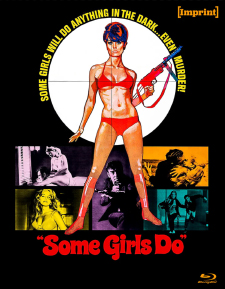
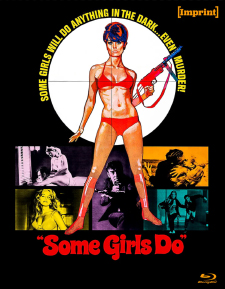
Some Girls Do (Blu-ray Review)
Director
Ralph ThomasRelease Date(s)
1969 (March 25, 2026)Studio(s)
The Rank Organisation/Ashdown Film Productions (Imprint Films/Via Vision Entertainment)- Film/Program Grade: D
- Video Grade: A-
- Audio Grade: A-
- Extras Grade: A

Review
[Editor’s Note: This is a Region-Free Australian Blu-ray import.]
The spy craze spawned by the huge success of the James Bond movies peaked during 1966/67. In every part of the world, 007 imitators proliferated—in France, Germany, Italy, Japan, Hong Kong—but precious few were any good. The handful of admirable children of Bond, James Bond, deliberately deviated from that series’ style and attitudes, movies like The Spy Who Came in from the Cold, from John le Carré’s novel, and the three Harry Palmer films with Michael Caine. But mostly the imitators copied only the superficial components—the glamorous women, the gadgets, the exotic locales—without really studying or even remotely comprehending what made those early 007 movies with Sean Connery so memorable. Even the more expensive imitators like Fox’s Derek Flint films with James Coburn and Columbia’s Matt Helm pictures with Dean Martin hadn’t an ever-lovin’ clue as to what made Bond tick.
Some Girls Do (1969) is a late-to-the-game British entry, so broadly comic at times that it almost (but not quite) qualifies as a spoof. It’s the second of two films that attempted to resurrect and update H. Cyril McNeile’s 1920s and ’30s adventurer Bulldog Drummond to the 007 age. Neither it nor its predecessor, Deadlier Than the Male (1967), bear any resemblance to the novels or, for that matter, the nearly two dozen Bulldog Drummond movies that came before it; those were mostly murder mysteries with adventure film components, such as the 1930s Paramount film series starring John Howard.
Deadlier Than the Male and Some Girls Do unambitiously reimagine Drummond as a generic James Bond-like suave, jet-set hero, though he seems to work freelance more in the manner of Roger Moore’s The Saint, at its peak of popularity when the first movie was made.
In Some Girls Do, Drummond’s arch-nemesis, the blandly-named Carl Petersen (James Villiers; Nigel Green played him in the first movie), is using beautiful female cyborgs to assassinate men developing the SST1, the world’s first supersonic airliner. The Air Ministry calls on Drummond (Richard Johnson) to investigate.
Very little of note happens. Indeed, there’s barely enough story to fill a 30-minute episode of Get Smart! More female robots kill more scientists in colorful ways. Like Deadlier Than the Male, two apparently flesh-and-blood real women, Helga Hagen (Daliah Lavi) and Pandora (Beba Lončar), assisting Petersen, vaguely supervise various acts of sabotage. Drummond teams of with a flighty American blonde, Flicky (Sydne Rome), and eventually closes in on Petersen’s fortress-like lair in North Africa.
What’s most disappointing about Some Girls Do is the way it squanders star Richard Johnson’s talents and the way it introduces a number of good ideas done better in later Bond films. Johnson (1927-2015) was director Terence Young’s first choice to play James Bond in Dr. No (1962), the first 007 movie, but reportedly Johnson was then under contract to MGM and unable to accept the role. (it was about this time he starred in The Haunting, his best-remembered film.) His Bond surely would have been a lot different from Connery, but in many respects, Johnson would have been ideal. The two Bulldog Drummond movies hint slightly at what might have been, though the films are so poor one has to squint more than a little to see those qualities. He certainly had the acting chops, as arguably the best interpreter of Shakespeare of his generation yet, conversely, after Some Girls Do, Johnson starred in some of the junkiest, mindboggliest movies ever made, such as Island of the Fishmen.
The film works around a few inventively conceived set pieces, but these are executed so poorly they have no impact. Drummond in Some Girls Do is introduced riding an early towable kite-hang glider, four years before Roger Moore used one in Live and Let Die. In another scene, after Drummond ejects from a glider only to find the ripcord of his parachute cut, so he has to try to open his chute manually while freefalling, conceptually similar to the opening of Moonraker ten years later. In Some Girls Do, these potentially exciting set pieces are thwarted by terrible special effects (the model work is appallingly amateurish), bad process shots, poor stunt doubling, clumsy editing, etc. One of the first assassinations, inspired by Goldfinger, almost works: mid-flight, an airline stewardess, actually a cyborg, opens an emergency door and her target is sucked out of the plane. Done entirely on-set with imaginative staging, this is the only successful bit in the entire film.
Worse, director Ralph Thomas directs the film in the most perfunctory, style-free way imaginable. Visually, Some Girls Do is stylistically closer to Dr. Goldfoot and the Girl Bombs than it is to Thunderball. He later admitted to doing the two films for the money, while actor Johnson called this one “frightful.” One can hardly disagree. Even the many beautiful women featured in the film—including Virginia North, Yutte Stensgaard, Joanna Lumley (in her film debut), Shakira Baksh (later Mrs. Michael Caine)—aren’t used well. I was surprised looking at the still photographer’s work of the women, included as an extra feature. In these stills the women are beautiful and glamourous but are so unimaginatively lit, photographed, and costumed in the movie they end up being less than window dressing.
As the primary villain, James Villiers ranks as one of the blandest ’60s spy movie villains ever. Typecast as pompous, arrogant Eton-educated upper-class types, he carries very little weight. Robert Morley’s “guest star” appearance as “Miss Mary,” an effeminate spy who as a front operates a cooking school, is embarrassing. Morley once said, “If you want me to do a film it’s £500,000. But if you want me to read the script first it’s £750,000.” Some Girls Do would seem to exemplify this contempt.
In 1.66:1 widescreen, Australia’s Imprint label has released a good encoding of the film on a Region-Free disc. The image is not outstanding, but reasonably sharp with decent color, probably the same master used for Network’s 2020 Blu-ray (a 2K remastering from an interpositive), which was Region “B” locked (and which I haven’t seen). The LPCM 2.0 mono is impressively strong, and optional English subtitles are provided.
For such a poor movie, extra features abound, most brand-new. There are two new audio commentary tracks, one with film historians Kim Newman and Barry Forshaw, the other with film historian Steve Mitchell. Also included are four featurettes: Film Historian Matthew Sweet on Some Girls Do, Film Historian Lee Pfeiffer on Actor Richard Johnson: The Man Who Almost Played Bond, Film Historian Paul Scrabo on the History of Spy Spoofs, and Film Historian Tony Latino on the Spy Craze of the 1960s. That’s a lot of film historians.
Also included, from the older Network release, are artists tests, an image gallery, behind-the-scenes stills, and portraits, all very interesting, and a trailer.
Dire as Some Girls Do is, it and Deadlier Than the Male genre fans should (and will want to) see them once, but they sure don’t have the perpetual watchability of even the worst James Bond movies.
- Stuart Galbraith IV