
Desperate Living (4K UHD Review)
Director
John WatersRelease Date(s)
1977 (June 23, 2026)Studio(s)
Dreamland/Charm City Productions/New Line Cinema (The Criterion Collection – Spine #1316)- Film/Program Grade: B
- Video Grade: A-
- Audio Grade: A-
- Extras Grade: A-

Review
Pinning down why the early films of John Waters have been so inspirational to generations of writers, filmmakers, and many other people in the arts, especially those from queer communities, isn’t a simple task. His original “Trash Trilogy,” as he calls it, was so over-the-top and offensive for even him that he decided to switch gears and try other things. From Pink Flamingos to Female Trouble to Desperate Living, there seemed to be a need to top himself in terms of how simultaneously outrageous and disgusting his work could be, while also throwing in ideas about sociopolitical issues. Desperate Living is perhaps the most obvious example of this, examining class structure and gay relationships, acting as a sort of lesbian fairy tale, but with an angrier approach than his previous work. There are reasons for this, but at the end of the day, Desperate Living is still a shocking and transgressive piece of work that could only come from John Waters.
In a wealthy Baltimore suburb, former mental patient and highly unstable housewife Peggy Gravel (Mink Stole) and her maid Grizelda Brown (Jean Hill) attack and kill her husband Bosley (George Stover). They then flee the community together, heading for the shantytown of Mortville outside the city, a place where anyone trying to get away from their past crimes can escape to. It’s also a fascist community ruled by the tyrannical Queen Carlotta (Edith Massey), who’s having troubles with her wayward daughter Princess Coo-Coo (Mary Vivian Pearce). Meanwhile, Peggy and Grizelda shack up with Mole (Susan Lowe) and Muffy (Liz Renay), lesbian outcasts who dream of getting out of Mortville and having a better life, but the arrival of the irrational Peggy mixed with Princess Coo-Coo’s rejection of her mother’s orders could be disastrous for them all. Also among the cast are Turkey Joe, Cookie Mueller, George Figgs, and Paul Swift.
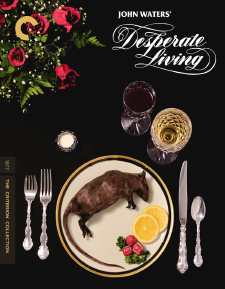
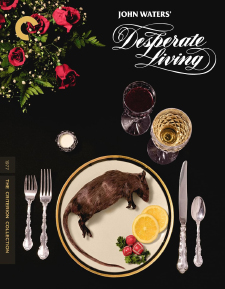
Desperate Living and its “trash” counterparts have always existed as a part of the shock cinema milieu, and while there’s plenty to be shocked by in John Waters’ previous films, Desperate Living doubles down on them entirely. From the opening credit sequence in which a real rat was cooked and served on a plate, to a dead dog being run over in the road, to Mole getting a sex change and subsequently cutting her new penis off and throwing it away for a dog to find, I would be willing to bet that even the most jaded John Waters fan would agree that Desperate Living is probably his most nauseating and stomach-churning effort. Part of that comes down to tone. Waters admits that he wasn’t in a very good place at the time the movie was made, and since he didn’t have his usual leading cast at his disposal, specifically Divine and David Lochary (the former of whom was doing a play at the time and the latter was heavily into drugs, sadly overdosing and dying a couple of months after the film’s release), he seemed to be in dark state of mind, and the film’s story and its tone do reflect that.
On the other hand, there’s still the traditional Dreamlander “let’s put on a show” mentality about Desperate Living. Shot on location in Hampstead, Maryland, the decrepit and treacherous Mortville (which was the film’s original title) is a sort of nexus of bad taste, the downtrodden, and the truly repulsive. There’s also a wonderful story about the have-nots rising up against their masters, or in this case master, and taking it over, but in hilariously extraordinary fashion. However, there’s a door left open at the end of the film if you’ve been paying attention and it may just be that this celebratory group of people may not get to fully enjoy their freedom for long.
This film was also the launching pad for the next phase of John Waters’ career, sticking with absurdism in Polyester before jumping into more “mainstream” fare like Hairspray and Cry-Baby. In truth, they’re all cut from the same cloth and you can certainly understand that if you’ve seen it all. Yet Desperate Living isn’t considered by many to be top tier John Waters. The gay community was initially upset with the film, though many have rallied around it since then. The lack of Divine and the midnight movie phenomenon of the early 1970s being essentially over certainly didn’t do it any favors either (as John Waters often points out), but Desperate Living is worth another look—and if you can see through the filth to find the wit, the charm, and the intelligence behind it, you’ll enjoy it.
Cinematographer Thomas Loizeaux shot Desperate Living on 16mm film, the results of which were finished photochemically and blown up to 35mm for theatrical exhibition in the aspect ratio of 1.37:1. The Criterion Collection debuts a new 4K restoration taken from the original 16mm A/B camera negative and a 35mm blowup interpositive by the Prasad Corporation in Burbank, California. This was supervised and approved by John Waters and framed at his preferred aspect ratio of 1.66:1. The final image has also been graded for High Dynamic Range in HDR10 and Dolby Vision, and encoded by NexSpec to a dual-layered BD-66 disc. It’s difficult to wrap one’s brain around just how great this new restoration looks. It’s true to its 16mm source while losing the majority of the boosted, chunky grain of the 35mm film blow-up. There are occasional moments when the latter has been used, likely to fill in damaged areas of the original negative, but you’ll have to be paying super close attention to even notice. It opens with the vintage New Line Cinema logo and most of the opticals appear to have been re-created digitally, though they blend in well enough to where it’s not much of an issue. The bitrate sits in a consistent 80 to 100Mbps range, with levels of fine detail never seen in prior presentations, or even in the theater. The amount of work that production designer Vincent Peranio put into the Mortville sets, mostly comprised of found garbage, has been given so much more clarity. The HDR is the most aggressive when it comes to shadows, making the blacks even blacker. The color palette is also afforded quite a variety as Mortville in particular is made up of many vivid reds, pinks, greens, and blues, while still maintaining its dingy, trashy appearance. It’s a clean and stable image that’s very organic, giving the film an amazing picture that it’s never had in its entire release history.
Audio is included in English mono LPCM with optional subtitles in English SDH. An optional Italian language dub is also included in mono Dolby Digital (more on that later). It’s a clean and supportive track, all said and done. The on-set audio and the occasional low grade score is afforded plenty of reinforcement. It’s what you’d expect from a John Waters film from this era, but in the most faultless container possible.
The Criterion Collection’s 2-Disc 4K Ultra HD release of Desperate Living sits in a clear Amaray case alongside a 1080p Blu-ray with an insert showcasing the original theatrical poster artwork that features photography by Peter Hujar; as well as a fold-out, accordion-style booklet containing cast and crew information, the essay Mortville in Revolt by Grace Byron, various set photos, transfer information, special thanks, acknowledgments, and production credits. The following extras are included on each disc:
DISC ONE (UHD)
- Audio Commentary with John Waters and Liz Renay
- Dubbed Italian
DISC TWO (BD)
- Audio Commentary with John Waters and Liz Renay
- Dubbed Italian
- “It Isn’t Very Pretty”:
- Straight to Hell: An Interview with John Waters (HD – 27:32)
- Return to Mortville with John Waters (HD – 13:17)
- Peggy, Mole, and Princess Coo-Coo (HD – 18:13)
- Production Design (SD – 8:21)
- Trailer (SD – 2:08)
The audio commentary featuring John Waters and actress Liz Renay dates back to the 2001 DVD release by New Line Home Entertainment, produced by Mark Rance. They’re recorded separately and their comments are reactionary with a few minor gaps here and there, but none of that matters as they both bring their charm and memories of the project to the table. Waters delves into various facets of the film, though he claims he doesn’t remember much about the actual making of it, praising his cast and crew for putting up with him and what they had to do for him. Renay speaks frankly about her contributions, citing that she had a wonderful time and only had issues with a couple of minor things while making the film. It’s a wonderful track and I’m glad that it carries over.
The real oddity here is a dubbed Italian audio option in mono Dolby Digital. Apparently in Italy, the film was re-edited and re-dubbed with different dialogue and released as Punk Story, likely to make it more palatable for European audiences. Unfortunately, there’s no way to enjoy it since there’s not a subtitle track to accompany it, but it’s an amusing inclusion regardless.
Straight to Hell is a new interview with John Waters conducted by film programmer Cristina Cacioppo. In it, Waters speaks about the film being pulled from theaters locally for being about lesbians, the trans community rejecting it and then re-embracing it, being inspired by Christine Mason and the lesbian community in Baltimore, making his movies into fairy tales, the poetry and alliteration in his dialogue, casting Liz Renay and Jean Hill, the baby in the refrigerator scene, his cast and crew getting along well on his sets, his love of Edith Massey, background details on Mole’s and Flipper’s characters, casting homeless people in the movie, not being the cinematographer for a change, Vincent Peranio’s production design, rarely being told no on a set, Van Smith’s costume design, the early days of New Line Cinema, the film’s premiere and its ad campaign, the film not being a success at the time, being unhappy while making the movie, being supportive of lesbians, how politically incorrect and offensive the film is today looking back on it, making a meme-worthy movie, and the film’s longevity.
Return to Mortville features John Waters once again who takes us on a tour of the main filming location with the property’s current owner and son, with Waters remarking on what it was like to shoot there and how it compares to today. Peggy, Mole, and Princess Coo-Coo contains an audio interview with actresses Susan Lowe, Mary Vivian Pearce, and Mink Stole who share their memories of the production with each other, highlighting some of their favorite moments, commending many of the actors and extras, and being excited to see the new restoration. Following that is a 2004 interview with production designer Vincent Peranio who shows off his collection of set photos and props from John Waters’ films. Last is the film’s trailer.
Criterion’s 4K Ultra HD and Blu-ray releases of Desperate Living are home runs, especially considering that the film hasn’t really been touched since the early 2000s and was in special need of assistance. Here’s hoping that the rest of John Waters’ catalogue makes it to the format (here’s to hoping that Mondo Trasho can be cleared for a release someday). Highly recommended.
- Tim Salmons
(You can follow Tim on social media at these links: Twitter, Facebook, BlueSky, and Letterboxd. And be sure to subscribe to his YouTube channel here.)