
Once a Thief (4K UHD Review)
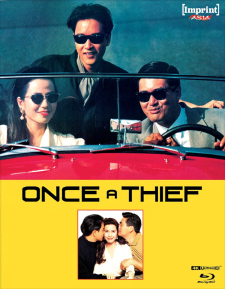
Director
John WooRelease Date(s)
1991 (June 10, 2026)Studio(s)
Golden Princess Film Production/Milestone Films (Imprint Asia/Via Vision Entertainment)- Film/Program Grade: B
- Video Grade: A-
- Audio Grade: B-
- Extras Grade: A-
Review
[Editor’s Note: This is a Region-Free Australian 4K Ultra HD release.]
When John Woo made a splash on the Hong Kong filmmaking scene in 1986 with A Better Tomorrow, a film that helped define the “heroic bloodshed” genre that would become a key part of the Hong Kong New Wave, it set him on a path that inevitably resulted with a stint in Hollywood. Yet it’s easy to forget that Woo didn’t spring fully formed from the forehead of Zeus that year, but rather had paid his dues for more than a decade prior to that point by making a string of wuxia films and comedies. Still, A Better Tomorrow had a trajectory that couldn’t be denied, leading to his most iconic Hong Kong effort The Killer in 1989 and his wildly unrestrained magnum opus Hard Boiled in 1991. In between those two films, he made an unremittingly bleak personal statement with Bullet in the Head, and the box office failure of that expensive film meant that a brief course correction was in order. The result was Once a Thief (aka Chung hang sei hoi), a lighthearted adventure that blended the crime milieu of A Better Tomorrow with the broad comedy of Woo’s earlier work.
While the title and the French setting may seem like an allusion to Alfred Hitchcock’s To Catch a Thief, Woo’s inspiration for Once a Thief was actually something from the French New Wave: François Truffaut’s 1962 masterpiece Jules and Jim. The stories may be completely different, but Woo was fascinated by the romantic triangle that lay at the heart of Truffaut’s film. He essentially grafted that element into a Hitchcockian cat-and-mouse story, throwing in a generous dose of the extended family dynamic from some of own films. Originally, Woo had something far more serious in mind for Once a Thief, but after Golden Princess sank a lot of money into Bullet in the Head and the investment didn’t pay off, he felt like he owed them one, and the studio wanted a more marketable effort from him for the Chinese New Year. So, Woo brought in Clifton Ko to help reshape his story into something a bit more palatable for family audiences, and thus Truffaut’s tragic romance became the relatively frothy (but still ultraviolent) Once a Thief.
The script for Once a Thief takes its twists and turns, but like Jules and Jim, the heart of the film is the triangle between three different thieves: Red Bean (Cherie Chung), Red Bean Pudding (Chow Yun-Fat), and James (Leslie Cheung). As children, they were orphans who learned their trade under the harsh tutelage of Boss Chow (Kenneth Tsang). Yet they also fell under the more protective wing of police officer Chu (Kong Chu), who became their unofficial godfather. As adults, they’ve become high-line thieves who specialize in art heists. Red Bean Pudding and James are devoted friends, but their mutual attraction to Red Bean has resulted in some undeniable tension between the two of them. Yet they’re also still somewhat beholden to Boss Chow, so when he asks them to steal a painting, they can’t resist his siren call. That sets in motion a chain of events that will threaten to tear the three of them apart, forcing them to deal with Boss Chow once and for all—and to settle matters between each other as well.
If Once a Thief sometimes seems like an uneasy blend, that’s because it bears the fingerprints of many different people including Clifton Ko, editor David Wu, composer Violet Lam, action coordinator Phillip Chung-Fung Kwok, stunt coordinator Bruce Law, and the legendary Rémy Julienne, who staged and directed the French car chase sequences (and let’s not forget the indelible presence of Chow Yun-Fat, Leslie Cheung, and Cherie Chung as well). Yet it’s still a John Woo film through and through, even if it may feel like a square peg compared to the rest of his films from the period. Lighthearted or not, there’s still plenty of gun-fu in Once a Thief that can get as violent as anything in his heroic bloodshed films, and the overall tone veers wildly from comedy to tragedy. That shouldn’t be an issue for anyone familiar with Hong Kong cinema, which has always reveled in drastic tonal shifts. Yet it may be one reason why western audiences haven’t embraced the film as much as A Better Tomorrow, The Killer, Hard Boiled, or even Bullet in the Head.
Eastern audiences, on the other hand, had no such issues. Once a Thief became a major box office success in Hong Kong and elsewhere in Asia, trailing only A Better Tomorrow among Woo’s films from that period. Bullet in the Head had been an intensely personal film, and while Woo felt no such intimate connection to Once a Thief, it still proved to be an important step forward for his career. Perhaps most significantly, it was his first collaboration with producer Terence Chang, who would help guide Woo through his next film Hard Boiled and into the Hollywood phase of the director’s career (and when Woo returned to Hong Kong to make Red Cliff in 2008, Chang returned with him). Yet Woo wasn’t quite done with Once a Thief after he landed in Hollywood, even directing a television remake in 1996 as the pilot for a proposed series (although what ended up happening with that is a story for another day). Regardless, his original version of Once a Thief is still an entertaining romantic thriller that doesn’t deserve to be dismissed as “lesser” Woo. It just needs to be appreciated on its own terms.
Cinematographer Poon Hang-Seng shot Once a Thief on 35mm film using Arriflex cameras with spherical lenses, framed at 1.85:1 for its theatrical release. This version uses the Shout! Studios 4K master, which was based on a 4K scan of the original camera negative, digitally remastered and graded for High Dynamic Range in Dolby Vision and HDR10. It’s still a John Woo film, so there’s plenty of optical work during the opening titles and elsewhere, all of which had to be scanned from dupe elements instead. But outside of those shots and/or sequences, which are softer than the surrounding material, everything else is sharp and detailed. There’s little damage of note aside from some faint scratches and other minor blemishes (some of which was probably introduced during the optical printing). The colors are consistent and they look perfectly saturated—Once a Thief isn’t necessarily a bright and cheerful film, but it’s still a bit more colorful than some other Woo efforts from that era (the gang’s red 1958 Austin-Healey really pops here). The encode here is different than the one on Shout’s set, but there doesn’t appear to be any significant differences between the two. It’s still a huge 4K upgrade for Once a Thief.
Audio is offered in Cantonese 2.0 mono LPCM and 7.1 DTS-HD Master Audio; Mandarin 5.1 DTS-HD Master Audio; and English 2.0 LPCM, all of them with optional English subtitles. As far as the original mono mix goes, international locations or not, it’s still the usual Hong Kong post-synced dialogue that never blends well with the music and effects. But this track is still a little perplexing, with everything sounding almost muffled at times, with a rolled-off high end. Yet the dialogue sometimes suffers from excessive sibilance, so there’s high end where it’s less desirable. Violet Lam’s score is lively (even if it blatantly steals from Wang Chung’s To Live and Die in L.A. music a few times), but the lack of a top end makes it sound a little constrained. Overall, nothing is too far out of character with many other Hong Kong mixes from the era, but it’s still an inconsistent track.
The 7.1 mix adds sound effects like chirping birds, barking dogs, thunder, and various other sounds of the city. It also replaces some of the existing effects like gunfire and explosions with new effects, although that means that the dynamics are stronger and the low end is deeper. All of that makes the experience much more immersive, although sometimes that’s at the expense of the dialogue—for example, during the Austin-Healey ride at 23:20, the dialogue is buried by the music and effects. Between the lack of balance and the added effects, I prefer the original mono (despite any of its own flaws). But your own mileage may vary, so audition both and decide for yourself.
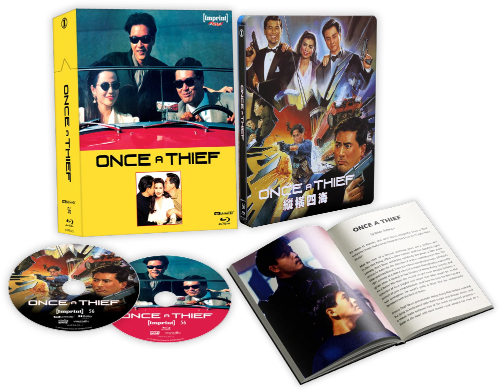
Via Vision’s Region-Free Limited Edition Steelbook 4K Ultra HD release of Once a Thief is #56 in their Imprint Asia line, and it’s limited to 1,500 units. It’s a two-disc set that includes a Blu-ray with a 1080p copy of the film and a 60-page hardbound booklet featuring essays by Sean Gilman and Brian Tallerico. Everything comes housed in one of Imprint’s rigid Hardboxes that opens up at the top. The following extras are included:
DISC ONE: UHD
- Commentary by James Mudge
- Original Theatrical Trailer (HD – 1:22)
DISC TWO: BD
- Commentary by James Mudge
- Handling a Heist (HD – 23:53)
- Thoughts About Thievery (HD – 21:24)
- Stealing Some Shots (HD – 27:10)
- Heists and Lows (HD – 7:55)
- Art of the Steal (HD – 10:03)
- Hong Kong Confidential: Inside Once a Thief (HD – 8:14)
- Once a Star, Always an Icon (HD – 17:08)
- Brothers in Arms (Upscaled SD – 11:16)
- Up Close and Personal (Upscaled SD – 35:24)
- Interview with Kenneth Tsang (Upscaled SD – 7:00)
- Image Gallery (HD – 5:33)
- Original Theatrical Trailer (HD – 1:22)
Most of the extras were originally produced for the Shout! Studios UHD. The commentary features James Mudge, producer and head writer for the easternKicks website. He puts Once a Thief into context with that phase of John Woo’s career, pointing out that it actually looked forward to the kinds of films that Woo would end up making during his later international phase while still paying homage to older Hong Kong comedies. In the process, Mudge offers a blisteringly quick overview of Woo’s career up to that point, including his conflicts with Tsui Hark and new collaboration with Terence Chang, all of which sets the stage for the making of Once a Thief. It was always intended as a more family-friendly Chinese New Year film, although it still toys with standard Woo themes like loyalty and brotherhood. Mudge also tells some stories about the production and breaks down all of the cast and crew. He’s essentially a Scottish Frank Djeng—in other words, he’s a fountain of information who rarely runs out of things to say, so there’s plenty of interesting stuff here.
With one exception, the rest of the Shout! extras consist of interviews. Handling a Heist is with Woo, who explains how the commercially-oriented Once a Thief was made in reaction to the expensive failure of Bullet in the Head as a way of making it up to Golden Princess. He admits that the different styles of the French sequences and the Hong Kong sequences don’t really gel together, but that audiences loved the film anyway (and Golden Princess was happy). Woo also breaks down his approach to comedy and his handling of the actors (although the goofy coda was actually the brainchild of editor David Wu).
Thoughts About Thievery is with screenwriter Clifton Ko, who had already started directing at that point but jumped at the opportunity to make a Chinese New Year film with Woo. He explains the process of developing the script and offers some anecdotes about the production. Stealing Some Shots is with cinematographer Poon Hang-Seng, who recaps his history with Woo before delving into shooting Once a Thief. He covers the international locations, the action scenes, and different approaches to action and comedy. Heists and Lows is with producer Terence Chang, who discusses Woo’s background in comedy and how Golden Princess insisted that Woo’s version of Jules and Jim also be comic after the unremitting darkness of Bullet in the Head. Art of the Steal is with David Wu, who also talks about the tonal shift between Bullet in the Head and Once a Thief, and points out the scenes in the film that he handled as second unit director (including the aforementioned coda).
There’s also another edition of Hong Kong Confidential with Grady Hendrix, co-author of These Fists Break Bricks. He provides a brief introductory overview of Chinese New Year films and the making of Once a Thief (including the various directors who helped Woo out). Hendrix says that Once a Thief teaches us that the best way to overcome an abusive childhood is to become a fabulous art thief in the south of France. Once a Star, Always an Icon is with Frank Djeng, who devotes his time to an appreciation of the all too brief life of Leslie Cheung (who took his own life in 2003 at the age of 46). Finally, the last of the Shout! extras is an Archival Interview with Kenneth Tsang, who offers his interpretation of the character that Woo asked him to play.
Via Vision has also added two of the archival extras from the Region 2 DVD from Hong Kong Legends in the U.K. Brothers in Arms is with Terence Chang, while Up Close and Personal is with Woo. While they naturally cover some of the same material as in their new interviews, it’s still nice to have these included here. What’s not included are the rest of the Hong Kong Legends extras that involved the problematic Bey Logan: a commentary track and his own tribute to Leslie Cheung. (It’s safe to say that those will probably never see the light of day again.) The Shout! Studios set was already a huge upgrade in terms of extras, but adding back some of the Hong Kong Legends stuff gives Via Vision an edge, however slight. Once a Thief isn’t quite in the caliber of Woo’s other Hong Kong classics like A Better Tomorrow, The Killer, Bullet in the Head, or Hard Boiled, but it’s still a breezily entertaining film that holds up well (provided you can accept the tonal shifts and slapstick comedy). While Via Vision’s set may not be worth the upgrade for anyone who already owns the Shout! version, it’s arguably a better choice for anyone who hasn’t picked it up on UHD yet. Recommended, especially for anyone who is building a collection of Imprint Asia titles.
-Stephen Bjork
(You can follow Stephen on social media at these links: Twitter, Facebook, BlueSky, and Letterboxd).