
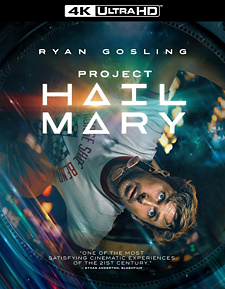
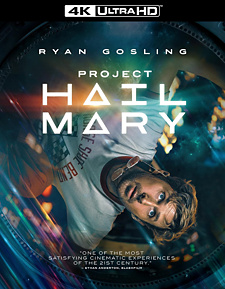
Project Hail Mary (4K UHD Review)
- Review Date: Aug 11, 2026
- Format: 4K Ultra HD
-


Director
Phil Lord and Christopher MillerRelease Date(s)
2026 (August 11, 2026)Studio(s)
Amazon Original/MGM/Lord Miller Productions/Pascal Pictures (Amazon MGM Studios/Alliance Entertainment)- Film/Program Grade: B+
- Video Grade: A+
- Audio Grade: A
- Extras Grade: B-

Review
Based on the best selling hard sci-fi novel by Andy Weir (The Martian, Artemis), Phil Lord and Chris Miller’s Project Hail Mary tells the story of a last-ditch and desperate manned interstellar mission to save the Sun from an alien pathogen, dubbed astrophage, that seems to be consuming its energy—and that of all the stars in its stellar neighborhood save one, Tau Ceti—from the inside out, thus threatening to destroy Earth’s habitability via global cooling.
Unfortunately, middle school teacher and ex-molecular biologist Ryland Grace (Ryan Gosling, Blade Runner: 2049, First Man) doesn’t remember any of this when he first wakes up from hibernation aboard the spacecraft Hail Mary, some 11.9 light-years from Earth. All he knows for sure is that he’s alone, far from home, and he’s got zero astronaut training. But things get even more frightening when a blip on his ship’s computer screen suddenly reveals a bigger surprise: Grace isn’t actually alone.
As a fan of science fiction cinema, I find it deeply satisfying when a film in this genre succeeds on so many levels, and Project Hail Mary does exactly that. First of all, Gosling is fantastic here. He carries this film and makes it look effortless, though it was surely wasn’t. Second, Weir’s original story—and scribe Drew Goddard’s adaptation—is compelling and grounded in believable, if speculative, science. It’s worth noting that Goddard did similar duty on Ridley Scott’s The Martian (2015), also based on an Andy Weir novel, to similar effect. Third, the production design here is superb. The Hail Mary looks and feels like a plausibly authentic spacecraft. Fourth, Greig Fraser’s large-format cinematography is absolutely magnificent (more on that in a minute). Fifth and finally—and this is perhaps the most important point—Rocky is arguably the best conceived and realized alien creature in any film or TV series since H.R. Giger’s iconic “xenomorph” in Ridley Scott’s Alien (1979). Stack it all up, and it’s clear that Lord and Miller (The LEGO Movie, Spider-Man: Into the Spider-Verse) have notched themselves an extraordinary achievement.
But that’s not to say this film is perfect. For one thing, the idea that humanity could build a manned interstellar spacecraft (and figure out hibernation) so easily, and in a timeframe to do any good, is hard to imagine. Also, for someone with zero training, Grace becomes a remarkably able astronaut—capable of piloting, astrogation, EVAs, and doing fuel calculations—in an implausibly brief time. And for a guy who’s not a linguist, he figures out interspecies communication in the space of a montage. All of these issues are the kind of thing that the original novel is just, by its very nature, better at addressing, but this is a movie so you just have to go with it.
I also wish the flashbacks to Grace’s time before the mission were more substantial. One of the reasons I love The Martian so much is that it’s a true ensemble, with many good characters all working together—something that’s very authentic to NASA and international space programs. The supporting cast here is small indeed, but its standouts include Sandra Hüller (The Zone of Interest, as the head of the international task force behind the mission), Lionel Boyce (The Bear, as a security guard who befriends Grace), and James Ortiz (as the voice of Rocky). Much less good is Mila Vayntrub (the AT&T girl, as a Russian cosmonaut), but then she only has a few lines of dialogue. In any case, had these characters been more developed, the emotional stakes might have been greater. Still, it must be said that Project Hail Mary’s merits far outweigh its shortcomings. And that’s a welcome thing indeed.
Project Hail Mary was captured digitally by cinematographer Greig Fraser (Dune, Dune: Part Two, Rogue One, The Creator, The Batman) in the ARRIRAW codec (at 4.5K and 6.5K) using Arri Alexa 65 and Mini LF cameras with Viltrox Epic 1.33x, Luna Zoom, Arri Heroes T.One, and IronGlass Helios anamorphic lenses. The genius of Frasier’s approach was to use these lenses rotated by 90 degrees (in relation to the large digital sensor) for scenes set in space, thus doing the anamorphic squeeze vertically instead of horizontally to achieve the IMAX aspect ratio of 1.43:1. And for the flashback scenes set on Earth, the standard anamorphic process was employed to render the usual 2.39:1 frame. The second part of Frasier’s approach was to utilize a film-out process (which he refined on Denis Villeneuve’s Dune films) to print that digitally-acquired image on photochemical film stock, then scan it back to digital, to lend the final image the best visual qualities of each and to complete a 4K Digital Intermediate. Obviously, Project Hail Mary was shown at a variety of (mostly variable) aspect ratios for its theatrical release, including 1.43:1/2.39:1 for IMAX, 1.85:1/2.39:1 for IMAX Digital, and 2.00:1/2.39:1 for standard theaters.
For it’s release on 4K disc, Amazon MGM (via their physical media distributor, Alliance Entertainment), made use of that 4K Digital Intermediate with grading for high dynamic range compatible with Dolby Vision HDR and HDR10. The film is presented on this disc in a variable aspect ratio that shifts from 1.78:1 to 2.39:1 to preserve as much of the IMAX experience as possible. And it’s been encoded on a 100GB disc to achieve the highest possible data rates, here averaging 65-75 Mbps. The result looks fantastic. The high resolution digital capture ensures detail and texturing are exquisite, while the film-out process renders a pleasing patina of light photochemical grain and lovely halation. It’s also worth pointing out the vertically-oriented lens flares in this image, which derive from the offset anamorphic lens orientation and add to this film’s unique visual character. Shadows are deeply black, which is a must for any space film, and highlights are brightly bold. The film’s palette is exquisite, lending magnificence to such imagery as cockpit instrumentation, planetary atmospheres, and aurora. And all of this works in tandem with the high data rate to render a remarkable sense of depth in the image. Bottom line: This is a really pretty 4K image that I’ll be revisiting often.
Primary audio on this disc is available in a terrific lossless and object-based English Dolby Atmos mix that serves the image well. The soundstage is broad across the front and pleasingly immersive, growing even more so in the space scenes. The interior of the Hail Mary features a range of environmental cues that shift from module to module, and the ship’s computer voice and notification chimes offer playful directionality. Daniel Pemberton’s sparse and ethereal score utilizes every channel, making the listening space akin to a cathedral. Dialogue is clear and natural at all times. And in tense moments, like the Hail Mary’s dive into the atmosphere of Tau Ceti e or the astrophage explosion back on Earth, there’s bluster aplenty, with deep bass, muscular dynamics, and active use of the height and surround channels for lift, expansion, and movement. The ship’s perilous tumble due to a fuel leak in particular is a sonic tour de force. Additional audio mixes include English Descriptive Audio, French Canadian and Spanish 5.1 Dolby Digital, and French 5.1 DTS-HD Master Audio. Optional subtitles are available in English, English for the Deaf and Hard of Hearing, French Canadian, French, Dutch, and Spanish.
Amazon MGM’s initial 4K release comes in Amaray packaging and features the film in 4K on UHD only—no Blu-ray is included (though one is available separately). The disc carries the following special features:
- Audio Commentary with Phil Lord and Christopher Miller
- Deleted Scenes (HD – 5 scenes with Play All option – 9:59 in all)
- Day 1 Food Paste (HD – 1:39)
- I Think I’m Handling Things Pretty Awesome (HD – 2:20)
- How to Put on a Spacesuit (HD – 1:49)
- You Sleep, I Watch (HD – 2:20)
- Maybe We’re Cousins (HD – 1:47)
- Earth’s Favorite Eridian (HD – 7:53)
The commentary with the directors is the same one some of you may have experienced in theaters via the TheaterEars app. The pair talks about the film’s creative and adaptive challenges, and their decision making. They reveal all kinds of interesting details, offer production anecdotes, and more. The track is worth your time. The deleted scenes are all entertaining—most involve Gosling improv-ing, though there are a couple more substantial moments—and they’re presented in high HD quality. Earth’s Favorite Eridian features many of the film’s participants—including Weir, Gosling, the directors, creature shop supervisor Neil Scanlan, VFX supervisors Paul Lambert and Mag Sarnowska, the “Rocketeers” puppet team, James Ortiz (the lead puppeteer and Rocky’s voice), VFX producer Barrie Hemsley, and senior animation supervisor Arslan Elver (at Framestore)—talking about how they realized the film’s alien character. It’s good content to be sure, though it’s worth noting that a more elaborate Amazon-exclusive Project Hail Mary: Collector’s Edition 4K Steelbook is coming on 10/13 (the set is currently sold out at this link, but more copies should become available at some point) that will feature additional special features. Again, there’s no Blu-ray included, nor is there a Movies Anywhere Digital code.
Project Hail Mary is a very entertaining science fiction epic, not to mention a cinematic marvel, and a definite crowd pleaser for audiences of all ages. Walking out of the theater after a 15-perf/70 mm IMAX screening, I was pleasantly surprised by how much I’d enjoyed the film, and it was fun to listen to the many teens, adults, and children in the audience who were chatting excitedly about the experience they’d just had. My hats off to Lord and Miller for a job well done, a special shout out to Frasier for his stunning visuals, and a hearty pat on the back to all involved. Thanks to everyone who helped deliver such fine A/V quality on this 4K disc as well. Recommended.
- Bill Hunt
(You can follow Bill on social media on X, BlueSky, and Facebook, and also here on Patreon)