
Point Blank (4K UHD Review)
Director
John BoormanRelease Date(s)
1967 (April 21, 2026)Studio(s)
Winkler Films/Metro-Goldwyn-Mayer (The Criterion Collection – Spine #1306)- Film/Program Grade: A+
- Video Grade: A
- Audio Grade: B+
- Extras Grade: B+

Review
In Donald E. Westlake’s 1962 novel The Hunter (written under his pseudonym Richard Stark), we first encounter the protagonist Parker while he’s crossing the George Washington Bridge into Manhattan by foot. A man in a Chevy pulls over and offers him a lift, and Parker’s only response is “Go to hell.” Easy for Parker to say, since he’s already been there, and he’s hellbent on revenge, too, although the reasons why won’t be revealed until later in the book. Aside from a parenthetical section that shifts the perspective to Parker’s target, The Hunter is a relatively linear narrative, yet it opens in media res and doesn’t provide any necessary context until Westlake finally offers a flashback a few chapters after Parker has taken his long walk out of hell and into the light. Parker does eventually get his revenge, but he loses out on the financial payback that he wanted at the same time. As unstoppable as ever, he finds another source of funds and plans to get plastic surgery to hide his identity before moving down to Florida.
It might not have turned out that way. Westlake told Mystery Scene magazine that he always intended The Hunter as a standalone story, but Pocket Books editor Bucklyn Moon asked Westlake if he could change his original ending to let Parker live to fight another day, all in the hopes that they could publish three Parker stories a year. Westlake agreed, but while he never actually kept up that pace, he did manage to write a grand total of 24 total Parker novels before his death in 2008. It was inevitable that Hollywood would come calling, although technically Jean-Luc Godard got there first with his 1966 film Made in USA. But while Godard based his film loosely (very loosely) on Westlake’s 1965 novel The Jugger, he never got permission to do so, leading to legal issues that lasted for decades. Yet Godard still ended up having an unintentional influence on the first official Parker adaptation Point Blank, which fused traditional film noir with the stylistic trappings of the French New Wave (among others). The results were something entirely unlike any other Parker adaptation before or since.
The reasons why are every bit as complicated as the film itself. Producers Robert Chartoff, Irwin Winkler, and Judd Bernard had optioned an adaptation of The Hunter by David and Rafe Newhouse, and they put the project together with John Boorman at the helm and Lee Marvin as Westlake’s antihero. Boorman was fresh off his feature film debut with the Dave Clark Five vehicle Catch Us If You Can, while Marvin had recently won the Best Supporting Actor for Cat Ballou and was very much in the catbird seat at that point in his career. The two of them immediately hit it off, and they agreed that they hated the existing script. Marvin had script and cast approval written into his contract, so he deferred both of those to Boorman, giving the director full control over the entire production. Boorman worked with writer Alexander Jacobs to hone the adaptation more to his liking, which meant fracturing the narrative into something far less linear. Yet per Westlake’s wishes not to use the name Parker, they retained changing the name to Walker instead, which (intentionally or not) echoes how he makes his first appearance in the book.
Ironically enough, Point Blank opens with the flashback that doesn’t appear until chapter six of The Hunter, although the location for the action been moved to the West Coast. While pulling down a heist of an organized crime drop in the abandoned Alcatraz prison, Walker is betrayed by his wife Lynne (Sharon Acker), shot by his partner Mal (John Vernon), and left for dead. Walker survives and somehow manages to swim off the island, where he ends up forming an uneasy partnership with Yost (Keenan Wynn). Yost wants to take down the organization that Mal is working for, so he’s happy to guide Walker in the right direction. Walker just wants Mal, although he also wants the $93,000 that Mal owes him, and he’s willing to do anything to get it. That includes using Lynn’s sister Chris (Angie Dickinson) to get closer to his quarry, and eventually he works his way up to the head of the organization, Brewster (Carroll O’Conner at his most Carroll O’Connor). Yet inevitably, Walker’s quixotic quest will take him full circle back to Alcatraz.
Point Blank may open with Mal and Lynn’s betrayal rather than working its way back to that point, but even this bit of exposition isn’t as straightforward as it was in the novel, with Boorman nesting flashback within flashback within flashback, all before the opening credits roll. Boorman doesn’t just tell Westlake’s story in nonlinear fashion; he also employs temporal and special discontinuity in order to keep viewers uncentered. While some of editor Henry Berman’s jump cutting, match cutting, and associative editing may have been inspired by nouvelle vague filmmakers like Godard, there’s likely another source that was much closer to home for Boorman: Richard Lester.
Catch Us If You Can was an attempt to cash in on the success of Lester’s Beatles film A Hard Day’s Night, and while it doesn’t entirely emulate Lester’s freewheeling editorial style, Boorman still absorbed some of it and used it to great effect in Point Blank. That’s especially true of the scene where Walker, well, walks through the LAX underground accompanied by the repetitive, insistent sound of his shoes clacking on the tiles. Boorman uses the sound effect to tie Walker together with Lynn waking up in her apartment, almost as if she can hear it from miles away. The sound persists even as Walker drives across the city to confront her, no longer motivated by anything other than at the thematic level. It’s Boorman’s version of Westlake’s Parker walking across the George Washington Bridge, filtered through the lens of Lester’s associative jump cut editing.
Where Boorman clearly struck his own path was through his use of color. Catch Us If You Can and his previous television work had all been black-and-white, which would have been perfectly appropriate for what’s essentially a film noir with multiple femme fatales, but the producers and the studio wanted color. Boorman decided to use it thematically, marking the various stages of Walker’s journey. Point Blank opens almost monochromatically on Alcatraz Island, but as the story progresses, Boorman gradually introduces silvers and white, then greens and blues, then yellows, and finally reds. Each stage emphasizes one of those colors, with Walker’s wardrobe magically changing colors to match. And when he returns to Alcatraz for the finale, while the prison is as drab as ever, the helicopter making the drop is now painted red instead of grey.
And in this version of The Hunter, it was inevitable that Walker would eventually find his way back to Alcatraz. Since the prison had been shut down a few years before the production of Point Blank and hadn’t yet been turned into the tourist trap that it is today, the choice of location may have been as much practical as anything else. Yet it’s still significant that Walker’s betrayal took place on the escape-proof Alcatraz Island, where he manages to escape anyway by swimming across the impassable bay even after having been shot in the abdomen. It’s not surprising that he makes his way back there at the end of the film, because it’s a fair question whether or not he ever left the island in the first place. Point Blank may well be the fever dream of a dying man, imagining that he gets his revenge before crossing over to the other side. And Boorman deliberately left that point ambiguous, offering various contradictory clues along the way, such as the fact that unlike Parker, Walker never directly kills anyone.
Still, however much that Boorman may have left viewers feeling uncentered by his use of various distancing devices like jump cut editing, unrealistic color schemes, and ostentatious uses of mirror images, it’s important to note that there’s nothing uncentered about Walker. Westlake may not have been influenced by Howard Hawks, but he still presented Parker as a consummate professional—a professional criminal, but a professional nonetheless. The one breach of professional ethics that he won’t tolerate is a double-cross, and he’s a literal machine when it comes to paying back anyone who has betrayed him. As implausible as Walker’s escape from Alcatraz Island may seem, it fits with the implacable nature of Parker.
So, is Walker having a dying dream, moving through reality as a ghost, or did he actually survive Mal’s machinations? As Boorman himself has admitted, it doesn’t really matter. Despite all of the postmodern trickery on display in Point Blank, despite the ambiguous nature of Boorman’s storytelling, and even despite the name change to Walker, Lee Marvin’s character is Parker. There have been other adaptations of Westlake’s work that have been more faithful to the source than Point Blank, but none of them have brought Parker to life as well as Boorman and Marvin did. In the end, that’s the only thing that matters.
Cinematographer Philip H. Lathrop shot Point Blank on 35mm film using Panavision cameras with anamorphic lenses, framed at 2.35:1 for its theatrical release. This version is based on a 4K scan of the original camera negative (although 35mm separation masters were used for a few sections), digitally remastered and graded for High Dynamic Range in Dolby Vision and HDR10. The image is immaculate, with no obvious signs of any remaining damage to be seen, and it’s about as sharp and finely detailed as the vintage Panavision anamorphic C- series lenses would allow. Boorman did make frequent use of dissolves and other optical effects, so those shots are inevitably softer than the surrounding material, but any footage that was derived from the separation masters is nearly indistinguishable from the negative scans. The encoding onto a BD-100 is quite good, too, so there aren’t any issues with grain reproduction. Now, the grading here is significantly different than the previous DVD and Blu-ray versions, so here’s your friendly reminder that older masters aren’t automatically the most accurate ones. Let’s delve a bit deeper into that subject.
In this case, Criterion used a 35mm archival print and an IB Technicolor print as reference, while there’s no evidence that previous versions used any reference materials whatsoever. The colors on them were flattened and normalized, with the familiar magenta push of older telecine efforts that robbed Boorman’s color scheme of its power. In comparison, this version is much cooler with a greater emphasis on cyan—yes, it leans more toward teal at times, but here’s your (somewhat less than friendly) reminder that teal wasn’t invented in the year 2000, it was just dialed out by older telecine transfers. In lieu of any reference materials of my own, I have no reason to question the new grade, and the plain fact of the matter is that it makes all the difference in the world. Boorman’s progressive color design works much better here than it ever has before on home video, from the nearly monochromatic opening scene to the silvers, blues, greens, yellows, and reds that crop up later on. And those colors are anything but monochromatic, with subtle but seemingly infinite variations in each of them, especially the greens and yellows. It’s a fantastic 4K presentation of Point Blank, and a huge upgrade from Blu-ray, let alone DVD.
Audio is offered in English 1.0 mono LPCM, with optional English SDH subtitles. The audio was remastered from the original magnetic tracks, and it’s clean with no distortion or other major defects (there’s still a bit of background hiss, but it’s not bothersome at normal listening levels). Everything is well-balanced, too, with clear dialogue and great supporting work from Johnny Mandel’s dissonant and disquieting score (and Stu Gardner’s song Mighty Good Times is as brash as ever).
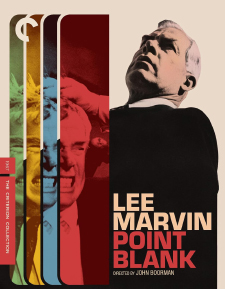
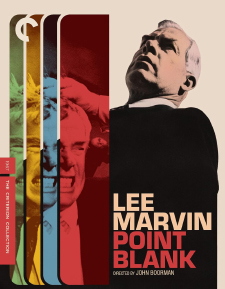
The Criterion Collection 4K Ultra HD release of Point Blank is a two-disc set that includes a remastered Blu-ray with a 1080p copy of the film. It also includes a 12-page booklet with an essay by critic Geoff Dyer, and the cover features new artwork by Jay Shaw. The following extras are included:
DISC ONE: UHD
- Commentary with John Boorman and Steven Soderbergh
DISC TWO: BD
- Commentary with John Boorman and Steven Soderbergh
- Boorman and Dyer (HD – 41:24)
- Harris (HD – 34:54)
- Jarmusch (HD – 17:05)
- Martino (HD – 8:50)
- The Rock (HD – 16:20)
- Marvin & Cavett (Upscaled SD – 22:27)
- Trailer (HD – 2:39)
The commentary with Boorman and Steven Soderbergh was originally recorded for the 2005 DVD from Warner Bros. Unsurprisingly, it’s as much of a dialogue as it is a scene-specific commentary, although they do comment on some scenes as they go along. But Soderbergh is clearly a huge fan of Point Blank (he admits that he’s stolen from it many times), so it’s as much of a journey into his mind as it is into Boorman’s. He really, really wanted to know how (and why) Boorman did what he did, so it’s fun to hear him pepper Boorman with fanboy questions—fanboy questions from a fellow director, so it’s much more in-depth than a typical podcaster commentary. They cover the background of the film, how Boorman dealt with the “suits” who didn’t understand his vision, and much more. That includes breaking down the color design, his love of anamorphic cinematography, and whether or not the whole story is a dying man’s dream—a question that makes Boorman demur and finally say that it doesn’t really matter. (He’s right: it doesn’t.)
Boorman and Dyer is another dialogue, this time between Boorman and Geoff Dyer, that was recorded for the Boris House Festival of Writing & Ideas. Dyer says that Point Blank was the first film that opened his eyes to the magic of cinema, and Boorman responds that he made it partly out of wisdom and partly out of inexperience. From there, they inevitably end up exploring some of the same stories that Boorman shared in his commentary with Soderbergh (like his use of color), but not always from the same angle—it probably helps that Dyer isn’t a filmmaker, so he asks different questions. They also move on to other films from Boorman’s career like Hell in the Pacific.
There are also two different interviews examining Point Blank from without rather than from within. The first is with journalist and author Mark Harris, who places Point Blank into context with where both Boorman and Marvin were at that point in their respective careers, then breaks down some of the differences between the book and the film, as well as a few other elements of the production. Yet he still does so from a contextual perspective, for example, comparing Boorman’s use of color to the lack thereof in traditional film noir up to that point. He also analyzes the varying interpretations of the film. The second interview is with Jim Jarmusch, who enthuses about his appreciation of crime fiction and crime films, especially ones that are set in Los Angeles (although he doesn’t care for the term “film noir”). He also loves Lee Marvin, and unsurprisingly, Point Blank is one of his favorite films. As abstruse as some of Jarmusch’s own films may be, his analysis of other people’s work is always cogent.
Martino is a locations featurette hosted by Alison Martino, creator of the online community Vintage Los Angeles. She revisits eleven of the original locations, comparing how they appear now to the way that they were presented in the film—and just like the film, she ends up at Alcatraz. Speaking of which, The Rock is a vintage 1967 two-part promotional film that was shot while the crew of Point Blank was on location at Alcatraz. The first part focuses on the film shoot, offering a rare glimpse behind-the-scenes of the making of Point Blank. (It also shows off some of the Life magazine photo shoot with Angie Dickinson and Sharon Acker.) The second part focuses on Alcatraz in general, with former inmate John Giles revisiting his one-time home.
Finally, Marvin & Cavett is an excerpt from Marvin’s October 1970 appearance on The Dick Cavett Show. Marvin is, well, Lee Marvin, keeping Cavett on his toes at all times and making the host play defense occasionally. Jeanne Moreau and Truman Capote also appeared on the same episode, and while this excerpt doesn’t include their full segments, it does include a moment where Capote made a reference to Marvin and Marvin responded by not responding at all (much to Cavett’s discomfort). It’s a fascinating time capsule of a bygone era—there will never, ever be another program like The Dick Cavett Show again, or the kinds of personalities that graced his stage.
There will never, ever be another film like Point Blank again, either. It’s been endlessly influential, and other filmmakers have liberally borrowed from it over the decades. But Boorman fused all of his own influences into something that felt fresh and original in 1967, while those who have been influenced by him can only seem imitative in return. It’s looking as fresh and vibrant as it ever has in this 4K presentation, so Criterion’s fantastic UHD set gets the highest possible recommendation.
-Stephen Bjork
(You can follow Stephen on social media at these links: Twitter, Facebook, BlueSky, and Letterboxd).