
One Battle After Another (Steelbook) (4K UHD Review)
- Review Date: Jul 22, 2026
- Format: 4K Ultra HD
-


Director
Paul Thomas AndersonRelease Date(s)
2025 (June 2, 2026)Studio(s)
Ghoulardi Film Company/Warner Bros. Pictures (Warner Bros. Entertainment)- Film/Program Grade: A
- Video Grade: A
- Audio Grade: A
- Extras Grade: B

Review
While some works of art are considered masterpieces because there’s more to them than meets the eye, there are others that achieve the same status because there’s arguably less. Such is the case with Paul Thomas Anderson’s Academy Award-winning One Battle After Another, a film that generated no small amount of toxic discourse from those who engaged with it in bad faith in order to generate some profitable clickbait rage. The nature of that discourse ended up revealing far more about the people who engaged in it than it did about Anderson’s film, which just as elusive and difficult to pin down as much of his other work. Yet while there’s a lot going on with One Battle After Another, the essential core of the film is as simple as the musical bridge that binds together all of the disparate elements in his sprawling interpersonal epic Magnolia. Just like Aimee Mann reminded us in that film, One Battle After Another isn’t going to stop until someone wises up.
When we first glimpse “Ghetto” Pat Calhoun (Leonardo DiCaprio) during the prologue of One Battle After Another, he’s late for a meeting of the urban revolutionary group the French 75, dragging a wagon behind him loaded with ballistics that will be used as a distraction during a raid to free undocumented immigrants from the Otay Mesa Detention Center in San Diego. He’s more than a little clueless, so he tells his lover Perfidia Beverly Hills (Teyana Taylor) that “I’m a little unclear as to what the plan is. I’m gonna need some direction.” That, in a nutshell, is the story of Pat’s life. He’s a follower, not a leader, and Perfidia has to drag him behind her just like he’s dragging the wagon. He doesn’t know how to be a revolutionary, and he doesn’t really know how to be a romantic partner, either. Before long, he’ll also demonstrate that he doesn’t know how to be a father.
Perfidia, on the other hand, isn’t so much a revolutionary force as she is a force of nature. If Pat can’t quite grasp the manifesto of the French 75, Perfidia isn’t always focused on it. Instead, she gets a sexual charge from the empowering thrill of taking violent action, openly admitting that for her, “the guns is the fuckin’ fun.” And she’ll prove that point during the raid on Otay Mesa, where she encounters the uptight commanding officer Col. Steven J. Lockjaw (Sean Penn). When she attempts to humiliate him sexually at the point of a gun, she ends up turning him on instead, setting into motion a chain of events that will result in the dissolution of the French 75 and her own exit from the stage, but not before leaving a baby girl behind her. She doesn’t know how to be a mother anymore than Pat knows how to be a father, and she certainly doesn’t want to play second fiddle to her daughter. So, she splits, betraying the entire movement in the process.
Fast forward sixteen years, and Pat is now living under the identity of Bob Ferguson, trying to raise his daughter Willa (Chase Infiniti) while keeping her safe from the government’s clutches. His smothering paranoia drives Willa to distraction, but she’s barely able to keep centered (hold that thought) by learning martial arts from Sensei Sergio St. Carlos (Benicio del Toro, demonstrating conclusively that he’s a national treasure). But while Bob’s paranoia might be partly fueled by marijuana, he still has a point. Lockjaw is auditioning for membership in a clandestine white supremacist group called the Christmas Adventurers Club, and he can’t afford to have anyone or anything roaming free that may connect him to previous interracial indiscretions. With Perfidia out of the picture, the colonel now has Bob and Willa in his sights instead.
As topical as that may seem, it’s significant that Paul Thomas Anderson never clarifies whether the opening scenes with the French 75 are a flashback and the rest of the film takes place in the present day, or if the opening is in the present day and everything else is in the future. One Battle After Another is based loosely (very loosely) on Thomas Pynchon’s 1990 novel Vineland, which was set in a very specific time and place: the Reagan-era war on drugs in 1984, with the revolutionary characters having lived through the turmoil of the Sixties. While One Battle After Another is still set in California, and it does offer contemporary elements by referencing the very real conflicts over immigration in America, Anderson wasn’t really interested in topical details. Instead, his focus was a far more timeless one: the complex interplay of human relationships, in this case the unstable intersection between Bob, Willa, Perfidia, and Lockjaw.
Unsurprisingly, that also means Anderson was interested in the sexuality that drives some of those relationships. Much has been made of the similarities between One Battle After Another and Dr. Strangelove, and Lockjaw is indeed driven by an obsession over his purity of essence (if not so much peace on earth). Just like Dr. Strangelove, absurdist humor and sexual references abound in Anderson’s script, from character names like “Junglepussy” to underground organizations like the Sisters of the Brave Beaver (and yes, Perfidia carries a big gun that would make even Brigadier General Jack D. Ripper jealous). Yet while the fate of the world in Dr. Strangelove hinged on the fragility of the male sexual ego, all of the characters in One Battle After Another struggle with feelings of inadequacy in one form or another, male and female alike. It’s just that they work out those feelings in different ways, and as a result, One Battle After Another shows signs of a broader Kubrickian influence than just the director’s legendary nuclear satire.
While Anderson’s first few films bore an obvious influence from the likes of Robert Altman, Alan Rudolph, and Martin Scorsese, his later work has been much more difficult to nail down. Anderson always follows his own muse, wherever it may take him, and in this case that muse (intentionally or not) appears to have been Stanley Kubrick. Yet One Battle after Another isn’t patterned after Dr. Strangelove as much as it is after Barry Lyndon, with Anderson even openly borrowing Lord Wendover’s speech about “the best people” for the introductory speech that Virgil Throckmorton (Tony Goldwyn) gives regarding the nature of the Christmas Adventurers Club. And even without including anything like Michael Hordern’s scathingly witty narration from that film, Anderson’s social satire is no less mordantly hilarious.
Crucially, Anderson also borrowed Kubrick’s use of tracking shots and centered framing (though not so much zoom lenses). Anderson shot the bulk of One Battle After Another using 8-perf VistaVision cameras, and while release prints were projected at anywhere from 1.43:1 to 1.85:1, Anderson’s heart was clearly with the full 1.50:1 VistaVision frame. The characters are frequently centered within that frame, especially during the numerous Kubrickian tracking shots that were clearly influenced by the ones in Paths of Glory, Barry Lyndon, The Shining, and Full Metal Jacket. Anderson’s VistaVision cameras follow and/or lead the characters as they walk down hallways, corridors, and alleys, keeping them centered in the middle of the frame while the world moves restlessly around them.
Centering the characters visually provides an ironic counterpoint in One Battle After Another since they’re really anything but centered—and not just in terms of them being either left or right of center, either, but also in terms of their personal lives and relationships. The revolutionaries in the film are just as fucked up as the white supremacists, always in search of something to help center their lives while the world keeps moving around them. Ultimately, One Battle After Another is a film about political revolutionaries that’s not politically revolutionary, and even the committed idealists like Perfidia and Lockjaw become somewhat peripheral to the heart of Anderson’s story. One Battle After Another isn’t really about leftists like the French 75 or rightwing groups like the Christmas Adventurers Club; instead, it’s about the strained relationship between a father and daughter, and how they finally come to terms with each other.
When we last glimpse Bob during the coda of One Battle After Another, he’s lying relaxed on his couch, as high as ever but no longer paranoid that everyone and everything is out to get him. He’s even learning how to use a smartphone for the first time, and even more significantly, he’s openly permitting Willa to use one, too. He’s finally learned the lesson that every parent has to face, sooner or later: how to let go and allow your children to find their own path through life, even if they face their share of risks in the process. In order for Willa to find her own center, Bob had to grant her the freedom to do so. For all of the political revolutionaries, white supremacists, undocumented immigrants, and jackbooted government thugs in One Battle After Another, the real message of the film is as simple as that. It’s just that it took a village to get Bob to wise up.
Cinematographer Michael Bauman shot most of One Battle After Another on horizontal 8-perf 35mm film using three vintage Beaumont VistaVision cameras with a grand total of 63 different spherical lenses, many of which were modified specially for the production by Panavision. While the noisy VistaVision cameras were blimped for dialogue scenes, Bauman ended up shooting some of them (mostly interiors) in vertical 4-perf Super-35 format instead, using two Panavision Panaflex Millennium XL2 cameras. (He primarily used Kodak Vision3 500T 5219 stock, but he also used their 250D 5207, 200T 5213, and 50D 5203 for select shots.) While there’s plenty of subtle digital visual effects work in One Battle After Another, it was finished as a cut camera negative, with effects work and the Super-35 footage filmed out and printed on VistaVision stock. While a 4K DI was still produced for digital projection, film prints were struck in 8-perf VistaVision, 15-perf 70mm IMAX, and standard 5-perf 70mm.
That means Bauman had to shoot and protect for a variety of different aspect ratios. The full VistaVision frame is a nonstandard 1.50:1, although since it was primarily a production format, not an exhibition format, most release prints during the Fifties and Sixties were matted to a variety of different aspect ratios. Yet in this case, three theatres in North America (and one in London) did actually project One Battle After Another in 8-perf VistaVision at 1.50:1. 15/70 IMAX prints were 1.43:1, while 5/70 prints were windowboxed 1.85:1. Most digital projection was also at 1.85:1, although digital IMAX theatres were at 1.90:1. In keeping with the spirit of maximizing the image area, this version has been reframed slightly to 1.78:1 in order to take advantage of the full HDTV frame. It’s also been graded for High Dynamic Range in Dolby Vision and HDR10.
Given Paul Thomas Anderson’s love of film and the great lengths that he has taken in order to continue not just shooting on film, but also maintaining a celluloid pipeline all the way through to exhibition, the good news is that the HDR grading has been done tastefully here, never pushing color saturation or highlights past the point of what film can reproduce. It’s a restrained grade that takes full advantage of Wide Color Gamut without pushing nits for the sake of nits. Bauman told American Cinematographer that “Anderson’s directive was, ’It’s got to look like a ’70s movie,’ and ’the looseness of The French Connection and The Last Detail really set the tone.’ Of course, given the large-format origination, the grain is usually much, much finer here than on either of those films (although the Super-35 footage is identifiable due to its slightly more prominent grain structure). But it’s always present even when it’s barely perceptible, and there aren’t any noteworthy issues with the encode even though the bitrate isn’t necessarily the highest. Taken as a whole, it’s a gorgeous 4K presentation that does full justice to Anderson’s filmic intentions for One Battle After Another.
Primary audio is offered in English Dolby Atmos. It’s a nicely immersive mix with subtle ambience during the quieter scenes, but plenty of dynamic punch whenever all hell breaks loose. The ceiling speakers do get a workout, from Pat/Bob’s rocket’s red glare to helicopters flying overhead. The dialogue is always clear and nicely balanced with the other elements in the mix; never fear, this isn’t a Christopher Nolan large format film. Yet not to put too fine a point on it, but all of that is secondary to the astonishingly propulsive score by PTA regular Johnny Greenwood. To put it bluntly, One Battle After Another wouldn’t work at all without Greenwood’s music to keep it moving forward. And in typical Greenwood/Radiohead fashion, he didn’t accomplish that in conventional fashion—if you’re looking for traditional cinematic leitmotif scoring, look elsewhere. Instead, he relies on insistent single-note pedal points that always seem like they’re going somewhere but never arrive, just like the characters in the film. It’s stellar work that proves that when it comes to film scoring, there are nearly infinite ways to skin the cat.
Additional audio options include English Descriptive Audio (U.S. and U.K.); German Dolby Atmos, 5.1 Dolby Digital, and Descriptive Audio; Italian Dolby Atmos and 5.1 Dolby Digital; and English, French, and Spanish 5.1 Dolby Digital. Subtitles options include English SDH, French, German SDH, Italian SDH, Spanish, Danish, Finnish, Norwegian, and Swedish.
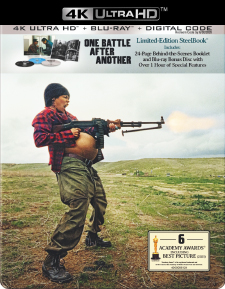
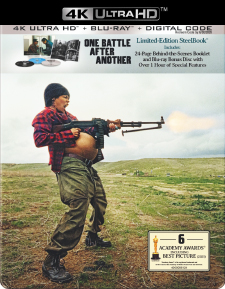
The Warner Home Video Limited Edition Steelbook release of One Battle After Another is a three-disc set that includes a Blu-ray with a 1080p copy of the film, a second Blu-ray with all of the extras, and a Digital Code on a paper insert. The UHD appears to be the same one that was included with Warner’s previous single-disc release of the film, although that set didn’t include a Blu-ray copy of the film (or any extras, for that matter). There’s also a J-card slipcover and a booklet featuring photographs excerpted from Merrick Morton’s out-of-print collection One Battle After Another. The following extras are included on the second Blu-ray only, all of them in HD:
- Camera, Lighting, & Costume Tests (6:12)
- Chase Infiniti Screen Test (11:51)
- Learning, Studying... Always Perfecting: The Making of One Battle After Another (52:51)
- The Cutting Rooms (7:51)
- Opening Night at The Vista (7:07)
The extras kick off with a collection of Camera, Lighting, & Costume Tests, as well as a separate compilation of Chase Infiniti Screen Tests. The latter is interesting because she performed most of them with Leonardo DiCaprio, so they were testing her chemistry with the lead actor as much as anything else.
Learning, Studying... Always Perfecting is a fly-on-the-wall documentary directed by Jacob “Kuba” Bojsza that consists entirely of footage captured on the set—no real interviews or narration (although at one point, the on-set projectionist offers an explanation of his duties). But it does include a variety of different material like rehearsals, planning, blocking, and the actual shooting. While Anderson no longer participates in explanatory extras like commentary tracks, featurettes like this still offer some glimpses of him at work on the set (and in this case, giggling at some of the performances, so he definitely saw the humor in the material). There’s some interesting footage here, like the raw takes of Bob’s fall from the building roof, showing the different elements that were stitched together digitally in the final shot. There’s also plenty of footage of the VistaVision cameras at work (and the Super-35 cameras can be glimpsed as well). Learning, Studying... Always Perfecting ends with a tribute to assistant director/producer Adam Somner, who passed away during the production. (The film itself and even the booklet in this edition are also dedicated to Somner.)
The Cutting Rooms focuses on editorial, with assistant film editor Andrew Blustain and negative cutter Jim Hall explaining the process of editing on Avid, conforming that to film reels, and then cutting the negative to match. The highlight is Hall demonstrating how the fades and dissolves were cut A/B roll, which explains the high quality of the opticals in the final film.
Finally, Opening Night at the Vista is a behind-the-scenes look at getting the Vista Theater in Los Angeles ready for opening night, followed by a montage of before-and-after interviews with the eager fans who were waiting in line. It’s not a huge collection of extras, but it’s a step up from what was included on the last several Paul Thomas Anderson films, and it’s a huge leap from the barebones original release of One Battle After Another. Like any Steelbook, it’s not cheap, and it may be difficult to get your hands on a copy, but it’s worth the effort. Highly recommended.
- Stephen Bjork
(You can follow Stephen on social media at these links: Twitter, Facebook, BlueSky, and Letterboxd).