
Odyssey, The (4K UHD Review)
Director
Christopher NolanRelease Date(s)
2026 (November 17, 2026)Studio(s)
Universal Pictures/Syncopy (Universal Pictures Home Entertainment)- Film/Program Grade: B+
- Video Grade: A-
- Audio Grade: A-
- Extras Grade: B+

Review
“In space, all warriors are cold warriors.”
– Klingon chief of staff General Chang, 2293
Time will tell whether or not Chang offers an accurate view of conflict that slips the surly bonds of Earth (although the creation of the United States Space Force in 2019 demonstrates that we’re well on our way to finding out), but in our present context, it would be more accurate to say that on Earth, all warriors are culture warriors. Outside of the occasional regional conflict, modern warfare has been as much cultural as militaristic—in fact, the lines between the two have blurred to the point that memes have become weapons. Yet in the culture wars that have become endemic to modern society, everything has become weaponized as grist for the outrage mill. So, it’s not particularly surprising that Christopher Nolan’s announcement that he was adapting Homer’s The Odyssey was met with immediate resistance by our intrepid modern culture warriors.
It doesn’t help that he chose to use Emily Wilson’s 2019 translation as a starting point. Wilson’s version was the first complete English-language translation by a woman, and while its critical reception was largely positive under the limited sphere of influence in which translations of The Odyssey are normally viewed, once Nolan helped raise it into the broader popular consciousness, the culture warrior knives were sharpened. Wilson’s approach was to eschew the grandiloquent verbiage of earlier translations like Alexander Pope’s 1725-1726 version, simplifying the language to fit into Homer’s verse structure while maintaining Homer’s original 12,100-line count (to make that work, she opted to replace the original Greek’s dactylic hexameter with English iambic pentameter). She also tried to eliminate the cultural biases of previous translations, including problematic gendered language that wasn’t necessarily accurate to Homer, and that’s what really upset the modern culture warriors—this despite the fact that they probably never read any translation of The Odyssey in the first place.
Pope’s English verse translation rendered Homer’s opening stanza thusly:
“The man for wisdom's various arts renown'd,
Long exercised in woes, O Muse! resound;
Who, when his arms had wrought the destined fall
Of sacred Troy, and razed her heaven-built wall,
Wandering from clime to clime, observant stray'd,
Their manners noted, and their states survey'd,
On stormy seas unnumber'd toils he bore,
Safe with his friends to gain his natal shore…
Oh, snatch some portion of these acts from fate,
Celestial Muse! and to our world relate.”
In Samuel Butler’s 1900 English prose translation (the first version that I read), the language is greatly simplified but still somewhat archaic. In Wilson’s modern translation, the same passage is rendered far more directly:
“Tell me about a complicated man.
Muse, tell me how he wandered and was lost
when he had wrecked the holy town of Troy,
and where he went, and who he met, the pain
he suffered on the sea, and how he worked
to save his life and bring his men back home...
Now goddess, child of Zeus,
tell the story for our modern times.
Find the beginning.”
It’s easy to see why her translation appealed to Nolan. It’s a simpler way of retelling Homer’s story for modern readers, maintaining a certain amount of ambiguity regarding the character of Odysseus (the “complicated man” of her first line, as opposed to “renown’d” in Pope or “ingenious” in Butler). Nolan’s script wasn’t so much adapted from Wilson’s translation as it was inspired by her approach, since that fit into his larger project of demythologizing the mythological. Nolan’s Dark Knight trilogy had stripped away overtly comic book elements from the Batman mythos in favor of keeping everything relatively grounded, and his adaptation of The Odyssey follows suit (no pun intended), going well beyond Wilson to express open skepticism regarding the nature of heroic values and the very concept of myth itself.
Tellingly, Nolan’s version of The Odyssey opens not with Homer’s call to the Muse (that comes later), but rather with a modest title card that states: “A time of apparent magic.” That deceptively simple adjective sets the tone for the entire film, putting viewers on notice that Nolan’s skepticism extends to gods, monsters, and the supernatural in general, and this version of The Odyssey is going to be significantly more grounded than any previous ones. The gods are referenced throughout the film but remain largely absent, never directly answering those who call upon them for aid. (There’s a single exception, but Nolan handles her in a way that makes it clear that she may simply be a figment of Odysseus’ imagination, and more importantly, the result of his overwhelming sense of guilt for what he’s done in the past).
Oh, there are still monsters in The Odyssey like Polyphemus and Scylla, but they’re usually half seen, either cloaked in shadow or else glimpsed via quick cuts that keeps them more offscreen than on. Nolan also toys with Arthur C. Clarke’s third law that any sufficiently advanced technology is indistinguishable from magic, presenting the giant man-eating Laestrygonians as enormous knights wearing anachronistic medieval armor, looking relatively human to modern viewers but still sufficiently monstrous to Odysseus and his crew. Emily Wilson sought to make The Odyssey relevant for modern readers, but Nolan took that idea to the next level, taking Homer’s story of gods and monsters and making it feel not just relevant, but also relatively real.
Nolan’s Odyssey is still epic in scope (thanks in no small part to his decision to shoot the entire film in 15-perf 70mm IMAX format), but it lacks the mythical grandeur of Homer. Yet that’s actually by design—a feature, not a bug. Nolan is far more interested in the human cost of heroic endeavor, both by those on the receiving end of the violent deeds enacted by complicated men and on the souls of those who engage in them—in The Odyssey, we have met the enemy, and they are us. Nolan’s script repeatedly references xenia, the Grecian concept of hospitality, calling it Zeus’s law (Zeus was considered to be the protector of strangers). The idea was that since the gods occasionally took human form, the inhospitable risked accidentally mistreating a god in disguise (a concept borrowed by the unknown author of Hebrews 1:32: “Do not neglect to show hospitality to strangers, for by doing that some have entertained angels without knowing it.”) In The Odyssey, those who violate this code of hospitality, whether hosts or guests, will pay the ultimate price. Perhaps Nolan’s unseen gods are at work behind the scenes after all.
So, it’s ironic that the same hospitality wasn’t necessarily extended to Christopher Nolan. The fact that he used Wilson’s translation lit the culture war fires underneath him, but he ended up fanning those flames once the casting was announced. The likes of Matt Damon, Tom Holland, Anne Hathaway, Robert Pattinson, Samantha Morton, Charlize Theron, John Bernthal, Bill Irwin, Mia Goth, and even John Leguizamo were all welcomed with open arms, but Lupita Nyong’o, Zendaya, Himesh Patel, and rapper Travis Scott were not, with particular outrage expressed toward Nyong’o as both Helen of Troy and her sister Clytemnestra. (In the culture wars, Zeus’s law doesn’t extend to people of color.) The inclusion of Elliot Page ended up throwing kerosene on the fire, although that was mostly due to false reports that he was playing Achilles in a flashback (Page actually plays Sinon, a character imported from Virgil’s Aeneid, and his diminutive stature makes perfect sense in context with Nolan’s version of this story).
Unsurprisingly, the pre-release furor over Nolan’s source material and his casting choices ended up being much ado about nothing. It’s important to remember that The Odyssey isn’t history, it’s myth. These aren’t historical Greek figures; they’re mythical ones, and no amount of grounding the story to make it feel more realistic will change that fact. They’re not real people (historical or otherwise), and they’re not even characters per se, but rather archetypes, and Nolan’s casting follows suit. Hell, even Homer himself may well be a myth, with the actual authorship of The Iliad and The Odyssey having been hotly debated for centuries (a debate that’s generated a title of its own: the Homeric Question). And actors like Matt Damon, Tom Holland, Anne Hathaway, and Robert Pattinson aren’t Greek either, so clearly the culture war outrage over Nolan’s casting choices was never really about authenticity in the first place.
Ultimately, none of the fuss mattered, either. Nolan’s take on The Odyssey went on to gross over $1.8 billion at the global box office (as of this writing), dominating IMAX screens for months and becoming the highest-grossing R-rated film of all time. If he who laughs last, laughs the loudest, then Nolan must have had a belly laugh indeed at those who doubted him (and if all warriors are cold warriors in outer space, then in box office space, no one can hear the screams of culture warriors). Love him or hate him, Christopher Nolan has an uncanny knack for making large-scale, large-format films that get modern audiences out from behind streaming devices in the comfort of their homes and into theatres. The Odyssey was enormously expensive to produce, topping the scales at $250 million, but in hindsight, the massive return on investment never should have been in doubt. Nolan will stumble eventually, but as The Odyssey demonstrates, not even our modern culture wars can slow him down.
Cinematographer Hoyte van Hoytema shot The Odyssey on 65mm film in 15-perf horizontal IMAX format using Imax MSM III, Mk IV, V, and Keighley cameras with custom Panavision, Zeiss, and Hasselblad lenses. IMAX also developed a new blimp system for the noisy cameras that allowed van Hoytema and Nolan to shoot the entire film in the format, dialogue scenes included (and unsurprisingly, the blimp was so massive that they also had to add mirrors around it so that the actors could maintain their eyelines with each other). While visual effects were still composited digitally and the film was also edited digitally, those VFX shots were output back to film so that The Odyssey could be completed as a cut camera negative (with the effects shots technically being internegative), and for the film’s release in 15 perf 70mm IMAX, prints were made directly from the camera negative at full-frame 1.43:1. But film and digital deliverables were also created for 5 perf 70mm at 2.20:1, 4-perf 35mm at 2.39:1, digital IMAX GT laser at 1.43:1, and digital IMAX at 1.90:1, plus wide-release DCPs at both 2.39:1 and 1.85:1 to cover differently-shaped screens. And that brings up a subject that needs to be addressed.
As the wide variety of deliverables clearly demonstrates, the goal was to have The Odyssey fill the screen regardless of aspect ratio—no letterbox bars, no pillarbox bars, no masking, just an image that covers every inch of available real estate. So, in that spirit, it’s being presented at full-frame 1.78:1 for home video. Anyone who thinks that it should be pillarboxed to 1.43:1 because that’s the “correct” ratio is missing the point that there is no correct aspect ratio for The Odyssey. Hoyte van Hoytema didn’t really compose for 1.43:1; he protected for it. He utilized what’s called “center-punch framing,” telling American Cinematographer that this was “one of the reasons that, in our case, the IMAX format is such a fantastic ‘master’ for any derived format: The essence of the frame doesn’t change from format to format.” The Odyssey was protected to work at ratios anywhere from 1.43:1 to 2.39:1, so the only “correct” ratio is that of the screen that’s playing it—and on home video, that’s natively 1.78:1.
This version has been graded for High Dynamic Range in HDR10 only, but in the spirit of Nolan’s desire to replicate the experience of analogue film even on digital formats, it’s effectively 10-bit SDR in an HDR container, never straying beyond the capabilities of projected film. While the image is sharper and better-defined in 4K, the grades on UHD and Blu-ray are nearly identical. There have already been complaints about the lack of “real” HDR and elevated black levels, but HDR isn’t only about the nits, it’s also about the move from 8-bit color to 10-bit color (although in terms of color, The Odyssey doesn’t really present many opportunities for an expanded gamut). And as far as the black levels go, Nolan’s films have always tended to be underexposed in the darkest scenes, like inside of Polyphemus’ cave here. If you’re looking for shadow detail, it’s usually not there, and elevated blacks are part and parcel with Nolan. In fact, while I would never presume to trust my own memories regarding theatrical color timing and/or grading, I do distinctly recall seeing muddy, grayish blacks in the digital IMAX screening that I attended. For good or for ill, The Odyssey on 4K Ultra HD looks exactly like it did in the theatres. Take that as you will.
Primary audio is offered in English 5.1 DTS-HD Master Audio. That’s Nolan’s preference, so as usual, there’s no Atmos mix available here. But also as usual, the quality of a mix isn’t defined by the quantity of available channels, but rather by how they’re used, and Nolan’s 5.1 mixes are usually fully immersive—and this one is no exception. It’s a creative mix, too, making interesting use of subjective sound, like when Eurylochus puts wax in his ears as a defense against the call of the Sirens. (He’s facing the camera, so when he puts wax in his right ear, the left screen channel is muted to match, followed by the right channel after he waxes his left ear.) The bass is appropriately thunderous if perhaps a bit muddy, but that’s still true to the IMAX experience, which is always far muddier than what well positioned and calibrated home subwoofers can achieve. And yes, it’s a Christopher Nolan film, so the mix is deafeningly loud at times, although after having recently seen the IMAX version of Godzilla Minus Zero, Nolan seems pretty tame in comparison.
Additional audio options include Spanish and French 5.1 DTS, with optional English SDH, Spanish, and French subtitles.
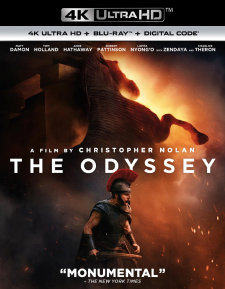
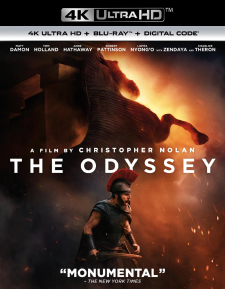
The Universal Studios 4K Ultra HD release of The Odyssey is a three-disc set that includes a Blu-ray with a 1080p copy of the film and a second Blu-ray with all of the extras. It also includes a slipcover that duplicates the theatrical poster artwork on the insert and a Digital Code on a paper insert tucked inside. (There was also a Limited Edition Steelbook version, but good luck getting your hands on that.) The following extras are included on the second Blu-ray only, all of them in HD:
DISC THREE: SPECIAL FEATURES (BD)
- Behind the Scenes:
- Plotting a Course (5:24)
- Icons (11:52)
- The Widest Window (4:43)
- On Location (8:23)
- The Horse (2:38)
- The Fall of Troy (8:23)
- Ithaca (6:20)
- Battle Ready (6:27)
- Apparent Magic (14:33)
- The Sea People (6:36)
- The Score (6:38)
- Bringing It Home (9:17)
- Trailers:
- Teaser (1:24)
- IMAX Exclusive Prologue (5:27)
- Trailer 1 (1:55)
- Trailer 2 (2:33)
- Countdown Trailer (2:32)
- Extras:
- James Blake, Travis Scott, & Ludwig Göransson When I’m Home Music Video (5:37)
- The Journey of Film on The Odyssey (1:31)
The Behind the Scenes is a 12-part documentary on the making of The Odyssey. Produced under the supervision of Christopher Nolan, it features an abundance of behind-the-scenes footage and interviews with Nolan, Hoyte van Hoytema, Ludwig Göransson, Matt Damon, John Leguizamo, Anne Hathaway, Tom Holland, Samantha Morton, Lupita Nyong’o, Zendaya, Himesh Patel, Bill Irwin, producer Emma Thomas, editor Jennifer Lame, costume designer Ellen Mirojnick, production designer Ruth De Jong, special effects supervisor Scott R. Fischer, visual effects supervisor Andrew Jackson, and many, many more.
Plotting a Course addresses the process of adapting Homer’s story for modern audiences, including how they avoided the clichés of historical epics and strove to make the mythology more believable. Icons looks at the casting and the way that the costumes, makeup, and hairdressing help to bring the characters to life. The Widest Window explores the IMAX format, which van Hoytema calls “the widest open window to the world.” On Location looks at the challenges in bringing the production to a variety of remote locations across the globe. The Horse shows the design and construction of the Trojan Horse. The Fall of Troy is about the massive scale of the sacking of Troy, from building the sets and costuming the extras to the elaborate electronic lighting scheme that van Hoytema developed in order to simulate firelight.
Ithaca explores the process of using the Favignana locations in Sicily and massive sets on stage to recreate ancient Ithaca. Battle Ready is about planning and choreographing the film’s fight scenes. Apparent Magic demythologizes the practical and visual effects in The Odyssey, with Nolan noting that they approached everything like it was a magic trick, mixing a variety of techniques in order to keep audiences off balance while not spoiling the illusion. The Sea People focuses on the construction of the ships and the challenges of shooting them at sea and in water tanks at Universal (with van Hoytema manhandling one of the massive IMAX cameras for handheld shooting). The Score is about just that, with Göransson, Nolan, and the various musicians demonstrating how the score was created. Finally, Bringing It Home looks at post-production, including editorial and sound design.
Universal has included a collection of different trailers including the IMAX Prologue, which is pillarboxed at the original 1.43:1 aspect ratio, so it shows how the film would have looked on a 1.78:1 screen. Yet all of the other trailers are framed at 2.39:1, so they also show how van Hoytema’s compositions were designed to work at any ratio.
There’s also a couple of bits of ephemera, including a music video and The Journey of Film, which is a brief interview with Nolan covering how the IMAX negative was processed; the way that they edited everything digitally; how the negative was cut to conform; and the way that 15/70 IMAX prints were printed directly from the negative.
It’s not the most comprehensive set of extras, but I’ve always maintained that one good making-of documentary is worth its weight in static talking-head interviews or other flabby, poorly edited featurettes. So, I’m very happy with the extras here. And in terms of replicating the intended look and sound of The Odyssey as seen in theatres, I’m equally happy with this 4K presentation. But if all that interests you are nits and Dolby Atmos, you may want to look elsewhere. Know thyself.
- Stephen Bjork
(You can follow Stephen on social media at these links: Twitter, Facebook, BlueSky, and Letterboxd).