
Letty Lynton (Blu-ray Review)
Director
Clarence BrownRelease Date(s)
1932 (June 30, 2026)Studio(s)
Metro-Goldwyn-Mayer (Warner Archive Collection)- Film/Program Grade: A-
- Video Grade: A-
- Audio Grade: B+
- Extras Grade: B

Review
Unavailable for decades due to a copyright infringement lawsuit, 1932’s romantic drama Letty Lynton helped Joan Crawford to further dominate the industry as a popular Hollywood actress with more access to and control over the kinds of projects she was offered, specifically by her then employer, Metro-Goldwyn-Mayer. She had recently been building her reputation with appearances in Possession and Grand Hotel, but Letty Lynton was a turning point in her career. Besides being an enormous success, the film also caused a fashion craze due to the popularity of one of Crawford’s gowns, which Macy’s sold to the public to great profitability.
Wealthy American socialite Letty Lynton (Crawford) has traveled to Montevideo, living the party lifestyle while having an affair with the debonair Emile Renaul (Nils Asther). Her nights on the town have come to an end as she begins to tire of her life, perfectly willing to shed it completely and go back home to her family in New York, despite Emile believing it to be nothing more than a whim. She and her maid Miranda (Louise Closser Hale) board a steamship home, whereupon she meets the dashing Jerry Darrow (Robert Montgomery). The two quickly fall in love, but things become complicated when they arrive at their destination and Emile is already there waiting for her. Seeing a true future with Jerry, Letty attempts to rid herself of Emile, but he won’t go away so easily. The rest of the cast includes May Robson, Emma Dunn, Walter Walker, and Lewis Stone.
What’s fascinating about Letty Lynton’s plot is that you don’t necessarily feel at ease once it’s concluded. Letty certainly receives some much needed (though not necessarily deserved) happiness, but if you examine her trajectory, up to and including what sets the ending in motion, then you’ll realize that it’s not a cookie cutter "and they lived happily ever after" close to the film. In fact, it leaves you with some questions about how it got there, and in a different era, specifically during the forthcoming production code, there’s no way a major studio would have released a film like this with that ending attached to it. Letty does some not so nice things during her travels, but she also has some not so nice things done to her, as well. And because Joan Crawford’s portrayal is so sympathetic, we side with her, even if we feel morally corrupted in some way. That’s what makes Letty Lynton more interesting than your average romantic drama. It has some teeth to it that others don’t always have, giving you pause about the characters and the events as they play out, never mind the frankness of Letty’s amorous entanglements.
While Joan Crawford is justifiably celebrated for her performance, the supporting cast is also worth appreciating. Robert Montgomery is absolutely charming as Letty’s would-be suitor, while Nils Asther’s Emile seems suave and charming at first, but becomes more unbalanced once he’s repeatedly jilted by Letty. May Robson’s mother character is absolutely fed up with her own flesh and blood, seeing a reflection of her late husband in her, but you can tell that she still cares, and she gets the chance to prove it. She may say little, but her silence speaks volumes, and when she does speak, it carries a lot of weight. Meanwhile, Louise Closser Hale’s Miranda is the more obvious comic relief, but thankfully not to an irritating degree. Her devotion to Letty is admirable, but without the presence of mother Lynton, you begin to wonder why she puts up with so much.
Letty Lynton is truly a lost gem, not just in the filmography of its star, but for its director Clarence Brown (Sadie McKee, Wife vs. Secretary) and its director of photography Oliver T. Marsh (Possessed, The Great Ziegfeld). It’s certainly one of the more emotionally complex and adult-oriented films of its era, which was right on the verge of being regulated two years later by the Hays code. Despite the lawsuit it incurred later on, having been accused of infringing upon the play Dishonored Lady by Edward Sheldon and Margaret Ayer Barnes, Letty Lynton was also based upon the novel of the same name by Marie Adelaide Belloc Lowndes. Whether there was any validity to the infringement claims or not, and in this reviewer’s opinion there likely wasn’t, Letty Lynton is an intriguing and entertaining film with a satisfying conclusion that may get you and your friends or significant others talking, weighing the pros and cons of how it gets there.
Cinematographer Oliver T. Marsh shot Letty Lynton on 35mm black-and-white film with spherical lenses, the results of which were finished photochemically, and framed theatrically at the aspect ratio of 1.37:1. The Warner Archive Collection brings the film to home video for the first time, debuting on Blu-ray from a new 4K restoration of preservation elements, which is a safety fine grain created by MGM prior to the 1965 and 1976 vault fires that, unfortunately, destroyed the original camera negatives for many films, including Letty Lynton. This presentation has been encoded to a BD-50 disc. It’s a beautiful black-and-white picture, and since there have been no others, there’s nothing else to judge it against. Nonetheless, it’s a stunner, even a step away from the original camera negative. Bitrates sit in the 30 to 40Mbps range most of the time, maintaining excellent picture quality with good compression and high levels of detail. Grayscale is outstanding, allowing for deep levels of detail in the blacks while never blowing out whites, and maintaining healthy gradations in between. There’s some mild instability and telecine wobble built in, but the process shots and even the opticals preserve a terrific sharpness with well-resolved grain. Aside from any flaws built in to the original elements themselves, this is a stunner.
Audio is included in English 2.0 mono DTS-HD Master Audio with optional subtitles in English SDH. Films of this vintage don’t always carry the most robust of soundtracks, especially since sound was a relatively new aspect of motion pictures during the early 1930s. That said, this is a relatively problem-free track with a mild hiss and some low level distortion, but dialogue and score are healthy enough and given plenty of support on this split-channel track.
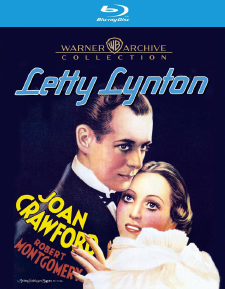
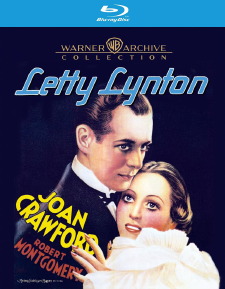
The Warner Archive Collection Blu-ray release of Letty Lynton sits in a blue Amaray case with an insert featuring artwork from the film’s Belgian theatrical poster. It’s significant to note that this film is also being released on DVD, a rarity for Warner Archive, since the film has never been available legally on any home media prior. The following extras are included:
- Irving Thalberg: Prince of Hollywood (SD – 74:04)
- Radio Shows:
- Good News of 1938 (HD – 52:27)
- Good News of 1939 (HD – 56:53)
- A Doll’s House (HD – 59:33)
- Train Ride (HD – 29:37)
- None Shall Part Us (HD – 31:25)
Irving Thalberg: Prince of Hollywood is a wonderful documentary from 2005 by Robert Trachtenberg about the life and career of the legendary Universal and MGM producer with various film historians, actors, and other figures. Out of circulation for some time, it gets into the nitty gritty of Thalberg, showing his best and worst sides, while also praising and appreciating his short life’s work. It’s absolutely worth a watch. Next are a series of episodes of radio programs featuring Joan Crawford. Good News of 1938 and Good News of 1939 is presented by Maxwell House coffee and also features appearances by Frank Morgan, Billie Burke, and Judy Garland, among others; A Doll’s House from 1938 is presented by Lux Radio Theatre and Cecile B. Demille, and also features Basil Rathbone; Train Ride from 1939 is presented by The Silver Theatre and Conrad Nagel; and None Shall Part Us from 1939 is presented by Gulf Stream Guild Theater and Roger Pryor, and also features Lew Ayres. Unfortunately, some of these programs contain dropouts all throughout. It would have been nice to have had someone on board to discuss the film’s history and its restoration, but this is still a nice set of supplements.
90 years is an awfully long time for a film that’s perfectly releasable to lie dormant, but thanks to the urging of Joan Crawford’s grandson Casey LaLonde, and the efforts of Warner Archive’s George Feltenstein, Letty Lynton now lives and breathes again. It’s a pre-Code classic film that deserves a higher status now that it’s fully available in superb quality. Highly recommended.
- Tim Salmons
(You can follow Tim on social media at these links: Twitter, Facebook, and Letterboxd. And be sure to subscribe to his YouTube channel here.)