
Obsession (2025) (4K UHD Review)
Director
Curry BarkerRelease Date(s)
2025 (July 14, 2026)Studio(s)
Blumhouse Productions/Capstone Studios/Tea Shop Productions/Focus Features (Universal Pictures Home Entertainment)- Film/Program Grade: B+
- Video Grade: A
- Audio Grade: A-
- Extras Grade: B-

Review
Note: while there aren’t any blatant narrative spoilers below, it’s difficult to discuss Obsession without openly addressing what happens on a thematic level. If you haven’t seen the film yet and have somehow managed to escape all of the online discourse about it, you’re better off skipping directly to the video section and watching it as cold as possible. Caveat emptor.
In Anthony Boucher’s 1955 short story Nellthu, a man encounters an old schoolmate who had once been homely and untalented, but now she’s beautiful, talented, famous, and extremely wealthy. After spending the night with her, he realizes that her faithful manservant is actually a demon who was required to grant her the traditional three wishes. But the math doesn’t quite add up, so he asks the demon Nellthu how she got so much out of him for so little. Nellthu responds that he successfully cheated her on her first two wishes, but for the third, she turned the tables on him with a deceptively simple request: “I wish that you fall permanently and unselfishly in love with me.” And the man who slept with her last night suddenly realizes just how lucky he was that she included the word “unselfishly” in her final request.
In Curry Barker’s breakthrough horror smash Obsession, Bear (Michael Johnston) is obsessed with his friend and coworker Nikki (Inde Navarrette), but he’s too shy and reserved to express his feelings to her. He even ropes their fellow coworker Ian (Cooper Tomlinson) into helping stage a practice session for him, while the fourth member of the triangle, Sarah (Megan Lawless), quietly deals with unrequited feelings of her own. After visiting a trinket shop, Bear buys a novelty toy called a One Wish Willow and plans to give it to Nikki while finally telling her how he feels, but after fumbling the situation like usual, he uses it to make a wish of his own: “I wish Nikki Freeman loved me more than anyone in the fucking world.”
Oh, if only Bear had read Boucher’s story first. The consequences of his pernicious and poorly-phrased wish will end up turning Bear’s world upside down, and even more importantly, it completely shatters Nikki’s world—with deadly consequences. “Be careful what you wish for,” the old saying goes, but you also need to be careful how you wish for it. Superficially, Obsession appears to be a riff on the 1902 W.W. Jacobs short story The Monkey’s Paw, where wishes always come at a great personal cost. And to be fair, Barker did indeed draw some loose inspiration from the Jacobs story. There’s a crucial difference, however: while the titular monkey’s paw bore a curse, and even the wishes granted by demons and djinns were usually twisted against the wisher (Boucher’s clever schoolmate excepted), there’s nothing inherently cursed about the One Wish Willow. The problem is that Bear dragged his own curse into the situation, and that’s the key not just to understanding Obsession, but to understanding Barker’s title as well.
On a superficial level, Obsession may seem like a cautionary parable about a wish that breaks very, very bad, with Nikki acting so obsessed with Bear that his newfound relationship is mildly disturbing at best and openly horrific at worst. But she wouldn’t be in that position if he didn’t put her there, and the reason why he did so is that he’s the one who’s long been obsessed with her. Since she’s being controlled by the One Wish Willow at Bear’s behest, she no longer has any choice regarding her actions, and that means she’s effectively a prisoner in her own body. Bear’s obsession with her is so shallow and thoughtless that he’s willing to remove her personal agency. He even sleeps with her despite the fact that he knows she’s not really consenting to it, and as the situation goes from bad to worse, he tries not necessarily to cancel the wish, but rather to alter it back to his original intentions—meaning, he doesn’t have any problem with the fact that he’s removed her agency, but only with how poorly things have worked out so far. When Nikki has a brief moment of unconscious lucidity and begs him to end her suffering, Bear responds plaintively, “What’s so bad about being with me?”
Everything, Bear, everything. Online debates about whether or not Bear is the villain of Obsession are tilting at windmills, because it really doesn’t matter what role that Bear plays in the structure of the narrative. All that matters is that he’s an asshole, plain and simple. Examining their relationship from the perspective of codependency also loses sight of that fact, because while Nikki’s obsessive caregiving behavior toward Bear enables his own destructive behavior toward her, she wouldn’t be there if he hadn’t forced her into that position in the first place. Yes, Obsession is a cautionary parable, but not so much about being careful what you wish for. Instead, it’s a warning to be careful around the kind of people who are willing to go to any lengths to get what they want. Bear’s wish does come true in the film, but the reason why he’s so shocked by the results is that he never really cared for Nikki in the first place; he only cared about his fantasized ideal of what she could mean for him. Yet even a device that makes wishes come true can’t turn fantasies into reality, so Nikki is the one who pays the price for Bear’s lack of vision.
In other words, when fantasies become reality, it’s usually at someone else’s expense. That holds true on the meta level as well, as the unexpected global box office success of Obsession demonstrates. It was certainly a wish come true for Curry Barker, who went from making comedic shorts for his that’s a bad idea YouTube channel to becoming a highly sought-after horror director attached to multiple projects like a reboot of The Texas Chainsaw Massacre. But it takes a village to make a film, and on an ultra-low budget project like Obsession, everyone has to wear multiple hats for low or even no pay—and when a film becomes a sleeper hit, it’s usually only the topline talent that benefits.
Art director Sally Choi pointed out on social media that she made a grand total of $6741.36 (with no mileage) for not just doing that job, but also serving as PA, set dresser, graphic designer, background actor, driver, swing, and buyer—all on a film that as of this writing has now earned $475 million worldwide. Her post generated plenty of online debate of its own, with some armchair quarterbacks arguing that she doesn’t deserve a penny more than what she agreed to in the first place, and that she should just be grateful that she was given the opportunity to work on the film at all. (That’s always easy to say when it’s not your own labor that was involved.) Regardless, it’s a striking reminder that when wishes come true for one person, someone else often pays the price.
Still, while Barker’s collaborators do deserve their fair share of the credit for the success of Obsession (especially cinematographer Taylor Clemens and composer Rock Burwell), it was all in the service of his vision for the film. As a result, the visuals in Obsession are as tightly controlled (and tightly wound up) as the characters. Bear and Nikki are usually centered within the frame in shallow focus, which creates an oppressive feeling of the world squeezing in around them. Combined with Burwell’s subtly dissonant score, Obsession becomes an exercise in quiet unease from the first scene to the last. Yet even all of that didn’t occur in a vacuum, as Barker has acknowledged that he drew visual inspiration from the work of Ari Aster, especially films like Heredity and Midsommar. But we’re all little more than the sum total of our influences and experiences, and there’s no denying that Curry Barker fused all of those influences into a compelling vision of his own. But unselfishly? That remains to be seen.
Cinematographer Taylor Clemens captured Obsession digitally at 4.6K resolution (in ProRes 4444 format) using Arri Alexa 35 cameras with vintage Panavision Ultra Speed and Primo Zoom lenses. Post-production work was completed as a 4K Digital Intermediate, framed at 1.50:1 (an increasingly common aspect ratio that Friend of the Bits Vincent Pereira affectionately refers to as “VinnieVision,” since he used it decades ago on his 1997 film A Better Place). This version is graded for High Dynamic Range in Dolby Vision and HDR10, and it’s been encoded onto a BD-66. Since the image is pillarboxed and there aren’t many extras on the disc, that’s more than enough space, and there aren’t any significant issues with compression artifacts.
The results are... interesting. Obsession isn’t going to land in anyone’s pile of demo discs, and yet it’s an entirely faithful representation of the look that Barker and Clemens were trying to achieve. In an interview for the Focus Features website, Clemens said that his visual touchstone was Se7en, and that he “was completely set on making this world feel as murky and dreadful as possible.” Sickly greens, ambers, and reds predominate the color scheme, with intentionally muddy shadows at the margins of the frame. Clemens rated most of the film at 160 or 200 ISO and used fast lenses at wide-open apertures, so that explains the consistently shallow focus. It also explains why those blacks appear are a bit elevated at times. It’s a deliberately dim film, so the HDR pass doesn’t affect the highlights very much, but it does offer just a touch more detail into those murky blacks (although that’s arguably as much due to the shift to 10-bit color as it is to anything to do with the actual HDR grade). But don’t look for detail where there never was any in the first place; while Se7en may been a touchstone for Clemens, his fantastic work here doesn’t replicate the high-contrast bleach bypass look of that film. As he explained to American Cinematographer:
“In the testing phase, I grew to love the nuanced gradients of darkness that this approach allows with the camera’s latitude overly bottom-loaded. It gives a feeling to the image that’s hard to describe. There’s a fuzzy, dream-like quality to the shadows in the camera reminiscent of a lo-fi PS1 video game. The toe of the image felt atmospheric, like a faded memory of a nightmare you once had... Of course, I never thought so many people would see the film. I especially didn’t expect the majority of viewings to be on a theatrical projection. I was a little shell shocked to learn how this look translated to a projection space... In the end, I’m happy I saw that idea through—it led me to a few breakthrough moments and clarity on the feeling I was chasing.”
Primary audio is offered in English Dolby Atmos. While there’s some gently immersive qualities to the mix, especially in noisy interiors like at Barker’s Pub (natch), the sound design generally adheres to the visual design and keeps things tightly focused around the characters who are front and center. It’s a great example of less is more, since it creates aural unease by making it feel like you have to lean forward to catch what’s happening—which helps make the occasional loud stinger work even more effectively. Still, there’s no question that Rock Burwell’s score is doing most of the heavy lifting in that regard. Since it stays firmly in the background of the mix, it’s another example of less is more, and yet it’s just as responsible for making viewers feel uncomfortable as any of the disturbing visuals on display. Like the video, it’s not a demo-quality mix, and yet it’s perfect for a film like Obsession.
Additional audio options include Spanish and French 5.1 Dolby Digital. Subtitle options include English SDH, Spanish, and French.
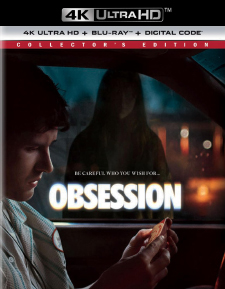
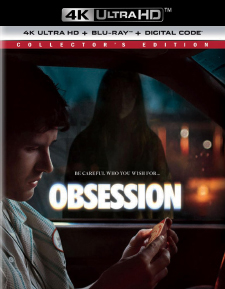
The Universal Pictures Collector’s Edition 4K Ultra HD release of Obsession is a two-disc set that includes a Blu-ray with a 1080p copy of the film, a slipcover that duplicates the theatrical poster artwork on the insert, and a Digital Code on a paper insert tucked inside. The following extras are included on both discs:
- Commentary by Curry Barker
- Obsession Unleashed (HD – 19:13)
Barker opens by offering some background regarding how Obsession came together and ended up getting picked up by Focus Features after it made a splash at the Toronto International Film Festival. From there, he breaks down the ins and outs of the film, pointing out scenes that were part of reshoots and appearances by veteran cast members from his that’s a bad Idea channel. He also explains how each of the film’s sequences were achieved, from camerawork to performances and editing. He’s willing to admit when things didn’t work out to his satisfaction, like insert shots of a phone screen that he never quite figured out how to shoot. But he’s more than willing to praise all of his collaborators, although he does discuss where he had to stick to his guns against the wishes of the producers. While he lapses into silence occasionally, there’s plenty of interesting information to be had here.
Obsession Unleashed is a making-of featurette that includes interviews with Barker, Michael Johnson, Inde Navarrette, Cooper Tomlinson, and Megan Lawless. Barker offers an overview of how the project came together, and then together with the cast, they discuss the story, the characters, their performances, and the making of the film. They tell a few interesting stories, like the process that Barker used to storyboard and previz the film and the challenges of shooting the iconic death of one of the characters. At 19 minutes, Obsession Unleashed is unavoidably a bit cursory, but it’s still better than the average EPK featurette and well worth a look.
Obsession is the kind of horror film that definitely won’t be everyone’s cup of tea, which is one reason why its viral success has been so fascinating. It looks like 2026 is still going to be dominated by big-budget tentpole filmmaking (hello, Christopher Nolan and the truly amazing Spider-Man), but between Curry Barker, Kane Parsons, and others, it’s been a helluva year for independent filmmaking, too. Demo disc or not, Universal’s 4K Ultra HD release of Obsession is a helluva presentation of the film. Recommended.
-Stephen Bjork
(You can follow Stephen on social media at these links: Twitter, Facebook, BlueSky, and Letterboxd).