
New York, New York: Limited Edition (Blu-ray Review)
Director
Martin ScorseseRelease Date(s)
1977 (June 25, 2025)Studio(s)
United Artists (Imprint Films/Via Vision Entertainment)- Film/Program Grade: C+
- Video Grade: B
- Audio Grade: B+
- Extras Grade: A-

Review
Martin Scorsese’s expensive passion project New York, New York was a critical failure and a commercial disappointment when it was released in 1977, and while its reputation has improved a bit over the last few decades, it’s still considered one of the director’s lesser efforts. Yet in some ways, it’s the apotheosis of his usual style of filmmaking, for good and for ill. There has always been a tension in Scorsese’s work between his preference for gritty, street-level stories and the sometimes wildly expressionistic ways in which he presents them. That duality was already clear by 1977 with the way that Mean Streets, Alice Doesn’t Live Here Anymore and Taxi Driver contrasted the harsh realities faced by Johnny Boy, Alice Hyatt, and Travis Bickle with Scorsese’s fluid camerawork and jump-cut editing. They’re like Vittorio De Sica stories as interpreted by Max Ophüls: neorealism meets expressionism, with grit covered in gloss.
So, it shouldn’t be too surprising that Scorsese took his own dichotomous bull by the horns and signed on to direct New York, New York. It provided the opportunity for him to address this kind of tension directly by grafting a downbeat, gritty story of struggling postwar musicians with the superficial gloss of MGM musicals from the Forties and Fifties. Granted, that basic concept wasn’t particularly novel; Depression-era Warner Bros. stage musicals like Gold Diggers of 1933 had already done something similar in the way that they contrasted the dour reality of life on the street with fantastical Busby Berkeley numbers that couldn’t possibly have worked in a real musical theatre—they were staged for the cameras, not for the theatre audiences that were supposedly watching them. But Scorsese mimicking the Technicolor gloss of MGM musicals took that concept to the next level, although the results were undeniably mixed.
The script for New York, New York is credited to Earl Mac Rauch and Mardik Martin, although it was heavily rewritten and revised on the fly to satisfy Scorsese’s predilection for improvisation, and perhaps more significantly for the film’s fate, his love of the darker side of human nature. New York, New York opens on V-J Day, with rakish saxophone player Jimmy Doyle (Robert De Niro) pestering USO singer Francine Evans (Liza Minnelli) at a club where their fellow New Yorkers are celebrating. He won’t take no for an answer, either personally or professionally, and after a fitful start, the two of them end up on the road with a travelling band. Jimmy’s fortunes eventually rise when he takes over the band, and after the two marry, Francine has to deal with pregnancy and the fact that her genuine talent is leading her down a different path. But can the two of them have a happy ending? New York, New York also stars Lionel Stander, Barry Primus, Mary Kay Place, Frank Sivero, George Auld, Clarence Clemons, and the late great Dick Miller.
Robert De Niro has always had an uncanny gift for making thoroughly reprehensible characters seem oddly compelling, if not exactly sympathetic. However disturbed that Travis Bickle may have been, it was still easy enough for audiences to follow him on his journey into the heart of darkness. But Scorsese’s vision for Jimmy Doyle was too much for even De Niro to bear—not to put too fine a point on it, but Jimmy is a pure asshole from his first time macking on Francine until the bitter end of the film. He’s genuinely repellent, and while that kind of thing would work beautifully a few years later for Rupert Pupkin in Scorsese’s The King of Comedy, it has the unintended side effect of making Jimmy’s relationship with Francine feel implausible. Granted, plenty of women do end up married to complete jerks, but dramatically speaking, it helps if audiences are given at least a shred of an understanding why.
Jimmy Doyle is essentially Jake LaMotta with a saxophone instead of boxing gloves, insanely jealous and unable do deal with Francine getting any kind of attention from anyone else, no matter how innocent that it may be. Still, that kind of character has always proven irresistible to Scorsese, so it’s not surprising that he ended up shaping his glossy homage to MGM musicals into something every bit as dark and unpleasant as the bleakest of his crime dramas. And to be fair, that was the whole point of New York, New York, at least as Scorsese conceived it: the film is as much a deconstruction of Hollywood musicals as it is an homage to them. It acts as a critique of the artifice that’s inherent to the genre, but for better or for worse, Scorsese’s artifice extended to the lead characters and the nature of their relationship. As a result, the gritty reality that’s supposed to throw the artifice of the musical format into sharp relief ends up feeling no less artificial. But paradoxically, that means New York, New York actually may be a bit more coherent than it appears at first glance. Lesser Scorsese effort or not, it’s challenging to untangle all of the intertwining layers of artificiality in the film.
It doesn’t help that New York, New York was a troubled production. The film went significantly over budget, and Scorsese produced mountains of footage that took a team of editors to whittle down to a reasonable length (including Irving Lerner, Marcia Lucas, Tom Rolf, Bert Lovitt, and David Ramirez). And while Scorsese did compromise his theatrical cut by trimming or eliminating some scenes that would eventually be restored for his director’s cut, he insisted on retaining his originally intended downbeat ending. In a further irony, he ended up cutting down the already ironic Happy Endings number that precedes it—no fantasy happy endings in the theatrical cut, just straight to the unhappily real one.
Still, there was one unambiguous happy ending in New York, New York, just not for most of the people involved, Scorsese included. While the film is filled with familiar standards like You Are My Lucky Star, The Man I Love, and Blue Moon, John Kander and Fred Ebb contributed four new songs: the aforementioned Happy Endings, There Goes the Ball Game, But the World Goes ‘Round... and a little ditty with an irresistible vamp that also went by the name of New York, New York. But while Minnelli belts it out with panache during the film, the song didn’t attract much attention at the time, failing to score even an Oscar nomination for Best Original Song. It wasn’t until Frank Sinatra rerecorded it for his 1980 album Trilogy: Past Present Future that it finally took off (and Sinatra at least got a Grammy nomination to show for it, plus the final Top 40 hit of his distinguished career). New York, New York the film may not have made much money, but residuals from the song certainly didn’t do Kander and Ebb any harm.
On the other hand, there definitely wasn’t a happy ending for Jimmy and Francine, or even for Martin Scorsese himself, at least as far as this particular film may be concerned—he’s willingly acknowledged that his rampant drug use at the time prevented him from ever getting a handle on the structure regardless of how many editors were available to help (New York, New York is the one film from 1977 that Marcia Lucas didn’t salvage in the editing room). Scorsese’s own happy ending would have to wait one more year until he finally bottomed out and ended up in the hospital (and it was his old pal De Niro who helped reinvigorate his career by pushing him to adapt Jake LaMotta’s autobiography Raging Bull: My Story). But while New York, New York didn’t exactly light up the box office in 1977, it still left an indelible mark on popular culture thanks to a song that most people will instantly recognize—even those who have no idea that it came from this film. That’s the final dichotomy of this uneasy fusion of grit and gloss, albeit a bitterly ironic one, but hey, at least Sinatra, Kander, and Ebb got a happy ending out of it.
Cinematographer László Kovács shot New York, New York on 35mm film using Panavision Panaflex cameras with spherical lenses, framed at 1.66:1 for its theatrical release. There’s no information about this 1080p master (and it’s significant that Via Vision doesn’t offer any details on the packaging or their website), but it appears to be the same dated one that was used for MGM’s 2011 DVD, not the more recent 4K restoration (to be fair, the latter probably wasn’t available yet when Via Vision produced their set). Given the abundant use of optical transitions and heavy diffusion, New York, New York will never look like demo material, even in 4K, but this old 1080p version definitely falls a bit short. It’s even softer and the abundant grain isn’t resolved as well—in long shots, the character’s faces can appear somewhat smeary. Scorsese wanted to shoot New York, New York in 3-strip Technicolor (which was no longer an option in 1977), but he did his best to mimic that distinctive look. The colors do seem accurate here, though they’re a bit less intense than with the HDR grade on the newer 4K master. It’s an adequate 1080p presentation of New York, New York that’s simply been bettered elsewhere.
Audio for the director’s cut is offered in English 2.0 mono LPCM and 5.1 DTS-HD Master Audio, with optional English SDH subtitles. (The European theatrical cut is 5.1 DTS-HD Master Audio only, also with English SDH subtitles.) New York, New York was released theatrically in mono, and the 2.0 track here does seem to be true 2.0 mono, so that’s one area where this release has an advantage (MVD’s UHD has a processed pseudo-stereo 2.0 instead). But everything in the 5.1 track is still mono focused, with some effects like thunder and crowd noises steered into the surrounds, and a bit of spread into the left and right front channels, but the majority of sonic information stays locked to the center channel. Think of it as mono with a bit more breathing room, rather than anything with significant directionalized sound effects. But it’s clean, clear, and the music has plenty of depth (if not much breadth). Still, it’s nice to have the genuine theatrical track as an option.
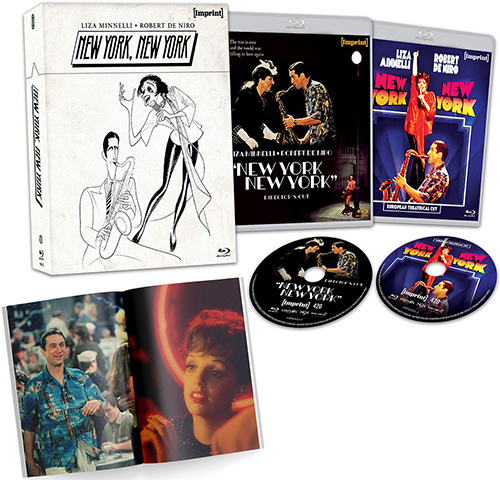
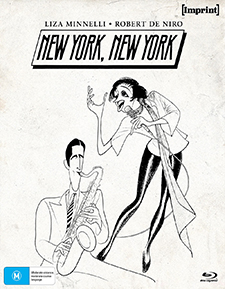
The Via Vision Limited Edition 4K Ultra HD release of New York, New York is #420 in their Imprint Collection. Limited to 1,500 units, it’s a three-disc set that includes the 163-minute director’s cut on one disc, the shorter 137-minute international version on another, and a third disc with the bulk of the extras. It also includes an 80-page hardbound booklet featuring an essay by Bilge Ebiri and abundant production photographs. The director’s cut is one Amaray case with the international version and the extras disc in another, with everything housed in one of Imprint’s rigid hardboxes that opens up at the top. Note that aside from the theatrical cut itself, there are no extras on the second disc, but the following extras are included on the other two:
DISC ONE
- Commentary by Daniel Kremer
- Commentary by Martin Scorsese and Carrie Rickey
- Introduction by Martin Scorsese (Upscaled SD – 5:38)
- Teaser Trailer (HD – 2:07)
- Theatrical Trailer (HD – 3:27)
There’s one new extra on the first disc: a commentary featuring filmmaker, historian, and extras producer Daniel Kremer, who says that New York, New York is his personal favorite Scorsese film and it’s an unabashed masterpiece. He says that he’s seen it so many times over the decades that he can recite nearly every line by heart. He adds that it’s Scorsese’s boldest experiment (fair), admitting that it confused audiences due to the way that it layered artifice on artifice. But Kremer layers appreciation on top of appreciation for the film, so if you’ve never warmed up to New York, New York, do give him a listen and keep an open mind. He mixes stories about the film with personal stories about his own relationship with it (like his struggles to acquire the director’s cut on VHS), offering plenty of thematic and technical analysis along the way. He also addresses mysteries like the fact that Robert Walden (or at least someone who looks uncannily like Robert Walden) seems to be in the film, but he’s uncredited and the film doesn’t appear on any of his filmographies.
The archival commentary featuring Scorsese and critic Carrie Rickey was originally recorded for MGM’s 1994 Collector’s Edition LaserDisc, but also included on all of the DVDs and Blu-rays that followed. Each of them was recorded separately and edited together, with Scorsese’s sections really consisting of an audio interview that’s not screen-specific. Rickey does occasionally address what’s happening onscreen, but even she usually speaks in broader terms. She notes the dualities in New York, New York: it’s a meditation on and criticism of Hollywood musicals; it’s downbeat rather than upbeat; and it contrasts reality with artificiality. (It also divided audiences and critics alike.) Scorsese discusses the inspirations for his filmmaking style in general and New York, New York in particular, plus he also addresses the film on a thematic level. Along the way, they do both offer some stories about the production, with Scorsese breaking down things like wanting to shoot in 3-strip Technicolor at 1.33:1, but he had to compromise that vision to meet the technological limitations in 1977. The whole commentary is undeniably a little dry, but there’s still some good information to be gleaned from what they have to say.
The Introduction was produced for MGM’s 2005 DVD. Scorsese addresses the way that he wanted to use artifice to express truth in New York, New York, placing his improvisatory style into the context of an MGM musical, and also mentions some of the technical goals that he wanted to achieve but couldn’t.
DISC THREE
- Player Piano Player (HD – 24:15)
- Bonus Extended Barry Primus Interview Footage (HD – 3:27)
- Momentary Departures: Movie Ballets, Musical Showstoppers and Detours (HD – 14:51)
- Scene-by-Scene Commentary by László Kovács (SD – 10:14)
- The New York, New York Stories: Part One (SD – 25:31)
- The New York, New York Stories: Part Two (SD – 26:58)
- Liza on New York, New York (SD – 22:09)
- Archival Interview with Liza Minnelli (Upscaled SD – 5:03)
- Archival Interview with Martin Scorsese (Upscaled SD – 5:11)
- Pre-Title Card with Commentary by Daniel Kremer (Upscaled SD – 2:07)
- Super-8 Version (SD – 17:00)
- Storyboards (Upscaled SD – 2:34)
- Alternate and Deleted Scenes (SD – 19:14)
- Alternate Ending (SD – 1:29)
Disc three includes several new extras, starting with a Daniel Kremer interview with Barry Primus, Player Piano Player, and a brief bit of extended footage from the interview. Primus recalls how he met Scorsese, his already existing friendship with Robert De Niro, and his own experiences making New York, New York (plus a few words about King of Comedy). It’s a relaxed interview, with Primus following his own muse and going where his thoughts take him, but there’s some interesting stuff here. (The extended footage is even more random than the main interview.) Kremer also offers the visual essay Momentary Departures, focusing on how musical numbers in the films that inspired New York, New York were elliptical detours from the main narrative that nevertheless served as a commentary on the main narratives—and yes, Scorsese’s beloved The Red Shoes is one of the centerpieces of the essay.
The rest of the new extras are actually archival ones, but they’ve never been included on any previous release of New York, New York, so they still qualify as new here. There’s are separate 1977 interviews with Minnelli and Scorsese, both of them conducted by longtime KXAS-TV reporter/critic/host Bobbie Wygant, who’s was as vacuous and fluffy as ever with them (Scorsese seems on the verge of losing patience at times). There’s also the Pre-Title Card from the 1981 theatrical rerelease of New York, New York and the VHS version, with commentary from Kremer, and the Super-8 digest version of the film.
The rest of the archival extras were produced for the 2005 DVD from MGM. The New York, New York Stories is a two-part documentary featuring interviews with producers Irwin Winkler & Robert Chartoff, Martin Scorsese, László Kovács, and editor Tom Rolf. It covers the Winkler/Chartoff partnership; developing the script for New York, New York (including how it evolved during shooting); the cast & crew; the songs; improvisation; the editorial process; and the film’s commercial & critical failure. While it’s studio-produced and hardly an unvarnished portrait of a troubled production (needless to say, drugs are never mentioned), the participants are at least open enough to discuss their disappointment with the negative reactions to the film, plus disappointment over how the title song ended up being associated with Frank Sinatra rather than Liza Minelli. The one silver lining is that when Bertrand Tavernier saw it, he wondered what would happen to a jazz musician moving to Paris after struggling at home, and that led directly to the director’s own wondrous Round Midnight.
While neither Robert De Niro nor Liza Minelli participated in The New York, New York Stories, the latter is represented in a solo interview titled Liza on New York, New York. She has nothing but positive things to share about the film, crediting Scorsese and the rest of the cast for bringing out the best in her. She also talks about the improvisation in the film, its stylization, and the music. Working at the MGM studios was a homecoming for her since she practically grew up there with her parents.
The Alternate Takes/Deleted Scenes/Alternate Ending includes a small selection of the voluminous footage that didn’t make it into the final theatrical cut (or even the director’s cut, for that matter). It also includes alternate versions of scenes that show off some of the endless improvisations that the cast performed (especially De Niro). There’s also Commentary on Selected Scenes by László Kovács. He breaks down some technical information about how a few of the scenes were staged and shot.
That’s a healthy collection of new extras plus all of the extras from previous MGM DVDs and Fox Blu-rays, although needless to say, not all of the extras from their Collector’s Edition LaserDisc are reproduced here. That had an extensive still-frame supplement that included the original screenplay and 1650 pages of production stills, storyboards, and publicity materials—over 2000 pages total. It also had a longer collection of outtakes. But missing LaserDisc extras are nothing new (don’t get me started on Criterion on that score), and given the new extras that have been added here, Via Vision’s Blu-ray release is the clear winner in terms of special features. MVD’s UHD has all of the old MGM extras but none of Via Vision’s new ones, so it falls short in that regard. The flipside is that the new 4K master on the MVD disc easily trumps this one. So, what to do? Well, hopefully Via Vision does a reissue with the new 4K remastering, but in lieu of that, the only option for hardcore fans of New York, New York is to double-dip.
Sorry, I don’t make the rules, so don’t shoot the messenger. Otherwise, the choice comes down to your own priorities. Regardless, for the extras package alone, Via Vision’s Blu-ray set is still a recommended release.
- Stephen Bjork
(You can follow Stephen on social media at these links: Twitter, Facebook, BlueSky, and Letterboxd).