
Murders in the Rue Morgue (1971) (4K UHD Review)
Director
Gordon HesslerRelease Date(s)
1971 (July 20, 2026)Studio(s)
American International Pictures (Hammer Films)- Film/Program Grade: C+
- Video Grade: A-
- Audio Grade: B
- Extras Grade: B


Review
[Editor’s Note: This is a Region-Free British 4K Ultra HD import.]
At the beginning of the 1970s, there was a sea change happening at American International Pictures. Their biggest star, Vincent Price, was renegotiating his contract, having appeared in a number of their films, most of them directed by Roger Corman and based upon stories by Edgar Allan Poe, in one way or another. Robert Quarry was being groomed to take his place, specifically in the Count Yorga series, while Vincent was moving on to other types of horror films, including The Abominable Dr. Phibes. As such, he didn’t appear in one of the company’s final Poe adaptations, 1971’s Murders in the Rue Morgue, directed by Gordon Hessler, who had previously worked with Vincent on The Oblong Box, Scream and Scream Again, and Cry of the Banshee. The resulting film wasn’t well received by critics or audiences, but has often been reappraised for its meta qualities and performances, even through the scissors of A.I.P.
In Paris during the early 1990s, a theatre company is putting on a presentation of Edgar Allan Poe’s Murders in the Rue Morgue. After the performance, it’s discovered that one of the cast members has actually been murdered, and that the man on the stage in costume took his place. Director Cesar Charron (Jason Robards) is meanwhile concerned about his young actress wife, Madeleine (Christine Kaufmann), who is continually having visions and nightmares about an ax-wielding maniac murdering her mother (Lilli Palmer). They soon discover that a former actor who was long-thought dead, Rene Marot (Herbert Lom), is the one behind the murder, subsequently murdering others with the assistance of the diminutive Pierre (Michael Dunn). As the bodies pile up and Inspector Vidocq (Adolfo Celi) takes the case, Rene gets closer and closer to Madeleine as she slowly begins to learn the truth about her past, of which Cesar has been shielding her from. Also in the cast is Maria Perschy, Peter Arne, Rosalind Elliot, María Martín, and in her first screen role, an uncredited Brooke Adams.
Let’s go ahead and get it out of the way how much better a film this would have been had Vincent Price starred in it. He had the tortured soul act down to a science by this point since he had played it repeatedly and definitely would have been a more compelling lead, especially in the latter half of the film when we learn the how and why of Cesar’s character. But even if that wasn’t the case, Jason Robards is totally wrong for this part. He seems to be less of a tortured soul and more of a lost actor, only appearing in a film because his agent insisted on it, which is purportedly what occurred. He also had the nerve to critique the film in public after its release, citing that it was a “disaster.” He’s not entirely wrong, but since he’s partly to blame, he shouldn’t be allowed into the conversation. His lackluster approach to the character, which in the commentary Chris Alexander cites as a positive thing (to each their own), drags the film down considerably.
What also didn’t help the film was when after American International saw the fully mixed and completed cut, they decided to chop it up and make it a much less interesting film, impacting much of the character development and the film’s slow burn qualities. Madeleine’s character was hit the hardest, as much of her dialogue with Cesar hitting the cutting room floor. It’s preposterous to think that a company like A.I.P. would spend even more money on a completely finished film to just do it over again, but they did just that, harming the film’s chances at the box office as a result. It became more of a straightforward narrative than an eccentric one. Thankfully, to Gordon Hessler’s delight, the original cut was saved and was released on DVD for the first time in 2003, garnering a much better response from not just new generations of film fans, but also those who were disappointed with it the first time around. It’s definitely not a lost gem, at least in my own estimation, but Murders in the Rue Morgue is a fascinating film that should have been left alone.
Cinematographer Manuel Berenguer shot Murders in the Rue Morgue on 35mm film with spherical lenses. The results were finished photochemically and framed theatrically at the aspect ratio of 1.66:1. Hammer Films brings the film to 4K Ultra HD for the first time in the U.K. with a new 4K 16-Bit scan and restoration from the original camera negative, featuring both versions of the film: the original theatrical version in 1.66:1 and the director’s cut in 1.85:1. Both have been graded for High Dynamic Range in HDR10 and Dolby Vision, and encoded to a triple-layered BD-100 disc. The opticals appear to have been pulled from an interpositve with some instability, but there’s also some scratches on the negative that either couldn’t be repaired or they were too costly. Interpositive elements were also used for some of the alternate footage exclusive to the director’s cut and it occasionally stands out since there’s a change in grain and fine detail, but it mostly blends well enough. The bitrate is a little low, sitting in the 50 to 60Mbps range, but the picture never suffers overtly for it. Saturation is decent, though it appears uneven, especially flesh tones which seem more pallid at times, but the HDR really soaks up the vivid hues and deep blacks. The image is otherwise stable and resolves well, and it’s definitely the best the film has ever looked on any optical disc format, minor caveats aside.
Audio is included in English 2.0 mono LPCM and 5.1 DTS-HD Master Audio for the director’s cut and 2.0 mono LPCM for the theatrical cut. Both feature subtitles in English SDH. The original mono in a split-channel container is very well presented while the 5.1 alternative opens the rear speakers up mostly for the score, although occasional sound effects do get pushed to surrounds, albeit briefly. Both tracks are clean with good support for the various elements, and it may be a toss-up as to which is the more preferable. They both anchor dialogue front and center, but the 5.1 giving the score by Waldo de los Ríos more room to breathe gives it more of an edge. Both are fine options.
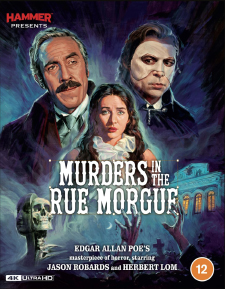
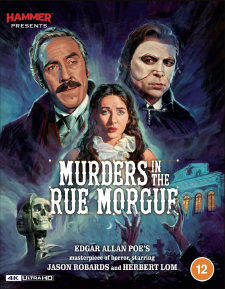
The Hammer Films Region-Free 2-Disc Blu-ray release of Murders in the Rue Morgue sits in a clear Amaray case with an advertisement for other Hammer titles and an insert featuring the original U.S. theatrical poster artwork. Everything is housed in a Limited Edition slipcover featuring new artwork by Sam Hadley. The following extras are included on each disc:
- Audio Commentary with Chris Alexander
- Theatrical Trailer (HD – 2:50)
- Stage Tricks and Screen Frights (Upscaled SD – 11:39)
- A Crazed Resurrection: Kim Newman on Murders in the Rue Morgue (HD – 21:29)
- Image Gallery (HD – 182 in all – 11:11)
Author, filmmaker, musician, and former Fangoria editor-in-chief Chris Alexander takes up commentary duties on this one, supplying his own brand of extemporaneous observations on the film, which he’s a big fan of. He leaves very few moments of silence and provides plenty of information about the film, as well as his own personal take on it; giving a spirited defense against the negative critiques that have been laid against it. It’s another great track from him.
The theatrical trailer has been re-created digitally using the new restoration as a source. In Stage Tricks and Screen Frights, director Gordon Hessler discusses trying to improve upon on the original story instead of just remaking it, choosing where to shoot and how to use the budget, working with Jason Robards instead of Vincent Price as the lead, feeling as though Robards didn’t give it his all, working with Michael Dunn and Christine Kaufmann, discovering that the film had been re-edited without his involvement, being relieved that a copy of the original version was saved, various problems at American International at that time, and reflecting on what kind of films he made during his career and noticing errors along the way. In A Crazed Resurrection, author and film historian Kim Newman delves into the many quirks of the film, as well as the history of adapting Poe for the big screen. The Image Gallery contains 182 stills of posters, lobby cards, promotional material, press book images, and color and black-and-white stills from the film.
Not included from Shout! Factory’s 2016 Blu-ray double feature release with The Dunwich Horror is an audio commentary with Steve Haberman.
Hammer’s 4K upgrade of Murders in the Rue Morgue aids the film’s legacy as one that warrants much further discussion than its initial negative response would you lead you to believe. Though each version of the film probably could have benefited by being encoded to separate discs with higher bitrates, this is still a mighty fine release. Very much recommended.
- Tim Salmons
(You can follow Tim on social media at these links: Twitter, Facebook, BlueSky, and Letterboxd. And be sure to subscribe to his YouTube channel here.)