
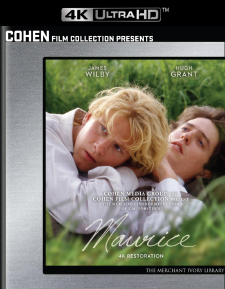
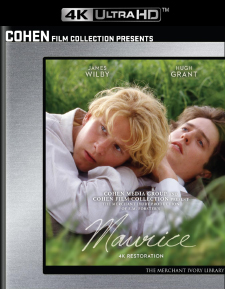
Maurice (4K UHD Review)
- Review Date: Sep 29, 2026
- Format: 4K Ultra HD
-


Director
James IvoryRelease Date(s)
1987 (June 30, 2026)Studio(s)
Merchant Ivory Productions/Film Four International (Cohen Film Collection/Kino Lorber)- Film/Program Grade: B+
- Video Grade: B+
- Audio Grade: B+
- Extras Grade: B

Review
Merchant Ivory Productions was riding high after the crossover success of their 1985 E.M. Forster adaptation A Room with a View. The film was universally celebrated by critics and audiences alike, and it ended up garnering eight Academy Awards nominations including Best Picture, Best Director, and Best Adapted Screenplay. It was also their biggest international hit to date, so it’s not surprising that they decided to ride the wave and opt for another of the author’s works for their follow-up. The surprise came from which book that they chose: Maurice, Forster’s posthumously published 1971 novel—although the reasons why it’s surprising aren’t necessarily as obvious as they may appear at first blush.
Forster initially wrote Maurice during 1913-1914 and revised it multiple times over the decades that followed, but he never even tried to get it published due to the fact that his choice of subject matter wasn’t acceptable in the England of his day: homosexuality. Forster was a closeted gay man who understood all too well the kinds of social, personal, and potentially criminal challenges that his title character would face by embracing his sexuality in a culture that was openly hostile to it. And while attitudes in England had changed somewhat by the time that Merchant-Ivory assayed the novel in 1987, LGBTQ themes were still relatively uncommon during that era. Granted, Ismail Merchant and James Ivory were lifelong partners in their personal lives as well as their professional ones, but it’s still a subject that they never addressed on film until Maurice (and they never returned to it, either).
So yes, Maurice was a surprising choice from a thematic perspective, but it was almost as surprising for artistic reasons since it’s usually considered a relatively minor work in the Forster canon. Even Forster seemed to have his doubts about it. That wasn’t a huge issue for Merchant-Ivory since their longtime screenwriter Ruth Prawer Jhabvala was more than up to the task of ironing out any narrative or dramatic wrinkles. Yet she wasn’t available at the time, so James Ivory ended up writing the script along with Kit Hesketh-Harvey instead—although Jhabvala did offer a few suggestions of her own for their final draft, improving on one of the core weaknesses of the novel by giving Clive (Hugh Grant) a more credible reason for choosing to deny his own sexuality (essentially, he ends up being “scared straight”).
Refreshingly, however, that’s no issue for Maurice (James Wilby). True to the times in which he lives, he does disguise his natural inclinations out of fear of the consequences, turning to family physician Dr. Barry (Denholm Elliott) for help and even trying to go through a form of “gay conversion therapy” under the guidance of hypnotherapist Dr. Lasker-Jones (Ben Kingsley). But that just ends up helping him understand that he can’t change who he is. Lasker-Jones warns him that “England has always been disinclined to accept human nature,” but however true that may be, Maurice comes to understand that he needs to accept his own.
Maurice has struck up a romantic relationship with Clive while both are attending the University of Cambridge, although Clive insists on keeping it celibate, both for philosophical reasons and out of concern for the damage that it could do to his social status and his future as a politician. Those fears become quite real when their fellow student Viscount Risley (Mark Tandy) is arrested for solicitation and sentenced to six months of hard labor. While his fate is a pressing concern to both of them, Clive decides to marry Lady Anne Scott (Phoebe Nicholls) and live his life a heterosexual man, albeit one who is uncomfortable in his own skin.
So far, so Brokeback Mountain. But Maurice is interesting for two reasons, one of which is that it introduces an element of class conflict into the equation. Maurice and Clive are both comfortably upper class, and that’s a big reason why Clive rejects his own sexuality out of fear not just of reprisals, but also of losing his social standing. Maurice, on the other hand, ends up going the Lady Chatterley’s Lover route by striking up a new relationship with the under-gamekeeper at Clive’s estate, Alec Scudder (Rupert Graves). Scudder has no illusions about who he is, socially or sexually, and this personal freedom is so attractive to Maurice that he throws his own fears out the window—quite literally so, when Scudder climbs a ladder into his bedroom window and provides the sexual release that Maurice could never receive from Clive.
While there are some inevitable misunderstandings due to their difference in social status, Maurice’s newfound love in the arms of Scudder offers something that was relatively unusual for LGBTQ stories during the Eighties: an unambiguously happy ending. This conclusion is derived directly from Forster’s novel, although Ivory and Hesketh-Harvey omitted the epilogue from Forster’s earlier manuscripts that even he ultimately rejected, even if it appears in a few of the posthumous editions of the book. (The epilogue didn’t affect the happy ending, but it does end up feeling somewhat anticlimactic). While they’ll still have to keep their relationship a secret from Edwardian society, they’re not punished in any way for their sexuality. Even Clive’s fate isn’t so much punishment as it’s the consequence of his personal weakness. But Maurice is rewarded for the fact that not only does he embrace his own sexuality, he’s willing to sacrifice class and social standing for the sake of true love.
A fable? Perhaps, especially in the context of Edwardian England, and even in the context of the irrational fears during the height of the AIDS epidemic when Maurice was released in 1987. But it was refreshing to see an LGBTQ relationship presented in such a positive fashion during the Eighties, with the narrative never punishing Maurice for his sexuality—or his choices. While Maurice has never received the same level of attention as A Room with a View or Merchant-Ivory’s later Forster adaptation Howard’s End, it’s still a landmark film in their filmography, and an even bigger landmark for cinematic LGBTQ representation in general.
Cinematographer Pierra Lhomme shot Maurice on 35mm film using spherical lenses, framed at 1.66:1 for its theatrical release. This version appears to be the same 4K master that was used as the source for Cohen’s 2017 Blu-ray, which was based on 4K scans of the original camera negative, with the digital remastering work supervised by Lhomme and James Ivory. Note that all of the grading was completed in SDR, so there’s no HDR grade available here. But you don’t need an HDR grade to make 4K presentation look properly filmic (quite the opposite sometimes), and this does indeed look like a film print, right down to the relatively limited contrast range and some elevated black levels in the darkest interiors and night shots. The grain is prominent at times but it doesn’t demonstrate any significant artifacting, even in those dark shots, and everything looks as pristine as possible without a trace of remaining damage.
The color scheme is quite muted, at least for the earlier sections of the film, although it opens up a bit toward the end. Curiously enough, while the disc reads as Rec. 709 SDR, I found that manually switching my display to BT.2020 resulted in colors that looked better saturated but still quite natural—not oversaturated like you would expect when playing Rec. 709 as BT.2020. But the Blu-ray also exhibits the same muted color scheme, so that does indeed appear to be quite intentional on the part of Lhomme and Ivory. (I saw Maurice in 1987, but not only don’t I have any clear memories of the color timing of theatrical prints, I wouldn’t presume to trust them if I did.) Overall, it’s an upgrade over Blu-ray, if a somewhat modest one.
Audio is offered in English 5.1 and 2.0 DTS-HD Master Audio, with optional English subtitles. Maurice was released in Dolby Stereo, and presumably this 5.1 mix is a straightforward discrete encoding of the original 4-channel mix (there doesn’t appear to be any split surround activity). Either way, it’s a simple mix that’s typical of Dolby Stereo productions from that era, especially for this kind of film: front focused, with limited ambient activity in the surrounds for things like thunder and crowd noises. The lush score by Richard Robbins is properly emphasized, providing more emotional impact for Maurice than any quantity of sound effects possibly could.
The Cohen Media Group 4K Ultra HD release of Maurice is a three-disc set that includes an unremastered Blu-ray with a 1080p copy of the film and a second Blu-ray with additional extras. Both of the Blu-rays are repressed from Cohen’s 2017 release and the commentary track is newly recorded for this edition, so it’s not available on the BD version of the film—in fact, aside from some forced trailers up front, there aren’t any extras on the second disc at all. The following extras are included on the other two discs:
DISC ONE: UHD
- Commentary with Wade Major and Joseph Bristow
The sole new extra here is a commentary featuring film critic Wade Major and Joseph Bristow, Professor of English at UCLA. They talk about the relationship between the novel and the film, and draw parallels between Forster’s sexuality, Merchant-Ivory’s, and the characters in the story. They also break down the cast and crew, pointing out the interconnectedness between the various actors in other British period dramas from the era. They do note that Maurice was a bit ahead of the curve in the way that heterosexual actors like Wilby and Grant were willing to play such intimate scenes between two gay men. Perhaps most usefully, they break down the issues of class, social status, and privilege that may not be entirely obvious to contemporary viewers, especially American ones, especially noting the way that Clive is disappointed in Maurice not because he found a new lover, but rather because of how he is willing to settle for someone in the lower classes with Scudder. Major and Bristow treat the track as much as a dialogue as they do a commentary, and it’s all the more enjoyable for that fact.
DISC THREE: BD
- Extras:
- James Ivory and Pierre Lhomme on the Making of Maurice (HD – 15:44)
- On-Stage Q&A (HD – 22:59)
- The Story of Maurice (SD – 30:29)
- Conversation with the Filmmakers (SD – 12:51)
- A Director’s Perspective: A Conversation Between James Ivory and Tom McCarthy (HD – 40:08)
- Original Theatrical Trailer (HD – 3:27)
- 2017 Re-Release Trailer (HD – 2:21)
- Deleted Scenes:
- Deleted Scenes and Alternate Takes (SD – 39:03, 30 in all)
James Ivory and Pierre Lhomme on the Making of Maurice is a dual interview with the director and cinematographer, conducted by Gavin Smith for the Cohen Media Group. They discuss working together and how their collaboration came about. Ivory wanted a new eye on the familiar English landscapes and buildings. He was also looking for a more worldly cinematographer who wouldn’t be put off by the subject matter of the film. They also discuss the straight cast’s comfort at playing gay characters; the irony of having Denholm Elliott play a homophobic character (Ivory had no idea at the time that Elliott was gay); and how A Room with a View opened doors to make this kind of film, even though it still wasn’t easy raising money for it.
Ivory and Lhomme are reunited for the On-Stage Q&A, recorded at the French Institute Alliance Française and moderated by Nicholas Elliott of Cahiers du Cinema. They open by explaining their collaboration again and the look of Maurice before answering questions from the audience. There were some surprising challenges during the production, like the camera crew walking off the set at one point because the first English crew couldn’t handle taking orders from a Frenchman. They also discuss their influences (Ivory’s biggest touchstone has always been Satyajit Ray); how the quality of the cast was able to overcome some of the deficiencies in Forster’s book; why the novel was published posthumously; and how Ivory’s final scene acknowledged the challenges that lay behind Forster’s intentions for a happy ending.
The Story of Maurice traces the making of the film, featuring interviews with Kit Hesketh-Harvey, Hugh Grant, James Wilby, and Rupert Graves. They explain how the project came together quickly, the casting process, the characters, and the nature of the sexuality in Maurice. Harvey explores writing the script, noting how the dialogue translated easily into cinematic terms, but it still fell short dramatically and that’s why they changed a few elements for the film. He describes it as boy meets boy, boy loses boy, boy finds another boy, falls in love, and lives happily ever after. The cast discusses working with James Ivory, playing gay characters as heterosexual men, and reactions to the film.
Conversation with the Filmmakers is a series of interviews with James Ivory, Richard Robbins, and Ismael Merchant. Ivory delves into the characters and how Clive’s change of heart wasn’t worked out well in the novel, but it still had the appeal of a happy ending. Robbins explains how he used his own memories of reading the book as a foundation for his work on the film, and also describes how he used the orchestrations and textures to express strong feelings. Merchant describes the settings and the challenges of dealing with locations like King’s College and Trinity College.
A Director’s Perspective is a retrospective look at Maurice featuring a conversation between Ivory and Spotlight director Tom McCarthy. They have a dialogue about the story and the relatively loose structure of the film, which partly came from Forster’s narrative but was also influenced by the change in screenwriters from Ruth Prawer Jhabvala to Hesketh-Harvey. They also discuss how the project came together, the cast, the costumes, the cinematography (including the issues with the original camera crew) and the ending. Interestingly enough, when McCarthy asks about actor’s instincts sometimes working contrary to the best interests of a film, Ivory says that he’s never had that issue and trusts them implicitly—McCarthy clearly has different working methodologies than Ivory does.
Finally, there’s an extensive collection of Deleted Scenes and Alternate Takes, which can be played with or without optional commentary from James Ivory. He explains how Maurice was restructured during the editorial process, removing the original flashback structure, which also required losing many scenes. It’s not really a running commentary as much as it is brief introductory explanations for each scene (or series of scenes), but Ivory does provide some much-needed context for what might have otherwise been somewhat confusing.
That’s all of Cohen’s previous extras with the addition of the new commentary track, but there are a few items missing from the BFI’s 2019 Blu-ray. They offered a commentary with Professor Claire Monk, who also provided commentary for the deleted scenes. They also offered an interview with James Wilby, another interview with Wilby and Hugh Grant, and an audio recording of a presentation by Ivory and Merchant at the National Film Theatre in 1992. But note that the BFI didn’t include the deleted scene commentary from Ivory, The Story of Maurice, or Conversation with the Filmmakers, so especially with the new commentary here, Cohen has the clear edge in terms of extras. HDR or not, they also have the edge with the new 4K presentation. Like any Merchant-Ivory production, Maurice may not be to all tastes, especially considering the subject matter. Yet four decades down the road, hopefully we’ve progressed enough that it should no longer be a barrier to entry. Recommended.
- Stephen Bjork
(You can follow Stephen on social media at these links: Twitter, Facebook, BlueSky, and Letterboxd).