
Little Shop of Horrors: 40th Anniversary Limited Edition Steelbook (4K UHD Review)
Director
Frank OzRelease Date(s)
1986 (October 6, 2026)Studio(s)
The Geffen Company (Warner Bros. Entertainment)- Film/Program Grade: B+
- Video Grade: A-
- Audio Grade: A-
- Extras Grade: B

Review
When Roger Corman directed his poverty row quickie Little Shop of Horrors back in 1960, he could never have anticipated the long-term cultural impact it would end up having. After all, the whole thing was little more than a lark, shot in just two days (five total if you count three days of rehearsals beforehand) to take advantage of the standing sets from his previous film A Bucket of Blood—and also to beat new industry rules that would have required him to pay better compensations to his cast. But Corman always knew how to make the most with the least, and the story that he cooked up with Bucket screenwriter Charles B. Griffith tapped into a rather singular vein of satirical horror, serving as a genuine cautionary fable about the price of success while still offering a steady stream of absurdist black humor along the way.
Two decades later, the story (and characters) would provide inspiration to composer Alan Menken and lyricist Howard Ashman for their wildly successful 1982 off-Broadway musical Little Shop of Horrors, and unsurprisingly, that meant Hollywood soon came a-knockin’. Corman’s low-budget quickie would become one of the rare films that made the leap from screen to stage and back to screen again, albeit at a budget nearly 1,000 times higher than the original. Yet while the 1986 film adaptation of the off-Broadway adaptation of Corman’s lark would end up being distributed by Warner Bros., it was still a relatively independent production. It’s just that it traded in a veteran mini-mogul like Corman for a younger and richer one, in this case producer David Geffen (under his Geffen Company banner).
Still, the results of that process would turn out to provide a bit of a cautionary fable of its own, demonstrating one of the immutable laws of cinematic commerce: when there’s enough money on the line, it doesn’t really matter if a project is a big studio effort or an independent production, because compromises will have to be made either way. Having a vision is all fine and dandy, but if whoever puts up the money isn’t seeing it as something that will provide a return on investment, then artistic integrity usually gives way to potential box office. But we’re getting a little ahead of ourselves here.
Geffen brought in Ashman to write a screenplay for the film (and he also retained Menken to add at least one new song), so he definitely respected the source material. But he needed a director who would do the same while also being able to handle the monumental technical challenges that were going to be involved in bringing the stage-bound carnivorous plant Audrey II to cinematic life, and fortunately, Frank Oz took the job (eventually, anyway, since he initially turned down the project). Oz certainly had experience with puppetry and animatronic effects, from the Muppets to the far more technically elaborate project that he co-directed with Jim Henson, The Dark Crystal. Oz brought all of that experience to bear for Little Shop of Horrors, including hiring Dark Crystal creature designer and fabricator Lyle Conway to figure out how to create a convincingly cinematic Audrey II.
While there was some back and forth with Geffen over the casting, Oz eventually prevailed in bringing Ellen Greene back from the off-Broadway production to play the role that she created for the stage: the utterly vacuous but irresistibly charming Audrey I. The rest of the casting leaned into names with more marquee value like Rick Moranis as her nebbish coworker Seymour Krelborn and Vincent Gardenia as their employer, Skid Row flower shop owner Mr. Mushnick. Steve Martin was picked to personify the thoroughly sadistic dentist Dr. Orin Scrivello, with Bill Murray as his masochistic patient Arthur Denton, while Levi Stubbs of the Four Tops provided the unforgettable voice of Audrey II. Other roles were filled out with recognizable faces like John Candy, Christopher Guest, and Jim Belushi—whoops, got ahead of ourselves there again, Paul Dooley (hold that thought).
The task of holding all of them together would end up falling on the shoulders of Tichina Arnold, Michelle Weeks, and Tisha Campbell as Ashman and Menken’s Greek chorus (girls) from the play, Crystal, Ronette, and Chiffon. Yet the way that they’re used in the film demonstrates the vision that Frank Oz brought to the production. Rather than simply appearing and disappearing stage right or left as needed, they serve as running characters that worm their way into nearly every scene, changing costumes and even personas as needed to provide a visual (and aural) anchor for the entire film.
Oz wisely resisted the temptation to open up his take on Little Shop of Horrors in comparison to the play, shooting everything on Skid Row sets built at the 007 Stage at Pinewood Studios in London (and he wasn’t afraid of letting them look like sets, either). Yet he still translated that inherent staginess into cinematic terms by using the chorus girls as a bridge in order to tie shots together, freely cutting from location to location and trusting that the audience would follow the chorus and the rhythms of the music—and editor John Jympson wasn’t afraid to cut on the beat, either. As a result, Little Shop of Horrors feels stage-bound yet thoroughly cinematic at the same time, which is quite an achievement (hold that thought, too, but we’re almost there).
It was a challenging shoot, especially since it was the middle of winter and the 007 stage wasn’t heated. Lyle Conway’s miraculous animatronic effects for Audrey II worked like a charm, but the largest versions couldn’t work quickly enough to keep in tempo with the music, so many of those sequences were shot undercranked, with the actors performing at slow speed to slowed-down playback (frankly, Moranis deserved an Oscar for his slow motion acting alone, which is nearly seamless in the final film). Challenges or not, Oz’s cast and crew rose to the occasion, and the main production went as smoothly as possible under the circumstances. And then, came post-production. Major spoilers follow for anyone who’s never seen the film or the play:
Post-production is where the real challenges cropped up for Little Shop of Horrors, resulting in Corman’s cautionary Skid Row fable becoming a Hollywood cautionary fable instead. Oz originally shot an ending in line with the play: Audrey I is mortally wounded by Audrey II, and Seymour ends up feeding her dead body to it (at her request). Afterward, he encounters World Botanical Enterprises entrepreneur Patrick Martin (Dooley), who explains his plan to sell Audrey II clippings all across the country, and it finally dawns on Seymour that the plant’s master plan is for world domination. So, he tries to defeat it—unsuccessfully, as he ends up yet another meal for the ravenous Audrey II. The chorus then reappears to warn the audience that other plants are spreading across the country, leading to the finale Don’t Feed the Plants.
There was just one problem: test audiences actively hated the ending—and that’s putting it mildly. Geffen panicked and worked with Oz and his team to rework everything, supplementing the existing footage with new reshoots (and Belushi stepped into replace Dooley during that process). This time, Audrey I survived her encounter with Audrey II, Seymour successfully defeated the plant, and they all lived happily ever after, Somewhere That’s Green. (Well, mostly happily, anyway, with a bumper at the end to remind audiences that there were still Audrey II clippings out there). The revisions paid off, too; while Little Shop of Horrors wasn’t a runaway box office success, it did better than it would have with the original ending, and it quickly became a perennial favorite on home video.
The end, right? Well, no, not really. The unused and unseen original ending became the stuff of legend almost as quickly, leading to Warner Bros. issuing a DVD in 1999 with a low fidelity black-and-white copy of it. The problem was, they didn’t get permission from either Geffen or Oz to do so, which resulted in the disc being recalled two days after release. Eventually, a more polished version of it showed up as a so-called “director’s cut” on DVD and Blu-ray, so once again, the end, right? Ah, if only life was so simple.
While fans have debated the relative merits of both endings ever since, there are a few facts to keep in mind. First of all, it’s dubious to use the term director’s cut for the film with the original ending because it’s clearly unfinished as is—and Oz has said as much, noting that it’s missing sound effects and music, plus it’s in need of tightening. Frankly, it feels like exactly what it is: an unpolished rough cut. Had that ending survived the post-production process, it would have benefitted from some much-needed additional work.
Second, there’s a fair argument to be made that the test audiences had a point. Ellen Greene is simply radiant as Audrey I, from her high-pitched “head voice” dialogue to her full-throated “chest voice” belting of songs like Suddenly, Seymour (which is one of the greatest vocal performances ever committed to film). And Rick Moranis is just too damned likeable as her wannabe boyfriend Seymour (frankly, the original ending was doomed the moment that he was cast). Yes, Little Shop of Horrors is supposed to be a cautionary fable where Seymour pays a deserved price for his macabre misdeeds in the name of ambition, and the Seymour of the film certainly deserves to die for what he’s done, but... he’s Rick Moranis, goddammit. How can you not root for him anyway? Combined with Ellen Greene, the cinematic Seymour and Audrey I are such an appealing couple that audiences inevitably want them to be together forever (and it doesn’t help that death always seems more “real” onscreen than it does on stage).
Third, there are a few practical issues with the original ending as well. The new song Mean Green Mother from Outer Space had already been added before the reshoots, and it makes the final confrontation between Seymour and Audrey II feel, well, more final. That makes everything that follows seem anticlimactic—and it doesn’t help that the scenes of the plant army engaging in worldwide destruction are slackly edited (again, they’re unfinished). But that also comes full circle to Frank Oz’s vision for the film. He was careful to respect the stage origins of Little Shop of Horrors by not opening anything up throughout the body of the film, so when he ended up violating that principle for the original ending, it can’t help but be a little jarring. (It’s also worth pointing out that none of this destruction was visible in the stage version, either, so it’s truer to Ashman and Menken’s original conception not to show it.)
So, is Geffen’s production of Ashman and Menken’s production of Roger Corman’s production of Little Shop of Horrors a cautionary fable in more ways than one? Even with the revised happy ending, Corman’s original message still comes through loud and clear: it’s just not cool to cut people up and feed them to plants in order to achieve fame. But what about the message to artists about the inevitability of having to compromise to please the money men and/or women? Well, that one isn’t quite so simple. When it comes to questions of art vs. commerce, most people fall on the side of original artistic vision when it’s pitted against corporate (or individual) responsibility. But in the case of Little Shop of Horrors, even Frank Oz has freely acknowledged that the original ending just wasn’t working, so the “original vision” thing isn’t quite as applicable in this case.
The reality is that the cinematic Little Shop of Horrors wouldn’t have had as much success (or longevity) without the revised ending. That’s the ending that most fans have watched over and over again, so it’s an indelible part not just of the film itself, but also of people’s memories. Yet one key factor has changed since Corman’s day: thanks to home video, it’s now possible for fans to have both endings and decide for themselves which one they prefer. That turned Little Shop of Horrors into something that Roger Corman, Howard Ashman, Alan Menken, David Geffen, or Frank Oz could never have anticipated: a Choose Your Own Adventure. Seymour and Audrey I’s ultimate fate is now between you and the vegetable, regardless of the intentions of the filmmakers or the people who put up the money. (There’s probably a cautionary fable in that as well, but that’s a story for another day.)
Cinematographer Robert Paynter shot Little Shop of Horrors on 35mm film using Panavision Panaflex cameras with spherical lenses. 35mm theatrical prints were framed at 1.85:1, while 70mm blowups retained that framing by pillarboxing the image inside the 2.20:1 frame. (The previous Blu-ray opened that up to 1.78:1, but it’s been properly framed at 1.85:1 here.) Pretty typical for Warner Bros. these days, there’s no hard information regarding this 4K master other than the fact that it’s a “new 4K restoration of the film,” but it certainly looks like a new scan from the original camera negative, and it’s been graded for High Dynamic Range in Dolby Vision and HDR10. While any optical work like the opening titles display the expected softness from generational losses (and Bran Ferren’s composites still have harsh matte lines and even fringing around Steve Martin during the opening of Dentist!), the bulk of the film is a definite upgrade over the aging Blu-ray master. It’s still not the last word in fine detail, but everything looks as clean and as sharp as possible. The HDR grading is subtle, leaning more into Wide Color Gamut than into extremes of contrast or brightness. There’s not a hint of overcooked reds or oranges, but all of the myriad subtle shades like Lyle Conway’s elaborate paint scheme on Audrey II or the fabulous dresses worn by the chorus girls are reproduced perfectly here. It may be an incremental upgrade, but it’s an upgrade nonetheless.
Primary audio is offered in English Dolby Atmos (both cuts) and 2.0 DTS-HD Master Audio (theatrical cut only). Little Shop of Horrors was released theatrically in optical Dolby Stereo on 35mm prints and 6-track mag Dolby Stereo for 70mm engagements. Aside from the question of matrix-encoded optical vs. discrete 6-track mag, the biggest difference between the two was that the 70mm mix was in the “baby boom” format, with extra bass tracks. The Atmos mixes here don’t stray too far from the original sound design, mostly just pulling the instruments farther forward into the soundstage (for example, the piano roll at the start of Skid Row now comes from the sides of the room). There’s also significantly deeper bass, like when the full-sized Audrey II falls forward and crashes to the ground (perhaps the boom track from the 70mm mix has been incorporated into these remixes). Otherwise, it doesn’t make heavy use of the overhead channels or even much of the surround channels either, retaining the front-focused nature of the original mix.
However, some of the sound effects have been repositioned, like the rolling can on the floor after the conclusion of the opening credits (it’s heard later now, on the reverse shot of Mushnick). Also, a few sound effects have been inadvertently dropped, like Audrey II’s reaction to being electrocuted (the “oh, shit” is still there, but not the preceding moans), and the sound effect of Scrivello’s motorcycle just before the reprise of Dentist! during the closing credits is also inexplicably missing. Fortunately, those missing effects are still present in the original 2.0 mix here, so that’s a good alternative for anyone bothered by their omission. The downside is that it’s a pretty weak and anemic 2.0 track, even after adjusting for level differences, and it lacks the guts of the new Atmos mix. From a pure sound quality perspective, there’s no comparison: the Atmos mix wins handily. You’ll just have to decide if you can live with the missing effects or not.
Additional audio options (theatrical cut only) include, French, German, Italian, Spanish (Spain), and Spanish (Latin America) 2.0 Dolby Digital. Subtitle options include English SDH, French, German SDH, Italian SDH, Spanish (Spain), Dutch, Spanish (Latin America), Danish, Finnish, Norwegian, and Swedish.
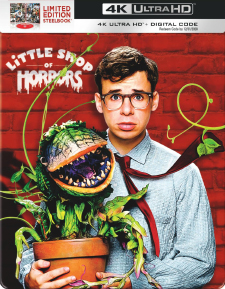
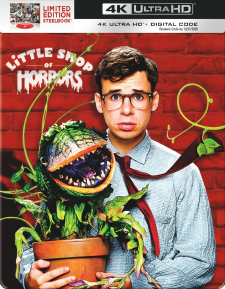
The Warner Bros. 40th Anniversary Limited Edition Steelbook 4K Ultra HD release of Little Shop of Horrors is UHD only—there’s no Blu-ray included in the package, but there is Digital Code on a paper insert tucked inside, as well as a J-card slipcover on the back. There’s also a standard version available. Either way, the disc-based content is the same, and the following extras are included:
- Commentary by Frank Oz
- To Feed or Not to Feed: The Love of Little Shop (HD – 14:39)
- Mean Green Mother: Creating Audrey II (HD – 8:23)
- Frank Oz and Little Shop of Horrors: The Director’s Cut (HD – 10:40)
- A Story of Little Shop of Horrors (Upscaled SD – 23:03)
- Outtakes and Deleted Scenes (Upscaled SD – 8:41)
- Director’s Cut Ending (HD – 22:03)
Warner Bros. has added two new extras for this release. To Feed or Not to Feed is a retrospective look at the production featuring interviews with Frank Oz and Ellen Greene. Oz explains how he initially turned down Little Shop of Horrors until he finally cracked how he wanted to tell the story, while Greene chimes in with how she wanted him to direct the film but understood why he originally said no. They also discuss some of the challenges of the shoot and why they both feel that the original ending just didn’t work on film (Greene leans into the notion that death on stage hits differently than it does on film). Mean Green Mother focuses on the late Lyle Conway’s unforgettable Audrey II, featuring interviews with Oz, Bran Ferren, and model unit supervisor Richard Conway. They cover the design work and the challenges of getting the lip sync perfect while varying the shooting speeds.
Frank Oz and Little Shop of Horrors is the introduction to the director’s cut that was produced for the 2012 Director’s Cut Blu-ray. Oz and Richard Conway describe how they shot the scenes of global destruction that ended up being eliminated from the theatrical cut. There’s also a separate version of the Director’s Cut Ending with forced commentary by Oz. This is where he acknowledges that it’s unfinished, missing sound effects and music, and he also would have shortened it if he could have done a true final cut.
The rest of the extras were produced for the first DVD release of Little Shop of Horrors in 2001, starting with a commentary track by Oz. He discusses how he got involved with the project and then steps through the film on a scene-by-scene basis, starting by breaking down the opening credit sequence—which wasn’t originally intended to have the credits over it, but it served as a perfect way to introduce the geography of Skid Row while letting the titles run (and Oz is proud of the fact that his own credit appears over Rick Moranis’ ass). He provides plenty of technical explanations of how everything was shot, but also why he made changes from the play like having Crystal, Ronette, and Chiffon appear as actual characters in the story rather than just as a chorus. (He also confirms that he did indeed plan for everything in the musical numbers to be in sync with the beat of the music.) He does occasionally fall into the trap of describing what’s happening onscreen, but for the most part, this is a great track with plenty of insights into the film.
A Story of Little Shop of Horrors is a making-of featurette that traces the history of the original Roger Corman film, the stage musical, and its adaptation back to film. It offers a fair quantity of behind-the-scenes footage, including some of the performances to slowed-down playback of the music, and it also includes vintage interviews with Corman, Oz, David Geffen, Rick Moranis, Ellen Greene, Tichina Arnold, Michelle Weeks, Tisha Campbell, and Lyle Conway. Finally, there’s a selection of Outtakes and Deleted Scenes with optional commentary from Oz, who doesn’t remember all of them or why the reel was created in the first place (although he guesses that it was a gag reel for the cast & crew).
The only noteworthy thing that’s missing here is the isolated score track that was on the DVD versions of Little Shop of Horrors but not the Blu-rays. Well, that plus at least a couple of sound effects in the new Atmos mix, so you’ll have to choose for yourself whether or not that’s acceptable to you. But hey, at least Warner Bros. is sticking to their guns about including original audio tracks whenever they do a remix, so that’s still an option, and Little Shop of Horrors has never looked better on home video. Plus, both endings are now available in full 4K, so there’s that. It’s an interesting time for physical media collectors, where even a studio that’s been on the acquisition chopping block is offering choices to fans. We’ll see what happens going forward, but for now, the Warner Bros. 4K Ultra HD release of Little Shop of Horrors is recommended, albeit with those few minor caveats.
- Stephen Bjork
(You can follow Stephen on social media at these links: Twitter, Facebook, BlueSky, and Letterboxd).