
King Kong (1976): 50th Anniversary Edition (4K UHD Review)
Director
John GuillermanRelease Date(s)
1976 (June 30, 2026)Studio(s)
Dino De Laurentiis Corporation (Paramount Scares/Paramount Pictures Home Entertainment)- Film/Program Grade: C+
- Video Grade: B+
- Audio Grade: B-
- Extras Grade: D-

Review
What seemed like heresy in 1976 eventually became a model for big budget studio remakes in the future: doing the same thing but with slightly different variables. The Dino De Laurentiis production of King Kong certainly follows that model. The characters have different names and come from different backgrounds and the film’s final minutes are in a different location, but it’s the same deal as last time.
In the story, business tycoon Fred Wilson (Charles Grodin) heads for a remote island where mass quantities of crude oil can be obtained, while stowaway Jack Prescott (Jeff Bridges) and the rescued Dwan (Jessica Lange) are along for the ride. Upon reaching the island, the natives take Dwan hostage and offer her as a sacrifice to the oversized ape known as Kong, and after the big guy falls in love with her (rather awkwardly), she escapes with the help of Jack. Realizing that the ape is worth more than the oil, Wilson manages to capture it and bring it back to civilization. Kong then cuts loose in New York City and snatches up Dwan again, climbing atop the World Trade Center, but with tragic consequences.
Outside of his appearances in other Japanese monster movies, as well as the fairly recent “Monsterverse,” the core story for Kong’s character hasn’t changed much. The effects are also less charming than they were in 1933, even though they’re technically superior since special effects technology had certainly advanced in forty-three years, but a stop-motion character replaced by a man in a suit just doesn’t have the same impact. One certainly can’t argue that the film’s greatest asset is its star attraction, driven by the design and execution of Carlo Rambaldi, Glen Robinson, Rick Baker, and the late Peter Cullen, but the final product just isn’t as satisfying. It doesn’t help that the characters are also less interesting. They’re no less thinly-drawn, but there’s nothing that appealing about them to engage with outside of Jessica Lange’s obvious and highly exploited sex appeal.
Comparisons to the original film aside, the 1976 version of King Kong was still a success upon its initial release, and had a tidy little set of merchandise to go with it, including toys, games, and apparel. People of a certain age who were children when it was released have a fondness for it, and there’s definitely merit to that. It’s not as mysterious, enthralling, or endearing as the original film, nor as problematic as Peter Jackson’s 2005 remake, but there’s something still oddly compelling about it.
Cinematographer Richard H. Kline shot King Kong on 35mm film (Eastman 100T 5254) using Panavision cameras and anamorphic lenses. The results were finished photochemically and framed theatrically at the aspect ratio of 2.35:1. For its 50th Anniversary, Paramount Pictures Home Entertainment brings the film to Ultra HD for a second time in the U.S. utilizing the same 2022 4K remaster of the original camera negative carried out by Paramount and StudioCanal. It has been graded for High Dynamic Range in HDR10 and Dolby Vision, and encoded to a dual-layered BD-66 disc. It’s very nice upgrade from Scream Factory’s 2021 Blu-ray, but there are some obvious changes in some of the color timing. There are also differences in framing since the StudioCanal restoration is stretched wider, meaning that there’s less detail along the left and right edges of the frame. However, there’s definitely a boost in detail, which is tighter with more pronounced grain. Sporadic bitrates don’t entirely serve the presentation well, even if visual discrepancies aren’t overt. Saturation is good with more even flesh tones, though some hues are markedly different than past releases. Blues skies, for example, take on more of a strong teal appearance than a clear blue. Blacks are deep with good contrast, but there’s definitely some occasional crush during extremely dark moments. The image is stable and clean throughout, much more so than before. A triple-layered disc with a better quality encode and less aggressive HDR would probably benefit the film, but as is, it still looks much better comparatively.
Audio is included in English 5.1 DTS-HD Master Audio with optional subtitles in English SDH, losing the theatrical 2.0 stereo option from the Scream Factory Blu-ray and StudioCanal Ultra HD releases, which is a bummer. The 5.1 mix gives the film’s soundtrack a bit more life, particularly in the surrounding speakers with John Barry’s score in particular granted added depth and clarity. Sound effects mostly have a thin, dated quality to them, though occasional low end does occur, mainly during Kong’s roars and footsteps. Dialogue exchanges are mostly discernible, though they sometimes fight for dominance during the more chaotic and cacophonous scenes. The original theatrical stereo audio is spaced wider without much impact on the score, but not having it included as an option is a real misfire.
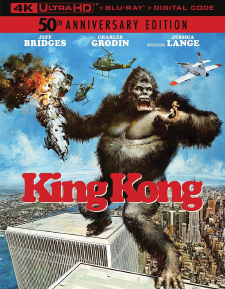
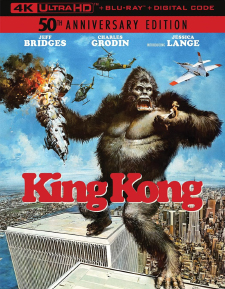
Paramount’s 2-Disc 50th Anniversary Edition 4K Ultra HD release of King Kong sits in a black Amaray case alongside a 1080p Blu-ray and a Digital Code on a paper insert. The insert and slipcover both feature the main U.S. theatrical poster artwork for the film. Disc One contains the theatrical version while Disc Two contains the extended TV version, as well as the theatrical trailer. All of the disc-based content is exactly the same as Paramount’s 2024 Steelbook UHD release.
King Kong was shown on television three times on NBC: in September of 1978, November of 1980, and March of 1983. This version adds extra footage back in, but also replaces various music cues and censors sexual suggestive material and offensive language. The final running time is 193:21, extending the film by nearly an hour (with recap footage and opening credits for each night). Scream Factory’s release featured the option of watching each night separately, but that hasn’t carried over here.
The text that opens this version states: “The best available sound and picture elements were assembled for this widescreen KING KONG extended broadcast TV cut. This presentation’s intent is to preserve the theatrical 2.35:1 widescreen aspect ratio, however this revealed sequences where audio anomalies are present (loose sync and missing dialogue) that were cropped out of the original 1.33:1 TV broadcast and cannot be remedied. We hope you enjoy this Paramount classic film.”
This version is the exact same master used for Scream Factory’s release, mixing the previous high definition scan with footage exclusive to the TV version, taken from a 2K scan of the film’s internegative. Visually, there’s a nice blend, but the newly-scanned footage is clearly superior. Either way, there’s a consistency in color and contrast to mostly hide the differing footage. The audio is provided in English 2.0 DTS-HD Master Audio with optional subtitles in English and English SDH. It’s a mixed bag, as one might expect, and doesn’t blend nearly as successfully, but it’s an otherwise pleasant presentation.
Unfortunately, none of the extras from Scream Factory’s absolutely packed Blu-ray release, aside from the main theatrical trailer, are included here. This includes two audio commentaries, one with author Ray Morton, and the other with special effects technician Rick Baker and moderator Justin Beahm; interviews with production manager Brian Frankish, assistant director David McGiffert, production assistants Jeffrey Chernov and Scott Thaler, sculptor Steve Varner, actor Jack O’Halloran, photographic effects assistant Barry Nolan, and second unit director Bill Kronick; an additional trailer; seven TV spots; three radio spots; several image galleries; commercials for Mego King Kong drinking straws, the King Kong ride at Universal Studios, and Burger Chef King Kong drinking glasses; openings and commercial intros and outros for the film’s TV airings; and a 40th anniversary panel discussion with Jack O’Halloran, director of photography Richard H. Kline, Rick Baker, Martha de Laurentiis, talent agent Richard Kraft, and Ray Morton. Also not carried over from Umbrella Entertainment’s 2013 Blu-ray release is the Making Kong featurette.
What this all means is that if you already have the Scream Factory Blu-ray release, you’re essentially upgrading for the visual quality only, and keeping the Blu-ray is a must. In a perfect world, both would be one and the same, but for now, having two releases on your shelf is the recommended way to go. Paramount’s 4K isn’t perfect, but it’s a strong upgrade nonetheless.
- Tim Salmons
(You can follow Tim on social media at these links: Twitter, Facebook, BlueSky, and Letterboxd. And be sure to subscribe to his YouTube channel here.)