
In the Heat of the Night (4K UHD Review)
Director
Norman JewisonRelease Date(s)
1967 (May 6, 2025)Studio(s)
The Mirisch Corporation/United Artists (The Criterion Collection – Spine #959)- Film/Program Grade: A
- Video Grade: A
- Audio Grade: A-
- Extras Grade: B+

Review
In the Heat of the Night felt like a jolt of electricity to those who saw when it was originally released in 1967. Its portrayal of a black homicide investigator from the city finding himself in the middle of a murder investigation in an overtly racist section of the South was well-handled by director Norman Jewison (Moonstruck, Fiddler on the Roof). The material itself borders on B grade, at least compared to what came before and definitely what would come later, but because Sidney Poitier drives the film merely with his presence, it becomes something else entirely: a cornerstone of commentary on race relations during a tumultuous time in US history.
In the town of Sparta, Mississippi, officer Wood (Warren Oates) finds the dead body of Phillip Colbert, who had recently moved to Sparta with his wife (Lee Grant) to build a new factory, which would have given the town a major financial boost. Passing through and waiting at a nearby train station is Virgil Tibbs (Sidney Poitier) who, because of his complexion, is brought in immediately. They’re ready to throw the book at him until police chief Bill Gillespie (Rod Steiger) discovers that Tibbs is actually a policeman. Phoning his own chief back home in Philadelphia, Tibbs is told to aid Gillespie in the investigation. At the further insistence of Mrs. Colbert, Gillespie is forced to work with Tibbs, but must set aside his prejudice if the case is to be solved.
The plot and its conclusion are merely a backdrop for the performances. It’s not a very intriguing or distinctive mystery, but one cannot take their eyes off of Sidney Poitier and how he handles the rampant racism constantly being hurled at him, particularly from Gillespie. But the formula of an outsider coming into a town and stirring up the pot is as tried and true as they come. One need look no further than the first season of Amazon’s recent Reacher series, which is almost identical to In the Heat of the Night structurally, to see that this type of narrative isn’t unique. What’s special about it is the fact that it’s a black man being tossed into a bad situation and having the wits and the integrity to not only rise above it, but bring others over to his cause. He may not change Gillepsie’s entire worldview, but he definitely gives him some food for thought.
In the Heat of the Night carries an unorthodox but excellent score by Quincy Jones, who mixes styles to create a tableau of Southern-soaked jazz and blues. The soundtrack also features a wonderful title song, sung by Ray Charles, as well as an incidental country tune by Glen Campbell.
At its heart, In the Heat of the Night is about the mutual respect that one can gain from a place of pure ignorance. The unfortunate truth is that the racism on display in the film is still incredibly relevant, which is partially why it’s aged so well. A pair of conventional though entertaining in their own right sequels were produced in the film’s wake featuring Sidney Poitier as Virgil Tibbs on the job as a tough city cop, but neither are as effective or as hard-hitting as In the Heat of the Night.
Cinematographer Haskell Wesler shot In the Heat of the Night on 35mm film (Eastman 50T 5251) with Mitchell BNCR cameras and Bausch & Lomb Super Baltar and Angenieux lenses. The results were finished photochemically and framed theatrically at the aspect ratio of 1.85:1. The Criterion Collection brings the film to UHD utilizing the same scan and restoration of the original camera negative that was included on the Kino Lorber Studio Classics and Imprint Films UHD releases (originally carried out by Park Circus and MGM, and supervised by Grover Crisp). The major difference is that Imprint includes High Dynamic Range grades in HDR10 and Dolby Vision, whereas Kino and Criterion offer a Standard Dynamic Range grade, though all three releases encode their presentations to triple-layered BD-100 discs, with Criterion’s encode carried out by NexSpec. Wicked Vision in Germany also released the film on UHD with HDR grades, but I don’t have access to that release to make direct comparisons.
It’s the same level of quality you’d expect if you’ve seen any of the previous 4K incarnations, though the lack of HDR grades is certainly a drawback, depending upon your own viewpoint. At first glance, it’s the exact same master as the Kino release, though grain has been tightened up slightly in certain places. However, it’s unlikely to be perceptible to most viewers since the bitrates are nearly identical. Outside of that, it’s still a wonderfully detailed presentation with outstanding saturation, HDR or not. Blacks are deep with excellent shadow detail, and it’s a stable and mostly clean presentation with only a stray scratch here or there. There are a couple of occasional dips in quality that occur during optically-printed transitions, as well a minor density fluctuation during one scene, but these moments are fleeting. It’s an otherwise spotless and gorgeous presentation.
Audio is included in English 5.1 DTS-HD Master Audio and 1.0 LPCM with optional subtitles in English SDH. (Take note that the Imprint release features 5.1 DTS-HD Master Audio and 2.0 LPCM audio options while Kino Lorber Studio Classics features a 5.1 and 2.0 mono DTS-HD Master Audio tracks.) The 5.1 option expands the original soundtrack without altering it substantially, allowing for ambient activity, score, and music in the surrounding speakers. There’s even some nice panning when cars cross the screen, as well as decent low end for the score. The mono track represents the film’s original sound design fine enough, but the 5.1 track is a marked improvement. Both tracks are clean and free of any major issues.
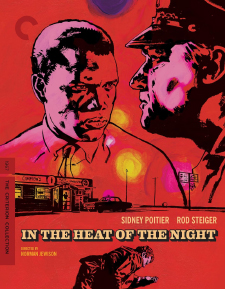
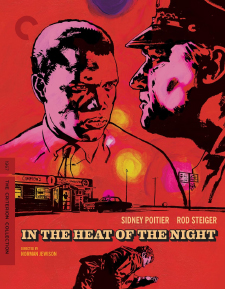
The Criterion Collection 2-Disc 4K Ultra HD release of In the Heat of the Night sits in a clear Amaray case with an insert featuring new artwork by Sean Phillips and an accordion-style booklet containing cast and crew information; the essay The Double Bind by K. Austin Collins; transfer information; special thanks; acknowledgments; and production credits. The following extras are included on each disc:
DISC ONE: UHD
- Audio Commentary with Norman Jewison, Haskell Wexler, Rod Steiger, and Lee Grant
DISC TWO: BD
- Audio Commentary with Norman Jewison, Haskell Wexler, Rod Steiger, and Lee Grant
- Norman Jewison (HD – 12:49)
- Sidney Poitier (SD – 7:44)
- Lee Grant (HD – 15:02)
- Aram Goudsouzian (HD – 17:30)
- Turning Up the Heat: Movie Making in the 60’s (SD – 21:10)
- Quincy Jones: Breaking New Sound (SD – 13:03)
- Trailer (HD – 2:45)
The audio commentary, which features director Norman Jewison, cinematographer Haskell Wexler, and actors Rod Steiger and Lee Grant, is quite good. It goes quiet a few times, but the participants (who’ve been recorded separately and stitched together later on) offer their own personal experiences with the film. Jewison and Wexler primarily run the commentary, but everybody contributes dutifully.
In the 2018 interview with Norman Jewison, he discusses the importance of characters having different emotions at different times, being exposed to the original book and adapting it for the screen, the characteristics of the characters, bringing Hal Ashby on to the project, and developing the music and the score with Ray Charles and Quincy Jones. The interview with Sidney Poitier is taken from the American Film Institute’s 100 Years...100 Cheers 2006 television special. In it, he talks about reading the script for the first time and asking for some changes, being excited to work with the other actors, how important it was to sell the reality of the situation in the film, and insisting to Walter Mirisch that his character slap back after being slapped himself.
In the 2018 interview with Lee Grant, she talks about being blacklisted in Hollywood, being caught up in the film’s story and identifying with the character’s rage, working in theater with other blacklisted actors and how she became blacklisted herself, fighting tooth and nail against being blacklisted, shooting her scenes for the film, and how great it was to work with Norman Jewison and Hal Ashby. In the 2018 interview with Aram Goudsouzian, chair of the history department at the University of Memphis and author of Sidney Poitier: Man, Actor, Icon, he speaks about the state of the world when Poitier entered the film business, his impact on political issues as well as the roles he inhabited, his being self-aware of how he was perceived by African American audiences and how it influenced what roles he accepted, critical analysis and liberal opinion of Poitier during the 1960s, the assassination of Martin Luther King and how it affected Poitier’s activism, how race relations changed in the 1970s and how films reflected that, and how Poitier’s roles in the 1970s and beyond no longer reflected his personal beliefs the way they once did.
Turning Up the Heat and Breaking New Sound take a retrospective look at the film and its score with Norman Jewison, Walter Mirisch, filmmaker John Singleton, university professors Dr. Imani Petty and Dr. Todd Boyd, AFI film historian Patricia King Hanson, cinematographer Haskell Wexler, composer Quincy Jones, filmmaker Reginald Hudlin, musician Herbie Hancock, film music historian Jon Burlingame, audio engineer Patrick Smith, and lyricists Alan and Marilyn Bergman. Last is the film’s trailer.
There’s also quite a bit of material not carried from the other three UHD releases. The Kino Lorber Studio Classics release includes an audio commentary with Nathaniel Thompson, Steve Mitchell, and Robert Mirisch; the featurette The Slap Heard Around the World; and the sequels They Call Me Mister Tibbs! and The Organization, as well as trailers for both films. The Imprint Films release includes the featurette When the Picture Was Over: The Life and Films of Rod Steiger, a Trailers From Hell commentary by film distributor Michael Schlesinger, and an 84-page hardcover booklet featuring the essay “Night Moves”: In the Heat of the Night’s Pursuit of the American South by Travis Woods. And finally, the Wicked Vision release includes many exclusive extras: an audio commentary with Dr. Gerd Naumann and Christopher Klaese; an image gallery; a re-edited version of the original theatrical trailer; the German versions of both trailers; a German VHS trailer; and German trailers for They Call Me Mr. Tibbs! and The Organization.
The Criterion Collection’s 4K Ultra HD release of In the Heat of the Night offers a stellar presentation of the film with a healthy extras package, even if it doesn’t feature HDR or the other extras from the other UHD releases. What it boils down to is that no matter which UHD release of In the Heat of the Night you lay your money down for, it’s a must-own. Highly recommended.
- Tim Salmons
(You can follow Tim on social media at these links: Twitter, Facebook, BlueSky, and Letterboxd. And be sure to subscribe to his YouTube channel here.)