
Full Moon Fright Box: Vol. I (Blu-ray Review)
Director
Albert Pyun/Peter Manoogian/Charles Band/William ButlerRelease Date(s)
1991/1992/1993/2010 (November 6, 2024)Studio(s)
Full Moon Features (Umbrella Entertainment)- Film/Program Grade: See Below
- Video Grade: See Below
- Audio Grade: See Below
- Extras Grade: B
- Overall Grade: B+

Review
[Editor’s Note: This is a Region-Free Australian Blu-ray import.]
In the annals of low-budget independent filmmaking, the name Roger Corman towers over all the rest thanks in no small part to his longevity and his resiliency. He’s not alone in that regard, however, as there have been a few other mini-moguls out there who don’t necessarily have the same level of name recognition that he does. One of them is the slightly less legendary (if also somewhat more notorious) Charles Band. Like Corman, Band kept reinventing himself throughout his career, though not always with the same levels of success. While Corman was able to sell companies like New World Pictures for a profit, Band tended to make a move because he didn’t have any other choice at the time.
When his original production company Charles Band International Productions struggled with distribution deals, he formed a new company named Empire International Pictures in 1983 to handle both production and distribution of low-budget exploitation films. A few of them had a bit more ambition than the rest, and that helped to contribute to Empire’s eventual collapse, especially since the independent film market was changing irrevocably as the home video market grew. Yet Band responded by reinventing himself yet again, forming his direct-to-video label Full Moon Entertainment immediately after his exit from Empire. (Sometimes, you just have to keep moving forward.) Full Moon has been Band’s home away from home ever since, and it’s also provided a home for some of the films that were otherwise abandoned after the collapse of his previous companies. Whatever that you can say about Full Moon as a business, it’s unquestionably been Band’s most successful brand name.
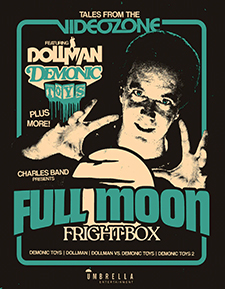
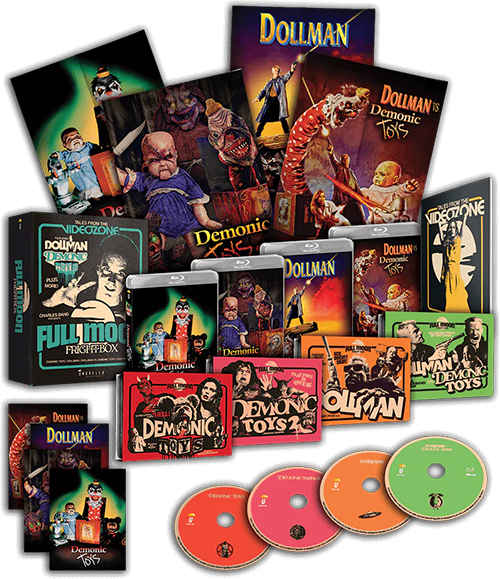
Umbrella Entertainment’s Full Moon Fright Box Vol. 1 (1991, 1993, 1992, 2010) Blu-ray Collector’s Edition is a four-disc set that includes Dollman, Dollman vs. Demonic Toys, Demonic Toys, and Demonic Toys 2. (No Puppet Master vs. Demonic Toys, but that’s a bit of a bastard stepchild since it wasn’t produced by Full Moon.) It also includes a 48-page booklet with essays by John Harrison and Guy Davis; individual slipcovers with new artwork by Johnny “Visibly Wasted” Bekavac; individual A3 reversible posters; and 4 standup counter cards with the original poster artwork. The set is limited to 1,500 units, and everything comes housed inside an individually numbered rigid storage case with illustrations by Bekavac.
Let’s address everything in chronological order, rather than the hybrid order given in Umbrella’s title for the set:
DISC ONE: DOLLMAN
One of Band’s earliest efforts was Tourist Trap in 1979, produced through his Charles Band Productions label but distributed by Compass International Pictures. While the story of mannequins coming to life was the brainchild of writer/director David Schmoeller, something about that concept clicked for Band, and it clicked hard. He ended up returning to the subject of malevolent mannequins, dolls, puppets, and even toys all throughout his career, from Stuart Gordon’s Dolls in the Empire Pictures days to launching Full Moon Entertainment with Schmoeller’s Puppet Master in 1989. The latter franchise would come to define Full Moon more than any of Band’s other properties, partly due to its popularity but also because of the fact that he keeps dipping into the Puppet Master well over and over and over again (as of this writing, the most recent installment was Puppet Master: Doktor Death in 2022). Still, there were far more possibilities to be mined from miniature worlds than just dolls, toys, and puppets, so in 1991, Band flipped the script with his idea for Dollman.
Granted, there’s nothing particularly new about placing miniature people into oversized environments, from films like The Devil-Doll, Dr. Cyclops, and The Incredible Shrinking Man to television series like Land of the Giants and Dr. Shrinker. James Whale even included a miniature menagerie in his glorious The Bride of Frankenstein, for no other reason than he could. Band’s twist on the concept was to take the ultimate tough guy, someone who’s badder than badass, and put him on the defensive by forcing him to deal with otherwise normal people who are now six times his size. And to play him, Band dipped into the Empire Pictures well to pluck out Tim Thomerson, star of Zone Troopers and Trancers. The former standup comedian had an uncanny knack for playing things straight, which allowed relatively sober characters like Sgt. Patrick Stone and Jack Deth to remain anchored in reality no matter what kind of fantastical shenanigans were taking place around them. (I mean, who but Thomerson could make lines like “Butt me, Mittens” and “Dry hair’s for squids” work?) Needless to say, Thomerson was a natural to help make the outlandish worlds of Dollman work.
And “worlds” they are, since Chris Roghair and David Pabian’s script for Dollman opens up on the planet Arturos, where Brick Bardo (Thomerson) is a maverick cop who does things his own way over the objections of his superiors. He even has his own oversized Dirty Harry-style weapon: the Groger Blaster, the most powerful handgun in the universe. While pursuing his archnemesis Sprug (Frank Collison), the two of them end up sucked through a rift in spacetime that lands them on Earth instead—where, due to a terrible miscalculation of scale, the two of them are only 1/6th the size of people on this new world called the Bronx (fortunately for both of them, they’re not accidentally swallowed by a small dog). Sprug quickly hooks up with a group of gangbangers led by Braxton Red (Jackie Earle Haley), while Bardo ends up taking refuge with the kindly Debi Alejandro (Kamala Lopez) and her son Kevin (Humberto Ortiz). Debi has been leading a neighborhood watch trying to cut down on crime in the neighborhood, which puts her in Braxton’s sights—and sets the gangster on a collision course with the diminutive Dollman.
Band brought in Albert Pyun to direct Dollman, although Pyun appears to have had some influence on the script as well (the name “Brick Bardo” actually came from his earlier film Cyborg.) Pyun had plenty of experience working with low-budget visual effect of all sorts, from miniature work to forced perspective, so he was a natural for Dollman. He also worked quickly and cheaply, even if his predilection for multi-camera shooting meant burning through more film stock than the notoriously penny-pinching Band would have preferred. Yet Pyun never quite found the right tone for Dollman, with the pacing feeling subtly off despite the scant 79-minute running time. To be fair, that may be as much due to Roghair and Pabian’s script as it is to anything Pyun brought to the table. They definitely lacked the deft touch of Danny Bilson and Paul DeMeo, and as a result, Dollman is no Trancers. Still, Thomerson was at the top of his game, Kamala Lopez makes an appealing heroine, and Jackie Earle Haley is as Jackie Earle Haley as ever. (Props to Frank Collison as well for pulling off a challenging role.) Dollman never launched a franchise of its own like Puppet Master did, although it wouldn’t be the final appearance of Brick Bardo. But to set that up, Band started by taking a step backward into the world of malevolent miniature creations yet again...
Cinematographer George Mooradian shot Dollman on 35mm film using Moviecam cameras with spherical lenses. While the original Full Moon SD home video versions were released open-matte at 1.33:1, all of their HD masters are reframed at 1.78:1, and since the compositions usually don’t look too tight at that ratio, everything was likely protected for potential projection matted to 1.85:1. It’s not clear what source element was used for Full Moon’s HD master, but like many of their in-house titles (as opposed to earlier Empire Pictures titles that they have released), it may well be based on a scan of the negative. The opening titles do look particularly rough, but while the optical work and stock footage in the rest of the film still stands out, it isn’t quite as bad. Otherwise, the image is reasonably sharp and detailed, only marred by a little instability, some speckling here and there, and a few prominent scratches. The grain is fairly heavy but Umbrella has definitely improved upon the encode over the Full Moon version, so there aren’t many issues with it. Nothing special here, but it’s a serviceable visual presentation of Dollman.
Audio is offered in English 5.1 and 2.0 DTS-HD Master Audio, with optional English subtitles. Dollman was produced in Ultra Stereo, but the 2.0 track sounds like basic mono, while the 5.1 just feeds an attenuated version of the mono signal into all five channels—it’s not a 5.1 remix in any sense of the term. Mono or not, there should still be a bit more punch than there is here, with the gunfire sounding particularly anemic, and Tony Riparetti’s score lacks any real guts. While there’s probably some improvement over Full Moon’s own Blu-ray thanks to the upgrade from their standard Dolby Digital to full lossless, nothing really stands out. Like the video, it’s serviceable audio, but definitely nothing special.
The following extras are included:
- Commentary with Nat Brehmer
- Charles Band on Dollman (HD – 7:03)
- Full Moon University – The VideoZone Story (HD – 18:02)
- Dollman VideoZone (Upscaled SD – 7:43)
- Tim Thomerson and Charles Band Vidcast July 2013 (HD – 5:45)
- Lost Pulse Pounders 1998 Promo (Upscaled SD – 1:23)
- Trailer (HD – 1:18)
- Full Moon Fright Box Trailers (HD – 5:24, 4 in all)
Umbrella has added three new extras here, kicking off with a commentary by Nat Brehmer, author of Puppet Master Complete: A Franchise History. He gives an overview of the ways that the Dollman concept evolved from its first poster design to the final film, and says that it still feels the most like an Empire film out of the entire Full Moon catalogue. But the whole 13” Dirty Harry idea came mostly from Albert Pyun, who Brehmer feels is one of the greatest low-budget action directors of all time. He’s really, really impressed with the look and style of Dollman, so he doesn’t appear to find any serious issues with the tone and pacing of the film. That sets the tone for the entire commentary; while he does offer a few stories about the making of Dollman, it’s really more of an appreciation of the film.
Charles Band on Dollman is an interview where Band acknowledges that smaller universes appeal to him, so going from small dolls to small humans seemed like a natural progression. He felt that the appeal was in having a Terminator-style tough guy being forced to deal with only being 12” tall, and that led to him casting Tim Thomerson in the role.
Full Moon University – The VideoZone Story is a look back at one of the ways that Band was ahead of the curve: by including VHS extras that played after the movie. Featuring interviews with Daniel Schwieger, Dave Parker, Jeffrey S. Farley, and Band, Full Moon University examines the way that these extras helped to build the Full Moon brand. It also includes clips from various VideoZones as examples (Farley says that he was only kidding in one of the clips). They share some interesting stories, like how the L.A. riots ended up trashing the entire Full Moon facility, and how some of the actresses were perfectly comfortable sitting around the sets in the nude.
The archival extras include, unsurprisingly, the Dollman VideoZone, which includes behind-the-scenes footage, clips, and interviews with Tim Thomerson, Jackie Earle Haley, Kamala Lopez, and Albert Pyun. There’s also a 2013 Vidcast interview with Band and Thomerson, as well as a 1998 promo for Pulse Pounders, an anthology film that fell apart along with Empire Pictures back in 1988 (and it was never actually released in 1998, either). That’s all of the previously available extras for Dollman.
DOLLMAN (FILM/VIDEO/AUDIO/EXTRAS): B-/B/B-/B
DISC TWO: DEMONIC TOYS
One year after making the leap from the malevolent miniature threats of Dolls and Puppet Master into miniature heroes (albeit reluctant ones) in Dollman, Charles Band took one step backwards and just a jump to the left with Demonic Toys in 1992. As usual, in the best exploitation tradition, he started with little more than a title and a poster in order to sell the idea before going to the trouble of commissioning the film itself—although in this case, his original concept was called Dangerous Toys. According to Band, his home video partner Paramount Pictures loved the idea, but when they did legal clearances, they discovered that there was already a Texan hard rock band called Dangerous Toys. But a malevolent miniature by any other name would still smell like money to Charles Band, so he changed the title to Demonic Toys instead, and the rest became history—or not quite history yet, because there would end up being more in store for the world of Demonic Toys after the first film. But we’re getting ahead of ourselves there.
The job of fleshing out Band’s new title and revised poster into an actual feature film fell to a young up and comer, David S. Goyer, who was hired to write and possibly direct the film for Full Moon. Also in the best exploitation tradition, Goyer delivered a script in a matter of days, but he ultimately declined to direct and wouldn’t make his debut behind the camera until ten years later with Zig Zag in 2002 (and then nearly scuttled his entire directorial career two years after that with Blade: Trinity). But Band was well-versed in working with talent both old and new, so he brought in Empire Pictures veteran Peter Manoogian as director instead. Manoogian was already working on Seedpeople for Full Moon, but he was equally well-versed in the Charles Band school of independent factory filmmaking after having worked on a segment in the Empire anthology film The Dungeonmaster all the way back in 1984. (Everything is cyclical in the world of exploitation filmmaking, so what goes around inevitably ends up coming around again.)
Full Moon Entertainment was only a few years old in 1992, but Band’s budgets were already getting smaller, and after the relatively ambitious Puppet Master III: Toulon’s Revenge in 1991, the story for Demonic Toys ended up being confined to a single setting in order to economize. Two police officers, Judith Gray (Tracy Scoggins) and Matt Cable (Jeff Weston) are staking out the Arcadia toy warehouse in the hopes of catching gun runners Lincoln (Michael Russo) and Hesse (Barry Lynch). Judith has been having strange dreams about two boys (Daniel Cerny and William Thorne) who play a perpetual version of the card game War. When their stakeout inevitably goes sour, Judith ends up trapped in the warehouse along with security guard Charnetski (Peter Schrum) and local fast food employee Mark (Bentley Mitchum), as well as a drifter (Ellen Dunning) who’s been hiding out in the air shafts. But gun runners are the least of their problems, as some of the toys have come to murderous life: Baby Oopsie Daisy (Linda O. Cook), Grizzly Teddy (Edwin Cook), Jack Attack (Tim Dornberg), and Mr. Static (Brigitte Lynn). But the toys prove to be the least of their problems, since these automatons serve a dark master with an even darker connection to Judith’s dream world.
Demonic Toys is essentially another riff on Die Hard, with an independent-minded police officer trapped inside a commercial building, fighting for her life and those of her fellow captives. It’s just that the warehouse is a whole lot smaller than Nakatomi Plaza, and the threats that she faces are a fraction of the size of Hans Gruber’s phony terrorists (and the ultimate demonic mastermind behind what’s happening is no Hans Gruber, either). But Scoggins throws herself into the proceedings with real intensity—it’s not clear if everyone else involved took the project seriously, but she certainly did. And longtime Charles Band associate John Carl Buechler delivered some reasonably effective animatronic doll effects (along with a few full-sized monsters). The late great David Allen and his crew were also on hand to provide some quality stop-motion animation for the finale. Demonic Toys is no Dolls or even a Puppet Master (it also can’t touch Tourist Trap, for that matter), but it works well enough for what it is: a cheapie Die Hard with a particularly unpleasant batch of killer toys instead of terrorists. Or, think of it as a “bottle episode” of Puppet Master. Regardless, as long as you’re in the right mindset, Demonic Toys delivers just enough of the Full Moon goods to make it worth 83 minutes of your time.
Cinematographer Adolfo Bartoli shot Demonic Toys on 35mm film using spherical lenses, also produced open-matte at 1.33:1 for home video, but protected for any potential projection matted to 1.85:1, and the HD version is reframed to 1.78:1. Once again, no clear indications of the source element that Full Moon used for this HD version, but while the results are similar to Dollman, they’re perhaps just a touch softer, so maybe an interpositive or internegative was used instead. In any event, it’s still reasonably detailed, damage is limited to occasional scratches and speckling, and Umbrella’s encode is a step up over Full Moon’s—although in this case, there’s some noise visible in some of the darker shots, but I suspect that’s baked into the master and there’s nothing to be done about it. Despite the fact that toys are the main characters, the colors aren’t particularly vivid, but that’s probably a side effect of the dim lighting. Like Dollman, this HD version is nothing special, but it gets the job done.
Audio is offered in English 5.1 and 2.0 DTS-HD Master Audio, with optional English subtitles. Demonic Toys was also released in Ultra Stereo, but this is another case where everything sounds center-focused and nearly mono. The 5.1 spreads that mono character around without really remixing anything, although there may be some ambient sound steered to the surround channels in 5.1. If so, it’s pretty faint. The upside is that the sound quality here is a little more dynamic than it was on Dollman, with effects like the infrequent gunfire having bit more punch, while Richard Band’s score also has a bit more depth. But it’s still not a dramatic improvement over Dollman, just a marginal one.
The following extras are included:
- Alternate Director’s Cut (HD – 83:00)
- Commentary with Nat Brehmer
- Commentary with Ali Chappel and Jay Clarke
- Charles Band on Demonic Toys (HD – 8:07)
- Build-a-Scare – Creature Sculptor Jeff Farley on Demonic Toys (HD – 4:58)
- Full Moon University – The Full Moon Story (HD – 18:02)
- Demonic Toys VideoZone Episode (Upscaled SD – 7:39)
- Trailer (HD – 1:19)
- Full Moon Fright Box Trailers (HD & Upscaled SD – 5:24, 4 in all)
Umbrella has added three new extras here, kicking off with another commentary by Nat Brehmer. While his Full Moon fandom started when he discovered Puppet Master at 8 years old, it turns out that Demonic Toys was actually his first experience with Full Moon, when he glimpsed a scene on television with a demon surrounded by toys coming to life. But it took him years to figure out what film that it came from, building up an image in his mind that was more his imagination than anything in the film itself, which he finally discovered when he caught it at the age of 14. But as usual, he’s still a fan, so he focuses on the positives more than the negatives. He does offer some limited background information about the production, but once again, he’s mostly focused on appreciating the film itself—at one point, he charitably calls a scene “riveting” (although he does admit that the film doesn’t have the “punchiest” of endings).
There’s also a new commentary featuring actor/screenwriter/filmmaker Ali Chappell and writer/filmmaker Jay Clarke, who are no less appreciative than Brehmer, but fortunately, they’re way more enthusiastic. Brehmer’s commentaries tend to be laid back, almost soporific, but Chappell and Clarke leap into the assignment with real enthusiasm. They explain their own personal connections with Full Moon: Clarke worked at a video store during the Nineties (didn’t we all?), while Chappell has acted in several recent Full Moon titles. They get sidetracked at times with personal stories, but they’re always entertaining when they do, and they also throw in some different background information than Brehmer does. But again, it’s mostly an appreciation from a couple of enthusiastic fans of Demonic Toys and all things Full Moon.
The other new extras consist of interviews and a reprise of Full Moon University – The Full Moon Story (probably to facilitate a later single-disc release). Charles Band on Demonic Toys features the mini-mogul explaining why he had to change the original title Dangerous Toys and also discussing David S. Goyer’s script, Peter Manoogian’s direction, John Carl Buechler’s puppets, and his legacy with dolls, toys, and puppets. Build-a-Scare is with sculptor Jeff Farley, who worked with Buechler going back to the Empire Pictures days. He sculpted the full-sized bear (spoiler alert) from the end of the film—although the production did end up reusing an older appliance of his for the demon at the end of the film.
The archival extras include an Alternate Director’s Cut, which runs about 23 seconds longer than the theatrical cut—in this version, anyway, as the one included by 84 Films in Germany was 16 seconds longer. But the discrepancy probably comes down to how they’re encoded to disc rather than any differences between the two director’s cuts. As far as the director’s cut itself vs. the original cut, it all comes down to a few shots here and there with extra violence, mostly in the form of additional biting and stabbing (13 shots total, according to the Movie-Censorship website). The downside is that the director’s cut is limited to 2.0 Dolby Digital, so unless you really, really need those extra stabs and bites, you’re better off sticking with the original cut.
Aside from the usual collection of trailers (including a reprise of the Full Moon Fright Box Trailers from the Dollman disc), there’s also another VideoZone episode, this time focusing on Demonic Toys. It includes behind-the-scenes footage, clips, and interviews with Manoogian, Buechler, Tracey Scoggins, Bentley Mitchum, Daniel Cerny, William Thorne, Ellen Dunning, Mike Deak, and Rod Matsui. That’s all the previously available extras for Demonic Toys, although note that the later Dollman Toybox Collection set from 101 Films in the U.K. added an interview with Richard Band, one with Demonic Toys 2 director William Butler, and a different interview with Charles Band. (It also included a couple extra films, but we’ll get to those at the end of the review).
DEMONIC TOYS (FILM/VIDEO/AUDIO/EXTRAS): C+/B/B/B
DISC THREE: DOLLMAN VS. DEMONIC TOYS
Given Charles Band’s predilection for milking all of his Full Moon intellectual properties for every last penny that they’re worth, it was perhaps inevitable that Dollman and Demonic Toys would both end up getting sequels. Yet ironically enough, Dollman never did, at least directly, and Demonic Toys would have to wait a full 18 years to receive its own belated sequel. Instead, they got something a bit different that proved that Band did have a knack not necessarily for being ahead of the curve, but for jumping onto it before it was popular to do so: a crossover event. Crossover events and shared universes were nothing new, of course, especially in the world of comics, but the cinematic comic book adaptations at that time weren’t diving into those waters. (Christopher Reeve’s Superman never even made an appearance in the Salkind’s 1984 Supergirl spinoff.) Of course, cinematic shared universes were nothing new either, with Universal Studios exploiting most of their classic monster characters in multiple crossover stories, even throwing Abbott and Costello into the mix for good measure. But in 1993, that kind of thing was vanishingly rare, so Band got the jump on the Marvel and DC cinematic universes with Dollman vs. Demonic Toys.
Yet in the best tradition of crossovers events, Dollman vs. Demonic Toys wasn’t just a mashup of those two (potential) franchises, and that’s where Band really did go out on a limb in 1993. Instead, it’s a mashup of three different Full Moon IPs: Dollman, Demonic Toys, and Bad Channels. Wait, what? Yes, Bad Channels, the Ted Nicolau-directed flight of fancy from the previous year where aliens invade a radio station, shrink women down to miniature size, and imprison them in glass tubes (shades of Dr. Pretorius’ miniature menagerie in The Bride of Frankenstein, but you just knew that everything had to go full circle back to Universal, didn’t you?) Band even had the foresight to include a post-credit sequence in Bad Channels where Brick Bardo (Tim Thomerson), the titular Dollman, heads out in search of the one woman left miniaturized at the end of the film, hoping for a meeting of the minds (or other body parts). There was just one problem: Dollman vs. Demonic Toys would end up using the character of Nurse Ginger (Melissa Behr), who was unshrunk at the end of Bad Channels while Bunny (Daryl Strauss) was left waiting in a test tube. No problem for Band, however; he just retconned all of that by reediting and redubbing the footage from Bad Channels that he included as a flashback in Dollman vs. Demonic Toys.
That would end up being a theme throughout all of Dollman vs. Demonic Toys. Not necessarily the retcon part, but rather the heavy use of stock footage. Band would end up padding out the scant 63-minute running time of the film with plenty of footage from Dollman, Demonic Toys, and Bad Channels. His budgets were continuing to shrink, so simplifying the locations like in Demonic Toys wasn’t enough; he had to economize in other ways. But that’s one of the fascinating things about Dollman vs. Demonic Toys, because for all of the padding, Band did focus his limited resources on some elaborate set pieces that included oversized sets, props, and characters, which allowed the otherwise diminutive toys from hell to interact directly with his shrunken human characters. Do these oversized toys intercut well with the normal-sized puppets? Oh, hell no, but hey, at least Band’s crew gave it a college try.
And it was indeed Band’s crew, because he stepped behind the camera to direct this time (which was probably another way of economizing). Craigh Hamann’s script fuses together the characters from the three different source films, a bit awkwardly at times, but in practice it’s more of a follow-up to Demonic Toys than anything else. Most of the story is set at the Arcadia toy warehouse from that film, with maverick police officer Judith (Tracy Scoggins) continuing her investigation into the supernatural shenanigans that traumatized her during the previous film. And since Peter Schrum’s security guard Charnetski came out the worse for wear, he’s been replaced by… another security guard, Ray Vernon, played by Phil Fondacaro (who fits right in with the proceedings, if you know what I mean). But while Tim Dornberg and Brigitte Lynn returned to voice the demonic toys Jack Attack and Mr. Static, respectively, Grizzly Teddy was out of the picture, replaced by the new toy Zombietoid (“Evil” Ed Smith). Yet the real twist was that Baby Oopsie Daisy was voiced by Frank Welker this time instead of Linda O. Cook, a change necessitated by the fact that Baby Oopsie Daisy somehow changed genders between the films in order to be able to attempt to impregnate Nurse Ginger (don’t ask, just don’t).
The good news is that despite the abundance of stock footage, Dollman vs. Demonic Toys never wears out its welcome—although at 63 minutes, how could it? But while Band is no Roger Corman (on either side of the camera), the reality is that he’s always been a perfectly serviceable director who is more than capable of handling this kind of project. Tim Thomerson is still Tim Thomerson, which never hurts, while Melissa Behr is surprisingly appealing as Nurse Ginger, and Tracy Scoggins (perhaps just as surprisingly) takes everything just as seriously as she did on Demonic Toys. (It’s a shame that she didn’t do more Full Moon titles.) The animatronic effects are serviceable, and David Allen’s stop-motion crew returned for an all-too briefly glimpsed giant spider. The score cannibalizes Anthony Riparetti and Richard Band’s themes from Dollman and Demonic Toys, but Charles band also threw in a bunch of songs from Quiet Riot’s album Terrified because—well, okay, you got me there, it’s God’s own private mystery. But given the hodgepodge of other elements that are blended together in Dollman vs. Demonic Toys, perhaps having a bunch of otherwise incongruous Quiet Riot songs was just what the film needed. You just have to take Full Moon on its own terms sometimes.
Cinematographer Adolfo Bartoli shot Dollman vs. Demonic Toys on 35mm film using spherical lenses, also produced open-matte at 1.33:1 for home video, but protected for any potential projection matted to 1.85:1, and the HD version is reframed to 1.78:1. Still no clear indications of the source element that Full Moon used for this HD version, but the results are on a par with Demonic Toys. Things are in good shape with no major damage visible other than some speckling and other debris, and while the optical work in the film can look particularly soft, everything else looks reasonably detailed (although there’s also some dupe footage sprinkled throughout the film that doesn’t appear to contain any optical work, so maybe there was some damage to the base element after all). The liberal quantity of stock footage that pads out the film looks like, well, stock footage, but it is what it is. The colors are fine, albeit a bit muted in some of the darker scenes, and the contrast range is solid with good black levels that do have some crushed shadow detail, but nothing excessive.
Audio is offered in English 5.1 and 2.0 mono DTS-HD Master Audio, with optional English subtitles. Dollman vs. Demonic Toys is another Ultra Stereo production where the 2.0 track sounds like basic mono, while the 5.1 just feeds an attenuated version of that mono signal into all five channels rather than being a full remix. The dynamics are still somewhat limited, but everything is otherwise clear and balanced—and unsurprisingly, Richard Band’s score is one of the big stars of the show.
The following extras are included:
- Commentary with Nat Brehmer
- Commentary with Ali Chappel
- Commentary with Charles Band and Tim Thomerson
- Charles Band on Dollman vs. Demonic Toys (HD – 6:25)
- Full Moon University – The VideoZone Story (HD – 18:02)
- Dollman vs. Demonic Toys VideoZone (Upscaled SD – 8:30)
- Uncut Footage from the Set (Upscaled SD – 195:40)
- Original Trailer (HD – 1:32)
- Full Moon Fright Box Trailers (HD & Upscaled SD – 5:24, 4 in all)
Umbrella has added four new extras here, kicking off with another commentary by Nat Brehmer, who says that Dollman vs. Demonic Toys is one of the silliest films in the Full Moon catalogue, which means it’s automatically entertaining. He discusses the nature of the crossover and how the film fit into what he calls the “comic book era” for Full Moon. And, as usual, he does a lot of describing the story, scenes, and characters, but he also addresses some of the distinctive elements of the production like the emphasis on oversized sets and props (something that Dollman hadn’t done), the way that it retcons footage from Bad Channels to replace Bunny with Nurse Ginger Jones as the leftover shrunken woman, and the mysteriously changing gender for Baby Oopsie Daisy.
There’s also a new commentary with Ali Chappel, who goes solo this time but once again provides the yang to Brehmer’s yin, leaping into the proceedings with much more enthusiasm than the laid-back Brehmer. She says that she’s already excited before the opening credits are over, and she hopes that everyone else is, too. She briefly reiterates her own connection to Full Moon before diving into the world(s) of Dollman vs. Demonic Toys. She may not have written the book on Full Moon, but she knows her stuff, so she provides plenty of information about the studio, Charles Band, the cast, and the weird crossover nature of the film (including the retconning from Bad Channels). She also enthusiastically endorses the Baby Oopsie streaming series.
Aside from yet another reprise of Full Moon University – The VideoZone Story, the last of the new extras is Charles Band on Dollman vs. Demonic Toys, with Band discussing getting back behind the camera to launch Full Moon’s first major crossover event. He says that the reason why they opted for a heavy use of oversized sets and props was because the film involved miniatures fighting miniatures, so forced perspective and other such techniques weren’t really a good option. He also talks about his production facilities and the challenges of making this kind of film on a limited budget.
The rest of the extras are archival, starting with a commentary by Charles Band and Tim Thomerson that was recorded for Full Moon’s 2015 Blu-ray. Band and Thomerson may not quite be John Carpenter and Kurt Russell, but they play off each other well and do a decent job of refreshing each other’s memories—although they still make a few mistakes along the way (Band is so used to telling stories that he may have forgotten the truth at this point). There’s also another reprise of the Full Moon Fright Box Trailers and the VideoZone focusing on Dollman vs. Demonic Toys. It includes behind-the-scenes footage, clips, and interviews with Band, Thomerson, Melissa Behr, Tracy Scoggins, and effects supervisor Ted Haines. But the big gun of all the archival extras is a whopping three hours and fifteen minutes of Uncut Footage from the Set, which includes an overabundance of behind-the-scenes footage and raw interviews with Scoggins, Behr, Thomerson, Haines, Phil Fondacaro, and Albert Band (who is uncredited on the film, but must have been serving as a producer and/or assistant director on the set). That’s all of the previously available extras for Dollman vs. Demonic Toys.
DOLLMAN VS. DEMONIC TOYS (FILM/VIDEO/AUDIO/EXTRAS): C/B/B+/B-
DISC FOUR: DEMONIC TOYS 2
Full Moon may be Charles Band’s longest-running venture, but it hasn’t been without its own share of changes over the years—and a few bumps on the road along the way. After losing his distribution deal with Paramount, he reinvented Full Moon, and would have to do so a few more times after that. One casualty of that process was the Demonic Toys franchise, with Band ultimately selling his planned Puppet Master vs. Demonic Toys crossover to the Sci-Fi Channel in 2004, where it was produced without his involvement (although Full Moon veteran Ted Nicolau did end up directing it). But Band retained the rights to the characters, so he was finally able to produce his own direct sequel to Demonic Toys in 2010, Demonic Toys 2 (aka Demonic Toys: Personal Demons)—only, in typical Full Moon fashion, it was arguably less of direct sequel than Dollman vs. Demonic Toys had been, and just as much of a crossover event.
That’s because with maverick police officer Judith and all of the other Demonic Toys human characters out of the way after the ending of Dollman vs. Demonic Toys, it was time for a fresh cast, which also made it time for a different setting—in this case, Castello di Giove, the Italian castle owned by Band that had been the setting for previous Full Moon titles like The Pit and the Pendulum, Meridian, and Castle Freak. The job of transplanting the demonic toys from the Arcadia warehouse to Italy fell to William Butler (not to be confused with William Butler Yeats), a director who would have an outsized influence on Full Moon over the years that followed. But whether it was his own idea or at Band’s behest, Demonic Toys 2 would also end up being a crossover film since it roped in oddities collector Dr. Lorca (Michael Citriniti) from Band’s 1997 horror-comedy Hideous!. The fact that Dr. Lorca ended up dissolved in a pool of acid at the end of that film might have been a minor inconvenience for some filmmakers, but Butler solved that problem via the time-honored tradition of ignoring it completely.
Butler’s script for Demonic Toys 2 picks up right where Dollman vs. Demonic Toys left off, with Dr. Lorca acquiring the stitched-together remaining pieces of Jack Attack and Baby Oopsie Daisy (voiced this time by The Go-Go’s guitarist Jane Wiedlin). He’s also in pursuit of another toy after having been notified by Caitlin (Alli Kinzel), one of the caretakers at an ancient castle, that she discovered an animated artifact called Divoletto. Lorca visits the castle along with his wife Lauraline (Elizabeth Bell), her stepson David (Lane Compton), his driver Eric (Billy Marquart), and psychic little person Lillith (Selena Luna). There, they join antiquities expert Mr. Butterfield (Leslie Jordan) to investigate the automaton and the strange occurrences at the castle. Naturally, Divoletto comes to life, soon joined by Jack Attack and Baby Oopsie Daisy, and much carnage ensues. But some of the humans in the party are harboring secrets of their own, and their machinations will end up involving their own personal demon (Gage Hubbard).
Another trip to Charlie’s castle, and another new voice for Baby Oopsie Daisy, who was voiced by Linda O. Cook in the first film but then by Frank Welker in Dollman vs. Demonic Toys, since that story required Baby Oopsie to grow a pair (literally). But it’s been gender-swapped back to female form this time, with Butler not bothering to explain why any more than he took the time to reconstitute the dissolved corpse of Dr. Lorca after the end of Hideous!. The practical doll effects are adequate at best in this long overdue sequel, but one of the biggest issues with Demonic Toys 2 is that for all of Band’s disavowal of digital effects, there’s some particularly bad CGI in the film, from bats to spurting blood and even a digital decapitation. That’s a shame coming from a studio that long reveled in practical makeup effects and stop-motion animation. But Butler certainly understood the assignment and keeps the story (and the carnage) moving quickly enough not to get bogged down in problematic details like that. That may be damning Demonic Toys 2 with faint praise, but we are talking about a franchise that revels in one-liners like this:
“I’m Baby Oopsie Daisy, will you be my special friend? I can walk, I can talk, I can even shit my pants. Can you shit your pants?”
In other words, the bar for Demonic Toys 2 wasn’t particularly high in the first place.
Cinematographer Terrance Ryker captured Demonic Toys 2 digitally, likely at 1080p HD resolution, but there’s no other information available. (At least this time it was framed natively at 1.78:1.) But it did make its Blu-ray debut via this set, since it was previously available on DVD only. HD or not, it definitely looks like digital video, with inconsistent contrast and sharpness. Bright highlights like candles and fireplaces tend to be completely blown out, but that’s doubtless how they were captured and there’s nothing to be done about it. At its best, Demonic Toys 2 does offer stronger contrast than the other shot-on-film titles in this series, but at its worst, it tends to look a little flat and washed out. There’s also some noise in the darkest shots. Again, that’s just the nature of the original cinematography, and not a flaw in this presentation of it.
Audio is offered in English 2.0 DTS-HD Master Audio, with optional English subtitles. This does appear to be a surround encoded mix, since effects like thunder are steered into the rear channels, and there’s some actual stereo spread across the front channels this time around. The dynamics are also stronger than in the other titles in this set. It may not be the best video quality, but it’s definitely the best audio.
The following extras are included:
- Commentary with Nat Brehmer
- Charles Band on Demonic Toys 2 (HD – 6:25)
- Trailer (HD – 1:17)
- Full Moon Fright Box Trailers (HD – 5:24, 4 in all)
There are two new extras this time, and no archival ones (the classic VideoZone era was over by 2010). The first is another commentary by Nat Brehmer, who points that Demonic Toys 2 is technically Demonic Toys 4, if you include the Syfy channel offshoot (which may not be a Full Moon title, but he still considers it canon). Brehmer goes over the troubled period in Full Moon history prior to Demonic Toys 2 and notes the importance of William Butler’s influence over the era that followed. From there, he discusses the rest of the cast and crew; the return to Band’s castle; the different designs (and natures) of the toys this time around; the story; and the spinoff movies that followed.
There’s also a new interview, Charles Band on Demonic Toys 2, where he explains how things had changed for Full Moon by the time that he finally got around to making an “official” sequel to Demonic Toys. He also acknowledges that life was easier for independent filmmakers in the direct-to-video days than they are in the streaming era. Other than that, there’s just another reprise of the Full Moon Fright Box Trailers. There aren’t any missing extras for Demonic Toys 2 for the simple reason that there haven’t been any extras prior to this.
DEMONIC TOYS 2 (FILM/VIDEO/AUDIO/EXTRAS): C-/B/B/C
Still with us? As Rich Eisen would say, hey, you made it all the way to the end, thanks for that. As mentioned previously, the only other things that are missing here are the other titles from the franchise that were included on the 2025 Dollman Toybox from 101 Films in the U.K. Three of them were compilation films that were derived from the Baby Oopsie streaming series: Baby Oopsie: The Feature, Baby Oopsie 2: Murder Dolls, and Baby Oopsie 3: Burn Baby Burn. They also included William Butler’s 2023 sequel Demonic Toys: Jack-Attack. If you must have every last bit of minutiae from the Demonic Toys franchise, then the 101 Films set may be the best option for you. But if you’re a Full Moon collector in general, Umbrella’s Full Moon Fright Box Vol. 1 is pretty much a mandatory purchase. While the selection of titles in their other sets so far have been a bit random compared to this themed one, they’re all gorgeous packages that demonstrate the breadth of Full Moon’s catalogue. Recommended.
- Stephen Bjork
(You can follow Stephen on social media at these links: Twitter, Facebook, BlueSky, and Letterboxd).