
Full House (Blu-ray Review)
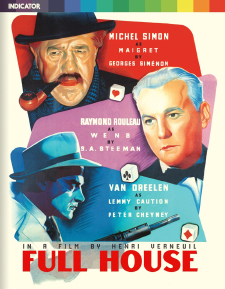
Director
Henri VerneuilRelease Date(s)
1952 (June 20, 2026)Studio(s)
Calamy-Terra Films/Pathé Consortium Cinéma (Indicator/Powerhouse Films)- Film/Program Grade: B+
- Video Grade: A-
- Audio Grade: A
- Extras Grade: B-
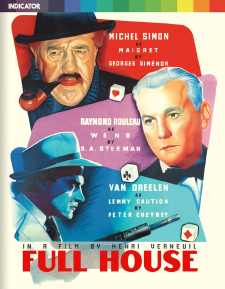

Review
A French crime and mystery anthology film directed by Henri Verneuil, Full House (Brelan d’as, or “Three of a Kind,” 1952) has the usual problems associated with portmanteau—segments of variable quality, each one better or worse than the others. Full House offers three segments spread across 118 minutes, adapted from a popular detective-type character: Georges Simenon’s Jules Maigret, Stanislas-Andre Steeman’s Monsieur Wens, and Peter Cheyney’s Lemmy Caution. The Wens segment is good, the Lemmy Caution awful, and the Maigret a delight. Two out of three ain’t bad.
The film opens with a delightful montage of various Parisians consumed by detective fiction stories. In L’alibi de monsieur Wens (“Monsieur Wen’s Alibi”), Private Detective Wenceslas Vorobeïtchik dit Wens (Raymond Rouleau) arrives at the fifth-floor apartment of Hubert Helding (Maurice Teynac), the estranged husband of a rich, tyrannical industrialist. Wens believes Helding may be plotting to murder her but, while both men are inside Helding’s apartment, she arrives, announced by the concierge (René Génin) but turning up murdered in the elevator across the hall. Has Helding committed the perfect murder, with Wens as his alibi? With his long-suffering fiancée, Denise (Jacqueline Porel) in tow, Wens learns of a sixth-floor gigolo, now vanished, with whom the wife may have been having an affair, and he also investigates nightclub entertainer Florence Gari (Arlette Merry), who has a quick-change impersonator act.
Wens appeared in a series of Belgian detective novels from 1931-1958, and seven Wens movies were produced from 1939 and 1964, including films for television. Unlike other fictional detectives, no one actor seems especially associated with the role; even Maurice Teynac, here the primary murder suspect, played him in a 1950 film. As someone completely unfamiliar with the character, I found the segment enjoyable, witty with moments of ghoulishness, if ultimately predictable despite its impressively baffling premise. Actor Rouleau is appealing, but even more so is Jacqueline Porel as Wens’s fiancée, alternately supportive and exasperated by her future husband’s obsession with the case.
The Lemmy Caution segment, Je suis un tendre (“I’m a Pushover”), is downright terrible. FBI agent Caution was the creation of British writer Peter Cheyney, who wrote 11 Caution novels over ten years, from 1936 to 1946. No English-language movie adaptations, British or American, were ever produced, but the novels took off in France, entertaining readers with French translations of a British writer’s concept of an American FBI agent. From 1953, the year after Full House’s release, American singer Eddie Constantine began playing Caution in a French-made film series that began as straightforward crime films but, by the 1960s, influenced by the popularity of the 007 series and other films, added comedy and other genre influences. The Lemmy Caution films are all but unknown in English-speaking countries, with the single exception of Jean-Luc Godard’s Alphaville (1965), hardly representative of the series. Constantine played the character in all of these films, while making occasional cameo appearances in others, all the way to 1991’s Germany Year 90 Nine Zero, again for Godard.
Indeed, the only film in which Lemmy Caution was not played by Constantine was in Full House, in which Dutch actor John Van Dreelen (who resembles a young Constantine) played him. The film is an almost incomprehensible mishmash of supposed tough guy action, with Lemmy Caution on the trial of international jewel thieves and nearly seduced by leggy Michèle Leroy (Nathalie Nattier). Much of this segment was shot in Hamburg, and is in nearly equal parts of French, German, and English, actor Van Dreelen competent in all three languages. Curiously, the French but not the German is subtitled into English; possibly in France the English is subtitled but not the German?
Van Dreelen later worked in the United States extensively, mostly in television and occasional films; he played Capt. Von Trapp in the touring production of The Sound of Music, but he’s better remembered for his TV work, including The Jeopardy Room, an episode of Twilight Zone featuring Martin Landau.
Despite its chase sequences and Tommy gun shootouts, the segment somehow is extremely dull and uninteresting, director Verneuil showing no affinity for the genre at all; visually, it resembles the style-free Jerry Cotton movies George Nadar made in West Germany in the 1960s. When it finally, thankfully ends and the Maigret sequence begins, Full House shifts back into gear in high style.
Universally regarded as the best of the three segments, Le témoignage d’un enfant de choeur (“The Testimony of an Altar Boy”) begins with Justin (Christian Fourcade), a working class altar boy, on his way to morning mass when he sees the corpse of a murdered man being dragged by junkman Simon Lesueur (Jérôme Goulven). Lesueur threatens to murder him and his mother should he go to the police but reward him if he keeps his trap shut. At mass, Justin faints and in a semi-conscious state blurts out that he’s seen a murder.
The assistants of Le commissaire Jules Maigret (Michel Simon) dismiss Justin’s declaration as a prank, but Maigret, laid up with the flu, isn’t so sure. Though Justin now insists it was all a lie, that he saw nothing, Maigret befriends the lad, hoping to get to the truth of the matter.
Later in the ’50s, the great if by now middle-aged Jean Gabin played Maigret in several films, but Michel Simon’s interpretation is much more the literary Maigret, subtly probing and observant, an ordinary, even (in Simon’s case) ugly, obese and pipe-smoking investigator. His gentle relationship with the boy—Christian Fourcade, later in the American film Little Boy Lost with Bing Crosby, no less—is likewise excellent, a boy circumstances force into a kind of instant adulthood, traumatized by witnessing the crime. One might complain that showing the murder and identifying the murderer at the beginning was a grievous error on the part of the screenwriters, but this segment is more a charming, intriguing character study than a mystery to be solved.
Indicator/Powerhouse Films’ Blu-ray of Full House, released in Region “B” format on July 20, 2026, and Region “A” the following day, each limited to a pressing of 4,000 copies, offers a video transfer derived from a 4K restoration of the original 35mm camera negative. The black-and-white, 1.37:1 standard frame release looks excellent, with fine detail and rich blacks; the location scenes look especially good here. The LPCM 1.0 mono is also very good, supported by optional English subtitles.
Extras consist of Michel Simon (1964), a 15-minute portrait of the eccentric actor, filmed in and around his animal-filled crumbling estate, it’s an excellent supplement; and an image gallery. Alas, as usual, The Digital Bits was sent only a check disc that did not include final packaging nor the 36-page booklet containing essays and other material. Wish they had.
Though not entirely satisfying, the first and third segments of Full House makes this a very worthwhile title, recommended.
- Stuart Galbraith IV