
Four Times That Night (Blu-ray Review)
Director
Mario BavaRelease Date(s)
1971 (June 29, 2026)Studio(s)
Delfino Film/Hape-Film/Arlington International Pictures (Indicator/Powerhouse Films)- Film/Program Grade: B
- Video Grade: A
- Audio Grade: A-
- Extras Grade: B

Review
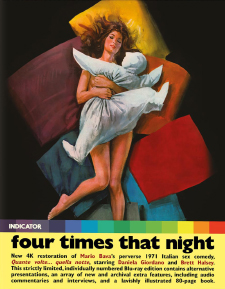
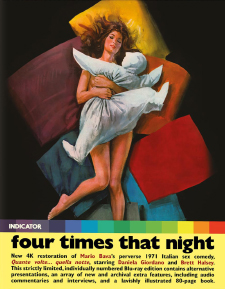
Many dozens, if not hundreds of racy sex comedies were made throughout much of the world during the late-1960s through mid-’70s, the genre eventually supplanted by more explicit, less innocent hardcore porn. Most of these are terrible when not unwatchable, but director Mario Bava’s Four Times That Night (Quante volte... quella notte, or “How Many Times... That Night?” 1971) is unusually clever and, despite its low budget, a handsome commedia sexy all-italiana. It’s basically a reworking of Akira Kurosawa’s Rashomon (1950) done as an Italian sex farce.
Womanizer Gianna Prada (American Brett Halsey) seeking that night’s conquest, prowls around in his expensive sportscar, eventually setting his sights on Tina Bryant (top-billed Daniela Giordano, a former Miss Italia), walking her toy poodle. After initially resisting his come-ons, she agrees to a date. Picking her up at her home, she’s cautioned by her very conservative Catholic mother, Sonia (Valeria Sabel), about Tina’s virginity and to not take advantage of her wholesome young daughter.
Tina and Gianna go to a disco, winding up at his very swinging ’60s bachelor pad, where Gianna locks the door and all but rapes her, she scratching his forehead and he ripping her expensive dress before she manages to escape.
Gianna returns to the disco where he tells three friends his version of what happened. In his testimony, shy Gianna fell victim to man-eater Sonia’s aggressive and insatiable desire for sex. In Gianna’s version, even Tina’s mother openly hits on him. Only the arrival of Gianna’s neighbors, Giorgio (Robert H. Oliver) and Esmeralda (Pascale Petit) save him from being eaten alive.
In yet another version, Gianna’s voyeuristic doorman (Dick Randall) discusses the evening with the milkman, the former having watched the evening unfold using binoculars from across the courtyard. He claims Gianna brought Tina to his apartment to provide Esmeralda company while he had sex with Giorgio, Tina completely unaware of Gianna’s homosexuality. In a final vignette, a scientist proposes yet another version of the story.
Cinematographer-director Bava (1914-1980) was a genuine artist, working within the confides of low-budget exploitation films. After his death he was all but forgotten in Italy (more a never-was than has-been) until Americans like Tim Lucas, Joe Dante, and others championed him in a series of retrospectives. Bava peaked in the 1960s, mostly with horror and suspense films, beginning with Black Sunday (1960) and continuing with Black Sabbath (1963), Blood and Black Lace (1964), Planet of the Vampires (1965), A Bay of Blood (1971), and Rabid Dogs (1974), among others. Bava was a genuine innovator, too: Black Sunday was a landmark of horror cinema; he virtually inventing the giallo genre with The Girl Who Knew Too Much (1963) and Blood and Black Lace, and the slasher film with A Bay of Blood. Planet of the Vampires is a very obvious influence on the later Alien (1979), while Rabid Dogs anticipates the later work of Quentin Tarantino and others.
Further, Bava worked in almost every Italian film genre, from peplum (e.g., Hercules in the Haunted World), to comedies and Spaghetti Westerns, with mixed results. Four Times That Night, in one sense, is beneath his abilities, but it is rather clever and amusing for what it is, and Bava attacks it with the same obvious enthusiasm as his other projects. Unlike the so-so DVD, Powerhouse Films Blu-ray really shows off Bava’s excellent cinematography, his use of bright, primary colors, and his lighting, and there are even a few of his clever trick shots (wide angle views of the discotheque).
There’s a little bit of nudity here and there, but as a sex romp the film is, on one hand, tame, even quaint, though the doorman’s version, with Gianni a gay man—Brett Halsey is effectively subtle in these scenes—was pretty daring for the time and avoids the prevailing stereotypes of the period. Further, its swinging ’60s aspects appear, unusually, fairly accurate if exaggerated. The other production points are likewise decent; the bouncy musical score, for instance, wouldn’t be out of place in one of the saucier Carry On films.
Released simultaneously in 4K, Powerhouse Films’ Blu-ray of Four Times That Night is presented in its original 1.85:1 widescreen via a 4K restoration utilizing the original camera negative. The resultant image looks splendid; Bava’s use of color really “pops” in this presentation, which is razor-sharp while displaying a pleasing level of film grain. Inherent to the original photography, a pesky hair in the film gate is visible for a long stretch, while at other times a smudge on the ground glass (or something) also appears for a good chunk of the film’s running time. Nevertheless, it’s a huge improvement from previous DVD versions. Included are both the original Italian version, running 83 minutes, and the slightly altered U.S. theatrical cut, dubbed into English, both LPCM 2.0 mono. Possibly seamless branching is at play here, as both cuts look pretty much the same apart from the opening titles, etc., which are only slightly less pristine on the U.S. cut. The English subtitles of the Italian track are excellent. The disc itself is Region-Free, and the release is limited to 4,000 4K discs and 1,000 Blu-rays.
Extras consist of two audio commentaries, one from 2019 by Tim Lucas (on the Italian cut) and a new one featuring Tony Howarth and Eugenio Ercolani, supporting the American version. Also included is a new 13-minute interview with Mario’s son Lamberto Bava, who worked on the film; Like Father, Like Son, a 14-minute minute interview with Roberto Colangeli, son of the film’s editor; The Rashomon Effect, a new, 19-minute video essay by Rachael Nisbet; a U.S. trailer, and an image gallery.
As The Digital Bits was sent only a check-disc (sigh), we can’t assess the reportedly 80-page book accompanying this release.
Some Mario Bava movies one can watch and enjoy over-and-over again, while for the minor ones, once is enough if not once too many—Roy Colt & Winchester Jack comes to mind. Like that dreary Bava Western, watching the DVD of Four Times That Night on DVD years ago satiated my curiosity, but Powerhouse Films’ Blu-ray is such a profound improvement transfer-wise, that and all the extra features make this a very worthwhile release. Plus, the film is actually pretty good for what it is.
- Stuart Galbraith IV