
Dirty Dozen, The (4K UHD Review)
Director
Robert AldrichRelease Date(s)
1967 (November 17, 2026)Studio(s)
MKH Productions/Seven Arts Productions/Metro-Goldwyn-Mayer/Warner Bros. (Arrow Video)- Film/Program Grade: B+
- Video Grade: A-
- Audio Grade: A
- Extras Grade: A-


Review
Based partly on the 1965 E.M. Nathanson novel of the same name, Robert Aldrich’s The Dirty Dozen tracks the training and deployment of a misfit band of military convicts, given a last chance to redeem themselves by taking part in a suicide mission behind enemy lines ahead of the Allied invasion of France. An OSS officer with authority issues, Major John Reisman (Lee Marvin), is tasked by Major General Sam Worden (Ernest Borgnine) with selecting a dozen men for this mission from the U.S. Army’s Marston-Tyne Prison in Great Britain. Numbered 1 through 12, they’re played by the likes of Charles Bronson, Jim Brown, John Cassavetes, Trini López, Telly Savalas, Donald Sutherland, Clint Walker, Tom Busby, Ben Carruthers, Stuart Cooper, Colin Maitland, and Al Mancini.
Getting these men to “volunteer” for the job is straightforward enough—most of them were destined for decades of incarceration and hard labor, while a few were even due to be hanged for their crimes, which include murder, rape, assault, larceny, and other unsavory deeds. Whipping them into crack airborne commandos in just six weeks isn’t even the hard part. No, the real challenge for Reisman is getting them to trust one another and molding them into a cohesive fighting squad capable of doing the job, which is to infiltrate a French château near Rennes that’s being used as a Wehrmacht officer retreat. The goal: Kill enough of the officers there to disrupt the German chain of command in Normandy just before D-Day. And if any of Reisman’s men survive the mission, there’s the possibility of amnesty for their crimes.
The irony of The Dirty Dozen’s success is that while fans of the ensemble war-action genre find appeal in its cynical humor, men-on-a-mission camaraderie, and visceral combat sequences, they tend to forget that in the context of its time—The Dirty Dozen was released in theaters at the height of the Vietnam War—the film is not only pointed in its depiction of amorality, it’s a clear statement by director Robert Aldrich against not only war but the morally dubious authorities that would presume wage it.
Having worked at RKO Pictures prior to the start of the Second World War, Aldrich was drafted into the Air Force, serving in its Motion Picture Unit until he was discharged due to an old football injury. Hollywood’s manpower shortage during this time offered Aldrich ample opportunity to hone his craft as an assistant director, which led to early TV directing jobs throughout the 1950s and finally to his first features, Apache (1954) and Vera Cruz (1954), both of which starred Burt Lancaster. Throughout his iconoclastic career, Aldrich’s films were notable for their pessimism and unflinching depictions of corruption, brutality, and evil. This is most assuredly not a filmmaker who romanticized violence; he weaponized it to make a point instead.
That violence is hard-hitting indeed in The Dirty Dozen, but it’s the actors that really elevate this film. Lancaster, Borgnine, Bronson, Robert Ryan, and George Kennedy were all familiar to audiences at the time, but for several other members of the ensemble—including Sutherland, Brown, and Cassavetes—this was their big screen breakthrough. Experienced or not, the company’s disparate personalities fit perfectly with Aldrich’s subversive tone. It’s no surprise then that The Dirty Dozen was a massive commercial and critical success, such that its tale of deeply flawed and insubordinate anti-heroes influenced many later war films, including M*A*S*H, Kelly’s Heroes, The Expendables, Rogue One: A Star Wars Story, and of course Inglourious Basterds (though one could argue that Quentin Tarantino rather missed Aldrich’s point).
The Dirty Dozen was photographed by cinematographer Edward Scaife (Black Narcissus, The African Queen, 633 Squadron) on 35 mm film using Mitchell BNC and Arriflex 35 II Series cameras with spherical lenses. It was superbly edited by Michael Luciano, a regular Aldrich collaborator, who allowed the action ample room to breathe. The film was finished for theaters framed at the 1.85:1 aspect ratio (and 2.20:1 for 70 mm blow-up prints). For its release on Ultra HD, Warner Bros. Motion Picture Imaging completed a 16-bit 4K scan of the original camera negative and additional elements (used to replace sections of negative that were damaged). Arrow Video then commissioned Duplitech to complete 4K digital remastering and HDR color grading (compatible with both Dolby Vision and HDR10). The resulting image has been encoded for release on a 100 GB disc to allow for high overall data rates (which average 75 Mbps).
Obviously, this film’s image issues are well known, having been apparent to enthusiasts for many years. One of the first things I did to prepare for this review is to go back and look at the original 2006 Warner Bros. Blu-ray release. To refresh your memory: The Warner Blu-ray looks excessively processed and digital, with crushed blacks, blown out highlights, and uneven color. It also appears that DNR was occasionally applied, over which grain was added back. In any case, it’s clear that heavy digital remastering was employed to even out the visual differences between the original camera negative and whatever interpositive was utilized replace the damaged sections, issues that are particularly visible during the film’s opening briefing, as General Worden gives the major his orders.
I say all of this up front to establish a proper visual baseline for comparison. And I can tell you without question that Arrow’s new 4K release is greatly improved. In the original negative at least, detail is far less processed looking and more refined. Colors are more natural and accurate, particularly skin tones. The HDR grading has hugely improved the overall palette, and particularly the detail visible in both the brightest and darkest parts of the frame. In the opening scene, you can see actual fabric detail in the hood now, not to mention the major’s uniform, whereas on the previous Blu-ray there was only crushed darkness. The replacement footage is improved too, though obviously not as much as the original negative. There’s still some contrast haloing visible—something that’s long been baked into the image. Optically printed titles and transitions exhibit significant generation loss of detail, though the difference isn’t as jarring as it was before. Grain is moderate and organic, a bit heavier in the replacement footage. But once you get past the opening titles, things start to improve greatly. (I would say the situation really starts to improve about 30 minutes in, as Reisman’s team finally departs the prison for training.) Original negative just exhibits far more detail and texture than ever before, visible in skin and uniform fabrics. Colors are more nuanced, and contrast is greatly improved. Again, there’s still a noticeable difference between the negative and replacement footage, and there’s the occasional shot that’s just slightly out of focus. So no one is going to mistake this for reference quality. But there’s no doubt that this is the best the film has looked in a good long time.
From an audio standpoint, the quality is more straightforward. Arrow’s 4K release includes restored English 1.0 Mono LPCM (the original 35mm source), the previous Blu-ray’s English 5.1 DTS-HD Master Audio mix, and also a newly-restored English 6.0 DTS-HD Master Audio mix (representing the original 6-track 70mm stereo experience). All of the audio mixes are excellent, with clear and clean dialogue. Frank De Vol’s score is presented in excellent fidelity, and is just a little more engrossing in the multichannel offerings. The mono mix is quieter, so you’ll need to turn it up a bit to fully appreciate its charms. The previous 5.1 is solid as ever, but my favorite by far is the new 6-track 70mm mix, which offers rich and full-sounding tones, excellent bass—enough to really give explosions and gunfire muscular heft—and just the right degree of sonic immersion, without ever crossing into modern action mix territory. Sound editor John Poyner won the Academy Award for Best Sound Effects for his work on this film, and it’s never sounded better at home. Optional English SDH subtitles are also available.
Arrow Video’s 4K Ultra HD release is a 2-disc set that includes the film in 4K on UHD along with a Blu-ray of bonus features (a separate 2-disc Blu-ray edition is also available). Special features include…
Disc One: The Film (4K Ultra HD)
- Optional Introduction by Ernest Borgnine (Upsampled HD – 3:30)
- Audio Commentary by Alain Silver and James Ursini – NEW
- Audio Commentary with the Cast, Crew & Experts
- Theatrical Trailer (Upsampled HD – 3:32)
- Image Gallery (HD – 323 images) – NEW
Disc Two: Bonus Features (Blu-ray)
- The Dirty Dozen: Next Mission (1985) (Upsampled HD – 95:33, with English SDH)
- Peter Whitehead Archives – NEW
- On Set (HD – 14:00)
- Lee Marvin Interview (HD – 6:11)
- War is Over (HD – 23:41) – NEW
- The War March (HD – 6:11) – NEW
- Armed and Deadly: The Making of The Dirty Dozen (Upsampled HD – 30:57)
- The Filthy Thirteen: Real Stories from Behind the Lines (Upsampled HD – 47:14)
- Operation Dirty Dozen (Upsampled HD – 9:14)
- Combat Leadership: The Ultimate Challenge (Upsampled HD – 29:42)
The newly-recorded commentary features Alain Silver and James Ursini, authors of the book Whatever Happened to Robert Aldrich?: His Life and His Films (2004, Limelight), who provide a steady stream of context and detail on the director and his work. The 4K disc also carries over the legacy Blu-ray commentary featuring original novelist E.M. Nathanson, film historian David J. Schow, military advisor Captain Dale Dye, actors Jim Brown, Trini Lopez, Stuart Cooper, and Colin Maitland, and producer Kenneth Hyman (all recorded separately), which is a great listen as always. There’s also the theatrical trailer (upsampled from SD) and a loaded new gallery of HD images featuring photos from the production and other material.
The lion’s share of the content is found on Disc Two, which carries over the rest of Warner’s 2006 Blu-ray special features. It begins with the feature-length TV sequel film, The Dirty Dozen: Next Mission (1985). But the less said about this the better. While Marvin, Borgnine, and Richard Jaeckel recreated their roles for this poorly scripted and ill-advised endeavor, Marvin looks tired and bored with the whole affair. Next up are four legacy featurettes with the surviving cast and crew, and various experts, including Armed and Deadly: The Making of The Dirty Dozen, The Filthy Thirteen: Real Stories from Behind the Lines, Operation Dirty Dozen, and the vintage U.S. Marine Corps Combat Leadership: The Ultimate Challenge recruitment piece. Arrow has also created a trio of additional features just for this release, including War is Over with film critic and author Kim Newman (an appreciation of the film), The War March with music expert and author David Huckvale (who looks at the score), and the Peter Whitehead Archives (featuring newly-discovered on set footage and an interview with Marvin). All in all, it’s a fine batch of disc-based features.
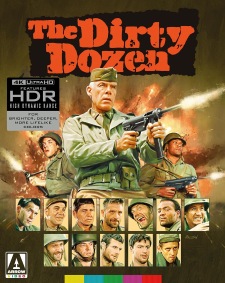
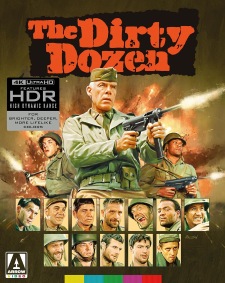
Arrow’s package also includes a reversible sleeve featuring the original poster and newly commissioned art by Tom Ralston, a sturdy and attractive O-card, and a collectors’ booklet featuring new writing on the film by Sean Hogan and Paul Talbot, as well as excerpts and photos from Dwayne Epstein’s Killin’ Generals: The Making of The Dirty Dozen and Silver and Ursini’s What Ever Happened to Robert Aldrich?.
Any way you slice it, The Dirty Dozen represents a turning point in Hollywood history, marking a sea change in the way that warfare was depicted on screen. With the end of the Hays Code, filmmakers were much freer to use profanity and to depict morally questionable behavior on screen. Aldrich took full advantage of this to show the full brutality of warfare, and the collateral damage that is the inevitable consequence of men being trained as killers and set loose upon the enemy. The film is a veritable showcase for Marvin’s talents and those of his blockbuster supporting cast. And while Arrow hasn’t quite been able to polish The Dirty Dozen up to reference standards, it’s only appropriate that sufficient grit remains. The important point is, the film definitely looks and sounds better than I’ve ever experienced it, and that’s more than enough reason for us to give this 4K release an enthusiastic recommendation.
- Bill Hunt
(You can follow Bill on social media on X, BlueSky, and Facebook, and also here on Patreon)