
Complete Kubrick, The (4K UHD Review)
Director
Stanley KubrickRelease Date(s)
1951-1999 (October 20, 2026)Studio(s)
RKO Radio Pictures/United Artists/Universal International/Metro-Goldwyn-Mayer/Columbia Pictures/Warner Bros Pictures (The Criterion Collection)- Film/Program Grade: See Below
- Video Grade: See Below
- Audio Grade: See Below
- Extras Grade: N/A
- Overall Grade: N/A

Review
Stanley Kubrick was a filmmaker who provoked strong reactions all throughout his career, both positive and negative. For every fan who considers 2001: A Space Odyssey to be one of the greatest films ever made, there’s a detractor who thinks that it’s a cold and sterile exercise in technical proficiency. And so on, and so on. Still, if there’s one common thread that ties together Kubrick’s entire oeuvre, it’s that first impressions aren’t always the lasting ones. Even the films that drew mixed critical and popular reactions when they were first released have been reappraised over the years, generally gaining in stature with repeat viewings. As a result, his body of work has stood the test of time regardless of how any given film was initially received. Love Kubrick or hate him, there’s no denying his importance in the history of cinema and the profound influence that he’s had on other filmmakers.
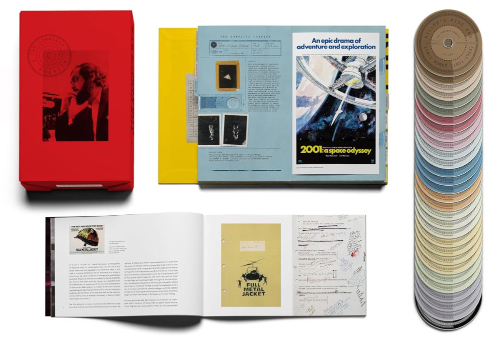
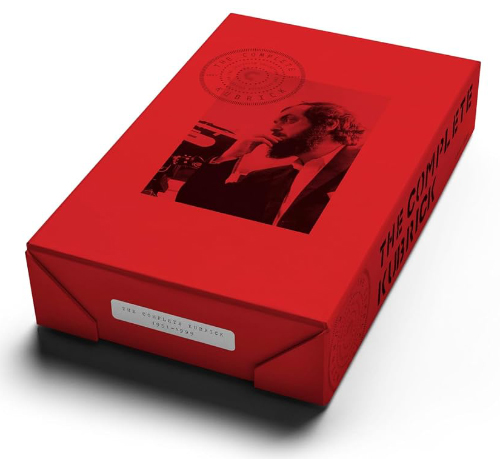
That has also resulted in plenty of anthologies of his work on every possible physical media format, most of them with strengths and weaknesses of their own. Now, The Criterion Collection has attempted to create the one set to rule them all with The Complete Kubrick, a massive 30-disc box offering all of his films on both 4K Ultra HD and Blu-ray, along with an abundance of supplemental material. It also includes an eighty-page booklet featuring a lengthy essay by Nathaniel Rich, cast & credit listings, and technical information about the video masters that are included.
That’s actually the easy part. Where things get more into the “love it or hate it” category is with Criterion’s packaging, which is arguably a weakness here. The discs and the booklet are housed inside an oversized hard box with individual cardboard pages inside for the discs—yes, that means they’re packed tightly into glued-together cardboard sleeves rather than in paper sleeves or on plastic spindles, and they’re deuce difficult to pull out without scratching the discs. It’s a triumph of form over function: a beautiful looking set that’s impractical for anyone who loves and cares for their physical media. Unsurprisingly, this packaging has already provoked strong reactions on social media, so it’s oddly Kubrickian in its own way.
Setting the packaging aside, what are the strengths and weaknesses of the rest of the set as a whole? Well, we’re going to be here for a while, so find a comfortable chair, pour a refreshing beverage, and let us guide you through it one step at a time. As with any boxed set of this magnitude, we’re going to address each film in the set individually and keep updating this review until we’re through the whole thing. Are you sitting comfortably? Then let us begin. Below, you’ll find quick links that will jump to each individual film in the collection and the final summary at the end:
DISCS ONE & TWO: KILLER’S KISS
DISCS THREE & FOUR: THE KILLING
DISCS FIVE & SIX: PATHS OF GLORY
DISCS SEVEN & EIGHT: SPARTACUS
DISCS NINE & TEN: LOLITA
DISCS ELEVEN & TWELVE: DR. STRANGELOVE, OR: HOW I LEARNED TO STOP WORRYING AND LOVE THE BOMB
DISCS THIRTEEN, FOURTEEN, & FIFTEEN: 2001: A SPACE ODYSSEY
DISCS SIXTEEN & SEVENTEEN: A CLOCKWORK ORANGE
DISCS EIGHTEEN, NINETEEN, & TWENTY: BARRY LYNDON
DISCS TWENTY-ONE, TWENTY-TWO, TWENTY-THREE, & TWENTY-FOUR: THE SHINING
DISCS TWENTY-FIVE & TWENTY-SIX: FULL METAL JACKET
DISCS TWENTY-SEVEN, TWENTY-EIGHT, & TWENTY-NINE: EYES WIDE SHUT
DISC THIRTY: ADDITIONAL SUPPLEMENTS
SUMMARY
DISCS ONE & TWO: KILLER’S KISS
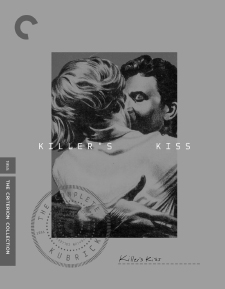
Stanley Kubrick’s sophomore feature Killer’s Kiss was a shoestring-budgeted film noir that he later dismissed as being amateurish (although at least he didn’t completely disown it like he would end up doing with his debut film Fear and Desire). Yet regardless of how he may have felt about it, Killer’s Kiss was still his first real step forward as a filmmaker, and it laid the foundation for his masterful follow-up The Killing. The story (from an uncredited Howard Sackler) is fairly standard issue noir fodder, with hapless New York City boxer Davey (Jamie Smith) becoming involved with his neighbor Gloria (Irene Kane), only to run afoul of her shady employer Vincent (Frank Silvera). While Gloria isn’t really a traditional femme fatale, Davey’s relationship with her leads to an innocent man’s death, with the boxer going on the run, Gloria held prisoner by the ruthless Vincent, and a final confrontation set in a mannequin factory—fittingly enough, with the palooka now surrounded by literal dummies.
The acting in Killer’s Kiss is adequate at best; there’s a good reason why Smith and Kane aren’t very well known aside from this film, with only Silvera’s oily villain making any kind of a lasting impression. It’s Kubrick’s keen eye that’s the real star of Killer’s Kiss. This was the last film where he officially served as his own cinematographer, and his gift for composition is evident in nearly every shot of Killer’s Kiss (even though he was still learning how to cut those shots together, as there’s some uncharacteristic breaking of the 180° rule throughout the film). The lighting emphasizes practical light sources, something that Kubrick would continue to do for the rest of his career. His limited resources on Killer’s Kiss also forced him to be inventive, shooting handheld on location while hidden inside of a car or using the back end of a pickup truck as an improvised dolly.
It’s those locations that remain the most unusual element in Killer’s Kiss—unusual for a Stanley Kubrick film, that is. Given his later preference for shooting on soundstages and recreating different worlds near the comfort of his own home in England, it’s ironic just how good that he was when using real locations. In this case, it was necessitated by his miniscule budget, but Kubrick turned that vice into a virtue with Killer’s Kiss. He made extraordinarily beautiful use of real New York locations, and unintentionally ended up providing a time capsule for the era. It’s the antithesis of his final film Eyes Wide Shut, where he went to the trouble of reconstructing Greenwich Village on soundstages in London. As a result, Killer’s Kiss and Eyes Wide Shut provide interesting bookends for the beginning and the end of Kubrick’s career.
Even the choice of a protagonist for Killer’s Kiss was as much a practical one as it was an artistic decision. A down-on-his-luck palooka may be a timeworn trope in the noir genre, but since Kubrick had directed the documentary short subject Day of the Fight just four years earlier, the boxing milieu was still very familiar to him, and that familiarity allowed him to work quickly and focus on getting shots in the can—he even openly mirrored shots from the short during Davey’s fight scene in the middle of the film. Given the way that his budgets (and shooting schedules!) tended to balloon in later years, the efficiency that he demonstrated in Killer’s Kiss is noteworthy. It keeps the film compelling despite any rough edges.
Noir wasn’t necessarily a genre for which Kubrick had any real affinity, but Killer’s Kiss displays some of the fatalism that would also mark both The Killing and Dr. Strangelove. It’s a random twist of fate that causes everything to spiral out of control for everyone involved: when a couple of drunken Shriners play a prank, it ends up causing the death of an innocent character and inadvertently saving the life of someone else. Yet Killer’s Kiss still pulls its punches at the conclusion, although that wasn’t by choice. When United Artists made a distribution deal with Kubrick, they insisted on a happy ending for the film, and Kubrick grudgingly complied. (The bleak, hopelessly fatalistic ending of his next film The Killing may have been his revenge on the studio for forcing him to soften this one.) Kubrick’s experiences of being at the mercy of others with Killer’s Kiss and Spartacus helped shape his insistence on having an obsessive-compulsive level of control in his later work, but despite any such compromises, Killer’s Kiss is still a fascinating step in his evolution into the master filmmaker who would leave an indelible mark on the world of cinema.
Stanley Kubrick shot Killer’s Kiss on 35mm film using Arriflex 35 IIA, Mitchell NC, and Bell & Howell Eyemo cameras with spherical lenses, framed open-matte at 1.37:1 for its theatrical release. This version uses Kino Lorber’s 4K master, which was based on 4K scans of the original 35mm camera negative, with a few sections replaced by scans of a composite fine-grain master instead. Digital remastering and grading were handled by Duplitech (both Dolby Vision and HDR10 are included). The difference here is that the film has now been encoded by David Mackenzie at Fidelity in Motion (although the actual disc authoring was still handled by NexSpec), and that’s no small thing. Killer’s Kiss is a particularly grainy film, and that’s one area where Kino Lorber’s encoding tends to break down. Aside from rare moments of swarming grain like on the highlights of Vincent’s jacket at 52:09, there are no such issues here.
There are still some light scratches and other minor blemishes visible, but it’s otherwise a clean 4K master with a surprising quantity of fine detail regardless of the vintage stocks and lenses that Kubrick used (Davey’s jacket during the opening sequence really stands out). There’s some softer-looking dupe footage for opticals like titles, dissolves, and the negative imagery in the dream sequence, but everything else is as sharp as possible. Contrast, black levels, and the grayscale all look solid. While I don’t think that HDR is necessary for vintage black-and-white films, it hasn’t done any harm in this case. It’s an impressive 4K presentation of an impressively micro-budgeted independent film.
Audio is offered in 1.0 mono LPCM, with optional English SDH subtitles. The audio here was remastered from the original 35mm mag tracks, with work performed in-house at Criterion. Killer’s Kiss was shot wild with all of the audio post-synced, and the dialogue definitely sounds like ADR. It’s still clean and clear, with no significant hiss, noise, or distortion, but the entire soundstage has an artificial quality to it that’s just the nature of the original production. Gerald Fried’s brash score is reproduced reasonably well, however.
The following extras are included:
DISC ONE: UHD
- Early Works:
- Short Films:
- Day of the Fight (Original Version) (UHD – 13:02)
- Day of the Fight (RKO Version) (UHD – 16:40)
- Flying Padre (UHD – 8:59)
- The Seafarers (UHD – 28:56)
- Fear and Desire (UHD – 70:43)
- Short Films:
DISC TWO: BD
- Early Works:
- Short Films:
- Day of the Fight (Original Version) (UHD – 13:02)
- Day of the Fight (RKO Version) (UHD – 16:40)
- Flying Padre (UHD – 8:59)
- The Seafarers (UHD – 28:56)
- Fear and Desire (UHD – 70:43)
- Short Films:
- Supplements:
- Alexander Singer (HD – 12:56)
- Geoffrey O’Brien (HD – 9:14)
- Trailer (HD – 1:46)
The extras kick off with Kubrick’s three short films. Day of the Fight (1951) follows middleweight boxer Walter Cartier as he preps for his April 17, 1950 bout with Bobby James. While the actual fight is shown briefly at the end, the bulk of the short lives up to its title by showing the rest of Cartier’s day leading up to the match. Kubrick ended up selling Day of the Fight to RKO Pictures, which released it in a reedited form with additional footage and a different narration, and both versions are included here. Flying Padre (1951) focuses on Catholic priest Fred Stadtmueller, aka “the Flying Padre,” who used a Piper Cub airplane to cover his vast parish in rural New Mexico. Like Day of the Fight, it’s a workaday documentary following Stadtmueller’s efforts over the course of two days, which included transporting a sick child to the hospital. The Seafarers (1953) may sound like an Alistair MacLean adventure, but it’s effectively an industrial film made on the behalf of the Seafarers International Union.
All three films are presented open matte at 1.37:1 with English 1.0 mono Dolby Digital audio. These are new 4K remasters done by Criterion from film elements that were stored at the Library of Congress: a 35mm composite print and a 35mm dupe negative for Day of the Fight; a 35mm composite print for Flying Padre; and the 16mm reversal positive for The Seafarers. All three are graded in SDR only. Day of the Fight and The Seafarers both still have some significant scratches and other blemishes visible, while Flying Padre is the cleanest of the group. The better source element for that one also pays off in terms of improved fine detail and grain reproduction.
Criterion has made the interesting choice to include Kubrick’s first feature film Fear and Desire as an extra in this set rather than featuring it separately. To be fair, they did something similar with their 2011 Blu-ray for The Killing, which offered Killer’s Kiss as an extra, and both Fear and Desire and Killer’s Kiss are short enough that it’s easy to include them on a single disc. Yet given Criterion’s filmmaker-forward focus, it’s likely that the decision to keep Fear and Desire in the extras was a conscious decision to honor the late filmmaker’s wishes. After all, he wanted the film withdrawn from distribution and even supposedly tried to have the negative burned. It’s still vitally important to preserve Fear and Desire for posterity, but it’s been shunted to second-class status here in deference to the late director’s own feelings. Fear and Desire is the one Kubrick effort that doesn’t divide fans and critics for the simple reason that it’s easily his weakest feature film, but it’s still worth revisiting as a way of understanding his rapid evolution as a filmmaker.
In any event, Kubrick once again served as his own cinematographer on Fear and Desire, shooting it on 35mm film using Mitchell NC and Bell & Howell Eyemo cameras with spherical lenses, framed open-matte at 1.37:1. This version also uses Kino Lorber’s 4K master (with a new encode by Fidelity in Motion), which was scanned from the 35mm original camera negative and a 35mm fine-grain master print stored at the Library of Congress (both Dolby Vision and HDR10 grades are included). The audio was remastered from the optical tracks on the 35mm print, and it’s presented here in English 1.0 mono LPCM with optional English SDH subtitles. The elements weren’t in the best of condition, and there’s persistent speckling, blotches, scratches, and other minor damage visible. There’s also an occasional frame jump. The audio was definitely post-synced on Fear and Desire, and it once again presents a relatively unnatural soundstage, but it’s relatively clean and free of noise, distortion, or other artifacts. Fried’s score is handled adequately this time.
Alexander Singer is an interview with the filmmaker and former collaborator with Stanley Kubrick, who explains his background with Kubrick and discusses their early work together, especially on Day of the Fight. It was originally recorded in 2012 but edited into its current form for this set. Geoffrey O’Brien is an appreciation of Killer’s Kiss by the critic that notes its differences with the rest of Kubrick’s filmography while nonetheless pointing out some common elements that would reappear in the director’s later efforts. It was originally produced for Criterion’s 2011 Blu-ray release of The Killing and Killer’s Kiss.
The only noteworthy extra that’s missing from previous releases of Killer’s Kiss is the commentary track by Imogen Sara Smith that was included on Kino Lorber’s 2022 UHD, and for whatever reason, Criterion has elected not to license it for this release. They also declined to license Kino’s two commentaries for Fear and Desire, the first with Eddy Von Mueller and the second with Gary Gerani. (Note that Kino Lorber also included both the 70-minute Venice premiere version and the later U.S. theatrical version that the distributor cut down to 62 minutes, but Criterion is keeping their filmmaker focus by only including Kubrick’s original version.) But in the spirit of Criterion’s intentions for this set, having Day of the Fight, Flying Padre, The Seafarers, and Fear and Desire as supplemental material for Killer’s Kiss still makes it a fine enough slate of extras as it is.
KILLER’S KISS (FILM/VIDEO/AUDIO/EXTRAS): B-/A-/B-/B+
DISCS THREE & FOUR: THE KILLING
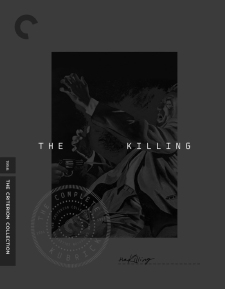
The Killing was Stanley Kubrick’s third feature film, and it marked his arrival as a major filmmaker—a fact that wasn’t lost on the young director. He had been unhappy with his debut film Fear and Desire and even tried to have it withdrawn from circulation, and while he didn’t go quite that far with his sophomore feature Killer’s Kiss, he still dismissed it as being an amateurish effort. While some directors like Quentin Tarantino seem to have sprung fully formed from the forehead of Zeus, others like Kubrick need to learn by doing. Of course, the reality is that Tarantino and his postmodernist ilk have been building on the lessons that were already learned by other filmmakers like Stanley Kubrick and Ringo Lam; they didn’t necessarily develop their own style as much as they cobbled it together from bits and pieces of the work done by those who came before them. On the other hand, Kubrick did everything the old-fashioned way: by learning from his own mistakes—and those hard lessons paid dividends with The Killing.
In some respects, The Killing is a much more confident and self-assured version of Killer’s Kiss. It’s anything but a remake of that film, but it does rework some of the same themes into a different setting and narrative structure. The fact that both films represent Kubrick’s only foray into film noir provides the common ground between the two, since they share a fatalistic streak that’s less obvious in the rest of his work. While Killer’s Kiss was based on an original screenplay by Howard Sackler, The Killing was Kubrick’s first adaptation of someone else’s work, in this case the novel Clean Break by Lionel White. Kubrick brought in author Jim Thompson to collaborate on the script, and that was an inspired choice since no one did hardboiled crime fiction better than Thompson. The Killing is a caper story that revolves around Johnny Clay (Sterling Hayden), an ex-con who assembles a five-man team to pull off a high-stakes robbery at a racetrack. Since Clay doesn’t trust the criminal class, the team that he puts together consists of ordinary people like track clerk George Peatty (Elisha Cook, Jr.) and rifle expert Nikki Arcane (Timothy Carey). The biggest thing that he requires of them is to keep their mouths shut while focusing on their own parts of the plan, and their failure in that regard proves to be Clay’s undoing. The Killing also stars Colleen Gray, Jay C. Flippen, Vince Edwards, Marie Windsor, and gentle giant Kola Kwariani (aka “Nick the Wrestler”).
The Killing was innovative at the time because Kubrick and Thompson chose to retain the non-linear structure of White’s novel rather than rearrange everything into chronological order. There’s no conventional cross-cutting between the players as the heist unfolds; instead, each of their misadventures is shown sequentially, one after the other. The Killing rewinds time, repeatedly, to break down the same event from different points of view. As a result, audiences have to assemble the various pieces together in their own minds, with the full picture only becoming clear once the final piece falls into place. It’s an interesting structure that forces viewers to become active participants in the process of narrative construction. Unfortunately, United Artists wasn’t comfortable with that approach, so they forced Kubrick to add a voiceover narration in order to clarify things for the audience. Yet ironically enough, the narration actually makes the chronology even more confusing than it would have been otherwise. It provides a needlessly detailed timeline for the events, right down to the minute, and that ends up distracting from the way that the pieces fit together as a whole. Still, it’s a minor misstep in an otherwise nearly flawless film.
The key to following the fractured narrative of The Killing isn’t the unnecessarily detailed timeline, but rather the inevitability of the ways in which everything falls apart. The Killing is the most purely fatalistic of film noir, with the end result being a foregone conclusion before Clay’s scheme has even a chance to begin. Once all of the dominoes have been methodically put into place, nothing can stop them from falling down, one after the other. In Killer’s Kiss, the hapless hero’s plans deteriorate when he falls behind schedule after a random encounter with a couple of drunken Shriners. In The Killing, the linchpin that starts the chain reaction is the classic noir trope of the femme fatale. One of Clay’s accomplices fails to keep his mouth shut, and by putting his trust in the wrong woman, the best laid plans of mice and men can’t possibly prevail.
As the final domino shatters and blows away in the wind, Clay’s girlfriend Fay (Colleen Gray) encourages him to run away. Clay stands there, his shoulders slumped in defeat, and replies, “What’s the difference?” Along with Lee Marvin’s final “Lady, I don’t have the time” in Don Siegel’s brutal version of The Killers, this is one of the single most perfectly fatalistic summations of any film noir ever made. The words are carefully chosen. It’s significant that he doesn’t say “What’s the point,” since that wouldn’t have had the same connotations. Instead, “what’s the difference” implies that Clay grasps that he’s been a prisoner of fate all along. He may no longer be in jail, but his entire life still takes place in a cage of his own making. Even if he escaped from the police, he’d still be living behind bars. Nothing that he could do would ever change that inexorable fact. If there really is no fate but what we make, then he’s already made his own fatalistic bed, and he’s finally ready to lie in it.
Cinematographer Lucien Ballard shot The Killing on 35mm film using Arriflex S and Mitchell BCR cameras with spherical lenses, framed at 1.66:1 for its theatrical release. (This was Kubrick’s first time working with another cinematographer, and the two of them didn’t see eye to eye; Kubrick ended up playing a guiding role with the lighting and camerawork over the objections of Ballard, who stopped even watching the dailies after a certain point.) This version uses Kino Lorber’s 4K master, which was based on 4K scans of the original 35mm camera negative. Digital remastering and grading were handled by Duplitech (both Dolby Vision and HDR10 are included). As with Killer’s Kiss, the difference here is that the film has now been encoded by David Mackenzie at Fidelity in Motion (although the actual disc authoring was still handled by NexSpec), and once again, it makes a difference in terms of how the grain is reproduced, with everything looking just a bit more natural and smooth than it does on Kino’s disc with their own encoding.
In practical terms, the actual level of fine detail isn’t significantly improved over 1080p since there was only so much detail to be wrung out of the original negative in the first place. Yet everything still appears ever so slightly crisper and more refined in 4K, especially when examined from up close. Textures like the fabrics in the men’s suits are particularly well-resolved, as are the wisps of cigarette smoke during their planning meeting. The HDR grade strengthens the contrast range and deepens the black levels, but also allows for more subtle gradations between the extreme ends of the spectrum, and the grayscale is flawless. Aside from a few scratches in some of the stock footage, everything is immaculately clean, and it’s worth noting that optical transitions like dissolves were cut into the middle of the surrounding shots, so there’s no degradation to the image other than in the dissolves themselves. Again, I’m not convinced of the need for HDR with vintage black-and-white films, but there’s no getting around the fact that this grade looks excellent.
Audio is offered in English 1.0 mono LPCM, with optional English SDH subtitles. The audio was remastered from the original 35mm mag tracks, with work performed in-house at Criterion. It’s a step up from the mono track on Kino Lorber’s disc, which had more prominent background hiss, crackle, and other minor defects. It sounded a touch harsh overall, but this version sounds cleaner and smoother, with less sibilance to the dialogue. (The barest hint of the background noise can still be detected during some of the dialogue scenes, but it’s never distracting.) Gerald Fried’s brash, bombastic score for The Killing has a decent amount of heft to it despite the source and the nature of the original recording.
There are no extras on the UHD, but the following extras are included on the Blu-ray only:
DISC FOUR: BD
- James B. Harris (HD – 21:07)
- Sterling Hayden (Upscaled SD – 23:40)
- Polito on Thompson (HD – 18:42)
- Trailer (HD – 1:48)
The extras are all carried forward from Criterion’s 2011 Blu-ray. James B. Harris is a 2010 interview with the producer, who first met Kubrick thanks to their mutual friendship with Alexander Singer. Harris is the one who brought Clean Break to Kubrick’s attention, while Kubrick suggested using Jim Thompson as a screenwriter. Harris details the complicated process of setting up their deal with United Artists and then breaks down the making of The Killing, including Kubrick’s conflicts with Lucien Ballard.
Sterling Hayden consists of excerpts from a couple of 1984 episodes of the French television series Cinéma cinemas, in English but with forced French subtitles. The actor, writer, and unabashed maverick offers an overview of his career, saying that he made the unusual progression of starting at the top with The Asphalt Jungle and working his way down from there. He discusses his flirtation with the Communist Party and his willingness to name names before the House Committee on Un-American Activities (a weakness that he acknowledges is the only moment in his life that he’s genuinely ashamed of), and he also describes his experiences working with Stanley Kubrick on The Killing and Dr. Strangelove.
Polito on Thompson is with Robert Polito, author of the book Savage Art: A Biography of Jim Thompson. Polito covers Thompson’s work with Kubrick, not just on The Killing but also doing rewrites on Paths of Glory, as well as the difficulty in adapting Thompson’s own novels for the screen and his complicated cinematic legacy.
Once again, Criterion isn’t including Kino Lorber’s commentary with Alan K. Rode from their 2022 UHD, but there are a few other things missing this time as well. Arrow’s 2015 Region B Blu-ray included in an isolated music & effects track; an interview with Michael Ciment; a 1970 interview with Hayden; and an appreciation by Ben Wheatley. Needless to say, you’ll want to hang onto those discs for the extras alone, but Criterion’s superior encoding of Kino’s 4K master makes this The Killing to beat.
THE KILLING (FILM/VIDEO/AUDIO/EXTRAS): A-/A-/B/C
(More Coming Soon...)
- Stephen Bjork
(You can follow Stephen on social media at these links: Twitter, Facebook, BlueSky, and Letterboxd).