
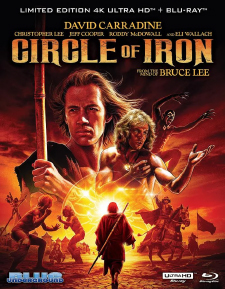
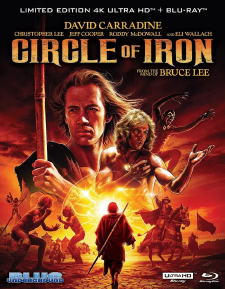
Circle of Iron: Limited Edition Steelbook (4K UHD Review)
Director
Richard MooreRelease Date(s)
1978 (August 25, 2026)Studio(s)
Sandy Howard-Richard St. Johns Productions/AVCO Embassy Pictures (Blue Underground)- Film/Program Grade: C+
- Video Grade: A
- Audio Grade: A-
- Extras Grade: A
Review
Long forgotten except by the most ardent of deep-seated film fans, 1978’s Circle of Iron (released internationally as The Silent Flute) is one of those legendary projects in which its journey to the silver screen is perhaps more interesting than the film itself, and that’s saying something. Based upon a screenplay developed by Stirling Silliphant (In the Heat of the Night) and Bruce Lee, the film was eventually made by other producing entities five years after his tragic passing. The finished film died a horrible death theatrically, but continues on as a cult item, mostly due to its multiple performances by David Carradine, and simply for just how unusual it is.
Sometime in an ancient land, the brazen warrior Cord (Jeff Cooper) takes part in a competition of hand-to-hand combat, and although he doesn’t have any true martial arts skills, he still manages to defeat his opponents by fighting his own way. However, he’s disqualified for not following the rules, and therefore not permitted to seek out Zetan (Christopher Lee), who keeps and protects a mysterious book that is said to contain all of the world’s wisdom and will allow its reader to find enlightenment. Undeterred, Cord follows the winner, Morthond (Anthony De Longis), along the way meeting a blind flutist and fighter, a barbaric monkeyman, a travelling nomad named Chang-Sha, and Death itself (all portrayed by David Carradine). Cord then accompanies the blind man, hoping to learn from him while making his way through the wilderness to reach Zetan. Other members of the cast include Roddy McDowall, Eli Wallach, Erica Creer, and Earl Maynard.
Mostly shot on location in Israel, Circle of Iron began as a personal project for Bruce Lee who at that time had not become an international star. He and James Coburn were to originally star in the film, but Lee later approached Steve McQueen about it, who turned him down. Discouraged from wanting to make the ultimate martial arts film combined with Eastern philosophy, he went back to Hong Kong and made several films that made him an overnight sensation, including The Big Boss aka Fists of Fury, Fist of Fury aka The Chinese Connection, and The Way of the Dragon aka Return of the Dragon. He then starred in the American/Hong Kong co-production Enter the Dragon, upon which he exploded in popularity as a martial arts icon, but sadly, he suddenly passed away six days before the film’s release. After his death, a couple of projects he was associated with were released to capitalize upon his superstardom in his absence, as were many others starring Bruce Lee clones. By this time, the script for The Silent Flute had become somewhat of a cult item and producers wanted to continue exploiting him, and so the script was re-written and went into production with David Carradine and Jeff Cooper as the two leads with cinematographer-turned-director Richard Moore (The Life and Times of Judge Roy Bean) at the helm.
Regardless of its two titles, neither of which really make much sense to begin with, Circle of Iron is a bizarre and somewhat fascinating B movie that’s aiming for A; in the vein of films like The Beastmaster and Conan the Barbarian, with odd and eccentric characters from one end of the film to the other, but mixed with Eastern philosophies, most of them uttered by the blind flutist. Performances range from over-the-top (Carradine) to completely flat (Cooper), but seeing locations in the Israeli countryside is at least something more unique than simply filming in the deserts of Europe. It was also a reportedly troubled production, some saying that Carradine was a dramatic and unsavory person on the set, while others enjoyed the experience and had very little to complain about. The fight scenes had to be picked up in the studio by another fight choreographer, and it’s fairly obvious which of the shots are studio-bound. Accidents were abound, with Jeff Cooper being hit so hard that one of his teeth was lodged in his cheek, and David Carradine had his nose broken not once, but twice, briefly delaying filming.
Another strange aspect of the film is the presence of some big name actors, especially for such an unorthodox production. Roddy McDowall oversees the opening tournament, Eli Wallach is a mentally ill man intent on standing in a cauldron of oil to rot away his genitalia (which was purportedly added to the script to make it more humorous), and Christopher Lee comes in at the end at Zetan in attire that could almost be mistaken for Ku Klux Klan robes. Though they all appear in one scene only, their presence was definitely exploited in the marketing, particularly Lee. On the other hand, the score is actually a bright spot, making the film sound much bigger than it really is, courtesy of Bruce Smeaton, who composed for Picnic at Hanging Rock.
The Silent Flute’s original co-writer, Stirling Silliphant, was reportedly unhappy that the film was made at all as he was a close friend and student of Bruce Lee, preferring that his dream for the project remain just that and nothing more. Many agreed with that assessment upon the film’s release, but today people look back on the film as something that’s entertaining despite itself, because of all of the offbeat elements at play. It didn’t leave much of a legacy in its wake, but Circle of Iron (or The Silent Flute, if you prefer) falls into its own category, shared with projects like The Visitor, Zardoz, and Barbarella, just for the sheer fact that they exist at all.
Cinematographer Ronnie Taylor shot Circle of Iron on 35mm film with spherical lenses. The results were finished photochemically and framed theatrically in the aspect ratio of 1.66:1. Blue Underground debuts the film on Ultra HD with new 4K 16-Bit scan and restoration from the original camera negative (presented here for the first time in the U.S. as The Silent Flute), which has been graded for High Dynamic Range in HDR10 and Dolby Vision, and encoded to a triple-layered BD-100 disc. It’s a beautiful upgrade of the film, one that’s never really looked bad on optical disc, but this presentation definitely bests all previous ones. Crisper and more solid levels of fine detail are evident with a bitrate sitting mostly between 70 and 90Mbps. Outside of occasional opticals, grain resolves well, though some of the transitions have been re-created digitally. Colors and flesh tones are greatly advanced over previous versions. The HDR improves contrast and shadow detail with deep blacks, while enhancing the rest of the palette with strong but organic shades of blue, red, purple, and green, among other hues. The film’s solarized sequence wherein Cord meets Death has always been the least-appealing portion of the film visually, however effective it is aesthetically. There’s not much that can be done to improve it without creating it from scratch, which would be pointless, so it is what it is. Other than that and some minor speckling, the image is clean and stable, looking better than it ever has.
Audio is included in English Dolby Atmos, 5.1, and 1.0 mono DTS-HD Master Audio with optional subtitles in English SDH, French, and Spanish. The new Atmos track and the 5.1 are similarly mixed, though the Atmos track is a little beefier when it comes to sound effects which have slightly more impact. The way that some of the action is mixed seems too wide both tracks, with the dialogue sitting smack in the middle, and the score spreading to the surrounds. The height channels have some decent use, but of the three options, I preferred the original mono for actually watching the film, but still appreciated the spread for the score in the surround mixes. Give all three a chance and see which suits you best as they all have their pros and cons.
Blue Underground’s 2-Disc Limited Edition 4K Ultra HD release of Circle of Iron includes a 1080p Blu-ray copy of the film in Steelbook packaging with a clear plastic slipcover, all containing new artwork. This release is an MVD Shop exclusive and is limited to 4,000 copies. The following extras are included on each disc:
DISC ONE: UHD
- Audio Commentaries:
- Richard Moore and David Gregory
- Frank Djeng and Chris Poggiali
- Alternate Opening (HD – 3:06)
- Trailers:
- U.S. Trailer (UHD w/HDR – 1:59)
- International Trailer (Upscaled SD – 3:05)
DISC TWO: BD
- Audio Commentaries:
- Richard Moore and David Gregory
- Frank Djeng and Chris Poggiali
- Featurettes:
- Playing The Silent Flute (Upscaled SD – 13:58)
- Circle of Success: Remembering a Martial Arts Masterwork (HD – 18:06)
- The Producer (Upscaled SD – 28:47)
- Joe Lewis: Karate Master (Upscaled SD – 31:04)
- Stirling Silliphant on Bruce Lee (Upscaled SD – 25:26)
- Alternate Opening (HD – 3:06)
- Trailers:
- U.S. Trailer (HD – 1:59)
- International Trailer (Upscaled SD – 3:05)
- TV Spots:
- #1 (Upscaled SD – :33)
- #2 (Upscaled SD – :33)
- #3 (Upscaled SD – :34)
- Poster & Still Gallery (HD – 81 in all)
- Easter Egg (HD – 1:23)
The first commentary with director Richard Moore, moderated by David Gregory, was recorded in 2004 for the first DVD release. They do fall into the trap of watching the film as there are some gaps along the way, but Moore is game to speak extensively about the project and what he brought to it, having a fine rapport with David Gregory who questions him in a conversational manner. New to this release is a commentary featuring film historians Frank Djeng and Chris Poggiali. This is obviously the more scholarly track, but it’s also the clunkier of the two since the chemistry isn’t quite the same. Nevertheless, they detail the history of the film and those involved with it, while also offering some personal critique.
In Playing The Silent Flute, David Carradine discusses the genesis of the project, getting the film financed and underway, playing the various characters, relating an off-set anecdote between him and Jeff Cooper that convinced him he was the right person to play Cord, the choreography in the fight scenes, the blind man’s teachings, the incorporation of Daoist philosophy, the rewriting of the script, the various locations, the film’s various titles, and his appreciation of the film. In Circle of Success, co-star Anthony De Longis discusses his earliest days on the stage and as a fight coordinator, learning various martial arts, being brought in for the role of Morthond, his memories of the set, working with David Carradine and Jeff Cooper, being aware that the project was meant for Bruce Lee, the quality of the fight scenes and the locations, working with Richard Moore, his work on films like Circle of Iron influencing his later work in a positive way, and his looking forward to seeing the UHD release.
In The Producer, co-producer Paul Maslansky discusses his early career as a musician before getting into the film business, working in Italy and the various films he’s worked on, befriending Christopher Lee on The Castle of the Living Dead, working with Michael Reeves, producing Death Line aka Raw Meat, directing Sugar Hill, being brought in for Circle of Iron, shooting in Israel for eight weeks, some of his memories from the set, having some regrets about the action sequences, moving on to Hot Stuff and The Villain, being brought in to fix problems on Return to Oz, being called by many world-class directors who wanted to come and help out Walter Murch, getting the idea for Police Academy and having a big success, and giving the cast and crew of Circle of Iron all of the credit.
In Karate Master, the martial arts coordinator Joe Lewis talks about his history of martial arts, his working relationship and friendship with Bruce Lee, his various competitions and matches, getting into acting and becoming involved with Circle of Iron, shooting inserts and improving the fight scenes, doubling for Jeff Cooper, having issues with David Carradine, the films that he starred in afterwards, and reflecting on his career and what he appreciates in his everyday life. Next is an audio interview with co-writer Stirling Silliphant, who was interviewed by journalist John Corcoran in 1980. In it, he discusses his background in martial arts, meeting Bruce Lee, relaying a humorous story about Bruce proving his skills to Frank Sinatra at a party, studying with Bruce, racism in Hollywood and how it affected Bruce Lee’s career, trying to get Circle of Iron made once he was successful but never getting it underway, shelving it after he died and later resurrecting it for other producing entities, and forever being disappointed that it was made without Bruce Lee’s involvement.
Last is an Alternate Opening with the Circle of Iron title card; a digitally re-created Circle of Iron U.S. trailer; an upscaled international trailer for The Silent Flute; three U.S. TV spots; and a Poster & Still Gallery containing 81 images of posters, color stills, black-and-white stills, marketing materials, newspaper clippings, home video artwork, script pages, and novel tie-ins. Pressing up on your remote control when Audio Commentaries is highlighted will reveal a sun symbol leading to an Easter Egg, which is an interview outtake with Anthony De Longis discussing his training of Michelle Pfeiffer on Batman Returns.
Not carried over from Blue Underground’s 2011 Special Edition Blu-ray release are text notes about Bruce Lee by Stirling Silliphant, the text essay Bruce Lee’s The Silent Flute: A History by Davis Miller & Klae Moore, and the first draft of the screenplay accessible via DVD-ROM.
Blue Underground delivers another top notch presentation with an excellent selection of bonus materials. Circle of Iron may not be to everyone’s taste, but one can’t deny the quality of this upgrade. If you’re a fan of the film, this is a must. Highly recommended.
- Tim Salmons
(You can follow Tim on social media at these links: Twitter, Facebook, BlueSky, and Letterboxd. And be sure to subscribe to his YouTube channel here.)