
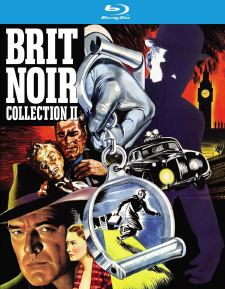
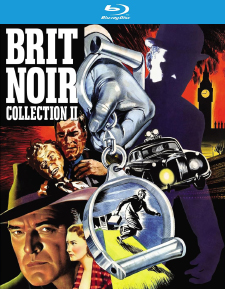
Brit Noir Collection II (Blu-ray Review)
Director
Ralph Richardson/Guy Hamilton/Charles FrendRelease Date(s)
1952/1953/1956 (June 30, 2026)Studio(s)
London Films/British Lion Films/Ealing Studios (Kino Lorber Studio Classics)- Film/Program Grade: See Below
- Video Grade: See Below
- Audio Grade: See Below
- Extras Grade: B-
- Overall Grade: A-

Review
Brit Noir Collection II offers three more titles, two of which really aren’t film noir much at all, but nevertheless welcome releases. Indeed, these three are superior to the triple-bill found in Collection I. And where that set coincidentally spotlighted actor Herbert Lom, who had roles in each film, this set features actor Jack Hawkins, who stars or co-stars in all three movies.
By a country mile the best film in this set is Home at Seven (1952), starring and directed by Ralph Richardson, his only film in the latter capacity. Adapted from R.C. Sherriff’s hit 1950 play, which also starred Richardson and several others appearing in the film version, it’s the kind of movie best experienced cold, knowing nothing about it going it. I won’t give away much here, but if you’re thinking about getting this set, you might want to scroll down to the next film to maximize your viewing experience.
Milquetoast banker David Preston (Richardson) happily returns home after a day at work to find his wife, Janet (Margaret Leighton), utterly distraught. She’s upset because he left for work on Monday morning and didn’t come home that evening, only returning now, at 7:00pm on Tuesday. He thinks she’s imagining things, insisting that it’s not Tuesday but Monday night. However, she produces the Tuesday morning and evening editions of the newspaper, and Preston’s boss at the bank calls, demanding to know why he didn’t show up for work. Preston is gobsmacked. Janet calls their physician, Dr. Sparling (Jack Hawkins), to try and unravel Preston’s apparent loss of memory.
Meanwhile, Robinson, the steward from Preston’s club, where Preston serves as its treasurer, has been found murdered and 550 pounds is missing from the safe. Preston has one of the few keys to the safe, and was widely-known to actively dislike Robinson. Sparling thinks it highly unlikely that Preston murdered the man or that he stole the money, but the circumstantial evidence continues to mount, and Preston himself begins to believe that maybe he did commit murder.
Home at Seven is a small-scale masterpiece that keeps its audience guessing until the very end. Partly it succeeds because of Sherriff’s play, adapted (presumably with only minor alterations to “open it up”) by Anatole de Grunwald, which, like David Niven’s hallucinations in Powell & Pressburger’s A Matter of Life and Death, positions Preston’s memory loss as bizarre yet grounded in logic and medical science. The story finds Preston in a dissociative fugue (fugue state), authentically dramatized by Richardson, whose performance is nothing less than outstanding, among the best work he did on film.
Sparling tries calming Preston in order to make sense of the mystery, but Preston understandably becomes increasingly agitated, and eventually resigned to the possibility that he unknowingly committed murder. The arc through which Richardson takes this character is utterly mesmerizing. Home at Seven is therefore intriguing as a mystery, but also works through its premise logically and with psychological authenticity.
Reviews at the time generally felt Richardson’s direction no better than competent, at worst “non-existent” (Sight & Sound) but that’s not remotely true. As one might expect from an actor-director, the performances are all good—especially Leighton, whose character dearly loves her husband and vice versa; and Campbell Singer as police Inspector Hemingway, Singer a veteran of the play—but the film never feels stage-bound at all and it’s hardly the unimaginative point-and-shoot style suggested by some reviewers. Richardson positions the camera intelligently, often staging scenes with conversations in the foreground while, in the background but out-of-sight, additional tense action plays out that the viewer is eager to see as well.
All three titles in this set have been licensed to Kino from StudioCanal, with the first two movies on one disc, and the third (The Long Arm) on a second Blu-ray disc. All three movies are Region “A” encoded. All three are in black-and-white and presented in 1.37:1 standard format with above-average DTS-HD Master Audio 2.0 mono audio. In the case of Home at Seven, the video transfer is strong if not quite stellar, but with excellent detail and strong blacks.
Each film gets a new audio commentary. In the case of Home at Seven, it’s hosted by Julie Kirgo and Peter Hankoff.
HOME AT SEVEN (FILM/VIDEO/AUDIO): A/A-/A
The Intruder (1953), director Guy Hamilton’s second outing following the mostly terrible The Ringer (found on Collection I) is much more conventional than Home at Seven but still generally good. Ex-tank regiment colonel-turned-upper-class-stockbroker Wolf Merton (Jack Hawkins) returns home one evening to find a burglary in progress. He recognizes the burglar as Ginger Edwards (Michael Medwin), a former soldier in his wartime regiment. Edwards flees but Merton is bothered by the question of how the formerly heroic Edwards ended up a criminal.
Concerned about Edwards’s welfare, Merton decides to visit officers and enlisted men under his command, asking about their wartime and postwar experiences with Edwards, including John Summers (George Cole), who was promoted during the war; Leonard Pirry (Dennis Price), a pompous but cowardly officer; Donald Cope (Duncan Lamont), now a farmer, and others. The film alternates between present-day scenes and flashbacks of them during the war.
The film is sort of like a cross between The Best Years of Our Lives and Citizen Kane, resembling the latter insofar as Hawkins’s character is like the newsreel reporter in Kane interviewing people about their experiences with the title character, seen in flashback, all to answer a central question. It resembles The Best Years of Our Lives insofar as it explores postwar readjustment, and just as that film opens with Dana Andrews lingering at a graveyard of now obsolete aircraft, The Intruder opens with Hawkins stumbling upon a graveyard of British tanks being converted into tractors. (The first line of the film is spoken by a tank mechanic, played by Hammer favorite Michael Ripper.)
Early ’50s British cinema was rife with nostalgic but psychologically reflective movies about the Second World War, and The Intruder falls as more into that category than as film noir. The compassionate C.O. was even in 1953 something of a cliché, but Hawkins’s sincere performance makes that central character believable. The picture stumbles a bit, here and there: one broad, superfluous comic scene has two flighty women (Dora Bryan and Gene Anderson) causing trouble after climbing inside one of the tanks, a sequence more at home in an Abbott & Costello comedy, but mostly the film is straightforward and interesting.
Long-lived Michael Medwin—he died in 2020 at 96—tended to play cheery, sociable characters, such as Ebenezer Scrooge’s indefatigable nephew in the 1970 musical of Scrooge, so it’s a little surprising seeing him here, playing such an embittered man gone off the rails, but he does so capably enough. Hamilton’s direction, meanwhile, is more assured.
The video transfer of The Intruder looks very good, as good or better than Home at Seven. Extras this time include a rather battered trailer and a new commentary track by, again, Kirgo and Hankoff.
THE INTRUDER (FILM/VIDEO/AUDIO): B+/A-/A
Jack Hawkins again stars in The Long Arm (1956), a familiar but extremely well-done police procedural, similar to John Ford’s made-in-England Gideon’s Day, in which Hawkins played an almost identical character. The plot revolves around a series of simple yet ingenious safe robberies, with the Scotland Yard investigation proceeding logically and authentically.
Scotland Yard Superintendent Tom Halliday (Hawkins), with newly assigned, baby-faced Det. Sgt. Ward (John Stratton, also appearing with Hawkins in The Cruel Sea), investigate the burglary of a safe, opened with a key, in Long Acre, London. The evening before the burglar alarm had police on the scene within 90 seconds, but night-watchman there insisted it was a false alarm, he later turning out to be the ballsy thief, responsible for some 14 safe-breaking jobs all over Britain.
(Spoilers) Halliday eventually realizes that all of these robberies had money stolen from the same brand of safe, using genuine keys, leading him and Sgt. Ward to investigate all current and past employees of the safe manufacturing company. During one of the robberies, a man on his way to work (Ian Bannen) is critically injured by the driver of a getaway car, suggesting a second man, and damage to the vehicle stolen from Mrs. Elliot (Ursula Howells) lead to additional clues sending Halliday and Ward to northern Wales, mountainous, picturesque terrain, which Ealing cinematographer Gordon Dines makes the most of.
While not breaking any new ground, The Long Arm is very well crafted. The screenplay by John Hunter, Robin Maugham, and Anthony Squire appears to authentically document Scotland Yard investigative methods (they cooperated with and advised the production); throughout the film are tiny, interesting details that convincingly portray how such policing is done. The series of crimes is also very smartly realized; the manner in which safe after safe is robbed undetected is both simple and ingenious at once.
There’s also room for a little compelling characterization. Halliday’s wife, Mary (Dorothy Alison) is supportive but also worries about her husband’s safety, especially since he rarely calls her while on the job. Sgt. Ward has a girlfriend, and while Halliday cautions Ward that the job will keep him away from her most of the time, Ward’s relationship with this never-seen girlfriend also gradually makes Halliday aware that he should be doing more for his wife. In a fine scene at a railway platform, watching Ward call his girlfriend, Halliday realizes he could be using that time calling his wife, too, and husband and wife end up having such a lively phone conversation he almost misses his train.
As with the other two titles, The Long Arm is presented in 1.37:1 standard frame, but this may be an error. By 1956, virtually all non-’scope British films (with the exception of some Hollywood-financed ones) were shot for 1.66:1 widescreen projection. The opening titles, with lots of empty space above and below the text, would seem to support this, though generally the framing is not distracting presented open-matte, either, so perhaps it was intended for exhibition in either ratio. Regardless, this is the best-looking and sounding of the three films, the image razor-sharp throughout with excellent blacks and contrast, and the audio way above average, albeit ordinary mono.
The lone extra this time is a new audio commentary by film historian Laurence Lerman.
THE LONG ARM (FILM/VIDEO/AUDIO): A-/A/A
With a higher batting average than Brit Noir Collection I, especially for the must-see Home at Seven, Collection II is even more desirable and highly recommended.
- Stuart Galbraith IV