
All Through the Night (Blu-ray Review)
Director
Vincent ShermanRelease Date(s)
1942 (August 18, 2026)Studio(s)
Warner Bros. Pictures (Warner Archive Collection)- Film/Program Grade: A
- Video Grade: A
- Audio Grade: A
- Extras Grade: A

Review
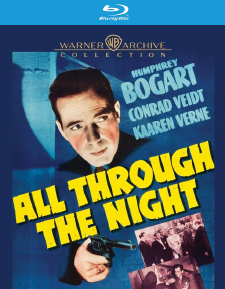
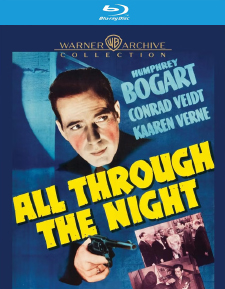
Humphrey Bogart was one of Warner Bros. biggest stars but it took him a while to achieve that status. Placed in forgettable roles as thugs and bad guys, he didn’t get his big break until he accepted the lead in a film that George Raft passed on—The Maltese Falcon. All Through the Night was made during a transitional period in Bogart’s career. His emerging star power turned this B picture into a major attraction.
Gloves Donahue (Bogart) is a prominent New York gambler who leads a colorful gang that includes fast-taking Sunshine (William Demarest), high-roller Starchie (Jackie Gleason), and Gloves’ driver, Barney (Frank McHugh), who never seems to get time to see his girl. Gloves is a popular guy, generous with working people and devoted to his mother (Jane Darwell), who keeps her son abreast of neighborhood goings-on.
When Ma Donahue tells Gloves that his favorite cheesecake baker, Mr. Miller (Ludwig Stossel), is missing, he goes immediately to the bakery and discovers the old man’s body hidden in the bakery’s basement. An attractive woman (Kaaren Verne) shows up to speak with Miller but quickly disappears when she’s told he’s dead. Suspecting the woman knows something about the murder, Ma Donahue tracks her down in a nightclub. Gloves arrives and learns that she’s a nightclub singer at the club, her name is Leda Hamilton, and she has a foreign accent, but what connection could she have to Miller’s death? When the club manager (Edward Brophy) overhears Leda and her piano accompanist, Pepi (Peter Lorre), speaking German, he realizes they’re German spies and is killed. Gloves stumbles upon the body and drops one of his gloves in the process. When he learns that then cops think he’s the murderer, he’s determined to find out the identity of the real killer. A perilous investigation leads him, Sunshine, and Barney to a German spy ring—and Leda.
Bogart plays a shady but likable character. He makes a lucrative living from illegal gambling but has a big heart and is community minded and generous. Everyone knows and admires Gloves, who’s very much a part of their world. He’s at his mother’s beck and call whenever she needs him, even if it means leaving Yankee Stadium when the game is at a crucial point. Bogart, self-assured, sociable and plain-spoken in the lower-crust tones and lingo of 1940s New York, gives Gloves plenty of charm. With a less accomplished and charismatic actor, All Through the Night would have been another assembly-line flick with a bunch of contract players. Bogart gives it stature.
Kaaren Verne’s Leda has an air of mystery when we first see her and looks shaken when she learns of Miller’s death. Leda is a variation on the damsel in distress. She’s in trouble, but not the kind we may think. Verne’s performance is purposely enigmatic. Her actions and the people she sees may not paint a full picture of who she is. The script keeps us wondering why she figures so significantly in the plot without telegraphing the outcome. There are surprises along the way that keep us on our toes.
One of Leda’s contacts is Ebbing (Conrad Veidt), leader of a group of fifth columnists that includes Madame (Judith Anderson), his authoritative, icy assistant. The casting of these two fine character actors gives the film added class. Known for playing villains of one kind or another, they nicely convey menace in every look, condescending remark, or gesture. Painted in broad strokes and delivered by Veidt and Anderson with soft-spoken sophistication, Ebbing and Madame are excellent evil foils for Gloves.
Conrad Veidt was one of several actors in the film who fled Nazi Germany. Others in the cast who also fled the country include Peter Lorre, Kaaren Verne, Ludwig Stossel, Irene Seidner (Mrs. Miller), and Martin Kosleck, who played Steindorff, one of the Nazi spies.
Peter Lorre, who would join Bogart later in the year in Casablanca, is a creepy sociopath as Pepi. His demeanor can switch from fawning to murderous in an instant. His unpredictability makes him especially dangerous. Frequently with a cigarette in his mouth, he creates swirls of smoke around himself as his expression conveys cold-bloodedness.
Jane Darwell is appropriately motherly as Ma Donahue. Her eyes bright with excitement and her voice conveying nervous energy, she gives her character relatability. She could be anyone’s mother—caring, concerned for neighbors, ready to help and console those who are in distress. The viewer can see where Gloves’ ethical compass comes from.
Phil Silvers has a small role as a nearsighted, wisecracking waiter. His film career consisted mostly of playing sidekicks. For four seasons he was Sgt. Bilko on TV’s The Phil Silvers Show. Jackie Gleason, too, plays a small role. He’s convincing as a big bruiser with a big mouth but had an unimpressive film career. He found his greatest success on television with variety programs that showcased many of his comic characters and The Honeymooners.
In All Through the Night, Director Vincent Sherman combines comedy with serious drama. The blend works. Demarest and McHugh contribute most of the humor and even Bogart has some witty repartee with them. Sherman’s staging is fast-paced. Actors speak quickly, a trademark of Warner pictures of the period. The snappy dialogue is clever and delivered with just the right comic touch. It’s surprising how smoothly Sherman switches from a comedic moment to a very serious one. He keeps the main story moving forward while incorporating bits of comic relief along the way. Balancing two distinct styles effectively isn’t easy.
Only one scene goes on too long. It’s when Gloves and Sunshine impersonate German fifth columnists at a meeting, answering questions in double talk, befuddling Ebbing and his assembled Nazi sympathizers. Well after the point is made, Sherman keeps the scene going too long. It stands out because the rest of the film is so well paced.
The film’s final third emphasizes themes of freedom, standing up for democracy, and denouncing fascism. They are evident in the actions of characters who become aware of Nazi spies in their midst. Apart from being entertaining, the film likely served as a cautionary tale during World War II of what America was up against at home as well as overseas. Like many films of the 1940s, All Through the Night used the power of cinema to warn that Nazis were not only a European problem.
All Through the Night was shot by director of photography Sidney Hickox on 35mm black & white film with spherical lenses, finished photochemically, and presented in the Academy aspect ratio of 1.37:1. Sourced from a 4K scan of the original nitrate camera negative, the film is pristine, in keeping with Warner Archive’s high standards in bringing older films to Blu-ray. Clarity and contrast are excellent, there are no perceptible visual imperfections, blacks are deep and rich, and Hickox’s lighting effects are beautifully rendered. Details such as objects in Miller’s bakery and basement, period automobiles, Bogart’s impeccable suits, and Kaaren Verne’s gowns are nicely delineated. Scenes of cars driving through city streets were filmed on Warner’s back lot, the streets wetted down to provide interesting reflections. Back screen projection is used in close-ups of people riding in cars and in a climactic scene of Gloves and Ebbing in a speedboat in New York harbor.
The soundtrack is English 2.0 mono DTS-HD Master Audio. English SDH subtitles are an available option. Dialogue is clear and easy to understand and well balanced in scenes with sound effects. The film features a mix of Adolph Deutsch’s orchestral score and two numbers delivered by Kaaren Verne as Leda Hamilton: All Through the Night, written by Arthur Schwartz and Johnny Mercer, and 1926’s Cherie, I Love You.
Bonus materials on the Blu-ray release from the Warner Archive Collection include the following:
- Audio Commentary by Vincent Sherman and Eric Lax
- Call the Usual Suspects (22:42)
- So You Want to Give Up Smoking (10:51)
- Lights Fantastic (6:30)
- 1942 Newsreel (1:59)
- Theatrical Trailer (2:46)
Audio Commentary – Director Vincent Sherman speaks about casting and production of All Through the Night and includes anecdotes about Bogart, Lorre, and Veidt. Bogart biographer Eric Lax provides brief overviews of cast members, including information about their previous and subsequent work. Sherman came to be known as a woman’s director because he had success with pictures starring Bette Davis, Joan Crawford, Ida Lupino and other actresses. Describing a shooting schedule, Sherman says, “everything was coordinated to save a dollar.” Whenever possible, he notes, you inject surprises to keep viewers entertained. Though Bogart wasn’t a typically handsome leading man, 75% of his fan mail came from women. Anti-Nazi sentiment wasn’t as strong then as it became. A lot of people were not taking the Nazis seriously. The film received good reviews and made money for Warner Bros.
Call the Usual Suspects – This featurette is about character actors, the “workhorses of the studio system." Some mentioned and shown in excepts include Jane Darwell, Peter Lorre, Eve Arden, Eric Blore, Walter Huston, Butterfly McQueen, and Sydney Greenstreet. Often, character actors were typecast as villains, sidekicks, waiters, servants, motherly types, cops, etc. Actress Edie McClurg says a character actor must be present in the scene even when there is no dialogue. The audience identifies with character actors who often have “juicy memorable moments.”
So You Want to Give Up Smoking – This 1942 Vitaphone/Warner Bros. short is the first in the Joe McDoakes Behind the Eight Ball series. Starring George O’Hanlon as Joe, the film offers a humorous look at the habits of cigarette and other tobacco smokers. Various types of smokers are examined, as are the difficult, frustrating ways people try to kick the tobacco habit. The on-screen chaos experiences by hapless Joe are commented on by off-screen narrator Art Gilmore. The film offers actual advice and mild comedy. Later shorts in the series would lean toward broader comedy.
Lights Fantastic – Directed by Friz Freleng, this 1942 Technicolor Merrie Melodies cartoon takes viewers on a stylized tour of New York City’s Times Square, where the bright neon billboards and commercial advertising signs magically come to life after dark.
1942 Newsreel – In this black & white 1942 Movietone News short, footage includes the aftermath of a tanker torpedoed by a submarine, a collision at sea between a steamship and a freighter because of the wartime blackout, and the launching of a new destroyer.
All Through the Night is a wartime thriller with Runyonesque characters for comic relief. Bogart shines as a big time gambler who’s sidetracked by the murder of his favorite baker and gets involved with Nazis. A fine roster of character actors provides villainy and comedy, making this hybrid an unusual and entertaining look at threats to Americans right under their noses.
- Dennis Seuling