
Ace Ventura: When Nature Calls (4K UHD Review)
Director
Steve OedekerkRelease Date(s)
1995 (July 1, 2026)Studio(s)
Morgan Creek Productions/Warner Bros. (Via Vision Entertainment)- Film/Program Grade: C+
- Video Grade: A
- Audio Grade: A
- Extras Grade: C+

Review
[Editor’s Note: This is a Region-Free Australian 4K Ultra HD import.]
One of the hottest tickets in town during the late 1990s was anything starring Jim Carrey. He had made a name for himself on the small screen, particularly as Fire Marshall Bill on In Living Color, but hadn’t broken through much as a film actor. That all changed in 1994 with the release of Ace Ventura: Pet Detective, which was an unexpected hit, and later that same year in The Mask and Dumb and Dumber, both blockbuster successes. The following year would see his further rise to fame with his portrayal of The Riddler in Batman Forever, and in the highly-anticipated and very successful sequel, Ace Ventura: When Nature Calls.
Ace Ventura has retreated to a Tibetan monastery searching for enlightenment when his services as the world’s foremost animal lover and pet detective are called upon once again by African consul Vincent Cadby (Simon Callow) via his assistant, explorer and guide Fulton Greenwall (Ian McNeice). Ace accepts, heading to the fictional land of Nibia in order to investigate the whereabouts of the Shikaka, an albino bat held sacred by the Wachati and Wachootoo tribes, which are due to come together through the marriage of the Wachati princess (Sophie Okonedo) and the Wachootoo prince (Tommy Davidson). If the bat is not returned, the tribes will go to war with each other, leaving Ace Ventura only a matter of days in order to recover it. Also among the cast are Bob Gunton, Adewale, Maynard Eziashi, and Bruce Spence.
Unless you were alive in the 1990s, it’s hard to grasp just how big Jim Carrey was during that time frame. Critics hated him and his rubber-faced antics, but the majority of audiences were lining up in droves to see his movies, one seemingly after another. He would later set his over-the-top comedic style aside and reinvent himself as a dramatic actor in films like The Truman Show and Man on the Moon, but for the time being, he was the biggest and most successful comedian in the world. Because of his newfound fame, he was given more creative control and choice of director in the Ace Ventura sequel, though in some ways it was a step back creatively.
In all honesty, the Jerry Lewis-inspired comedy in both Ace Ventura films doesn’t necessarily hold up for everyone, and it has nothing to do with racial stereotypes, transphobic humor, or other off limits comedic touches. There’s only so much one can take of Jim Carrey’s brand of comedy, especially in When Nature Calls. Comparatively, the first film feels more grounded because it takes place in the real world, even if the open vistas and fictional African jungle environments give Ace Ventura’s character plenty to work with comedically. The film’s infamous “rhino birth scene”, which was censored when it was shown on television, is also a sign of the times as comedy was trending more toward fantastical and gross-out than just straight wit.
That’s not to say that When Nature Calls doesn’t have its charms. It’s straightforward as far as plot is concerned, and Ian McNeice makes for a wonderful straight man against Carrey’s constant antics, almost never cracking a smile. Simon Callow as the African consul is an inspired choice, but there are also appearances by Bruce Spence and Tommy Davidson, the latter an In Living Color alumnus, as well as the breathtakingly beautiful Sophie Okonedo. Unfortunately, the film wasn’t actually shot in Africa at all, but on various plantations and resorts in South Carolina, Texas, and the British Columbia. Jim Carrey likely wouldn’t have entertained the idea of shooting on location at the time. This isn’t an historical dramatic epic, after all, it’s Ace Ventura, and the fact that it wasn’t made where it’s meant to take place is humorous in a meta sort of way.
Like many studio films of this era, When Nature Calls also had a fun soundtrack. Featuring Pato Banton’s excellent cover of The Police classic Spirits in the Material World (with Sting on board), as well as Blues Traveler’s run-through of Secret Agent Man, Angélique Kidjo’s Ife, White Zombie’s Blur the Technicolor, a cover INXS’ Don’t Change by the Goo Goo Dolls, and a rendition of Boll Weevil by The Presidents of the United States of America, among others.
Tom Shadyac, who later directed Jim Carrey once again in Liar Liar and Bruce Almighty, didn’t return for the sequel. Director Tom DeCerchio was initially replaced by Steve Oedekerk, a friend of Carrey’s who felt comfortable with the fellow comedian as they improvised their way through the script. If the trailers are admissible as any form of evidence, then it’s clear that a lot of alternate footage hit the cutting room floor. Regardless, the results were even more profitable than the original film upon its theatrical and home video releases, actually surpassing the original in popularity. Jim Carrey would leave the role of Ace Ventura behind (at least, as of this writing) and the studio did attempt to make one without him, but the less said about that one, the better.
The late, great cinematographer Donald E. Thorin (Thief, Purple Rain, Midnight Run) shot Ace Ventura: When Nature Calls on Super 35mm film using Panavision Panaflex cameras and Zeiss lenses. The results were finished photochemically and framed theatrically at the aspect ratio of 2.39:1. Via Vision Entertainment brings the film to Ultra HD with a new 4K restoration from the original camera negative, which has been graded for High Dynamic Range in HDR10 and Dolby Vision, and encoded by David Mackenzie at Fidelity in Motion to a dual-layered BD-66 disc. It’s an incredibly film-like presentation with perfect encoding, maxing out bitrates that reach into 90 to 100Mbps territory and beyond. Opticals and some minor CGI are very slight, but blend in well enough with the rest of the material to not be an overriding issue. The HDR soaks up the fine detail in the jungle settings, as well as the interiors of Cadby’s home and the monastery. Hues are natural with strong greens, reds, and blues, never oversaturated or undercooked, though flesh tones are occasionally a little pallid. There’s amazing depth in the image to be had with excellent contrast and super deep black levels. The image is clean and stable from beginning to end, aiding a highly muscular and organic presentation of the film.
Audio options is include English 5.1 DTS-HD Master Audio and 2.0 LPCM, with optional subtitles in English SDH. The 5.1 option presents a full and expansive surround experience with deep bass response and sometimes aggressive steering of sound effects. The stereo track has slightly more spread to it, but with less low end, giving it a thinner quality comparatively. Nevertheless, both options are solid with excellent support for dialogue, score, and the music selection. You may want to give each track a test drive and decide which is more appropriate for your setup.
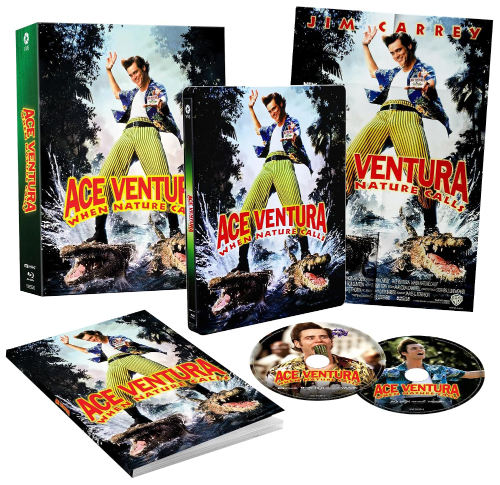
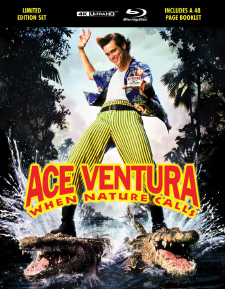
The 2-Disc Limited Edition 4K Ultra HD and Blu-ray release of Ace Ventura: When Nature Calls from Via Vision Entertainment sits in Steelbook packaging within a side-loading lenticular hardcase, both of which showcase the original theatrical artwork. Also included is a 17” x 26” poster, also featuring the original theatrical artwork, and a 48-page hardcover booklet containing a set of production notes and publicity materials. The following extras are included on each disc:
DISC ONE: UHD
- Theatrical Trailer (HD – 1:58)
DISC TWO: BD
- Silent Films to Looney Tunes: On Jim Carrey Becoming a Live-Action Cartoon (HD – 13:25)
- Behind-the-Scenes Featurette (SD – 6:43)
- EPK Interview with Actor Jim Carrey (SD – 2:50)
- EPK Interview with Writer/Director Steve Oedekerk (SD – 2:11)
- Interview with Actor Ian McNeice (HD – 5:12)
- Archival Press Junket Interview with Actor Jim Carrey (SD – 5:31)
- Archival Press Junket Interview with Actor Ian McNeice (SD – 4:13)
- Archival Press Junket Interview with Actor Tommy Davidson (SD – 5:56)
- Archival Press Junket Interview with Writer/Director Steve Oedekerk (SD – 6:57)
- Alternate Scene from TV Cut (HD – :50)
- B-Roll (SD – 7:58)
- Theatrical Trailer (HD – 1:58)
- TV Spots & Teaser Trailer (Upscaled SD & HD – 3 in all – 1:27)
Silent Films to Looney Tunes is a visual essay by filmmaker and screenwriter Jason Kleeberg that explores the style of Jim Carrey’s comedy, making comparisons to similar styles from other comedians of the past. Next is a Behind-the-Scenes Featurette and a pair of EPK interviews with Jim Carrey and Steve Oedekerk, all taken from the film’s electronic press kit (obviously). Following that is a new interview with Ian McNeice who recalls his memories of the set and working with Jim Carrey, being very fond of the film and for the recognition he received for it. Next is a series of Archival Press Junket interviews with Jim Carrey, Ian McNeice, Tommy Davidson, and Steve Oedekerk, all with Forth Worth reporter Bobbie Wygant. The aforementioned Alternate Scene from TV Cut trims all of the footage of Ace Ventura actually exiting the Rhino’s rear end and adds in a brief outtake of Ace standing up and declaring “Man, was I lost!” before walking away. Last is a brief set of B-Roll footage, the film’s trailers, and a pair of TV spots. Interestingly, this release manages to cull together all of the film’s relevant bonus materials from its various DVD and Blu-ray releases from around the world.
Via Vision’s 4K upgrade of Ace Ventura: When Nature Calls will definitely please long-time fans. The comedy may not be to everyone’s taste, but you can’t deny how good the film looks on UHD.
- Tim Salmons
(You can follow Tim on social media at these links: Twitter, Facebook, BlueSky, and Letterboxd. And be sure to subscribe to his YouTube channel here.)