
7th Voyage of Sinbad, The (4K UHD Review)
- Review Date: Aug 19, 2026
- Format: 4K Ultra HD
-


Director
Nathan JuranRelease Date(s)
1958 (July 21, 2026)Studio(s)
Morningside Productions/Columbia Pictures (Sony Pictures Home Entertainment)- Film/Program Grade: A-
- Video Grade: A-
- Audio Grade: A-
- Extras Grade: A-

Review
When visual effects wizard Ray Harryhausen and producer Charles H. Schneer unleashed The 7th Voyage of Sinbad on an unsuspecting public in 1958, it ended up being a watershed moment that changed people’s lives and the entire history of cinema in the process. That’s not hyperbole, either; there’s a direct line from The 7th Voyage of Sinbad to the fantastic worlds of Star Wars, Close Encounters of the Third Kind, The Lord of the Rings, and many similar films. Not only was The 7th Voyage of Sinbad a huge inspiration to filmmakers like George Lucas, Steven Spielberg, and Peter Jackson, but it helped inspire budding young visual effects experts like Phil Tippett and Dennis Muren to pursue a career in the industry. That’s really just paying it forward, since Harryhausen himself was inspired by Willis O’Brien’s technical wizardry on the original King Kong (he even ended up working with O’Brien on Mighty Joe Young). In the great cycle of influences, landmark films like King Kong and The 7th Voyage of Sinbad are steps along the continuum, not necessarily a point of origination.
That’s because by the time that The 7th Voyage of Sinbad was released in 1958, the art of stop-motion animation was already a half-century old. O’Brien had cut his teeth on silent shorts like The Dinosaur and the Missing Link in 1915 before moving into feature filmmaking with The Lost World in 1925 and eventually breaking the art form wide open with King Kong eight years later. Even Harryhausen worked on Puppetoon shorts for George Pal during the Forties and as an assistant to O’Brien on Mighty Joe Young in 1949 before he graduated to his own projects with The Beast from 20,000 Fathoms in 1953. Yet it’s when he found a kindred spirit in producer Charles H. Schneer that his career really took off, with the duo working together on It Came from Beneath the Sea, Earth vs. the Flying Saucers, and 20 Million Miles to Earth, all in rapid succession. Harryhausen and Schneer were already leaving their mark on the world of film long before The 7th Voyage of Sinbad went before the cameras.
So, why did The 7th Voyage of Sinbad have much greater impact than any of Harryhausen’s previous efforts? For one thing, it was produced in full color, while everything else that he had done to date had been in black-and-white. And despite the fantastic creatures on display in his other films, everything had taken place in contemporary urban settings. Not so The 7th Voyage of Sinbad, which takes place a long time ago in an Arabia far, far away. It’s the fabulous world building in The 7th Voyage of Sinbad that provides its greatest joy, with Harryhausen’s effects work serving not just to provide cheap thrills, but rather to evoke a different time and a very different place. Even the amazing creatures on display serve a real purpose as they help provide the hook that makes viewers eager to immerse themselves in the rest of this wondrous world.
The choice of Sinbad as subject matter gave Harryhausen an excuse to let his imagination run free, unconstrained by the need to make his creations fit into a contemporary milieu. Kenneth Kolb provided the script, which worked with the set pieces that Harryhausen had already been developing. It’s all based loosely on the tales of Sinbad the Sailor in the collection One Thousand and One Nights (which were a relatively late addition to the canon and don’t exist in any of the earliest manuscripts). Sinbad made seven journeys in these 18th and 18th century tales, with Harryhausen and Kolb picking and choosing whatever bits and pieces interested them—although ironically enough, none of the pieces that they chose came from the actual Seventh Voyage. For example, the roc appeared in the Second and Fifth Voyages, while the encounter with a man-eating giant occurred in the Third Voyage (not actually a cyclops, but close enough). The story that ties them together was largely invented by Kolb:
Sinbad (Kerwin Matthews) and his crew are sailing back to Baghdad, where he plans to marry Princess Parisa (Kathryn Grant). They land on the island of Colossa, where they encounter the magician Sokurah (Torin Thatcher) fleeing from a giant, man-eating cyclops. Sokurah stole a magical lamp containing the genie Barani (Richard Eyer), and when he loses it during everyone’s escape, he demands that Sinbad take him back to Colossa. Sinbad refuses and heads to Baghdad instead, so Sokurah secretly works his magic to shrink the Princess down to a few inches tall to trick Sinbad into returning to Colossa, where they can obtain the shell of a roc egg to make a potion that will restore her to normal size. He also offers plans to make a giant crossbow in order to deal with the cyclops. Of course, like most magicians, Sokurah has a few tricks up his sleeve, forcing Sinbad and the rest his crew to fight for their very lives. The 7th Voyage of Sinbad also stars Alec Mango, Harold Kasket, Alfred Brown, and Nana DeHerrera.
Granted, all of that is still mostly just window dressing to tie Harryhausen’s set pieces together, but it does help to establish what feels like a fully-functioning fantasy world. It certainly doesn’t hurt that Kerwin Matthews was Harryhausen’s best Sinbad (although I still have a soft spot for John Phillip Law), Torin Thatcher was his most delicious villain (but honorable mention to Tom Baker on that score), and Kathryn Grant was his most appealing heroine (no contest there). Add in solid direction from Nathan Juran and one of Bernard Hermann’s finest scores, and you have an irresistible fantasy adventure that fires on all cylinders from the first frame to the last. It’s not hard to understand why The 7th Voyage of Sinbad has proven so profoundly influential on other fantasy filmmakers.
Fine, but we’re all here for the creatures, aren’t we? Never fear, The 7th Voyage of Sinbad offers some of Harryhausen’s best set pieces, with the cyclops in particular catching the eye of many a future visual effects technician. It’s a cyclops like no other (at least up until that point in time), with Harryhausen deciding to ensure that no one could possibly think that it was a man in a suit by giving it inhuman proportions and a satyr’s goat legs. Yet just like O’Brien, he brought it to life by giving it recognizable anthropomorphized characteristics, overcoming the inherent jerkiness of stop-motion animation by imbuing it with tangible personality. The dragon, roc, and snake woman are no slouches, either, but Harryhausen’s fateful decision to include a reanimated skeleton warrior laid the groundwork for his next-level “children of the Hydra” set piece five years later in Jason and the Argonauts.
For that reason (among others), Jason and the Argonauts would prove to be every bit as influential as The 7th Voyage of Sinbad, with Harryhausen taking all of the lessons that he learned on The 7th Voyage to the next level. Yet there still wouldn’t have been a Jason and the Argonauts without The 7th Voyage of Sinbad breaking that fertile ground first. In the great cycle of influences, Ray Harryhausen even managed to influence himself. The 7th Voyage of Sinbad is the closest thing to a ground zero that can be found in his entire career, overshadowing everything that he did before and casting an even longer shadow over everything that followed—and every single fantasy filmmaker, visual effects expert, and ardent fantasy fan is still living in that shadow. We’re all the children of Ray Harryhausen, in one form or another.
Cinematographer Wilkie Cooper shot The 7th Voyage of Sinbad on 35mm film using spherical lenses, framed at—well, that’s complicated. By 1958, 1.85:1 was winning the war of the new widescreen aspect ratios, but it may still have been shown open-matte 1.37:1 in some theatres and it likely would have been shown at 1.66:1 overseas. Harryhausen preferred 1.37:1 and composed all of his animation to work open-matte, but he grudgingly accepted the widescreen revolution and protected for matting to 1.85:1. When the film was released on Blu-ray in 2008, Sony’s Grover Crisp reached out to Glenn Erickson, aka DVD Savant (now CineSavant) to explain why they chose 1.66:1 for that version (and the same thing applies to this UHD version as well):
“You will notice that it is formatted in the 1.66:1 ratio. As you no doubt know, he basically shot all his effects work 1.33, but with the idea that they could be framed 1.33, 1.66 or 1.85 and still work. We usually show it 1.85 in theatres, but I always felt it looked best 1.66. So, when I asked Ray what he thought of the Sinbad Blu-ray, he definitely agreed that it should be 1.66.”
This new 4K Ultra HD release is based on a 4K scan of the original camera negative, digitally remastered and graded for High Dynamic Range in Dolby Vision and HDR10. To assess the results fairly, it’s important to reiterate exactly how Harryhausen’s Dynamation worked. While there is traditional optical work in the film in the form of titles, dissolves, and overlayed fog, with a few travelling mattes as well (mostly involving Princess Parisa’s miniaturization and Barani’s magic), Harryhausen relied on rear projection for most of his animation. The live action plates would be printed and then projected behind his models and other set pieces, resulting in generational loss for the live action elements but not for the models. Assuming that Harryhausen printed directly from the negative, the resulting effects shot would contain first-generation animation but third generation live action elements (and theatrical prints would have been a few generations removed from that).
In other words, don’t expect any miracles here. That said, anyone thinking that the animation will somehow look worse in 4K than it did on Blu-ray is way off the mark. There’s simply no more detail to be wrung out of the dupes for the live action footage—they don’t look worse, but they can’t possibly look any better, either. The grain gets thick at times, especially in the skies in the rear projection background plates, but Sony’s encoding handles all of it with no major issues (just an occasional bit of noise). And the bulk of the film still consists of live action footage minus any effects work, all of which looks sharp, clear, and beautifully refined. The 7th Voyage of Sinbad was released in Technicolor (although it wasn’t produced in the 3-strip version), and despite the fact that the negative has faded at this point, the HDR grading still brings all of the vivid colors to life—and Harryhausen’s first color film is very colorful indeed, from the elaborate costumes to the equally intricate production design. And never fear, the cyclops and the dragon also look wonderful, with perfectly saturated colors+. It’s a lovely 4K upgrade.
Primary audio is offered in English 2.0 mono and 5.1 DTS-HD Master Audio. The 7th Voyage of Sinbad was originally released in mono, but this 5.1 version was remixed using the original stereo music elements, as Crisp explained to Erickson: “We also went on a hunt and came up with original stereo score elements (not fake stereo) for most of the film. It really adds to the experience, but I didn’t want to go overboard with it, either. This has always been my favorite Bernard Herrmann score so I was very happy to oversee the mix, and happy with the result.”
Normally, I might lean toward the original mono mix, but not in this case. While there’s some light steering with the sound effects, mostly panning across the front soundstage rather than into the surrounds, hearing Hermann’s score in full stereo makes all the difference in the world. It’s not just the stereo spread, either; the music sounds smoother and more robust in 5.1, with a bit more depth on the bottom and air on the top end. In comparison, the music on the original mono track sounds thin and just a wee bit harsh. Audition both and decide for yourself, but this is a 5.1 remix done right, providing more breathing room for all of the original elements but adding nothing that takes away from the original experience.
Additional audio options include French 5.1 DTS-HD Master Audio and Spanish 2.0 mono DTS-HD Master Audio, with optional English, English SDH, French, and Spanish subtitles.
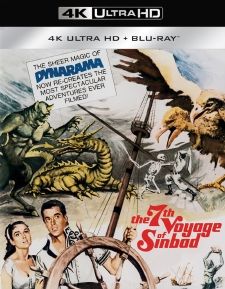
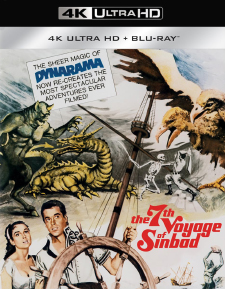
The Sony 4K Ultra HD release of The 7th Voyage of Sinbad is a two-disc set that includes an unremastered Blu-ray with a 1080p copy of the film and a Digital Code on a paper insert tucked inside. Note that the Blu-ray is the exact same disc as Sony’s 2008 release, right down to the useless BD-Live functionality, so it’s not helpful to anyone hoping for an HD upgrade, but it’s a reasonable way to get the archival extras into the set without reauthoring them for the UHD. There’s also a slipcover that duplicates the theatrical poster artwork on the insert, but it’s worth pointing out that it’s from the 1975 rerelease, not the original 1958 release (the “Dynarama” box is a tipoff, since Schneer didn’t coin that variation on Dynamation until The Golden Voyage of Sinbad in 1974). In any event, the following extras are included:
DISC ONE: UHD
- The Harryhausen Chronicles (Upscaled SD – 57:56)
- Theatrical Trailer (HD – 1:41)
The Harryhausen Chronicles is a television documentary that originally aired on AMC in 1998. It was included on Sony’s Signature Collection DVD but omitted from their Blu-ray, so it’s nice to have it back again. Directed by Richard Schickel and narrated by Leonard Nimoy, it features new interviews with Harryhausen, Charles H. Schneer, Ray Bradbury, Dennis Muren, Harry Selick, and George Lucas, plus archival footage of Kerwin Matthews, Kathryn Grant, Todd Armstrong, John Philliip Law, Harry Hamlin, and more. It covers Harryhausen’s entire career from his experimental animation as a child to his final film Clash of the Titans. It’s basically an expanded remake of Richard Jones’ 1983 documentary Aliens, Dragons, Monsters and Me, improving on it across the board. It’s been upscaled from standard definition here, and while the film-based footage doesn’t look too bad, the SD video-based material suffers from jaggies, combing, and other deinterlacing artifacts. If you can look past that, it’s still a great documentary.
(Speaking of the 1975 rerelease of The 7th Voyage of Sinbad, note that the trailer included here is from that reissue, not the original 1958 release.)
DISC TWO: BD
- Commentary by Ray Harryhausen, Phil Tippett, Randall William Cook, Steven C. Smith, and Arnold Kunert
- Remembering 7th Voyage of Sinbad (SD – 23:31)
- The Harryhausen Legacy (SD – 25:32)
- The Music of Bernard Hermann (SD – SD – 26:52)
- Photo Gallery (SD – 9:34)
- Sinbad May Have Been Bad, but He’s Been Good to Me (SD – 3:07)
- A Look Behind the Voyage (SD – 11:47)
- This Is Dynamation! (SD – 3:25)
- Ray Harryhausen Interview (SD – 11:52)
- Previews:
- Casino Royale (HD – 1:34)
- Men in Black (HD – 1:07)
- CJ7 (HD – 2:10)
- The Water Horse: Legend of the Deep (HD – 2:32)
- Blu-ray Disc Is High Definition! (HD – 2:36)
The commentary was originally recorded for Sony’s 2008 Blu-ray. It includes contributions from Ray Harryhausen, Phil Tippett, Randall William Cook, and music historian Steven C. Smith, with producer Arnold Kunert acting as moderator. Actually, where Harryhausen is concerned, pretty much all of them serve as moderators, peppering him with questions throughout the track—especially Tippett and Cook, who clearly are in awe of the man who inspired both of them to turn to stop-motion animation as a career. Naturally, that means that they dive deep into the visual effects (and the sound effects as well), but they also discuss the locations, the script, the cast, the cinematography, Bernard Hermann’s score, and more. Ultimately, it’s a fanboy’s track recorded by fanboys, but there’s nothing wrong with that.
There are also three different featurettes produced for the 2008 Blu-ray. Remembering 7th Voyage of Sinbad is an interview with Harryhausen, who explains how he (vainly) tried to sell the concept for a period adventure until he and Schneer had success with their contemporary science fiction efforts. From there, he breaks down the making of the film from the designs to the casting, locations, live-action shoot, and visual effects. The Harryhausen Legacy is an appreciation of the film (and the filmmaker) that includes interviews with John Landis, Phil Tippet, Hoyt Yeatman, Ken Ralston, Joe Dante, John Dykstra, the Chiodo Brothers, Dennis Muren, Doug Beswick, John Berg, Rick Baker, Kevin Kutchaver, Frank Darabont, Forrest J. Ackerman, Stan Winston, and poignantly enough, the late great Bob Burns. They all agree that Ray Harryhausen changed their lives. The Music of Bernard Hermann is an interview with Steven C. Smith, who literally wrote the book on the composer: A Heart at Fire’s Center: The Life and Music of Bernard Herrmann. Smith sketches a biography of Hermann with an emphasis on his fantasy film scores and his work with Harryhausen & Schneer.
The last of the bits and pieces from 2008 include a Photo Gallery and a real oddity: the song Sinbad May Have Been Bad, but He’s Been Good to Me, which was a 45rpm recording that was distributed to theatres in 1958 for promotional purposes. It’s been set here to a slideshow of promotional artwork for the film.
The rest of the extras include A Look Behind the Voyage, which is a featurette from Columbia’s 1995 LaserDisc set The Sinbad Collection. It includes interviews with Harryhausen, Charles S. Schneer, and Kerwin Matthews. There’s also an interview with Harryhausen hosted by John Landis, who openly lets his own fanboy flag fly. It’s not from The 7th Voyage of Sinbad, however, but rather from Columbia’s 1995 Jason and the Argonauts LaserDisc (which is why it focuses on that film). Finally, This Is Dynamation! is a promotional short from 1958 that touts Harryhausen’s process—although interestingly enough, it focuses on the blue screen work used to shrink Kathryn Grant and completely elides how Dynamation actually worked. But that’s in keeping with Harryausen’s secrecy over his techniques.
That’s all of Sony’s previous extras, but there are a handful of items missing here from various Powerhouse Films/Indicator releases in the U.K. They added an isolated score track (in 2.0 mono); an interview with Phil Tippett; a video tribute to Harryhausen by Tippett; and the Super-8 digest version of the film. Aside from some different trailers, that’s about it, because other boutique labels like Via Vision in Australia and Koch Media in Germany mostly stuck with Sony’s extras. And it is indeed a very nice collection of extras, even if the included Blu-ray is getting pretty old in the tooth and could use a remaster. Still, we’re here for the 4K upgrade of Harryhausen’s wondrous creations, aren’t we? Sony delivers in that regard, making this set an easy recommendation.
- Stephen Bjork
(You can follow Stephen on social media at these links: Twitter, Facebook, BlueSky, and Letterboxd).