
Picture of a Nymph (Blu-ray Review)
Director
Wu MaRelease Date(s)
1987 (March 10, 2026)Studio(s)
Golden Harvest Productions (88 Films)- Film/Program Grade: B-
- Video Grade: B+
- Audio Grade: B
- Extras Grade: B

Review
Ching Siu-tung and Tsui Hark’s A Chinese Ghost Story was hardly the first Hong Kong film to make the move from traditional wuxia into the more fantastical world of xianxia—Hark’s own Zu Warriors from the Magic Mountain had mined similar territory 14 years earlier—but it proved to be one of the most influential. It spawned two direct sequels and numerous imitators, although given the fact that the source material was a story from Pu Songling’s 1740 collection Strange Tales from a Chinese Studio, the lines between influencer and influenced can seem a bit blurry at times. That’s especially true of Picture of a Nymph (aka Hua zhong xian), which was released shortly after A Chinese Ghost Story and also draws heavily from Songling’s tale Nie Xiaoqian. All things being equal, that could simply be an example of two competing films using the same centuries-old text as inspiration, but in the case of Picture of a Nymph, all things were decidedly not equal. A Chinese Ghost Story was produced by Cinema City Film Productions, while Picture of a Nymph was produced under Sammo Hung’s Bo Ho Films Company banner, and it clearly drew more from the rival studio’s film than just the source material. But more on that in a moment.
Picture of a Nymph opens with a prologue featuring a swordsman (Wai Lam) who saves an infant’s life after a battle by setting it adrift in a basket a la Moses in the bulrushes, and then he’s never referred to again for the rest of the film. The basket, on the other hand, is picked up by Taoist monk Wu Men-Chu (Wu Ma), who raises the baby as his own and trains him in the way that he should go. As an adult, Shih Erh (Yuen Biao) has joined his adopted father in battling demons. Meanwhile, the young bride Mo Chui (Joey Wong) has been taken by the Ghost King Nine-Tailed Fox (Elizabeth Lee) and is now an involuntary part of the spirit realm. But when Shih Erh befriends a befuddled scholar (Lawrence Ng), all the threads start to come together after the scholar becomes smitten with the tragic Mo Chui, putting all of them in the path of the Ghost King’s wrath. Well, all of the threads except for the forgotten swordsman from the prologue, but Picture of a Nymph offsets that omission with the addition of a demonic elderly spirit (Yuen Wah), setting up the first true mano-a-mano between Biao and Wah, the latter of who engages in some epic Hair Fu (don’t ask).
If all of that sounds a bit familiar to fans of A Chinese Ghost Story, it should. Not only is it a parallel narrative with similar characters, but two of the latter are openly borrowed from that film: Wu Ma’s monk and Joey Wong’s ghostly love interest. And just in case anyone might miss the connection, Picture of a Nymph doesn’t just borrow those characters, but the actors who played them as well. There’s wearing your inspirations on your sleeve, and then there’s having nothing up your sleeves while you blatantly pick the pocket of your predecessor. Nabbing Wun Ma and Wong to more or less repeat the exact same roles that they played in the previous film sends the not particularly subtle message that your film is essentially an unauthorized spinoff.
Sammo Hung also tapped Wun Ma to direct Picture of a Nymph, and while he doubtless drew some inspiration of his own from A Chinese Ghost Story, he offers plenty of manic energy of his own, from his slapstick bathing sequence during the prologue to even more Evil Dead influenced camerawork like Dutch angles, exaggerated closeups, and energetic POV shots prowling through the woods. Like much of Hong Kong cinema, Picture of a Nymph veers sharply from low comedy to high tragedy, but Wun Ma keeps the story moving forward, Yuen Biao is as appealing as ever, and Yuen Wah gets to go out with a bang. It may not ascend to the heights that A Chinese Ghost Story did, but it’s a worthy film in its own right, and it stands well enough on its own; there’s no need to see its predecessor first. As with many films, it’s best enjoyed on its own terms.
Cinematographer Raymond Lam shot Picture of a Nymph on 35mm film using spherical lenses, framed at 1.85:1 for its theatrical release. This version is based on a 2K scan of the original camera negative. It’s still a little soft at times, which is at least partly due to the gauzy nature of Lam’s cinematography. Yet between that and the very fine layer of grain, it’s possible that some light grain reduction has been applied, although not in destructive fashion. It does have a slightly “digital” look to the proceedings, but it’s still a big step up from previous home video versions. The colors benefit the most from the remastering process, from the intense “bridal” reds to the deep blues elsewhere, and the whites are pure as well. Things can look a bit murky in the nighttime sequences in the woods, with flatter contrast and minimal shadow detail, but that’s probably just how they were photographed. On the balance, it’s still a significant upgrade for Picture of a Nymph.
Audio is offered in Cantonese 2.0 mono LPCM with removable English subtitles. Typical for Hong Kong cinema from that era, it sounds compressed and even somewhat harsh at times, with a touch of excessive sibilance in the dialogue. That also means there’s some distortion, but nothing that’s too distracting. The dialogue does have that boxy, unnatural post-synced sound, but it’s otherwise clear and comprehensible (right down to Wu Men-Chu’s singing, which admittedly won’t be to all tastes).
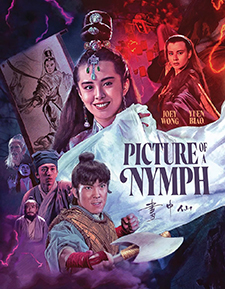
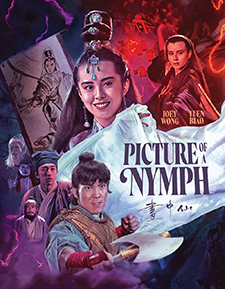
The 88 Films Region A/B Deluxe Limited Edition Blu-ray release of Picture of a Nymph features a reversible insert with new artwork by Sean Longmore on one side and the original theatrical poster artwork on the other. There’s also an art card and a 40-page booklet featuring essays by Paul Bramhall and Fraser Elliott. Everything comes housed in a rigid slipcase/slipcover combo with Longmore artwork. It’s a handsome set. The following extras are included:
- Commentary by Frank Djeng
- Commentary by David West
- Image Gallery (HD – 1:32)
- Original Trailer (HD – 3:35)
Aside from a brief Image Gallery and Picture of a Nymph’s theatrical trailer, the extras are confined to two different commentary tracks, but it’s the one-two punch of Frank Djeng and David West, so there’s still plenty to see here. Djeng, programmer and former marketing manager for Tai Seng Entertainment, offers his usual wealth of detail, breaking down all of the cast and crew, including which actors were dubbed and by whom. Naturally, Wu Ma gets plenty of attention, but so does producer Sammo Hung. Djeng discusses the ways in which Picture of a Nymph was an outgrowth of A Chinese Ghost Story, noting all of the similarities and differences. He also dives into minutiae like the precise translation of the title Hua zhong xian (it’s something more akin to “Immortal in the Painting”). Another fine track from Djeng.
David West, author of Chasing Dragons: An Introduction to the Martial Arts Film, is a bit more laid-back than Djeng, but no less knowledgeable in his own way. He lays out his intentions up front: to examine the “gods and spirits” subgenre of wuxia; the literary roots of the story; and how it relates (and compares) to A Chinese Ghost Story. But he does so more than that, diving deep into other topics like Sammo Hung’s various production companies; the influence of Sam Raimi on the film’s visuals; and the use of color (as well as other cultural elements that may be lost on western audiences). West has no less of an attention to detail than Djeng does, but he frequently expands into broader contexts, so both of these commentaries complement each other nicely.
That’s appropriate, because as usual, 88 Films complements Hong Kong cinema nicely. This Deluxe Limited Edition of Picture of a Nymph is another great release of a film that may not be familiar to mainstream audiences in the west, but it’s more than worthy of the extravagant treatment that 88 Films has afforded it. It’s definitely worth a look for adventurous viewers who haven’t yet explored the xianxia genre, and for fans, it’s pretty much a must buy.
- Stephen Bjork
(You can follow Stephen on social media at these links: Twitter, Facebook, BlueSky, and Letterboxd).