
Being There (Blu-ray Review)
Director
Hal AshbyRelease Date(s)
1979 (August 26, 2025)Studio(s)
Lorimar Productions/United Artists (Warner Bros. Discovery Home Entertainment)- Film/Program Grade: A
- Video Grade: B-
- Audio Grade: B
- Extras Grade: C-

Review
Imagine, if you can, this obviously fictional scenario: not so much a rags to riches story, but rather one where someone who has led a relatively comfortable life while taking advantage of the wealth (and labor) of others is given far more credit than he deserves. In reality, he’s a rather simple-minded man who loves consuming endless quantities of media, and he often struggles to distinguish the fantasies that it presents from the reality that surrounds him. Yet his simplistic pronouncements are mistaken for profundity, leading to him becoming an influential figure in Washington D.C., despite not having the slightest clue how a government actually operates. Still, the business interests that drive much of what the government actually does are able to understand how easily he can be used to their advantage, so they suggest taking him all the way into the Oval Office if necessary.
Relax, that kind of thing could never happen in the real America, could it? Yet that’s exactly what happens in Hal Ashby’s 1979 fable Being There, which was based on Polish-American author Jerzy Kosiński’s 1971 novel of the same name. And as often occurs in the journey from print to the screen, something fundamental about Kosiński’s story would end up being drastically altered in the process. Oh, Ashby’s version of Being There is actually remarkably faithful to the book, which isn’t particularly surprising considering that Kosiński wrote the screenplay. But Ashby being Ashby, he wasn’t satisfied with the somewhat anticlimactic conclusion to Kosiński’s story, so he devised something in an entirely different style at great expense and at the last minute. Okay, so it wasn’t really at great expense, but his last-minute alteration did indeed elevate Being There into something else entirely. But more on that in a moment.
Being There is the story of Chance (Peter Sellers), a feeble-minded gardener who has spent his entire life working for a rich old man while never leaving their townhome. His only exposure to the outside world has been via television, and while he’s perfectly capable of tending gardens, he’s completely incapable of caring for himself. His life is upended when the old man dies and he’s sent out into the real world, where he’s immediately struck by a limousine carrying Eve Rand (Shirley MacLaine), the wife of wealthy industrialist Ben Rand (Melvyn Douglas). She takes him to see their doctor, Robert Allenby (Richard Dysart), and soon Chance finds himself an important part of their lives. Ben Rand has enormous power in political circles, and Chance ends up meeting figures like the Soviet ambassador (Richard Baseheart) and even the President of the United States (Jack Warden). His simplistic statements about gardening are misunderstood as being metaphors about the economy, leading to Chance gaining national prominence. Yet he’s still the same simple man that he always was—or is he?
However much that people misinterpret what Chance says, he’s not really speaking metaphorically, and for most of the film, neither is Ashby. Being There is filled with opportunities to make statements about subjects like media consumption and the manipulation of politics by business interests, but just like Chance, Ashby wasn’t interested in saying anything that shouldn’t be taken at face value. Chance is a simple man, and for the most part, Being There is a simple film. Yet it’s the quintessential open text, one that can be read in a variety of different ways to support different perspectives. It’s as trifling or as profound as you want it to be, a one-joke premise carried to its logical extremes—a reductio ad absurdum for anyone who feels that works of art must have inherent meaning that transcends interpretation. Being There belongs as much to the viewer as it does to the artists who created it.
Still, the fact that Being There works as well as it does is as much due to Peter Sellers as it is to Hal Asbhy. Sellers delivers an astonishingly mannered and tightly controlled performance, never breaking character even after the cameras stopped rolling—although the outtakes that play over the closing credits do prove just how difficult that was. But Sellers never lets his guard down for a single moment in the film itself, and that’s why Chance ended up serving as a mirror not just for the other characters in Being There, but for viewers of the film as well. If there was the slightest trace of intentional irony in his performance, or any indication that he was winking at the audience, the entire film would have collapsed around him. (The Academy of Motion Pictures Arts and Science disagreed, however. While Sellers was nominated for Best Actor, he ended up losing to Dustin Hoffman playing Dustin Hoffman in Kramer vs. Kramer, which remains one of the many injustices in the history of the Academy.)
Ashby never lets his guard down either, maintaining the one-joke premise for Being There all the way until the end. And yet that’s exactly where he did lets things break momentarily: the ending. Kosiński’s screenplay concludes in similar fashion to his novel, with a quiet moment between Chance and Eve, which provides no sense of resolution. Ashby shot that ending but wasn’t satisfied with it, so he devised something else entirely, and that’s where Being There appears to eclipse its own limited premise to become, well, something else entirely. Yet however potent that this imagery may be, it still defies simplistic interpretation, offering numerous different possibilities instead (including mundane ones). Despite the seemingly transcendent nature of Ashby’s revised ending, Being There remains an open text that gives back however much (or little) that you choose to read into it. As a result, Chance’s life story remains whatever you want it to be.
After all, life is a state of mind.
Cinematographer Caleb Deschanel shot Being There on 35mm film using Panavision Panaflex cameras with spherical lenses, framed at 1.85:1 for its theatrical release. Spoiler alert, but since this is the identical disc as the original Warner Bros. Blu-ray release, it’s the same outdated master, not the 4K restoration that’s available on Criterion’s 2017 Blu-ray. Reframed at 1.78:1, it’s at least an improvement over DVD, but it pales in comparison to the Criterion version. The contrast is flat, the image is too soft, and everything bears obvious signs of digital image manipulation, including a problematic treatment of grain. The colors are somewhat inconsistent as well. It’s still watchable, but you can do much better.
Audio is offered in English 2.0 mono Dolby TrueHD, plus English, French, and Spanish 1.0 mono Dolby Digital, with English, French, Spanish, and Portuguese subtitles. As the fruit of the same Warner Bros. tree from that era, the audio actually defaults to Dolby Digital and you have to manually switch it to lossless instead—either via the popup menu or by using the audio button on your remote, since there aren’t any regular menu options for it. While the lossless track is an improvement over Dolby Digital, like the video, it’s still adequate at best.
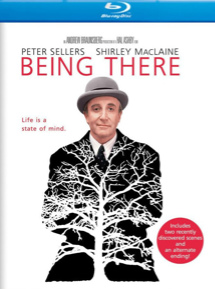
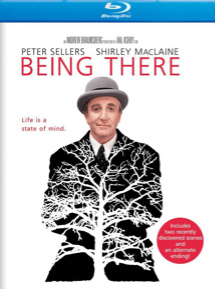
Now, let’s cut to the chase here. This Warner Bros. reissue of Being There isn’t really a reissue in any conventional sense of the term. Studios have been doing actual reissues for many years now, using the same audio/video master and usually the same disc authoring while rereleasing it in new packaging (frequently as an “Anniversary Edition,” or what have you). But that’s not what Warner Bros. has done here. This is the exact same disc, in the exact same packaging, with the exact same shrink wrap, right down to the PlayStation 3 sticker on the front. It’s not a reissue as much as it is a case where someone was cleaning out a warehouse and found a few boxes of unsold discs from 2009. This is the Warner Bros. equivalent of a Lionsgate Limited “warehouse finds” sale, only there’s no sale price in this case. Like most vintage Warner Bros. Blu-rays, that also means that the film autoplays as soon as the disc boots up, so you have to hit the menu button in order to access the limited extras, all of which are in SD:
- Behind the Story:
- Memories from Being There (14:48)
- Additional Footage:
- Additional Scenes (2 in all)
- Alternate Ending (2:03)
- Extras:
- Gag Reel (6:15)
- Trailer:
- Theatrical Trailer (2:44)
Memories from Being There is an interview with Illeana Douglas, granddaughter of Melvyn Douglas, who visited the set of Being There while she was still a child. She offers her memories of the experience and a few thoughts about the film. The Additional Footage includes two different brief scenes that were dropped from the final cut, as well as the original ending that Ashby dropped in favor of sailing into the mystic. Of course, it’s the Gag Reel that’s the real selling point with these extras, featuring the full set of outtakes of Sellers breaking up during his Raphael story. It closes with a promo where Sellers jokingly introduces Ashby and the film.
That means that most of the extras from the 2017 Criterion Collection Blu-ray are missing here, including the TV Spots, the featurette The Making of Being There, an audio-only lecture with Hal Ashby at the American Film Institute, a vintage appearance by Jerzy Kosinski on The Dick Cavett Show, and two different appearances by Peter Sellers on The Today Show and The Don Lane Show. The rest of Criterion’s extras are nearly identical to what’s here (albeit arranged slightly differently), with the exception of Memories from Being There which was dropped in favor of The Making of Being There. Between that and Criterion’s vastly superior video quality, there’s exactly zero reasons to buy this pointless Warner Bros. “reissue.” Skip it.
- Stephen Bjork
(You can follow Stephen on social media at these links: Twitter, Facebook, BlueSky, and Letterboxd).