
Weapons of Death (Blu-ray Review)
Director
Mario CaianoRelease Date(s)
1977 (September 22, 2026)Studio(s)
Capitolina Produzioni Cinematografiche (Kino Lorber Studio Classics)- Film/Program Grade: B+
- Video Grade: A
- Audio Grade: B+
- Extras Grade: A

Review
Italian crime movies proliferated in the 1970s, partly to reflect rising criminality in Italy. With threadbare plots and plenty of action, they owed much to American films such as Dirty Harry and The French Connection, which blurred the difference between cops and bad guys. Weapons of Death (aka Napoli Spara!) is about the determination of a detective to capture a violent crime boss.
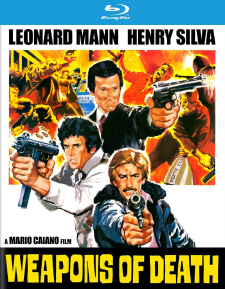
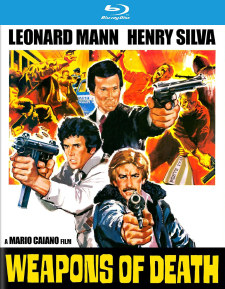
Commissioner Belli (Leonard Mann) is on the trail of mobster Santoro (Henry Silva) but his efforts fail because Santoro always has an alibi. The mob has been tying to maintain a low profile but Santoro arranges daring robberies on a large scale, often getting personally involved. Afraid his aggressive behavior will draw attention to their operations, other mob leaders confer with aging Mafioso Don Alfredo (Tino Bianchi). Because Santoro has been loyal to him since his son was killed years earlier, Don Alfredo refuses to intervene. Some who hate Santoro attempt to kill him as Commissioner Belli and his men close in.
Leonard Mann, an American actor whose background includes many made-in-Italy Westerns, is energetic as the Commissioner almost obsessed with stopping Santoro’s crime spree. Sometimes a bit over the top, Mann nonetheless channels a cop’s frustration at having his prey elude him time and time again. Impressively, Mann performs many of his own stunts.
Henry Silva (The Manchurian Candidate) plays Santoro with controlled intensity. His gaze is icy and he makes clear that Santoro is always thinking of his next move. Without much dialogue to work with, Silva draws on an attitude of arrogant indifference to the law and an air of invulnerability. While Belli is always rushing, hustling, exasperated, Santoro is disturbingly calm. Channeling bits of Brando’s Don Corleone and Clint Eastwood’s Dirty Harry, Silva turns in a memorable performance as a mobster who seems to savor matching wits with the police.
Director Mario Caiano has created a fast-paced action flick with practically nonstop action, including a botched bank robbery that opens the film, a train robbery, shoot-outs and several stunt-filled scenes. Several scenes are expertly staged and look as if they come from a film with a more substantial budget. Caiano knows how to maximize production value. The film is edited with breakneck speed to keep the action percolating. At no points does the pace bog down. Exposition is kept to a minimum in order to let the story unfold visually as much as possible. Caiano may have obtained some shots without proper permission—“stealing” them for expedience. In the bank robbery sequence, for instance, crowds watching the filming double as spectators watching the police taking out the robbers.
Weapons of Death was shot by director of photography Pier Luigi Santi on 35mm film with spherical lenses, finished photochemically, and presented in the aspect ratio of 1.85:1. For the Blu-ray, a new HD master is sourced from a 4K scan of the original camera negative. Clarity is much improved over poor-quality VHS tapes and TV broadcasts. Visual imperfections have been removed for a more distraction-free viewing experience. Complexions are well rendered. The color palette lies within the darker, muted range. Bright primary colors are scarce. A red van is an exception. Production value is strong, with many scenes filmed outdoors to take advantage of the busy streets of Naples. Stunt sequences are staged excitingly and benefit from great camera work by Santi.
There are two soundtrack options: the original Italian 2.0 LPCM language track and the English 2.0 LPCM language dub accompanied by English subtitles. In the English dub, it’s distracting to hear Mann and Silva dubbed by not-the-best actors. The jazz-inflected, propulsive score by Francesco De Masi is similar to other 70s European thrillers. Sound effects include pistols being fired, bodies pummeled in fist fights, machine guns, car crashes, explosions, an oil tanker barreling down the highway, cars skidding, tires screeching, and screams of pain.
Bonus materials on the Blu-ray release from Kino Lorber Studio Classics include the following:
- Audio Commentary by Steve Mitchell, Nathaniel Thompson, and Troy Howarth
- Napoli Spara! Revisited (17:48)
- Naples Under Fire: Interview With Director Mario Caiano (15:10)
- Video Essay by William Webb (5:25)
- Trailers:
- Weapons of Death (3:30)
- The Counsellor (4:13)
- Blazing Magnum (3:32)
- Assassination (2:59)
- The Outside Man (1:51)
Audio Commentary – Film historians Steve Mitchell, Nathaniel Thompson and Troy Howarth provide a lively commentary about Weapons of Death, also known as Napoli Spara! They call attention to the score. For a violent film, they find the score disappointing, not the “finest hour” for composer Francesco De Masi. The film is fast-paced and “weird” due to directorial choices. Actual crime in Italy was happening while the film was being shot. Despite dangerous stunts, no fatalities occurred during the making of Italian crime pictures. Actors shot blanks which make a very loud sound. Residents complained. Many scenes were shot in public places without official permission, probably in the early morning. Leonard Mann is an American actor who had a brief period of stardom in Italy. Tropes of the Western film are transferred into an urban landscape in Weapons of Death. Big scenes are impressively staged and filmed. The original Italian track is superior to the English dub. The cop genre exploded in Italy and lasted about a decade. The films reflect crime in the streets and terrorist activity and served as wish fulfillment because the bad guys received comeuppance. There’s a social consciousness to the film as well as political content. Often, the Italian crime films are called fascistic. Separate music was used for the oil tanker sequence to amp the excitement factor. The look of the film is gray with overcast skies. Primary colors are rare. Sometimes “grubby films” have their own appeal. Mario Caiano directed films in many genres and loved Westerns. Outdoor scenes are plentiful, adding production value. Henry Silva is dubbed. He became a big star in Italy but also worked regularly in the United States, mostly on series TV episodes. The commentators note that “the camera loves Henry Silva.” The film has an artisanal quality with few evident post-production fixes.
Napoli Spara! Revisited – In this archival interview with actor Leonard Mann, the actor speaks about the crime surge in Italy in the 1970s. He also talks about Italian films in which he starred. In Weapons of Death, there’s a sense that “the good guys are going to restore order.” Paradoxically, the crew couldn’t have shot Weapons of Death without the Mafia accompanying them to make sure streets were closed off. Mann did most of his own stunts except for the most dangerous. His stunt double worked with him in several films. Weapons of Death is tame by today’s standards but audience reaction at the time was strong and enthusiastic. Some sequences were shot without sound and some without obtaining required permits. Italian films were spontaneous and unpredictable, flawed the way life is flawed.
Naples Under Fire – In this interview, director Mario Caiano speaks in Italian. English subtitles are shown at the bottom of the screen. After the American film Quo Vadis became a big hit, the Italian cinema industry started to make epics. Similarly, Italian movies followed the popularity of Western, kung fu, 007, and crime pictures. A non-pigeonholed director could do any of these. “It was a matter of craftsmanship.” Caiano directed all kinds of movies. He speaks about the political climate of 1970s Italy. Television was subject to greater censorship than movies. Crime films strove for realism. Caiano tells how several shots were captured surreptitiously. Leonard Mann had a limited range but was physically capable and good for the role of Belli. After all these years, Italian crime films have proven to have ongoing appeal.
Video Essay by William Webb – This is a featurette titled The Brutal World of the Poliziotteschi (Italian crime). Webb says Weapons of Death, director Mario Caiano’s 25th film, put a new spin on the police procedural. It has “high octane” action as corruption vies with law and order. Commissioner Belli’s attempts to make changes in his investigation are greeted with complacency. Santoro represents a new brutality adopted by criminals. The lines between law and crime are blurred. The film is bleak. A young lame orphan who’s featured throughout serves as comic relief. The moral is that even when the law wins, someone must pay.
In Weapons of Death, director Mario Caiano delivers violence, often exploiting it, with a few scenes shocking in their intensity. The pace is fast and constant, with the two leads pitted against each other in a cat-and-mouse relationship. Leonard Mann and Henry Silva turn in strong performances and make for expert screen adversaries. Fans of non-stop action delivered through a swift narrative will find much to enjoy.
- Dennis Seuling