
Sword and the Sorcerer, The (4K UHD Review)
- Review Date: Jun 03, 2026
- Format: 4K Ultra HD
-


Director
Albert PyunRelease Date(s)
1982 (January 7, 2026)Studio(s)
Sorcerer Productions (Imprint Films/Via Vision Entertainment)- Film/Program Grade: C+
- Video Grade: B+
- Audio Grade: B
- Extras Grade: A
Review
[Editor’s Note: This is a Region-Free Australian 4K Ultra HD Blu-ray import.]
While Conan the Barbarian is sometimes remembered as the film that launched the wave of fantasy adventure films in the Eighties, the late Albert Pyun’s The Sword and the Sorcerer was arguably its real starting point. It was released a month earlier in North America, and given the fact that it had a significantly lower budget than the expensive but ponderous John Milius epic, it actually turned a healthier profit—in fact, it ended up being the most successful independent production of 1982. The Sword and the Sorcerer proved that credible fantasy films don’t require unlimited means; just a lot of creativity on both sides of the camera. That’s a lesson that was reinforced a few months later when Don Coscarelli’s The Beastmaster finally reached theatres, but The Sword and the Sorcerer still got there first. (And yes, for the pedants out there, Excalibur and Dragonslayer were both released a year earlier, but the fantasy wave still didn’t really kick into full swing until 1982.)
As if the title wasn’t already a giveaway, the script by Pyun, Tom Karnowski, and John V. Stuckmeyer lays out a fairly straightforward fantasy tale of might and magic. King Cromwell (Richard Lynch) makes a deal with a literal devil in the form of the undead sorcerer Xusia (Richard Moll), as a way to expand his kingdom by conquering the territory of his rival King Richard (Christopher Cary). Richard’s son Talon (Lee Horsley) escapes the ensuing carnage to become a mercenary, and years later, his help is enlisted by Mikah (Simon MacCorkindale), a contender for Cromwell’s throne, as well as by Mikah’s sister Alana (Kathleen Beller). Talon agrees to aid the pair, but Cromwell has plans of his own, and the threat from the missing Xusia still hangs over everyone’s heads. The Sword and the Sorcerer also stars Joe Regalbuto, Anthony De Longis, George Maharis, Earl Maynard, and Nina van Pallandt.
The Sword and the Sorcerer stays within the means of its relatively small budget by essentially being an epic writ small. Despite the scope of the story, there’s a deliberate lack of scale to the proceedings, with most of the action handled in either close-up or else medium shots—it may have been Pyun’s first film, but he had already learned how to cover a lack of background detail by drawing the viewer’s attention to the foreground. Instead of spending money on vast sets or legions of extras, he kept everything much tighter, and the limited resources that he had were spent on making the sets and costuming of reasonably high quality. Whatever else can be said about The Sword and the Sorcerer, it looks quite good.
Yet it was a challenging production, since Pyun found himself in frequent conflict with producer Brandon Chase, and the man with the money won out in the end. As a result, the tone of The Sword and the Sorcerer is inconsistent, with lighthearted comic moments that don’t always mesh with the darker material. Chase wanted a swashbuckling Errol Flynn adventure, and he ultimately got it, but those elements sometimes seem at odds with the rest of the story. And to be fair to Pyun, the film’s most effective moments are those darker ones, especially the scenes involving Xusia’s rebirth(s). The Sword and the Sorcerer wears its hard R rating with as a badge of honor; Chase got the T&A that he wanted (well, most of it, anyway), but Pyun really relished the extreme gore. There are some impressive visuals here, too, such as the wall of faces in Xusia’s tomb. The Sword and the Sorcerer doesn’t always work, but when it does, it works surprisingly well.
Albert Pyun’s name will forever be associated with quickie filmmaking on the cheap, and while The Sword and the Sorcerer was indeed a low-budget production, it still manages to punch above its weight class. Flaws or not, there’s a lot of impressive work in the finished product. It’s a shame that Pyun never really got to make his planned sequel Tales of the Ancient Empire (we’ll be generous here and pretend that the 2010 cheapie doesn’t exist, as Pyun was already starting to suffer from the slow decline in health that would ultimately take his life 12 years later). Yet The Sword and the Sorcerer is still enjoyable enough on its own, warts and all, and it stands as a high point of Pyun’s legacy.
Cinematographer Joseph Mangine shot The Sword and the Sorcerer on 35mm film using Panavision Panaflex cameras with spherical lenses, framed at 1.85:1 for its theatrical release. (There’s some stock footage of lightning near the beginning that was originally shot anamorphic, and it’s still squeezed in the film, so it stands out like a sore thumb.) This version uses the 2022 Shout! Studios master, which is based on a 4K scan of the original camera negative, digitally remastered and graded for High Dynamic Range in Dolby Vision and HDR10. The opening titles and any other optical effects were scanned from dupe elements instead, and so they’re softer, with coarser grain, but the rest of the film is much sharper—within the confines of the limitations of the original production, that is.
Mangine and Pyun favored diffusion all throughout the film, with frequent layers of smoke, and so The Sword and the Sorcerer can never be as sharp and detailed as films that were photographed with absolute clarity in mind. There’s light speckling here and there, and the closing credits do waver a bit, but there’s little else in the way of damage. The HDR grade doesn’t significantly expand the contrast range, and black levels aren’t always the deepest, but there’s plenty of shadow detail visible. The range of colors has been noticeably expanded—the reds during some of Xusia’s scenes look really red here. Some of the highlights are brighter too, such as the torches that are carried by various characters, or the glittering sparks off the swords during the final duel between Talon and Cromwell. It’s not a reference-quality transfer, but it couldn’t be, and it seems faithful to the original intentions for the film.
Audio is offered in English 2.0 LPCM (the Shout release was a DTS-HD Master Audio container) and 5.1 DTS-HD Master Audio, with optional English SDH subtitles. The Sword and the Sorcerer was released theatrically in Dolby Stereo, and as there were no original sound elements available, this 2.0 version is derived from the optical audio tracks. The 5.1 remix was created for the Anchor Bay DVD release. A title card at the beginning of Shout’s UHD release, which isn’t included with Imprint’s, explained the differences between the two, and while there was damage to the optical tracks that couldn’t be fixed, they still recommended the 2.0 version due to directional errors in the 5.1 mix—and they were right, as the 2.0 definitely has the edge. While there’s audible crackling and background noise, it sounds slightly fuller than the 5.1 mix, which is relatively thin in comparison. Both versions are primarily focused on the front channels, with just a bit of ambience in the surrounds, but the 2.0 still has more body to it. David Whitaker’s Korngold-influenced score sounds fine, though it really would have benefited from access to the original mag stems.
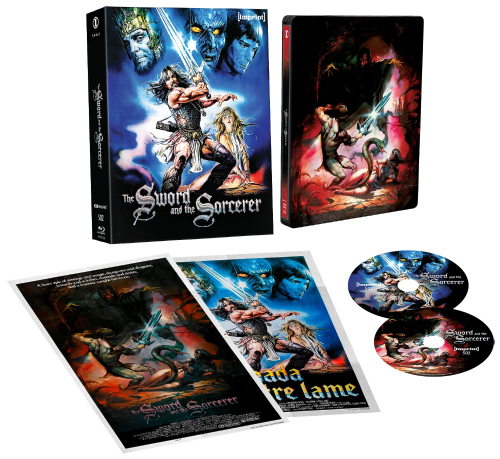
The 2-Disc Limited Edition Steelbook 4K Ultra HD release of The Sword and the Sorcerer also contains a 1080p Blu-ray and a large double-sided poster featuring the Peter A. Jones-painted U.S. theatrical artwork on one side and the Enzo Sciotti-painted Italian theatrical artwork on the other. Everything is housed in a 3D lenticular hardcase featuring the same Enzo Sciotti artwork, but with the English language title instead. This release is limited to 1,500 units, and the following extras are included on each disc:
DISC ONE (UHD)
- Commentary by Albert Pyun, Moderated by John Charles
- Commentary by Albert Pyun, Moderated by Chris Gore
DISC TWO (BD)
- Commentary by Albert Pyun, Moderated by John Charles
- Commentary by Albert Pyun, Moderated by Chris Gore
- Tales of the Ancient Empire (HD – 33:06)
- A Princess’ Tale (HD – 24:08)
- Mightier Than the Sword (HD – 19:51)
- Master of the Blade (HD – 13:53)
- The Specialist and the Effects (HD – 12:10)
- Brothers in Arms (HD – 10:23)
- Dedicated to Jack Tyree, Stuntman (HD – 11:50)
- Trailers from Hell (HD – 3:30)
- Theatrical Trailers (Upscaled SD – 6:20, 2 in all)
- TV Spot (Upscaled SD – :26)
- Image Gallery (HD – 9:02, 106 in all)
The first commentary with Pyun was recorded for the 2022 Shout! Factory UHD, and it’s moderated by author and Video Watchdog contributor John Charles. Pyun was battling dementia at that point, and Charles does a nice job of keeping things on track. Pyun’s memories of the production were still generally sound, and he tells some good stories about making the film. He says that due to the difficult nature of the production, he felt like he was an inch away from being fired every single day, and he also goes into his conflict with Brandon Chase. He notes some interesting details, like the fact that Earl Maynard’s final moment was a deliberate reference to his fight scene in The Deep (something that seems obvious in hindsight, but I’d never thought of it before). At one point, he gets emotional and completely breaks down while discussing how important that it was to him that his film played in theaters in his home town of Honolulu, so that people who had dismissed him could see that he had successfully brought his vision to the screen. (Charles kindly steps in to reassure him that he has plenty to be proud of.) It’s a difficult moment to listen to, but it’s a real one, and it really humanizes the struggles that Pyun was facing.
A new addition, the second commentary was originally recorded for the 2008 DVD from Big Sky Video in Australia, moderated by Chris Gore from Film Threat. Gore can be a little hard to take these days, but in this case, he largely stays out of Pyun’s way and just asks questions to keep the conversation moving (although his puerile sexism does creep in at times). They discuss Pyun’s background (including his work with Toshiro Mifune in Japan), where the idea for the sword came from, and the long history of trying to bring The Sword and the Sorcerer to the screen. Pyun says that he was influenced by Richard Lester and George McDonald Fraser’s work on The Three Musketeers and The Four Musketeers, so not all of the swashbuckling elements came from Brandon Chase (Chase goes mostly unmentioned in this track). He acknowledges the challenges due to his inexperience as a director, including the fact that Richard Moll’s eyes ended up being scratched by the scleral contact lenses. Pyun and Gore also spend time on the rest of the cast, the makeup effects, the sets, the humor, the critical reaction to the film, and yun’s plans for the sequel.
Aside from a collection of trailers and an Image Gallery, the rest of the extras consist of interviews that have been ported over from the 2022 Shout! Factory UHD. Tales of the Ancient Empire is with Pyun, who relates the challenges that he faced bringing The Sword and the Sorcerer to the screen. He admits that he was a temperamental director, and put his cast through a lot, yet when he considered quitting, it was Lee Horsley who convinced him to continue. He also admits that he didn’t bother shooting his storyboards, but just winged it every day (not much of a surprise there, knowing Pyun). He discusses dealing with studio heads while getting offers after the success of the film, most of whom were taken aback to find that he was non-white. He also candidly acknowledges that his dementia had already ended his film career.
A Princess’ Tale is with Kathleen Beller, who talks about working with the rest of the cast, dealing with the snake, and shooting the nude scene. She felt that Pyun was out of his depth, and that the first assistant director was really in charge of the set. She also gives her reactions to watching the film for the first time in years (she’s still not a fan, although she’s come to accept it a bit more). Mightier Than the Sword is with co-writer/co-producer John Stuckmeyer, who discusses the development process, raising money, dealing with Brandon Chase, and the successful theatrical release. He has nothing but kind words for Pyun, whom he describes as having infectious enthusiasm.
Master of the Blade is with editor Marshall Harvey, who talks about his early career and his working relationship with Chase. Harvey says that the temp track that he added to a sizzle reel is what was responsible for increasing the budget for the music, and that resulted in Whitaker being hired. He also tells the story of what happened after they brought in Oliver Reed to do the narration (needless to say, that didn’t go well). The Specialist and the Effects is with Allan Apone, who worked on the additional makeup effects inserts for the film. (The primary effects were supervised by Ve Neill.) He explains what it was like to work on such a limited budget, and gives a lot of credit to art director George Costello for creating some impressive sets despite the limited resources.
Brothers in Arms is with the irrepressible Chiodo Brothers, who worked on the wall of faces in the crypt. It was the first film that the three of them worked on together, and it helped launched Chiodo Brothers Productions. Dedicated to Jack Tyree, Stuntman is a compilation of clips from all of the interview sessions, with everyone discussing the death of stuntman Jack Tyree, who was killed after he missed the airbag during his high fall stunt. A few of them share their feelings regarding the wisdom of including the footage of the jump in the final film.
Trailers from Hell features Marshall Harvey, who didn’t just edit the film, but also cut this Red Band trailer. He gives an overview of the production and explains why Chase demanded a Red Band trailer in the first place. The Theatrical Trailers includes the full version of that trailer, as well as one for general release that uses alternate footage shot for the film’s television broadcast. Lastly, the Image Gallery collects posters, lobby cards, other advertising materials, production photographs, articles, soundtrack artwork, home video releases, and even tie-ins like the novelization and video game. It also includes an interesting 1982 letter from Marshall Harvey to Joseph Bensoua at the Daily Breeze, debunking statements that Albert Pyun had made in a recent interview.
The addition of the older commentary helps to paint a portrait of the Pyun that was and the man who later fought a brave but losing battle with multiple sclerosis and dementia. (Pyun finally succumbed on November 26, 2022, in the arms of his wife and caregiver Cynthia Curnan, surrounded by well wishes written by his fans and supporters.) The audio and video quality is essentially identical, but Via Vision wins in terms of extras, and their Steelbook packaging with the hardcase is a definite upgrade from what Shout! offered. It may not be enough to justify a double dip, but if The Sword and the Sorcerer isn’t already in your collection, then Via Vision’s 4K set is the best option. Recommended.
- Stephen Bjork
(You can follow Stephen on social media at these links: Twitter, Facebook, BlueSky, and Letterboxd).