
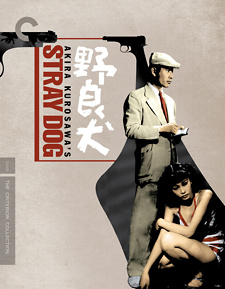
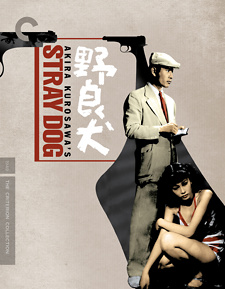
Stray Dog (Criterion) (4K UHD Review)
Director
Akira KurosawaRelease Date(s)
1949 (May 5, 2026)Studio(s)
Shintoho/Film Art Association/Toho Co., Ltd. (The Criterion Collection)- Film/Program Grade: A
- Video Grade: B+
- Audio Grade: B
- Extras Grade: C

Review
[Editor’s Note: The film review below is by Todd Doogan, adapted from his look at the 2009 Criterion AK100 DVD release. The 4K disc comments are by Bill Hunt.]
It’s a brutally hot summer day when rookie detective Murakami (Toshirô Mifune) has his police-issue Colt pistol lifted from his jacket pocket on a crowded trolley. Racked with shame (keep in mind that the Japanese have strict prohibitions on guns, even to this day), he reports the theft to his superiors, who simply dock him half pay for the next three months and send him on his way. Not one to stand idly by, Murakami goes undercover to try and locate the pistol, walking amid the dregs of post-war Tokyo in a movie-halting (yet oddly captivating) 9-minute montage sequence filmed in and around actual Japanese slums. It’s not until he gets paired up with veteran detective Sato (Kurosawa company player Takashi Shimura) that he starts to close in on his target.
But then something happens—something that sends shivers down Murakami’s spine: Whoever has the gun is using it to commit crimes and people are getting hurt. There are seven bullets in his Colt. That means seven potential victims, and Murakami is willing to do anything he can to ensure that those remaining bullets never get fired.
Stray Dog is equal parts film noir (with its very Western use of language and procedure) and social commentary (mainly focused on disenfranchised youth coming home from the war to a world struggling to pull itself back together around them), and it excels on both fronts. The film noir conventions take great influence from the work of both American expat director Jules Dassin (Brute Force, The Naked City, and Thieves Highway) and French pulp writer Georges Simenon, with Sato owing more than a passing nod to Simenon’s greatest creation, Jules Maigret. But the film’s true power comes from its commentary. Both Murakami and the villain of the tale (Yusa, played by Isao Kimura, who would join Mifune, Shimura, and Kurosawa again five years later as Seven Samurai member Katsushiro) share very similar pasts. Both are in their late 20s, both are back from the war and both arrived home to Tokyo and quickly had their duffle bags (containing their whole lives up until that point) stolen from them. But whereas Yusa chose a life of petty crime, Murakami chose to try and stop it. Kurosawa alludes to this “doppelganger” concept several times over the course of the film, and would later play it up on a bigger chessboard in High and Low, using a “have and have not” theme.
Stray Dog was shot by cinematographer Asakazu Nakai (Seven Samurai, Ran) on 35 mm B&W film using Mitchell cameras with spherical lenses, and it was released into theaters at the 1.37:1 aspect ratio. Criterion’s new 4K Ultra HD + Blu-ray edition takes advantage of a recent 4K scan and digital restoration of an original 35 mm master positive by Toho Archive Co. Ltd, in Setagaya, Japan. There’s no HDR grading here, this is 10-bit SDR only. But Criterion has encoded the image for inclusion on a 100GB disc to allow for the highest possible data rates (averaging 90-100 Mbps).
Once again, Toho’s restoration work is quite good. Once you get past the optically-printed opening titles, image detail is generally clean and well-refined. Given that the film’s original camera negative does not survive, the detail here is quite pleasing overall. It’s important to note that some lingering age-related issues do remain however, including light scratches and a little bit of image warping—Japanese films of this period were often not stored properly—while optically-printed transitions (dissolves, wipes, etc) also show the expected softness. Still, the film’s photochemical grain structure is intact and appropriately light-moderate. Shadows are dark, though there’s not as much detail retained in both the shadows and highlights as you’d see in good HDR image, and the highlights are a little blown out. It’s probably a toss-up whether there’s enough detail in the scan to really benefit from an HDR grade here. This film is also notable for having a narrow depth of field—there’s a shot of Murakami searching records in the police archives for example (about 6:14 into the film) where he’s in focus but everyone behind him is blurry. Still, this is a modest but definite upgrade over the previous Blu-ray editions (including those of both Criterion and the BFI). Frankly, it’s just nice to have a Japanese B&W film of this vintage on 4K disc at all.
The film’s original mono audio mix has also been remastered for this release by Toho from a 35 mm soundtrack positive to reduce unwanted noise and age-related defects. It’s available here in 48kHz/24-bit LPCM 2.0 mono format. The track is largely clean and free of defects, with clear dialogue. Composer Fumio Hayasaka’s unique score is presented in good fidelity, serving to punctuate the image as much as to complement it. Optional English SDH subtitles are also included.
Criterion’s 4K edition is a 2-disc set, featuring the remastered film in 4K on UHD and also the existing 1080p HD Blu-ray version. Both discs include the following special feature:
- Audio Commentary by Stephen Prince
To this, the Blu-ray adds the following:
- Akira Kurosawa: It Is Wonderful to Create – Stray Dog (SD – 32:42)
The audio commentary was recorded in 2003 for DVD, and it’s sublime. There are few greater authorities on the work of Akira Kurosawa than Stephen Prince, author of The Warrior’s Camera: The Cinema of Akira Kurosawa (1990, Princeton University Press), and he’s always a delight to listen to. Meanwhile, the obligatory episode of It Is Wonderful to Create is part of a larger documentary series created in 2002. It offers great stories, behind-the-scenes stills, and retrospective interviews with members of Kurosawa’s cast and crew.
Not included here from the BFI’s 2025 Blu-ray release are the audio commentary by the Japanese-Australian short subject and documentary filmmaker, Kenta McGrath, and the 30-minute featurette with film scholar Jasper Sharp, A Japanese Tale. (Diehard Kurosawa fans will probably want to get their hands on both editions accordingly.)
Criterion’s package also includes a modest booklet featuring an essay by film critic Terrence Rafferty and an excerpt from Kurosawa’s book Something Like an Autobiography, as well as the usual remastering notes and credits.
At the time of its release, Stray Dog was Kurosawa’s best film since Drunken Angel. It blends the world of post-war Japan perfectly with the Western influences Kurosawa was critical of (and yet adopted, at least in part) in his work. And though he would later consider it a disappointment, Stray Dog was by no means a failure and stands tall alongside other classic film noirs of the 1940s. Up until now, the BFI and Criterion Blu-rays were the best versions we’ve had, so it’s a treat to see this film on 4K disc at last. Let’s hope that many more Kurosawa titles follow it on this format. Recommended.
-Todd Doogan and Bill Hunt
(You can follow Bill on social media on X, BlueSky, and Facebook, and also here on Patreon)