
Mutant (4K UHD Review)
Director
John “Bud” CardosRelease Date(s)
1984 (May 26, 2026)Studio(s)
Laurelwood Productions/Film Ventures International (Vinegar Syndrome)- Film/Program Grade: C-
- Video Grade: B+
- Audio Grade: B+
- Extras Grade: B

Review
The zombie subgenre has proven to be a remarkably resilient one, ever since Bela Lugosi first commanded hordes of them in Victor Halperin’s 1932 film White Zombie—and arguably even earlier than that, if you count Cesare in Robert Weine’s The Cabinet of Dr. Caligari (a somnambulist by any other name still smells like a zombie, at least in terms of form and function). The zombies themselves may vary from mind-controlled voodoo casualties to literal undead and even victims of biological or chemical agents, and they may shamble slowly or run like the wind, but regardless, all of that just demonstrates how versatile the subgenre can be.
Of course, after George A. Romero introduced his flesh-eating ghouls with his 1968 classic Night of the Living Dead, most zombie films and television series have followed a similar template, but there still has been a surprising number of variations on the theme (hell, even Romero toyed with it in The Crazies). For example, Lucio Fulci and Gary Sherman returned zombies into a vaguely voodoo-oriented context in Zombi 2 and Dead & Buried, respectively (although Fulci later divorced them from any natural context whatsoever in City of the Living Dead, The Beyond, and The House by the Cemetery). Danny Boyle even returned to the concept of Romero’s The Crazies in order to make his own virus-run-amuck film, 28 Days Later, which launched a franchise of its own.
For the 1984 variant Mutant (aka Night Shadows), writers Peter Z. Orton, Michael Jones, and John C. Kruize went old-school by turning not to voodoo, but rather to one of the staples of monster movies for many, many decades: toxic waste, in this case blended into the redneck milieu of Deliverance. Josh (the late Wings Hauser) and Mike (Lee Montgomery) are two brothers who are vacationing in a rural area (cue the banjos). After encountering a gang of rednecks, their car ends up wrecked, and they’re forced to take refuge in a nearby town. But there’s more going on than meets the eye, and as the bodies start to pile up, they seek the assistance from alcoholic Sheriff Will (Bo Hopkins), the local doctor (Jennifer Warren), and even an elementary schoolteacher (Jody Medford). Eventually, they’re surrounded by toxic waste-fueled zombies (not zombie redneck torture families, see?) and forced to fight for their lives. Mutant also stars Marc Clement, Cary Guffey (yes, that Cary Guffey), and Mary Nell Santacroce.
The mélange of elements in Mutant shouldn’t come as much of a surprise, as the story evolved throughout the development process. Even the production evolved as it went along, with original director Mark Rosman being fired a week into the production and replaced at the last minute by actor/stuntman/director John “Bud” Cardos, who finished everything quickly and efficiently despite his lack of preparation. Even the film itself ended up evolving. It was essentially a regional production, shot in Georgia for Film Ventures International, and it was initially released regionally under the title Night Shadows. Eventually, it was retitled Mutant for home video release, and that title has stuck with it ever since.
While Mutant is no Night of the Living Dead, it still offers plenty of zombie movie fun for anyone who is willing to watch it with the proper drive-in theatre frame of mind. Cardos wasn’t exactly George A. Romero, so it lacks any deeper meaning or social criticism, but he was more than capable of putting together an entertaining genre effort. He was aided greatly in that regard by one of Richard Band’s finest scores, which frankly does much of the heavy lifting in terms of creating atmosphere and suspense. And Cardos wasn’t afraid to invert Night of the Living Dead by ending the film in a way that demonstrates that it is indeed possible to survive the long night (however shadowy that it may be). A zombie movie with a happy ending? Well, why not? It just proves how versatile the subgenre can be.
Cinematographer Alan Taylor shot Mutant on 35mm film using spherical lenses, framed at 1.85:1 for its theatrical release. This version is based on a 4K scan of the original camera negative, digitally remastered and graded for High Dynamic Range in Dolby Vision and HDR10. While I don’t have the previous Code Red Blu-ray for comparison purposes, from the look of screenshots, it suffered from a heavy application of DNR. In this case, aside from a few light scratches (and at least one heavier scratch), the image is pretty clean overall, but there’s definitely no traces of noise reduction here—if anything, the abundant grain seems to have been pushed a bit at times, especially in some of the night shots. The colors generally look natural, although the flesh tones do occasionally display Vinegar Syndrome’s tendency toward oversaturated reds. The contrast range is strong, however, with plenty of deep blacks that keep the environments looking ominous and threatening. It’s a nice 4K upgrade for a title that definitely wasn’t on anyone’s 4K bingo card.
Audio is offered in English 2.0 DTS-HD Master Audio, with optional English subtitles. Mutant was released theatrically in Dolby Stereo, although for some reason, Code Red’s Blu-ray appears to have only included a mono track. But everything springs to life here in matrix-encoded Dolby Stereo, and while surround usage is limited to general ambience, there’s a wide stereo spread that really benefits Richard Band’s evocative score. Mutant wouldn’t be half as effective without it, so it’s hard to imagine how much would have been lost by limiting it to mono. Thankfully, it has plenty of breathing room here.
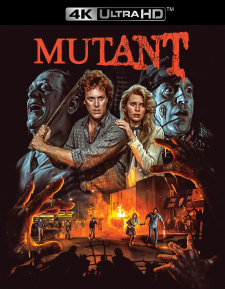
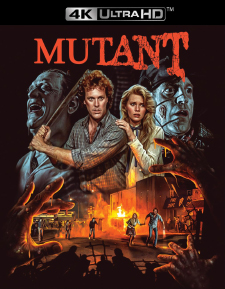
The Vinegar Syndrome 4K Ultra HD release of Mutant is a two-disc set that includes a Blu-ray with a 1080p copy of the film. The insert is reversible, featuring new artwork by Chris Barnes on one side and the theatrical poster artwork on the other. Vinegar Syndrome is also offering a Limited Edition version featuring a spot gloss slipcover designed by Barnes that’s available directly from their webstore and at a few select retailers, limited to 7,000 units. Or, at least it might be, depending on when you look. Vinegar Syndrome has long been in the habit of taking their entire website down before and after sales, and even when it’s up, they sometimes limit the available selection. As of this writing, it’s been down completely since their Halfway to Black Friday Sale ended, and it’s not going live again until 6/1/26—at which point it will switch to a Partner Label sale for the entire month, so Mutant won’t even be available for purchase from them until July. I just don’t understand the marketing strategy of actively preventing customers from buying your product.
Sorry, that diatribe has been a long time coming, since it seems like every time that I sit down to review one of their titles, I can’t pull up their listing for it without resorting to using the Wayback Machine. Anyway, the following extras are included:
DISC ONE: UHD
- Commentary with Howard S. Berger and Steve Mitchell
- Commentary with John “Bud” Cardos
DISC TWO: BD
- Commentary with Howard S. Berger and Steve Mitchell
- Commentary with John “Bud” Cardos
- A Real Country Boy (HD – 17:10)
- Mutant Report (Upscaled SD – 7:22)
- Archival Interview with Bo Hopkins (Upscaled SD – 10:58)
- Archival Interview with Lee Montgomery (Upscaled SD – 15:41)
- Trailer (Upscaled SD – 1:30)
Vinegar Syndrome has added three new extras for this release, starting with a commentary track that pairs old friends (and fellow zombie lovers) Howard S. Berger and Steve Mitchell. They open with a history of the different titles and the revised marketing campaign, and from there, they move into discussions about the script, the production, and the cast, with an emphasis on Lee Montgomery, Jennifer Warren, Bo Hopkins, Cary Guffy, and Wings Hauser. They give Hauser the most love, pointing out how he gave his all in every part that he played. But Hopkins gets plenty as well, especially when Berger calls out his performance in the woefully underappreciated Sam Peckinpah film The Killer Elite. They also spend some time defending John “Bud” Cardos as a filmmaker, offering praise for Richard Band’s stellar score, and talking about the mutating nature of the mutants in Mutant.
There are also two new interviews. A Real Country Boy is with Cali Lili Hauser, the widow of Wings Hauser, who says the late actor entrusted her with the task of protecting his legacy—although she’s chosen some dubious paths in that regard, since she says he’s going to continue to appear in films thanks to A.I. In any event, she ties the themes of Mutant into the fact that Wings was a committed environmentalist (the couple founded a marine life and butterfly sanctuary). She also offers some biographical information, including her husband’s lifelong battles with asthma and COPD. Mutant Report is with Anthony Everitt, son of Fangoria writer David Everitt, who pays tribute to Mutant and the way that his father championed the film in the magazine.
The rest of the extras are ported over from the 2016 Code Red Blu-ray, starting with a commentary featuring Cardos, producer Igo Kantor, and Lee Montgomery, moderated by Jeff McKay. They’re a lively bunch who aren’t in great need of moderation, but McKay still helps keep things focused and moving forward. They tell plenty of unfiltered stories about the production, including how Montgomery’s brief fling with a local cheerleader ended up causing problems for security on set.
There are also two archival interviews. The first is with Bo Hopkins, who offers plenty of praise for Cardos and Kantor, a few choice stories about Hauser, and some thoughts about his own willingness to star in just about anything, as long as he likes it a little. The second is with Lee Montgomery, who talks about his own experiences making Mutant and his relationships with the rest of the cast and crew. (Never fear, the subject of the cheerleader comes up again.)
You really have to hand it to Vinegar Syndrome: They’re willing to release just about anything in 4K. Mutant may not have been on anyone’s 4K bingo card, but here it is, larger than life and twice as natural. It does offer plenty of zombie goods for those who are willing to meet it on its own terms, and it’s never looked better than it does here. All that, plus a decent slate of extras. Mutant may not be a zombie movie masterpiece, but this is still a great 4K release, so do pick it up if you’re a fan.
-Stephen Bjork
(You can follow Stephen on social media at these links: Twitter, Facebook, BlueSky, and Letterboxd).