
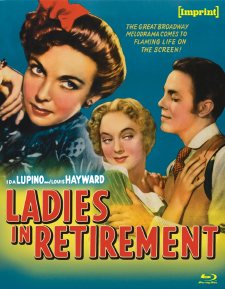
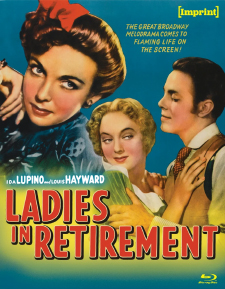
Ladies in Retirement (Blu-ray Review)
Director
Charles VidorRelease Date(s)
1941 (August 26, 2026)Studio(s)
Columbia Pictures (Imprint Films/Via Vision Entertainment)- Film/Program Grade: A
- Video Grade: A
- Audio Grade: A
- Extras Grade: D-

Review
[Editor’s Note: This is a Region-Free Australian Blu-ray import.]
Every now and then, a long overlooked film emerges that’s a surprising find. Ladies in Retirement, a major 1941 release based on a successful Broadway play, has a solid cast and a gripping story but has been virtually forgotten despite its impressive credentials.
Retired Victorian era music hall actress Leonora Fiske (Isobel Elsom) lives in a country house just outside London. She loves the peace and quiet of country life and has the financial wherewithal to support herself in comfort with two live-in servants, housekeeper Ellen Creed (Ida Lupino) and maid Lucy (Evelyn Keyes). Ellen receives a letter from a landlady in London complaining of the behavior of her mentally ill sisters, childlike Louise (Edith Barrett) and troublesome Emily (Elsa Lanchester). If Ellen doesn’t take them off her hands, the landlady will call the police who will take them to an insane asylum, where they will be horribly abused.
Desperate to keep her sisters safe, Ellen appeals to Miss Fiske’s generosity and gains her permission for them to stay at her home for a few days. Things turn sour almost at once. The sisters are noisy, rude, and destructive. The “few days” turn into six weeks. By then, Miss Fiske’s nerves are shattered and she finally tells Ellen her sisters must leave immediately. When Ellen protests and talks back, Miss Fiske fires her. To protect her childlike sisters, Ellen resorts to an extreme measure.
Complicating matters, Ellen’s ne’er-do-well nephew Albert (Louis Hayward) shows up at the house, on the lam from the police after being caught embezzling money from his employer, a London bank. Albert discovers a dark secret Ellen is keeping and blackmails her into letting him live in the house permanently.
Ida Lupino, 23 at the time, is hard to accept at first as the 40-year-old spinster Ellen is supposed to be. Her severe hairdo, stiff posture, and somber dresses help to convey the impression of an older woman, and her acting ability soon makes us forget the age discrepancy. Lupino plays Ellen as level-headed, thoughtful and intelligent. With a slightly raised head causing her to look down on others, she has an imperious manner. When a key line of dialogue is uttered, she visibly tenses up and a loud chord emphasizes the importance of the line.
Elsa Lanchester, as the more obviously crazy sister, Emily, has a ball with the role, speaking her character’s unfiltered thoughts, dumping excess firewood onto the parlor floor, scratching Miss Fiske’s highly polished table, and generally behaving offensively. Her antics provide humor in an otherwise serious melodrama. Lanchester is masterful at stealing a scene.
Edith Barrett plays the less flamboyant role of dithering sister Louise, driving Miss Fiske to distraction with non-stop babbling about nonsense. She can’t keep mum about sensitive subject matter, even though Ellen has pleaded with her to be discreet. Emily and Louise reminded me of the eccentric, elderly Brewster sisters in Arsenic and Old Lace.
Louis Hayward’s Albert is on hand to stir the pot of melodrama. A con artist who’s gone through life charming the ladies, engendering trust and betraying it, and seizing every easy means to enrich himself, Albert soon suspects that something very strange is going on in Miss Fiske’s home.
Evelyn Keyes plays maid Lucy as flirtatious, not too bright, and easily misled. Most of her scenes are played with Hayward, who uses Lucy to get information about the goings-on in the household. When we first see her with Miss Fiske, Lucy is quick to obey, even going out in pitch darkness on a rainy night to fetch provisions.
Director Charles Vidor opens the film up from its limited stage settings with an atmospheric, fog-shrouded area outside the Fiske home. Periodically, characters get into or out of a wagon that serves as the local taxi. Staging includes a good deal of movement, as characters cross rooms, enter or exit from doors, descend a staircase, or walk to look out windows. There’s a constant forward drive to the narrative as we become engrossed with the clash between Ellen’s loony sisters and Miss Fiske, whose life has been thrust into turmoil.
The art direction leans into film noir with deep shadows, flashing lightning, low angle shots, and flickering candles. The outdoor set is appropriately moody, and the wagon slowly rattling through the low-hanging fog is a memorable image.
Ladies in Retirement was shot by director of photography George Barnes on 35mm black & white film with spherical lenses, finished photochemically, and presented in the aspect ratio of 1.37:1. The Blu-ray has an aspect ratio of 1.33:1. Barnes keeps the film from feeling static by creating moody and deeply shadowed lighting that builds tension, underscores paranoia, and reflects Ellen’s moral conflict. The outdoor sets enhance the house’s isolation, contributing to an “old dark house” vibe.
The soundtrack is English 2.0 mono LPCM. Dialogue is clear and distinct. Actors speak with British accents. Ernst Toch’s score has dark, brooding chords that forebode evil. The song Tit Willow from Gilbert and Sullivan’s comic opera The Mikado, initially played on the piano by Miss Fiske, becomes a recurring, eerie psychological theme woven throughout the film’s suspenseful sequences. Sound effects include a heavy rain storm and thunder. Whenever the doorbell rings, Ellen stiffens with tension and her eyes nervously glance left and right.
The only bonus material on the Region-Free Blu-ray release from Imprint Films is the following:
- Theatrical Trailer (2:10)
Ladies in Retirement is an atmosphere-rich melodrama based on a play that was in turn based on a true story from 1886. The ensemble cast is excellent and director Charles Vidor nicely builds suspense. Lupino’s career was on the rise at this time. She had made High Sierra earlier the same year and would become a regular leading lady at Warner Bros. Later, she became an in-demand director of both feature films and television. Ladies in Retirement is a gem, a studio product that has been overlooked with the passage of time. It orchestrates many elements—including story, acting, direction, and production design—to create a riveting motion picture.
- Dennis Seuling