
Heller in Pink Tights (Blu-ray Review)
Director
George CukorRelease Date(s)
1960 (August 26, 2026)Studio(s)
Paramount Pictures (Imprint Films/Via Vision Entertainment)- Film/Program Grade: B
- Video Grade: A
- Audio Grade: A
- Extras Grade: B-

Review
[Editor’s Note: This is a Region-Free Australian Blu-ray import.]
George Cukor directed Camille, Lust for Life, Born Yesterday, and My Fair Lady, among many other classic films in a number of genres. His career spanned six decades, but the only Western he ever made was Heller in Pink Tights with stars Sophia Loren and Anthony Quinn. Unlike typical Westerns, this one focuses on a theatrical troupe that makes its way from town to town putting on operas and plays.
The film opens with two red wagons of the Healy Drama Company fleeing from a sheriff and a creditor across the plains to the Wyoming border where another state’s law can’t touch them. The troupe arrives in Cheyenne to perform in a local theater. They include actor/impresario Tom Healy (Quinn); his attractive, fiery leading actress and girlfriend Angela Rossini (Loren); ingenue Della Southby (Margaret O’Brien); her overbearing mother, Lorna Hathaway (Eileen Heckart), known for her flute playing and bird calls; and elderly Shakespearean ham Manfred “Doc” Montague (Edmund Lowe).
Near the theater, they encounter Clint Mabry (Steve Forrest), a gunslinger hired by crooked banker DeLeon (Ramon Navarro) to get rid of three men who have a legal claim on mines he covets. Mabry does the job. DeLeon, however, reneges on paying him and orders his henchman to ambush and kill him.
Mabry sees Angela perform and he’s smitten with her. She, however, has a knack for getting herself into tough situations, much to Healy’s consternation. Yet again, the troupe needs to escape from creditors only this time the terrain is treacherous. Mabry becomes the troupe’s guide and protector. On their way to the boom town of Bonanza, they’re attacked by Indians and must abandon the wagons with only the costumes and props they can carry on horseback.
The interweaving of a standard Western plot with broad theatrics, humor and a few musical sequences makes the film an odd hybrid. Director Cukor opens up the action to exploit the spectacular Arizona landscape with its majestic mountains, vast plains, and endless expanse of open land. The story holds our attention because it’s unusual, the characters are colorful, and the cinematography is breathtaking.
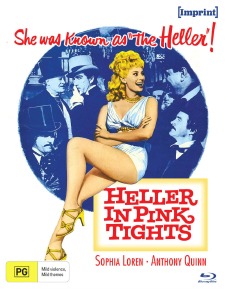
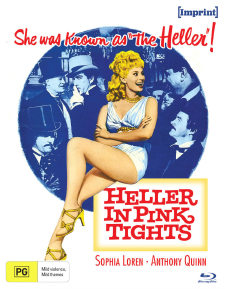
Sophia Loren with blonde wig and come-hither look is the best element of the picture. Her performance is energetic, sensual, and amusing. Her character knows how to melt men’s hearts, a talent that comes in handy when finances are in short supply. Loren gives Angela a sense of mischievous fun that keeps us involved.
Anthony Quinn, on the other hand, is miscast. As the magnetic star and impresario of the troupe, he musters little assertiveness and sex appeal. He often blends into the background, allowing Loren to carry the film. Quinn seems unsure of how to play Healy. In some scenes he actually looks lost. Forrest, as the handsome renegade, is far more interesting and certainly more dashing. When Mabry wins Angela in a high-stakes game of poker, a sense of sexual tension is established as Mabry fully expects to collect his debt. But while Quinn’s Healy should be seething with anger, he comes off as petulant instead.
Eileen Heckart, in a blazing red wig and garish make-up, carries most of the comedy. Heckart is masterful at stealing scenes and it’s to her credit that she does. She brings a surefire spark to the proceedings with her withering looks and fussbudget nitpicking. Whether eluding creditors or Indians, she copes but not without voicing her objections to the indignities an “artiste” must endure.
Former child star Margaret O’Brien doesn’t have a lot to do as Della other than protest her mother’s browbeating and criticism. She sort of disappears under Heckart’s impressive shadow.
Heller in Pink Tights, based on a Louis L’Amour novel, asks its viewers to accept circumstances far afield from Hollywood’s typical Western plots. Sophia Loren is an odd choice for the leading lady, though the casting against type in her case works. She brings her natural allure and star glow to the role, so we can accept her as an actress traveling the frontier in the 1860s. Director Cukor blends the story lines skillfully.
For a 1960 film, Heller in Pink Tights is pretty frank in showing how Loren’s Angela unashamedly uses her feminine charm and sensuality so men fall over themselves to accommodate her wishes. This is exaggerated, of course, and that’s part of the film’s running gag. Quinn comes off more as an ensemble player than the lead. To his credit, he doesn’t have a lot to work with. The script by Dudley Nichols and Walter Bernstein portrays Healy as ineffectual and dull. It’s left to Quinn to make the best of an underwritten role with evidently little help from Cukor.
Heller in Pink Tights was shot by director of photography Harold Lipstein on 35mm film with spherical lenses, processed by Technicolor, Hollywood, and presented in the aspect ratio of 1.85:1. The Blu-ray has an aspect ratio of 1.78:1. The Technicolor cinematography captures the rugged look of dusty cow towns, crowded narrow walkways flanking muddy streets, and the lush, bold hues of theatrical costumes (designed by Edith Head) and stage-production sets. Reds are dominant in the Healy wagons, Heckart’s day-go red wig, and loud stage costumes. Some impressive tracking shots follow the wagons racing to flee irate creditors. The wagon interiors are crammed with “stuff”—costumes, props, provisions, trunks, and more.
The soundtrack is English 2.0 mono LPCM. English SDH subtitles are an option. Dialogue is clear and distinct. Loren speaks in a soft, sensual manner when enticing men to fulfill her wishes. Quinn underplays throughout, making little impression as Healy. Heckart is loud, brash, and opinionated as Lorna Hathaway. Sound effects include wagons rushing over dirt roads, Indians whooping it up, actors in the play within the film emoting, a horse running a treadmill on stage, ambient noise in a saloon, and horses’ hooves as the troupe goes up a mountain on horseback. The score by Daniele Amfitheatrof blends traditional Western motifs and theatrical dramatic melodies. The main title captures a rich sound that balances the rugged nature of the frontier setting with the flamboyant world of itinerant performing.
Bonus materials on the Region-Free Blu-ray release from Imprint Films include the following:
- Heller Without a Gun (13:58)
- Theatrical Trailer (2:04)
Heller Without a Gun – This 2026 video essay is presented by author and critic Matthew Asprey Gear. Heller in Pink Tights is representative of a “knockabout tradition that brought a little culture out to the wilderness.” Director George Cukor identified that tradition as a forerunner to Hollywood as the center of filmmaking. The film taps into nostalgia for a bygone era of entertainment. Traveling entertainers provided escape from hard pioneer life. Audiences wanted spectacle and blood and thunder. The title of the film didn’t help its fortunes. The script is based on the Louis L’Amour novel Heller With a Gun. In 1960, the Western was at its height. The genre was attractive to major filmmakers because of themes that could be woven into plots. Cukor, known primarily as a “woman’s director," gave the film his own spin. Sophia Loren’s character is based on the real Adah Isaacs Menken, who created a sensation in the equestrian melodrama Mazeppa by appearing in little more than flesh-colored tights and being strapped to the back of a live horse that races up a steep, narrow ramp above the stage. Heller in Pink Tights was part of a four-picture deal Loren’s husband, Carlo Ponti, made with Paramount.
Heller in Pink Tights deals with a subject not often covered in Westerns—the trials and tribulations of a theatrical troupe performing to audiences in cow towns and mining towns across the wild West. With an acting company constantly on the run from its financial responsibilities, a headstrong actress who gets herself into difficult situations, a gunslinger targeted by a ruthless moneyman, and conflict between rival lovers, the film tackles a lot. Loren’s performance, the striking scenery, and the script’s light touches make for an entertaining viewing experience despite its miscast and inadequately directed leading man.
- Dennis Seuling