
Hell’s Highway: The True Story of Highway Safety Films (Blu-ray Review)
Director
Bret WoodRelease Date(s)
2003 (September 8, 2026)Studio(s)
Livin’ Man Productions (Kino Cult #50)- Film/Program Grade: A
- Video Grade: B+
- Audio Grade: A
- Extras Grade: A

Review
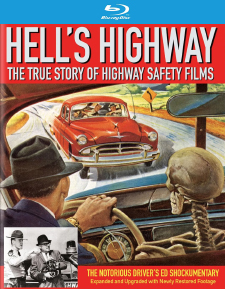
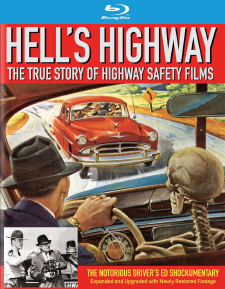
Before World War II, educational films were mostly devoted to science. They could show a flower blooming through time-lapse photography, illustrate principles with on-screen experiments, and explore close up the habits of insects. The military used films to acquaint soldiers with what to expect overseas. When they proved effective, educational films made their way into classrooms. Some of these films showed the aftermath of fatal and near-fatal car accidents in graphic detail intended to deter reckless driving. The documentary Hell’s Highway: The True Story of Highway Safety Films chronicles their heyday.
Initially, educational films dealt with topics such as how to observe safety measures on the job, how to brush your teeth properly, and what constitutes good manners on a date. The highway safety films began in 1959. The point was to instill fear in teenagers with real-time, full-color footage of the mangled victims and the efforts to pry them from the wreckage. The horrific images and sounds didn’t shy away from physical devastation but emphasized it. The moans of injured victims testified to their suffering. So did the silence of the unconscious and the dead.
Films such as Signal 30 (the police code for “fatality”) and Wheels of Tragedy doled out propaganda through grim images of young, blood-soaked, often maimed victims. Some of the films linked dating with reckless driving. All were designed for shock value. Many were sponsored by the Ohio State Highway Patrol. Footage was shot as soon as possible after such accidents occurred. In one film, a narrator solemnly says, “Unlike Hollywood, our actors are paid nothing. Most of the actors in these films are bad actors and received top billing only on a tombstone.”
An impressive excerpt from Highways of Agony (1969) representing the number of lives lost in automobile accidents shows an elaborately staged shot of men, women and children lying on a road head to toe as the camera pans over them almost endlessly. They lie in various positions as if they have been in an accident. Of course, there’s no blood, but the shot is impressive and more memorable than the actual accident scenes, which tend to run together as a montage of horror.
John R. Domer was a photographer whose job it was to hurry out to accident scenes before bodies could be removed and to capture the gruesome images that would later turn up in safety films. Domer talks about the public’s fascination with accidents and how crowds would often assemble to gawk at the carnage.
Mike Vraney of Something Weird Video speaks about his affection for the gory horror movies of the 1970s and adds that none of them had the effect on him that the bloody safety films did. The fact that they recorded human devastation in real time made the difference. Color photography didn’t spare the viewer from quantities of blood. At the time, apart from medical personnel and soldiers who had been in battle, the average person had never witnessed such carnage, so the images were terrifying.
Rick Prelinger, Educational/Industrial Film Archivist, provides historical context for the safety films. He says that they were made by well-intentioned individuals who didn’t know how to make a film. Had they turned to professionals, the results might have been more powerful without the proliferation of bloodshed.
John P. Butler, former Chief of Police, of Mansfield, Ohio speaks about the safety films and Richard Wayman, who headed the Highway Safety Foundation and was instrumental in getting the seat belt law passed. Wayman organized charities to support the police. The Foundation “shoveled” money into bigger projects. Wayman was able to secure Sammy Davis, Jr. to host a telethon to raise money for highway safety. Davis was able to get many celebrities on board. But Davis’ and Wayman’s egos got in the way and they put the telethon in 60 markets. The costs were enormous. Many pledges weren’t fulfilled and the telethon lost a lot of money.
The documentary touches on other cautionary films. The Shoplifter shows store personnel techniques thieves use to shoplift. The Child Molester, a scare film shown to children, uses actors to simulate the abduction of two young girls.
The controversy as to whether the highway safety films accomplished their purpose is discussed. The consensus is that they weren’t that influential in curbing accidents. The question of abuse comes up. Two brothers recall seeing The Child Molester in class when they were about six years old and being traumatized by it.
The graphic safety films were replaced by films of simulated crashes with crash dummies to show what the impact would be on the human body. Cameras photographed the crashes in slow motion from several angles. This approach is believed be more effective in emphasizing the importance of safe driving. By the 1970s, the older, graphic films were no longer shown in schools.
Interviews for Hell’s Highway: The True Story of Highway Safety Films were shot by director of photography Steve Anderson on 16mm film. The safety films were originally shot on 16mm color and black-and-white film between 1959 and 1979, with much of the accident footage shot by John R. Domer. The documentary utilizes 2K and 4K scans of the original elements preserved by the Library of Congress. All of this material was finished digitally as a 2K Digital Intermediate. The quality varies on this new Blu-ray release from Kino Cult. Despite the restorations, excerpts from the original safety films lack the pristine quality of the interview segments. The original accident footage is frequently overexposed, but this lack of quality was likely an unavoidable consequence of the age of the original films, not the restoration process. Nevertheless, the lingering camera on suffering or deceased victims is still unsettling to watch.
The soundtrack is English 2.0 DTS-HD Master Audio with optional English subtitles. Interview recollections and the often stentorian tone of the safety films narrators are clear and distinct. Mangled victims moaning in agony immediately after accidents comes across as overly gruesome. Added sound effects are heard in many of the original films—skidding, crash impacts, glass shattering, people screaming.
Bonus materials on the 2-Disc Blu-ray release from Kino Cult (#50 in the line) include the following
DISC ONE:
- Audio Commentary by Bret Wood
- Mechanized Death (7:33)
- Wheels of Tragedy (7:52)
- Highways of Agony (27:34)
- Options to Live (22:45)
- 2026 Re-Issue Trailer (1:38)
DISC TWO:
- Original 2003 Pre-Restoration Version (95:17)
- Teenicide (6:20)
- Death on the Highway (15:46)
- Go, Sober and Safe (28:34)
- The Child Molester (20:19)
- The Shoplifter (19:06)
- Trailer (2:03)
- Deleted Scenes (11:00)
Audio Commentary – Writer/Director Bret Wood speaks at length about the second edition of Hell’s Highway. Incidental changes were made, images were transferred to high definition, and better film elements were located. Since footage was shot in several aspect ratios, Wood attempted to smooth out the visual aspect so that there wouldn’t be too many different screen sizes. Since making the film in 2003, much camera footage came available when original pre-print elements that were believed lost had bern found. Wood talks about different methods used to “clean up” the film. Both 2K and 4K were used in the restoration. He says that the safety films were a result of civic activism. They showed up on VHS in a series of releases from Something Weird Video. In one of the films, the narrator is Death complaining that he hasn’t claimed enough victims in highway fatalities. With its constant images of blood and gore, the George A. Romero film Dawn of the Dead (1978) opened Wood’s eyes to the power of cinema. He says that childbirth films were a sensation. They were shown to girls, while syphilis films were shown to boys. Wood also mentions the anti-drug films that used scare tactics to make their point. The 16mm safety films were sold to schools for $150 to $175 each. When Wood interviewed the photographers of the accidents, they were unrepentant about taking footage of the gory aftermath. Wood claims they should have consulted experts, but his final point is that their intentions were good.
Mechanized Death – Produced by the Ohio State Highway Patrol, this 1961 driver’s ed scare film was one of the first educational films to use cameras at actual collision sites to show the bloody reality of highway crashes.
Wheels of Tragedy – This 28-minute short, made in 1963, follows officers of the Ohio Highway Patrol as they prepare for potential accidents on a holiday weekend. They deal with several, most involving fatalities. Events leading up to these tragedies are re-enacted, followed by actual file footage of the brutal aftermath.
Highways of Agony – Directed by Richard Wayman, this 1969 driver’s ed film is narrated by Wayne Byers. Real wreckage, injured survivors and covered dead bodies are shown. An ominous organ soundtrack accompanies the narration. The film concludes with a long line of people laid out to represent the yearly death toll.
Options to Live – Made in 1971 on the tenth anniversary of the Highway Safety Foundation, the film explains that the organization makes traffic-safety films intended to shock. They show sights and sounds of pain experienced by real-life victims of auto accidents, photographed and recorded on the scene, and tell viewers how to avoid the same fate.
Teenicide – The title refers to a post-World War II surge in motor vehicle deaths among teens and young adults. Produced by an insurance company with the technical assistance of the Los Angeles Police Department, this 1950 film blames lack of proper training, speeding and overconfidence.
Death on the Highway – Rather than recreations, this 1971 film relied heavily on graphic black & white footage and still photographs retouched with red ink to emphasize blood and gore for maximum shock value. It was often shown to high school drivers education classes in the 1970s and 1980s to terrify teenagers into driving responsibly.
Go, Sober and Safe – Produced by Earl Deems and the Highway Safety Foundation in Mansfield, Ohio, this 1966 film took a lighter, experimental approach to demonstrating the dangers of drunk driving. The narration discusses how blood alcohol concentration is affected by variables like a person’s weight, the presence of food in the stomach, the quantity of alcohol consumed, and the time elapsed since the last drink. The film visually documents how different amounts and types of alcohol progressively impair a driver’s reflexes and control.
The Child Molester – Herbert J. Leder directed this 1964 film, a dramatization warning about predators. The plot follows a stranger who lures two young girls into his car and takes them to a remote area. The film includes graphic case studies and real-life crime elements intended to shock viewers into what to watch out for.
The Shoplifter – Produced by the Highway Safety Foundation, this two-reel 1964 short was created to make retail employees aware of techniques professional and amateur thieves use to shoplift. It shows how people conceal items inside coats, large bags, boxes, and under skirts. A convicted shoplifter demonstrates actual stealing methods.
Deleted Scenes – These sequences were removed from the final film because of redundancy, time limitations, or pacing.
Hell’s Highway: The True Story of Highway Safety Films is a look back at a series of short films that used uncensored, grisly images to underscore the devastation caused by reckless driving. There’s definitely a voyeuristic quality to the films akin to why people driving on the highway slow down to rubberneck when they pass an accident. The images both repel us and draw us in. They show something not often seen and they fascinate. They also reflect a complete lack of concern for the trauma that such images might inflict on young minds. Showcasing a period when baby boomers were coming of age, getting their first driver’s licenses, and heading out on the road, shock safety films still create controversy nearly 70 years later.
- Dennis Seuling